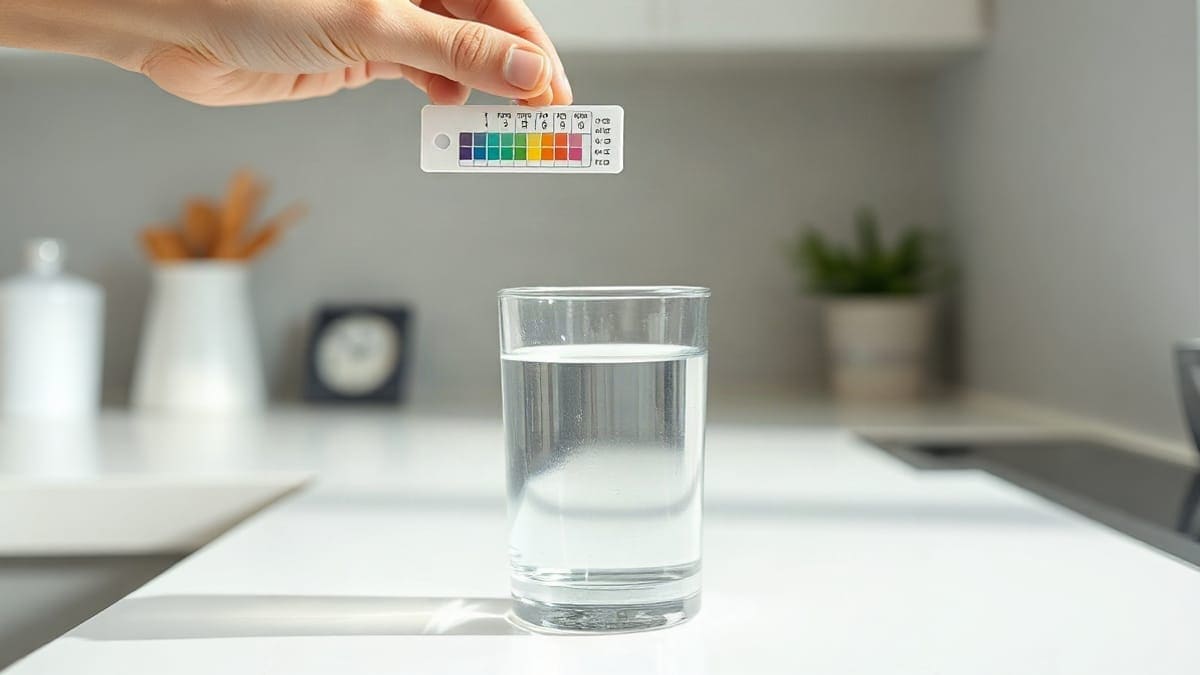
Hardness is the calcium and magnesium dissolved in your water, reported in parts per million (ppm, the same as mg/L) or grains per gallon (gpg). One gpg equals about 17 mg/L. Ten tests from Hach, Watts, Varify, SenSafe, LaMotte and Tap Score are compared below by range, test count, method and the limits their makers publish, with no price anywhere. We also show how to read a result, what it does to softener sizing, and when a strip is the wrong tool. Whether it ends in a new unit from our best water softener guide or a lab visit, the how to test water hardness at home guide owns the do-it-yourself methods.
Ten water hardness tests at a glance
Water check
Ten tests span 0 to 1,000 ppm. Seven are strips or color charts with about 50 tests, three Hach kits are drop titrations of about 100 tests each, and the LaMotte kit gives 50. Tap Score is a mailed lab test.
The table lists each test as its maker describes it on the page we read in November 2026. A dash means the page gives no figure. Strip ranges are color steps, not continuous scales, so compare step spacing and not just the top number. Where two pages from one maker disagree, the detail section says so.
| Test | Type | Range stated | Tests per pack | What you read |
|---|---|---|---|---|
| Hach Total Hardness Test Strips 2745250 | Strip | 0 to 425 mg/L | 50 | Color chart |
| Watts Total Hardness Test Kit 68107951 | Strip | 0 to 425 ppm (0 to 25 gpg) | 50 | Color chart |
| Varify Water Hardness Test Kit | Strip | 0 to 425 ppm | 150, 100 or 50 (page conflicts) | Color chart, soft, medium, hard |
| SenSafe WaterWorks Total Hardness 480008 | Strip | 0 to 1,000 ppm | 50 | Eight color levels |
| SenSafe Safe Tap Check 487940 | Multi-strip kit | 0 to 1,000 ppm hardness | 2 | Hardness, pH, free chlorine, copper |
| Hach Model 5-B 145300 | Drop titration | 1 to 30 gpg (17 to 513 mg/L) | About 100 | Drop count, 1 drop = 1 gpg |
| Hach Model 5-EP 145400 | Drop titration | 1 to 30 gpg | About 100 | Drop count |
| Hach Model HA-71A 145201 | Drop titration | Dual ranges | About 100 | Drop count |
| LaMotte 4482-LI-02 | Dropper bottle | 200 ppm or 20 gpg full scale | 50 | Drop count, 1 drop = 10 ppm or 1 gpg |
| Tap Score Hardness Water Test | Mailed lab test | Lab report | 1 sample | Written report |
Which test fits which job?
Match your job to a row. A strip answers "is my water hard?" and "is the softener working?" quickly, a drop kit gives a number to program a softener from, and a lab report is the only row that carries weight with a third party. Check your utility report first, because it may already give the hardness for free.
| Your job | Pick | Why |
|---|---|---|
| Quick check of city water, 5 minutes | Hach strips 2745250 or Watts 68107951 | 50 tests, 0 to 425, color chart |
| Set a new softener or dishwasher | Hach 5-B | 1 gpg per drop, the unit softeners are programmed in |
| Monthly softener outlet check | Hach strips or SenSafe 480008 | Many cheap tests, low steps at 0, 25, 40, 50 ppm |
| Well water with iron or manganese | Hach HA-71A, then a lab | Hach points iron and manganese water to this kit |
| Hardness plus pH, chlorine, copper once | SenSafe Safe Tap Check | Four parameters, 2 tests |
| Official number for a purchase or dispute | Tap Score or a state-certified lab | Written lab report |
| Aquarium, appliance or pool water | Varify strips | Maker lists tap, well, appliance and aquarium use |
How accurate are water hardness test strips and kits?
Water check
Strips give a range: the Hach chart steps run 0, 25, 50, 120, 250 and 425 ppm, and Hach says they should not be used when an exact value is required. Drop kits resolve 1 gpg (17.1 mg/L) per drop, and a lab is more precise still.
Accuracy depends on how wide each step is, because the strip can only say which color block your water is closest to. Hach publishes no accuracy figure for its strips or drop kits on the pages we read, so none is written here. What we can do is show the step size from the published charts.
| Method | Smallest step | Step as share of a 10 gpg (171 mg/L) reading | Source |
|---|---|---|---|
| Hach strip chart | 25 ppm at the low end, 130 ppm between 120 and 250 | 130 ppm is 7.6 gpg wide, about 76% of the reading | Hach hardness parameters page |
| Hach 5-B drop kit | 1 gpg (17.1 mg/L) per drop | 10% | Hach 5-B |
| Hach 5-EP mg/L kit 145401 | 20 mg/L per drop (about 1.17 gpg) | 11.7% | Hach 145401 |
| LaMotte 4482-LI-02 | 10 ppm or 1 gpg per drop | 5.8% at 10 ppm, 10% at 1 gpg | LaMotte |
| Laboratory EDTA titration | Reported to the mg/L | Method used by certified labs | NEMI, Standard Methods 2340 C |
The arithmetic: from 120 ppm to 250 ppm is 130 ppm, and 130 divided by 17.1 is 7.6 gpg. A house at 12 gpg (205 ppm) falls inside that gap, so the strip will show either the 120 or the 250 block, never 205.
Hach adds that its digital titrator kits are more accurate than drop count kits.
Do water hardness test strips work?
Yes, within their step size. A strip tells soft water from hard water and can show whether a softener is bringing the reading down. It cannot tell 150 ppm from 220 ppm, and it says nothing about iron, bacteria or lead. The FAQ and the mistakes list below cover the limits.
How do water hardness test strips work?
Water check
A strip has a pad that changes color with the calcium and magnesium in the water, which USGS defines as hardness. You dip it, wait seconds to a minute, then match the color to a printed chart in ppm or gpg.
USGS defines hardness as the amount of dissolved calcium and magnesium, so a strip reads total hardness and cannot split it into calcium and magnesium. Varify says its pad is green before use and shifts toward red as hardness rises, and that the strip is single use.
A drop kit uses a different principle. The sample turns red or pink when hardness is present, and a titrant containing EDTA is added one drop at a time until the color turns blue, per Hach's kit page. The same red-to-blue endpoint is the basis of the laboratory EDTA method summarized in NEMI. Counting drops therefore gives a number, where a strip gives a block of color.
How do you read a water hardness test strip?
Water check
Match the pad to the closest block on the chart in good light, then convert: divide ppm by 17.1 for gpg. A 120 ppm block is 7.0 gpg, a 250 ppm block is 14.6 gpg, and the 425 ppm block is 24.9 gpg.
Read the strip at the time the maker states, in natural light, against the chart printed on your bottle or sleeve. Varify says to let colors develop for 30 seconds and to view the strip in natural light, and its FAQ says a strip is useless if it gets wet before use. A Cove dishwasher strip, by contrast, is passed under running water for 1 second, flicked, and read after 15 seconds against a chart marked 0, 3, 7, 15 and 25 gpg. The timing differs by strip, so follow yours.
The table converts the common strip steps. We divided by 17.1, the factor Hach prints, and compared each result with the classes USGS and Penn State publish.
| Chart step | In gpg (ppm ÷ 17.1) | USGS class (mg/L) | Penn State class (gpg) |
|---|---|---|---|
| 0 ppm | 0 | Soft, 0 to 60 | Soft, under 1.0 |
| 25 ppm | 1.5 | Soft | Slightly hard, 1.0 to 3.5 |
| 50 ppm | 2.9 | Soft | Slightly hard |
| 120 ppm | 7.0 | Moderately hard, 61 to 120 | Hard from 7.0 to 10.5 |
| 180 ppm | 10.5 | Hard, 121 to 180 | Hard, edge of very hard |
| 250 ppm | 14.6 | Very hard, over 180 | Very hard, over 10.5 |
| 425 ppm | 24.9 | Very hard | Very hard |
Sources: USGS Water Science School and Penn State Extension, Water Softening. The two bodies draw the lines in different units, which is why 120 ppm is moderately hard to USGS and 7.0 gpg, the start of "hard", to Penn State. Penn State says water below 7.0 gpg is unlikely to cause major scaling and soap film.
Hach's printed gpg marks (1, 1.5, 3.7, 15 and 25) do not divide out exactly from its ppm marks, so trust the numbers printed on your own chart over our table when they differ. The water hardness converter handles any other reading, and the hard water vs soft water guide explains what each class means in the house.
How do you use a water hardness test strip or test kit?
Water check
For strips: fill a clean cup, dip one dry strip, remove, wait the printed time (about 15 to 30 seconds on the makers we read), and compare to the chart. For a drop kit: add reagent, then titrant drop by drop until pink turns blue, and count.
Test the water at a cold tap that has run for 30 seconds, and test before the softener (an untreated outdoor spigot or the line before the unit) and after it. Use the cold tap, because hot water has already passed through your water heater.
How do you use a water hardness test strip?
- Wash and dry your hands and the cup. Varify says water on a strip before use ruins it.
- Take 1 strip, close the bottle tightly, and dip the pad as the instructions say (Cove's strip: 1 second under running water).
- Shake off excess water if the instructions say so, then wait the printed time, 15 to 30 seconds on the makers we read.
- Compare the pad with the chart in daylight and write down both the ppm and gpg block.
- Test again after the softener, with the same bottle, to see the change.
The Varify strip page adds that one strip is one test, and that a seal-tight cap protects the rest of the bottle.
How do you use a water hardness test kit with drops?
- Fill the supplied tube with the stated sample volume, then add the reagent powder or drops. Hach says the sample turns red or pink when hardness is present.
- Add titrant one drop at a time, swirling, and count each drop.
- Stop when the sample turns blue. On the Hach 5-B, 1 drop equals 1 gpg, so 9 drops mean 9 gpg (154 mg/L).
- On the Hach 5-EP mg/L kit 145401, 1 drop equals 20 mg/L, and you divide by 17.1 for gpg. The page also says "number of drops equals total hardness," so confirm which version of the kit you hold.
- Rinse the tube and repeat for a second sample.
LaMotte's dropper bottle kit 4482-LI-02 is a drop count too, with three reagents and its own manual, 4482-DR-LI-02. Read the manual, because the page gives both 10 ppm and 1 gpg per drop and does not say which sample volume goes with which.
The ten water hardness tests in detail
Water check
The ten range from a 50-strip bottle at 0 to 425 ppm to a mailed laboratory test. Each section gives the maker's figures, one limit and who should look elsewhere, with the page we read.
Hach Total Hardness Test Strips 2745250: the reference strip
Hach lists a 0 to 425 mg/L range (0 to 24.9 gpg by our division) and 50 tests per bottle, individually wrapped, with 250 and 1,000 test packs on the same page. Hach's product page gives no accuracy figure, no shelf life and no step list. The steps (0, 25, 50, 120, 250 and 425 ppm) come from Hach's hardness parameters page, which also tells readers to use strips when a general range is enough, and not when an exact value is required.
Best for: a check of tap water or a softener outlet at 0 to 425 mg/L, read in about 1 minute. Not for: sizing a softener, or any number a third party will rely on.
Watts Total Hardness Test Kit 68107951: the strip with gpg on the label
Watts sells 50 strips and a color chart reading 0 to 425 ppm, or 0 to 25 gpg. The Watts page lists part number 68107951, a visual color-chart reading, and no shelf life or accuracy statement. The gpg scale on the label saves the division, which suits anyone setting a softener control.
Best for: gpg-first readers who want 50 tests at 0 to 25 gpg. Not for: a buyer who needs a stated accuracy.
Varify Water Hardness Test Kit: strips for home and aquarium
Varify lists 0 to 425 ppm, a soft, medium or hard color chart, and a 30 second develop time. Its product page conflicts with itself on count: the title says 150 strips, the FAQ says 50 and the address says 100, so read the box. Varify says strips should be used within a year of receipt and within 6 months once opened, and its strip guide lists a weekly test for softeners, washing machines and drinking water. The page gives no gpg range.
Best for: a household that wants soft, medium and hard labels across 0 to 425 ppm after a 30 second wait. Not for: a buyer who needs a clear pack count before ordering.
SenSafe WaterWorks Total Hardness 480008: the wider-range strip
SenSafe lists 50 tests per bottle and eight detection levels: 0, 40, 80, 120, 180, 250, 425 and 1,000 ppm. The SenSafe page shows a 1,000 ppm top step and no gpg scale. The extra low steps (40 and 80 ppm) separate soft from moderately hard water better than a chart that jumps from 50 to 120, and the 180 ppm step lands on the USGS "hard" boundary (180 mg/L, 10.5 gpg).
Best for: softener outlet checks, where the 40 and 80 ppm steps matter. Not for: anyone who wants gpg printed on the chart.
SenSafe Safe Tap Check 487940: four parameters in one kit
The kit contains 2 tests of each parameter: total hardness (0, 50, 80, 120, 250, 425, 1,000 ppm), pH (6.0 to 9), free chlorine (0.0 to over 6.0 ppm) and copper (0.0 to 2 ppm). The SenSafe page lists those scales. Two tests of 4 parameters is enough for a one-time check of a new home, not a monthly routine, and none of the four scales covers iron or lead.
Best for: one look at hardness, pH, chlorine and copper together. Not for: a recurring softener check, or lead.
Hach Model 5-B 145300: the number for a softener setting
The 5-B reads 1 to 30 gpg (17 to 513 mg/L), with 1 drop equal to 1 gpg (17.1 mg/L) and about 100 tests. Hach's page describes an EDTA-based drop count with a red or pink to blue end point. It lists no sample size, accuracy or shelf life. Hach's parameters page says the 5-B and 5-EP, which use UniVer reagent, suit industrial samples with high metals such as copper better than natural water.
Best for: programming a softener or dishwasher from a gpg number in the 1 to 30 gpg range. Not for: iron-heavy well water, where Hach points to the HA-71A.
Hach Model 5-EP 145400: the field case version
The 5-EP in gpg, part 145400, covers 1 to 30 gpg with about 100 tests in a carrying case; 145401 reads 20 to 400 mg/L with 1 drop equal to 20 mg/L. Hach lists 145400 with drop-count titration and the same 1 to 30 gpg range as the 5-B, and 145401 as the mg/L twin. Buy the gpg version for a US softener, because the mg/L version needs a division by 17.1.
Best for: a case that travels with a plumber or inspector across 1 to 30 gpg. Not for: a household that needs only one reading.
Hach Model HA-71A 145201: the iron-tolerant kit
The HA-71A provides dual ranges and about 100 tests as a drop count kit. Hach's page lists the method and test count but does not map each range to hardness, so we do not print the ranges. Hach's parameters page says the HA-71A, which uses ManVer indicator, works best for natural water, especially when iron or manganese is present or alkalinity is high.
Best for: well water with iron or manganese. Not for: a buyer who wants ranges confirmed on the product page.
LaMotte Total Hardness Test Kit 4482-LI-02: the dropper bottle
LaMotte lists 50 tests at 200 ppm or 20 gpg, three reagents, and 1 drop equal to 10 ppm or 1 gpg as CaCO3. The LaMotte page names a dropper-bottle method with a reagent refill, R-4482-LI-02. At 20 gpg (342 mg/L) full scale it covers most US tap water, but harder well water needs a diluted sample.
Best for: water below 20 gpg (342 mg/L), with a manual and a refill from one maker. Not for: very hard water without dilution.
Tap Score Hardness Water Test: the mailed lab report
Tap Score sends a sample to a lab and returns a written report. Tap Score's own hardness test page says hardness is included in its Essential, Advanced and Extended tests. Water Filter Guru's review lists 47, 109 and 118 parameters for the three city water tiers, reports "most tests" at a 5 day turnaround and says Tap Score "uses certified labs" without naming the certification. Ask which lab and which state accreditation before you rely on it.
Best for: a record you can show a lender, buyer or installer. Not for: a monthly softener check or a result in minutes, since most tests take about 5 days.
How do you choose a water hardness test kit?
Water check
Choose by what the number will do: a color strip for a yes or no, a drop kit for a gpg setting, a lab for a purchase or a well. Then count tests, because a monthly before and after check uses 24 strips a year.
Four questions decide the pick. First, what do you do with the answer? A softener control takes whole gpg numbers, which favors a drop kit. Second, how often will you test? A monthly softener check on the raw and treated sides uses 2 tests a month, or 24 a year. A 50-strip bottle covers about 2 years at that pace, but Varify advises using strips within 6 months of opening, a 75 percent shorter life, so the bottle will expire before it empties. Third, is the water from a well? Then iron and manganese matter more than hardness, and you test those at a lab. Fourth, do you need a document? Only the lab row delivers one.
Read the well water filtration guide if your water comes from a well, and the water softener size calculator once you have a number.
What does your reading mean for softener size?
Water check
The reading drives the size: four people at 75 gallons each remove 4 times 75 times your gpg in grains daily, so 7 gpg means 2,100 grains and 14.6 gpg means 4,380. A strip block can be wrong by a factor of two for sizing.
Penn State Extension sizes a softener as gallons per person per day, times hardness in gpg, times people, then divides the unit's capacity by that daily load. Its worked example is 75 times 10 times 4, or 3,000 grains a day, and a 20,000-grain unit regenerating every 6 to 7 days. We reran it for a 32,000-grain unit and a four-person house that sits between the 120 and 250 ppm blocks.
| Reading | gpg | Grains per day (4 people, 75 gal each) | Days between regenerations, 32,000-grain unit |
|---|---|---|---|
| Strip block 120 ppm | 7.0 | 2,100 | 15.2 |
| True value, 12 gpg (205 ppm) | 12.0 | 3,600 | 8.9 |
| Strip block 250 ppm | 14.6 | 4,380 | 7.3 |
The arithmetic: 4 times 75 times 7.0 is 2,100 grains, and 32,000 divided by 2,100 is 15.2 days. At 12 gpg (205 ppm) it is 3,600 grains and 8.9 days. At 14.6 gpg it is 4,380 grains and 7.3 days. Picking the wrong strip block doubles the apparent time between regenerations, so a strip is the wrong tool for the control setting. Use a drop kit or the report from your utility, then read the what size water softener do I need guide and the softener settings guide.
A rule of thumb used by softener makers adds 4 to 5 gpg per ppm of iron to the hardness before sizing, depending on the maker, and above 3 to 5 ppm of iron an iron filter should go first. It is not a standard, and the iron filter guide covers the cases.
Do water hardness test strips expire, and how do you store them?
Water check
Yes: Varify says to use strips within 1 year of receipt and within 6 months of opening, and the date is printed on the box. Keep the cap tight, hands dry and the bottle away from heat and moisture.
Hach does not publish a shelf life for its 50-test hardness strips on the pages we read, so check the date and lot printed on your bottle, and call the maker if it is missing. The Varify guide says brown pads are normal if used within 6 months of opening, and that a strip wetted before use is invalid.
Where can you buy water hardness test strips and kits?
Water check
Buy from the maker or a large retailer that ships in the United States. Hach, Watts, Varify, SenSafe, LaMotte and Tap Score each sell their own, and the Check price buttons on this page go to current listings.
Hach lists its strips in packs of 50, 250 and 1,000 tests. The same maker can sell several versions, so match the part number on this page, such as 2745250 for Hach strips or 145300 for the 5-B, before you order. We have not verified stock at any local chain, so we name none. A dishwasher or softener may include a strip, as the FAQ shows.
Can you test water hardness without a kit?
Water check
Yes, in two free ways: read your utility's annual water quality report, which often lists hardness in ppm or gpg, or look up your area on a map. Neither replaces a test at your own tap, which is what a kit is for.
Every community water system produces a Consumer Confidence Report, and EPA's CCR page links a tool for finding yours. USGS says hardness information for a home "should be provided by the local health agency or local water utility," and warns that its old national data are not for local decisions. The water hardness map and zip code lookup shows maps, and the how to test water hardness at home guide covers do-it-yourself methods that need no kit. We do not repeat those methods here.
When is a laboratory test better than a kit?
Water check
A laboratory is better for a private well, for any dispute, or when a result decides a purchase. EPA requires labs that analyze drinking water for regulatory purposes to be certified, so ask your state which labs are.
EPA's drinking water laboratory certification page says labs analyzing drinking water samples must be certified and use EPA-approved methods, and links a contact list for state certification programs. EPA's private wells page says well owners are responsible for the safety of their water and points to state programs. Penn State Extension tells buyers to have water tested by an independent lab before choosing a softener.
A lab reports hardness in mg/L as CaCO3, usually with iron, manganese, pH and TDS. EPA's secondary standards set non-enforceable limits of 0.3 mg/L for iron, 0.05 mg/L for manganese, 500 mg/L for TDS and a pH of 6.5 to 8.5, and hardness itself has no standard. Use the well water treatment finder to turn a lab report into a treatment order. The what is hard water guide and the hardness, TDS and alkalinity guide explain the numbers.
What backs the numbers on these test kits?
Water check
Of ten tests, none has a maker page naming an NSF/ANSI, WQA or IAPMO listing, and none publishes an accuracy figure. What you can check is the stated range, step list and method, and the lab accreditation behind Tap Score.
NSF, WQA and IAPMO certify water treatment products, and the NSF drinking water treatment unit database lists those units. We did not search it for test kits, and no maker page we read names a listing, so no kit here is called certified. The table sorts what each maker publishes.
| Test | Method named | Accuracy figure on page read | Standard or listing named |
|---|---|---|---|
| Hach strips 2745250 | Color chart | None | None |
| Watts 68107951 | Color chart | None | None |
| Varify | Color chart | "As good or better" than liquid kits, a claim without a figure | None |
| SenSafe 480008 and 487940 | Color chart | None | None |
| Hach 5-B, 5-EP, HA-71A | EDTA drop count | None | None |
| LaMotte 4482-LI-02 | Dropper bottle | None | None |
| Tap Score | Lab analysis | None | "Certified labs," not named |
A good product can have no listing, and "tested to" is not "certified to". For a number that has to hold up, use a lab your state certifies.
Which other water numbers matter besides hardness?
Water check
Hardness is cosmetic: USGS says it is not a health concern. Iron above 0.3 mg/L, manganese above 0.05 mg/L, a pH outside 6.5 to 8.5 and, on a private well, bacteria and nitrate are the numbers that change what you buy.
USGS calls hardness "not a health concern, but it can be a nuisance," though it notes drinking water may add some calcium and magnesium to the diet. Iron and manganese stain and can clog softener resin, and Penn State says oxidized iron clogs the resin and filtration before softening prevents it. A kit that tests hardness alone will not show any of that. For a salt-free conditioner, a strip will still read hard after treatment, because the minerals stay dissolved. The salt-free water softener guide explains why, and the softener for well water guide and the hard water filter guide show what to put after the number.
For a home with a softener, a before and after check is the easiest sanity test. A working salt-based softener should drop the reading to the soft class, under 1.0 gpg by Penn State's table, or to the lowest block of your chart. A treated reading, ideally under 1.0 gpg, that stays close to the raw reading suggests a bypass valve left open, empty salt or a missed regeneration, so check those before you call anyone. The water softener maintenance checklist lists them.
Water hardness tests: our conclusion
Water check
Use a strip for a yes or no and a drop kit for a number you can size a softener from. Book a state-certified lab for a well with iron, or whenever a lender, landlord or insurer needs the figure.
The Hach Total Hardness Test Strips give a fast answer: 0 to 425 mg/L, 50 tests per bottle, read by color in about a minute Check price on Amazon. The Hach 5-B drop kit reads 1 to 30 gpg, one drop for each 1 gpg, about 100 tests Check price on Amazon. A monthly before and after softener check uses 24 strips a year, so count your tests. One gpg equals about 17 mg/L, which turns any result into a softener size on the water softener size calculator. A private well with iron needs a lab, as the well water treatment finder explains.
5 common mistakes with water hardness tests
Water check
Five mistakes cause most bad readings: sizing a softener from a strip block, testing only after the softener, using an expired or wet strip at 6 months past opening, trusting a strip on a well, and testing hot water.
Sizing a softener from a strip block
A strip block spans up to 7.6 gpg (130 ppm), so a 12 gpg house can read 7 or 14.6, and the sizing result changes from 15.2 to 7.3 days between regenerations. Use a drop kit or your utility report.
Testing only after the softener
Test the raw water and the treated water. A single reading after the softener tells you nothing about how much hardness was removed, and a bypass valve can send raw water to some taps.
Using an expired or wet strip
Varify says to use strips within 6 months of opening and that a wet strip is invalid. A bottle left open in a damp bathroom is the usual cause of a result that looks wrong.
Trusting a strip on a private well
A strip says nothing about iron, manganese, nitrate or bacteria. EPA puts the safety of a private well on its owner, so test at a state-certified lab.
Frequently asked questions
What is the best water hardness test kit?
For a fast check, the Hach strips 2745250 or the Watts 68107951 (0 to 425 ppm, 50 tests each). For a gpg number to set a softener, the Hach 5-B (1 gpg per drop, about 100 tests). For iron or a document, a lab, because no strip or drop kit lists a certification we could check.
How accurate are water hardness test kits?
Drop kits are tighter than strips: the Hach 5-B reads 1 gpg (17.1 mg/L) per drop, and the 5-EP mg/L kit reads 20 mg/L (1.17 gpg) per drop. Hach publishes no accuracy figure for either, so treat a drop count as good to about one drop, and a lab report as the reference.
Do water hardness test strips work?
Yes, within the step size of the chart. Hach says strips suit a general range and not an exact value. A strip can show hard water or a working softener, but a 12 gpg house can read 7.0 or 14.6 gpg on the same strip.
Where can I buy water hardness test strips?
Hach, Watts, Varify and SenSafe sell strips directly and through large online retailers, and the Check price buttons on this page go to current listings. Match the part number, such as 2745250 for the 50-test Hach strips, because one maker sells several versions with pack sizes from 50 to 1,000 tests.
Where can I buy a water hardness test kit?
Hach, LaMotte and Watts sell kits through their own sites and lab suppliers. A drop kit like the Hach 5-B, part 145300, is normally ordered online. We have not verified stock in any local store, so we do not name one.
Can you buy the water hardness test strips?
Yes. Hach, Watts, Varify and SenSafe strips are sold to US buyers, and a strip that came with a dishwasher or softener is only a strip with its own chart. Use the chart printed on that strip, because a Cove dishwasher strip is read at 15 seconds against 0, 3, 7, 15 and 25 gpg.
Do dishwashers come with water hardness test strips?
Some do. Sub-Zero Wolf says its Cove dishwasher water softener model comes with strip 826639, packed with the use and care guide. The installation guide has the chart of hardness settings, so check yours before you buy a separate strip.
Do water softeners come with hardness test strips?
Some do. Search results for the Whirlpool WHES20 and WHES30 manual list a hardness strip in the parts shipped, and a Water Boss manual says to use the supplied strip to read hardness. Check your own parts list; a softener may rely on a utility number instead.
How do you read water hardness test strips for a Breville machine?
Use the strip in the box and the chart printed with it, because the grading differs by model and we did not read a Breville chart. Breville's setup page says to use the strip to find your water level, then set the machine to that level. Check your manual for the number of levels.
Do water hardness test strips expire?
Yes. Varify says to use strips within 1 year of receipt and within 6 months of opening, and prints the date on the box. Hach publishes no shelf life on the pages we read, so check your bottle.
How do you store hard water test strips?
Keep the cap tight, the bottle in a cool dry place and your hands dry. A strip that gets wet is invalid, per Varify.
How do you read a hard water test strip result in gpg?
Divide the ppm block by 17.1. A 120 ppm block is 7.0 gpg (USGS moderately hard), a 250 ppm block 14.6 gpg and a 425 ppm block 24.9 gpg. Hach prints its own gpg marks, so use the numbers on your chart when they differ.
Where can I get a free water hardness test kit?
We did not verify any free-kit offer, so we name none. Your water utility's yearly report is free and may list hardness, though hardness is not regulated and is sometimes absent; what is hard water shows how to read it and what the classes mean.
How we researched this page
Water check
Ten tests were chosen for sale in the United States from Hach, Watts, Varify, SenSafe, LaMotte and Tap Score. We read the maker pages in November 2026, and we did not test any kit ourselves.
We read each product page, Hach's hardness parameters page, USGS, Penn State and four EPA pages. Several limits matter. Hach's pages gave no accuracy, sample size or shelf life, and the HA-71A page gave no ranges, so none is printed. The Varify page gave three different strip counts. Tap Score's own page refused our request once, so its inclusion of hardness in three tiers is reported from its listing, and the parameter counts and turnaround come from a review. A Watersafe kit was left out because we could not verify its hardness range. Check price links are affiliate links and the site may earn a commission at no extra cost to you.
Sources
Our sources by topic
Public agencies and universities
- USGS, Hardness of water; Penn State Extension, Water Softening; NEMI, Standard Methods 2340 C.
- U.S. EPA, Consumer Confidence Reports, private wells, laboratory certification and secondary standards; NSF, certified drinking water treatment units.
Manufacturers, retailers and other references
- Hach, Total Hardness Test Strips 2745250, hardness parameters, Model 5-B 145300, Model 5-EP 145400, 5-EP mg/L 145401 and Model HA-71A 145201.
- Watts, Water Test Kit for Total Hardness; Varify, hardness kit and strip guide.
- SenSafe, WaterWorks Total Hardness and Safe Tap Check; LaMotte, Total Hardness Test Kit.
- Tap Score, Hardness Water Test; Water Filter Guru, Tap Score review.
- Sub-Zero Wolf, Cove dishwasher hardness strip; Breville, check and set water hardness.
Keep comparing
 Whole House Water Filtration SystemEight whole house water filters compared by rated flow in GPM, capacity in gallons
 Reverse Osmosis System for HomeEight reverse osmosis systems compared by NSF-listed output, drain water, feed pressure and certification
 Water SoftenerEleven water softeners sold in the US compared by grains, GPM, salt use and certification
 Salt-Free Water SoftenerEight salt-free water conditioners compared by flow in GPM, hardness limit in gpg
 Well Water Filtration System for the Whole HouseNine well water systems compared by flow, stated iron, manganese and sulfur limits, and certifications
 Salt vs Salt-Free Water SoftenerHardness removed, scale, sodium, salt, wastewater, upkeep, California limits and certifications