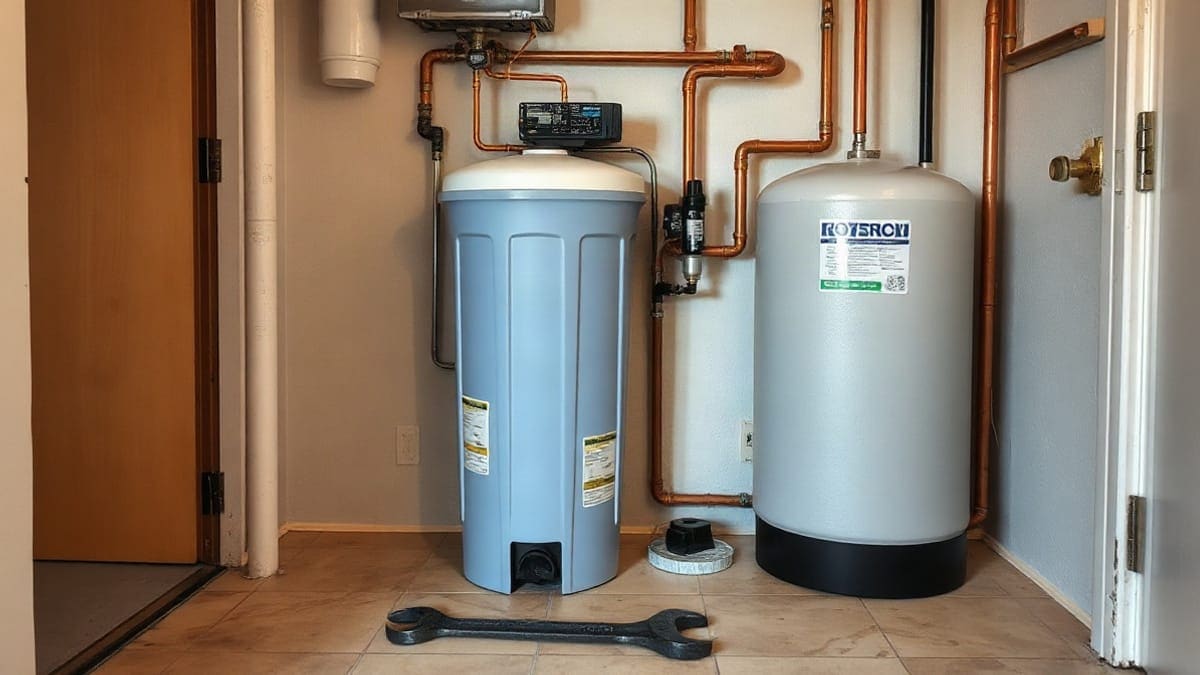
A water softener is a tank of resin beads, a control valve and a brine tank, and nearly every repair comes down to one question: did the unit make brine and rinse it through the resin, or did it not? A failed brine draw leaves hard water, which is why so many faults lead back to it. This page follows the manuals for Fleck, Clack, Rheem, EcoPure and Kinetico valves and turns them into a table you read from symptom to test to fix. It also covers salt bridges, a brine tank full of water, leaks, error codes, who to call, and when a new unit beats a repair.
How do you troubleshoot and repair a water softener?
Water check
Work in this order: bypass position, power, salt level, salt bridge, brine tank water, then a manual regeneration. The first 4 steps take about 15 minutes, cost nothing, and explain most service calls.
The cheap causes hide the expensive ones, so the order matters. The Rheem and EcoPure manuals list no salt and a bypass left in bypass as the first causes of no soft water, and the Fleck 5600SXT manual opens with interrupted power and a defective timer.
| Step | What to do | Time |
|---|---|---|
| 1. Bypass | Confirm the valve is in service | 1 min |
| 2. Power | Check plug, outlet, breaker, display | 2 min |
| 3. Salt | Refill if under 1/4 full | 2 min |
| 4. Bridge | Push a broom handle down into the salt | 5 min |
| 5. Water level | Look down the brinewell after a cycle | 3 min |
| 6. Manual regeneration | Run the cycle by hand, watch brine and drain | 30 min to 2 hours |
The EcoPure manual says to check the salt every 2 to 3 weeks and add whenever the tank is under 1/4 full. A Rheem started from its RECHARGE NOW button takes about 2 hours to finish, so begin it in the evening.
Why is my water softener not working? Symptom, cause, test and fix
Water check
13 faults cover nearly every no-soft-water call, from dry salt and a stuck bypass to a plugged injector, worn seals, low pressure, iron on the resin, a dead board or motor, and a cracked tank or distributor.
The table merges the maker troubleshooting tables into one list. The Fleck manual and the Kinetico PowerLine manual print almost the same lists, and Rheem and EcoPure share one table. The test column is a quick check, not a lab method.
| Symptom | Likely cause | Test | Fix from the manual |
|---|---|---|---|
| Hard water everywhere | Bypass open | Look at the valve | Move to service |
| Hard water, salt not dropping | Salt bridge | Probe with a broom handle | Break it, no sharp tools |
| Hard water, tank holds water | Plugged nozzle, venturi or injector | Watch brine level in a manual cycle | Clean nozzle, venturi, screen |
| Hard water, regenerates on time | Worn rotor or piston seals | Weak or no brine draw | Replace seals, spacers, piston or rotor |
| Hard water in spells | Wrong hardness or time; hot water used mid-cycle | Check settings | Reset hardness and time |
| Hard at hot taps only | Heater still full of hard water | Compare cold and hot | Flush the heater repeatedly |
| Orange stains, iron in soft water | Iron on the resin | Test untreated water | Clean the bed with resin cleaner |
| Display blank | Power, fuse or board | Check outlet, breaker | Restore power, then replace board |
| Water to drain constantly | Valve stuck mid-cycle or internal leak | Listen at the drain | Clear debris, replace seals |
| Motor stalled or clicking | Worn motor or valve torque | Error code or clicking | Replace rotor and seal, then motor |
| Resin beads in the house | Cracked distributor or riser | Beads in aerators | Replace the resin tank assembly |
| Brine tank leaks | Cracked brine tank | Look at the base | Replace the tank assembly |
| Weak brine draw | Pressure under 20 psi | Gauge at a spigot | Raise to at least 20 psi |
The Fleck manual says to "increase line pressure to 20 psi" and blames a plugged injector screen or an internal control leak for a failed brine draw. Rheem and EcoPure add an upper bound: above 100 psi in daytime, fit a pressure reducing valve through a licensed plumber. The Rheem RHS32 is rated for 20 to 125 psi, 40 to 120°F and at least 3 gallons per minute at the inlet.
Single faults have longer pages: water softener not softening water, water softener not using salt, water softener low water pressure and water softener keeps running or draining. To confirm a repair, use how to tell if your water softener is working: treated water in the soft class sits under 1.0 gpg, about 17 mg/L, on the Penn State Extension scale.
How do you fix a salt bridge in a water softener?
Water check
A bridge is a hard salt crust with an empty space under it, so no brine forms. Push a broom handle straight down; if it stops before the pencil mark reaches the rim, break the crust gently in several places. Never pound the tank or use sharp tools.
Mark the handle with the distance from the floor to the softener rim, then push it straight down into the salt. A hard object felt before the mark is level with the top is most likely a bridge. The manual blames high humidity and the wrong salt, and says to keep the salt level lower and refill more often in humid areas. Both manuals recommend nugget, pellet or coarse solar salt with under 1 percent impurities, and list rock, block, granulated, table and ice-melting salts as not recommended.
Culligan also describes salt mushing, a sludge at the bottom: empty the tank, discard the sludge and refill, and call a professional if a bridge keeps returning. See best water softener salt for salts, and water softener salt bridge for the full page on this fault.
How do you fix a water softener that is overflowing or full of water?
Water check
Water in the brine tank that never drops after a regeneration means no brine is being drawn. The usual culprit is a plugged nozzle and venturi (EcoPure, Rheem) or injector (Clack, Fleck), but bad seals, a kinked drain or low pressure also stop the draw.
Some water under the salt is normal; a tank that stays full after a cycle is not. The Rheem and EcoPure manuals list 7 causes, which the table merges with the Clack WS1 manual, the Fleck manual and the Kinetico manual.
| Cause | Manual's fix |
|---|---|
| Dirty or plugged nozzle and venturi | Take apart, clean, inspect |
| Inner valve fault leaking | Replace seals and rotor |
| Valve drain hose plugged or kinked | Remove kinks and blockages |
| Valve drain and brine overflow joined by a tee | Disconnect it, run separate drains |
| Line pressure too low or too high | At least 20 psi; reducing valve above 100 psi |
| Brine float dirty or broken | Clean or replace the float assembly |
| Leak between valve and tank | Replace the o-rings between them |
| Injector or injector screen plugged | Clean the injector and screen |
| Brine line flow control plugged | Clean the flow control |
How do you clean a nozzle and venturi?
Per the EcoPure manual: remove the top cover, put the bypass in bypass with the unit in the service cycle, and unscrew the cap, keeping the o-ring. Lift out the screen support and screen, then the nozzle and venturi disc, gasket and flow plug. Wash them in warm soapy water, rinse, and clean both faces of the disc, using a small brush for iron or dirt and not scratching it. Reassemble in the same order with the small hole in the gasket centered over the small hole in the housing, grease the o-ring with silicone, tighten the cap by hand only, and return the bypass to service.
Then recharge and look down the brinewell. The manual says that if the level does not drop after a recharge, the problem is not resolved. See water softener full of water for the full page, and water softener parts and components explained for part names.
How do you check brine draw by hand?
Hold RECHARGE for 3 seconds to enter the fill cycle and shine a flashlight down the brinewell to see water enter. Press again for brining: a slow flow runs to the drain and the liquid should visibly drop. If it does not, the manual lists a dirty nozzle and venturi, an unseated nozzle, a restricted drain, a bad seal or an inner valve problem. Press again for backwash and look for a fast drain flow; a weak one means a plugged top distributor, backwash flow plug or drain hose.
How do you read water softener error codes?
Water check
EcoPure and Rheem show E1 to E5 for position switch, motor and board faults; Fleck shows 0 to 3; Clack shows 101 to 104 or E1 to E4. Most mean a stalled valve, a bad switch or motor, or a setting error.
Codes are model specific, so treat the table as a start and check your own manual. Rheem and EcoPure say to clear a code by unplugging the transformer, fixing the problem, plugging it in and waiting 8 minutes; the code returns if the problem remains.
| Valve | Code | Meaning in the manual | First thing to try |
|---|---|---|---|
| Rheem, EcoPure | E1, E3, E4 | Wiring, position switch, motor or valve torque | Check wiring; replace switch, rotor or motor |
| Rheem, EcoPure | E5 | Electronic control malfunction | Replace the board |
| Fleck 5600SXT | 0 | Drive took over 6 minutes to reach the next position | Check cam switches, motor, piston travel |
| Fleck 5600SXT | 2 | No regeneration for over 99 days | Check settings and meter, run a cycle |
| Clack WS1 | 101, 1001, E1 | Cannot recognize start of regeneration | Replug the power jack, or press NEXT and REGEN for 3 seconds |
| Clack WS1 | 102, E2 | Unexpected stall | Check piston and spacer stack for debris |
| Clack WS1 | 103, 104, E3 | Motor ran too long | Check motor, wiring, drive gear |
For clearing the controller after a power cut, see how to reset a water softener and water softener settings, hardness and programming.
Why does a water softener make noise, and how do you fix it?
Water check
Clicking or grinding at the valve points to a stalled motor or stuck piston, and the manuals call for a new rotor, seal or motor. Air in a well system is another listed cause of trouble.
The manuals do not describe normal regeneration sounds, so check yours first. They list "motor stalled or clicking": a motor malfunction or internal valve fault causing high torque, with a new rotor and seal, then motor and switch, as the fix. The Fleck manual lists air in the water system as a cause of media lost through the drain line and says to check the well's air eliminator and for a dry well. See water softener making noise.
How do you fix a water softener that leaks?
Water check
A leak at the brine tank base means a cracked tank; a drip between valve and resin tank means worn o-rings. Both are parts jobs. Bypass the unit first.
A crack in the brine tank means replacing the salt storage tank assembly, per Rheem and EcoPure. A leak between valve and tank means new o-rings. A cracked distributor or riser sends resin beads into the plumbing and means replacing the resin tank assembly. The drain hose must have no kinks, sharp bends or blockages. Rheem lists a leaking faucet or toilet, wasting hundreds of gallons in a few days, as a cause of hard water at times.
After a repair, Culligan suggests running a cold tap for a few minutes to flush the lines. The page for this fault is water softener leaking.
How do you fix iron, rust stains and a fouled resin bed?
Water check
Penn State says red, oxidized iron clogs the resin, while dissolved clear-water iron is removed. A fouled bed shows as orange stains and short soft-water runs; the fix is a resin cleaner, an iron filter upstream and more frequent regeneration.
Penn State says oxidized iron clogs the resin. Rheem lists a resin bed cleaner as the fix for clear-water iron and says bacterial or organically bound iron cannot be treated by a softener. The Fleck manual says to clean the control, add mineral cleaner to the bed and regenerate more often.
The numbers: the EPA secondary standard for iron is 0.3 mg/L (EPA, 40 CFR 143.3); the Rheem RHS32 limit for clear-water iron is 8 ppm, with Wisconsin requiring extra treatment above 5 ppm; and Rheem adds 5 grains to the hardness setting per 1 ppm of iron, as do Whirlpool, GE and EcoPure, while other makers use 4. Follow your own manual. Rheem can force a regeneration every set number of days, up to 15, which it suggests for iron, and shows "CLEAn" every 4 months as a cleaner reminder. Using its cleaner every four months extends its 1 year parts and labor cover to 5.
Above about 3 to 5 ppm, put a filter ahead of the softener: best iron filter for well water and best water softener for well water. For cleaners and resin, see best water softener resin cleaner and water softener resin guide. Have a well tested by a state-certified lab (EPA).
Why is the water salty, or still hard after regeneration?
Water check
Salty water means brine reached the house: a plugged injector, a stuck timer or debris in the brine valve. Hard water after a cycle means a poor brine draw, or a hot water heater still full of hard water.
Kinetico's PowerLine manual lists four causes of salt water in the service line: a plugged injector system, a timer not cycling, and debris in the brine valve or the brine line flow control. The fixes are to clean the injector, replace the screen or timer, and clean or replace the valve and flow control. For hard water after a cycle, the heater needs repeated flushing, and Rheem says hot water used mid-regeneration fills it with hard water. See why does my water softener make water salty.
To prove a fix, test treated water with a drop kit: how to test water hardness at home, best water hardness test kit and what is hard water.
Who repairs a water softener: a plumber, a dealer or you?
Water check
Start with the maker or its dealer, since parts are brand specific. A WQA Certified Service Technician is trained to service home systems. Plumbers can handle leaks and pressure fixes, but ask whether they work on your valve brand first.
We found no source that counts how many plumbers service softeners, so we do not say all do. Kinetico sells through authorized, independent dealers; Culligan tells owners to contact a local Culligan expert for error codes; and WQA certifies a Certified Service Technician for servicing existing residential systems and a Certified Installer for installing them, with a Find Certified Professionals directory. The Rheem manual says to use a licensed plumber for a pressure reducing valve. We list no local providers, round-the-clock services included: use the WQA directory, the brand's dealer or the number on the decal.
How do you repair a Culligan water softener?
The Culligan page covers bridges, mushing, pressure, regeneration, a high brine level and error codes, and sends harder cases to a technician. See also Culligan consumer water products review.
How do you repair a Kinetico water softener?
Kinetico says its softeners use non-electric technology with no timers or computers, regenerate on demand and sell through dealers, so the electrical faults here do not apply to those models. Its electric PowerLine has an owner manual with the table above. For a non-electric unit, call the dealer.
When should you call a professional instead of fixing it yourself?
Water check
Handle bypass, power, salt, bridges and a nozzle or injector clean-out yourself. Call a technician for valve leaks, cracked tanks, board or motor replacement, pressure reducing valves, or anything under warranty.
Warranty is the strongest reason to stop. The Rheem and EcoPure warranties exclude unauthorized repair and say aftermarket, used or non-manufacturer parts void all warranties, so a DIY repair can cost you the cover you have left. Valve seals, rotor and piston mean taking the valve apart, a cracked tank or distributor means disconnecting plumbing and handling resin, and bacterial or organic iron belongs to a water treatment dealer.
No CPSC recall of a water softener was known on 18 November 2026 (see water softener recalls, and report a hazard at SaferProducts.gov). Culligan lists three triggers: a bridge that is hard to reach or keeps returning, a brine level that stays high after the checks, and low pressure that persists after bypass and drain checks. For a safe shutdown see how to bypass or remove a water softener.
Can a water softener be repaired, and when should you replace it?
Water check
Yes, every part in the manuals is replaceable. Replace when the unit is past warranty and two or more major parts are failing, or when the resin is fouled for good. Check the warranty first.
The Rheem RHS32 and EcoPure EP31 and EP42 warranties share a shape: 1 year of parts and labor, 10 years on the salt tank and resin tank, 3 years on the control board, and no labor cover after year 1. The Clack valve carries a 5 years limited warranty sold to the equipment maker. Penn State says resin that cannot be washed of its contaminants may need replacing, which should not happen if it is regenerated and maintained.
| Situation | Verdict |
|---|---|
| Salt bridge, dry tank, bypass open | Repair, free |
| Plugged nozzle, injector, screen | Repair, cleaning |
| Board failed inside 3 years (Rheem, EcoPure) | Repair, warranty part |
| Cracked tank inside 10 years (Rheem, EcoPure) | Warranty claim |
| Fouled resin that cleaner does not fix | Resin replacement, or replace an old unit |
| Several failures well past warranty | Usually replace |
We publish no repair prices because we found no reliable US source. The water softener cost guide and when to replace a water softener and what it costs cover money, and how long do water softeners last covers lifespan. If you replace, size it with what size water softener do I need and the water softener size calculator, then compare best cheap water softener, best high efficiency water softener and water softener rental vs buying.
Which cleaners, kits and replacement models fix the problem?
Water check
For iron stains, try an iron-fighting salt before a new unit. For a worn valve, the Fleck 5600SXT kit uses parts plumbers know; the SpringWell SS1 and Rheem RHS32 replace the whole softener.
Figures match the best water softener guide. We print no prices. If you buy through a button, this site earns a commission and the price does not change.
Morton Clean and Protect Plus Rust Defense
Morton's page lists no purity or additive names, and its resin claim rests on Morton's own comparison with plain salt. It helps resin shed iron but cannot fix a worn seal.
Best for: moderate iron on a pellet unit. Not for: high iron or hydrogen sulfide.
Hach 5-B hardness kit
Hach's page describes an EDTA drop count reading 1 to 30 gpg (17 to 513 mg/L), 1 drop per gpg.
Best for: checking a softener from a gpg number. Not for: iron-heavy well water, where Hach points to the HA-71A.
Fleck 5600SXT 48,000-grain kit
The WQA listing covers "5600 SXT" in 5 sizes from 0.75 to 2.0 cu ft, NSF/ANSI 44 efficiency rated. One seller lists the 48,000-grain kit with 1.5 cu ft of resin at 13 GPM, while others print 12 to 14 GPM; the listing covers Pentair's models, not every kit.
Best for: a serviceable valve with a published efficiency listing. Not for: one company answering for tank, valve and brine tank.
SpringWell SS1
SpringWell's spec table lists 32,000 grains, 11 GPM, 1 in ports and 25 to 80 psi, while its size guide says 9 GPM. We found no NSF or WQA certification for it. Read the SpringWell SS1 review.
Best for: 2 to 4 people on city water up to about 10 gpg. Not for: a buyer who needs a certification number.
Rheem RHS32
The RHS32 manual prints 13,000 grains at 2.6 lb, 27,600 at 8.3 lb and 33,000 at 14.1 lb, with 0.88 cu ft of resin. Check its listing on NSF's database.
Best for: a buyer who wants the numbers in print. Not for: a house with three bathrooms on very hard water, since 7.9 gpm runs tight.
5 common mistakes when repairing a water softener
Water check
The costliest repair mistakes are hitting the tank, using sharp tools or the wrong salt, voiding the warranty, forgetting the bypass, over-tightening a cap, and clearing an error code without fixing the cause.
Pounding on the brine tank
Both manuals say not to break a bridge by pounding on the outside of the tank. A cracked tank leaks, and the warranties exclude abuse.
Using sharp tools or rock salt
A screwdriver can puncture the brine tank, so use a broom handle. The Rheem manual calls rock salt high in impurities, and names the wrong salt as a cause of bridges.
Leaving the bypass in bypass
A bypass left in the wrong place keeps hard water in the house. After any repair, check the valve is in service and run a cycle.
Overtightening the nozzle cap
The EcoPure manual warns that overtightening may break the cap or housing.
Clearing an error code and moving on
The code returns after 8 minutes if the cause stays. Fix the part, then clear it.
Frequently asked questions
Should you repair an old softener or replace it?
Repair a cleaning job or a warranty part, such as an injector, a board in its first 3 years or a tank in its first 10. Replace when several parts fail on an old unit. The verdict table above sorts the cases.
What are the common problems with water softener systems?
Dry salt, a bridge, bypass left open, a plugged injector or nozzle and venturi, worn seals, low pressure, wrong settings, iron fouling, a dead board or motor, and leaks. The symptom table lists 13.
What does a repair cost and how long should a softener last?
We give no figures, since we found no reliable US repair price or neutral resin-life figure. The best guide is warranty: 10 years on Rheem and EcoPure tanks, 3 on the board. Cheap causes such as a salt bridge or a clogged injector are usually worth fixing; for a unit past its 10 year tank warranty, get a written quote and weigh it against when to replace a water softener. See water softener cost guide and how long do water softeners last.
Is a water conditioner repaired like a softener?
A salt-based conditioner in Fleck and Kinetico manuals is a softener, so the steps here apply. A salt-free conditioner has no valve, brine tank or resin to rebuild, so repair means replacing its media or the unit. See salt vs salt free water softener.
Can I repair a reverse osmosis system with these steps?
No. Osmosis systems have membranes and a storage tank, not a control valve and brine tank. Start from the best reverse osmosis system guide.
Does the regeneration interval point to a fault?
The right interval has its own page: how often should a water softener regenerate. For a 32,000-grain unit and 4 people on 10 gpg water the usual interval is about 10 days, and a change from yours is the sign to check the salt level and the meter.
How do I know a repair worked?
Test softened water with a drop kit: it should read under 1.0 gpg (about 17 mg/L). Watch the salt level fall over 2 to 3 weeks and the brine level drop during a cycle.
Should I leave the softener in bypass while waiting for a repair?
Yes if it leaks or shows a fault, since bypass keeps water flowing, though hard. Culligan tells owners to bypass and call for service. Then follow the maintenance checklist.
Can a fouled resin bed be cleaned?
Often, if the fouling is iron. Rheem and Fleck both call for a resin or mineral cleaner on the bed, and Penn State says commercial cleaners exist. Bacterial or organically bound iron is not removed by a softener. See best water softener resin cleaner.
Do I fix the softener or the water first?
Test the water: hardness, iron and pressure decide the fix. Use the water hardness converter, your city report from the EPA consumer confidence report page, or the well water treatment finder.
How we researched this page
Water check
The fault tables come from the Rheem RHS32, EcoPure, Fleck 5600SXT, Clack WS1 and Kinetico PowerLine manuals, plus Culligan, Kinetico, Penn State, WQA and EPA pages, read in November 2026. We have not repaired or tested any softener, and we publish no prices.
We merged each manual's troubleshooting table by symptom. Rheem and EcoPure printed their columns out of order in our tool, so we kept only rows where cause and fix matched clearly.
Not confirmed: normal regeneration sounds, resin life, repair prices, and how many plumbers service softeners. NSF lists the Rheem RHS32 under Water Channel Partners; we found no NSF or WQA listing for the SpringWell SS1. The SS1 flow is 11 GPM in the spec table and 9 GPM in the size guide.
Sources
Our sources by topic
Public agencies and universities
Certification and standards bodies
- WQA, professional certification and Pentair listing; NSF, certified products; CPSC, SaferProducts.gov.
Manufacturers, retailers and other references
- Rheem, RHS32 manual: troubleshooting, error codes, salt bridge, nozzle, warranty. EcoPure, EP31 and EP42 manual Rev. D.
- Pentair, Fleck 5600SXT service manual; Clack, WS1 and WS1.25 service manual; Kinetico, PowerLine owner manual and softener page.
- Culligan, water softener troubleshooting; Penn State Extension, Water Softening.
- SpringWell, softener specifications; Pace Supply, Fleck kit; Morton, Rust Defense pellets; Hach, Model 5-B.
Keep comparing
 Salt-Free Water SoftenerEight salt-free water conditioners compared by flow in GPM, hardness limit in gpg
 Water Softener InstallationPipe sizes, bypass, drain air gap, psi limits, first regeneration, DIY or plumber
 How Does a Water Softener Work? (Ion Exchange Explained)Resin beads swap calcium and magnesium for sodium, then a brine rinse recharges them
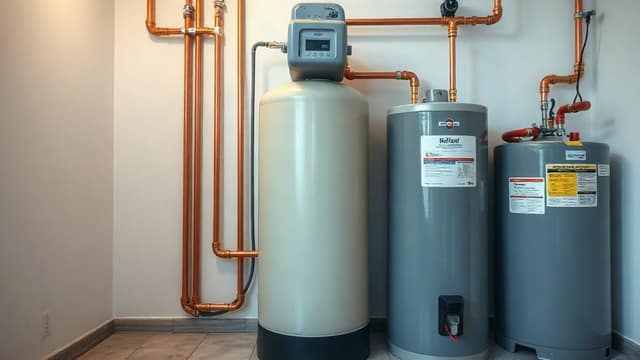 Water Softener BrandsWater softener brands compared by who builds them, NSF and WQA listings, valve
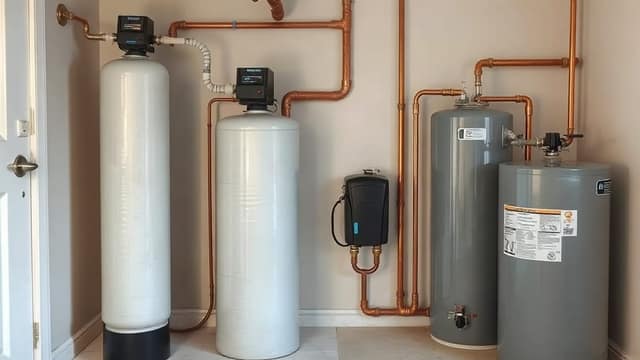 Water SoftenerEleven water softeners sold in the US compared by grains, GPM, salt use and certification
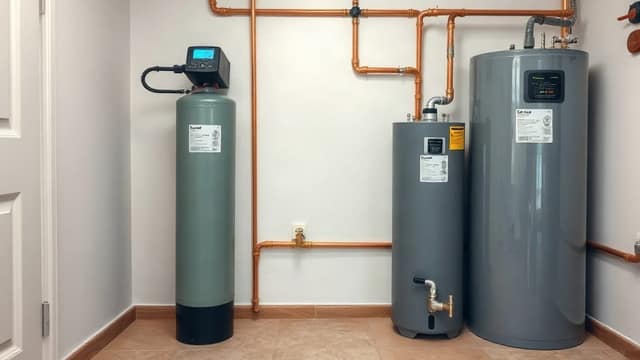 How Much Does a Water Softener Cost? Price GuideSalt, rinse water, power, warranty years and install work counted in pounds