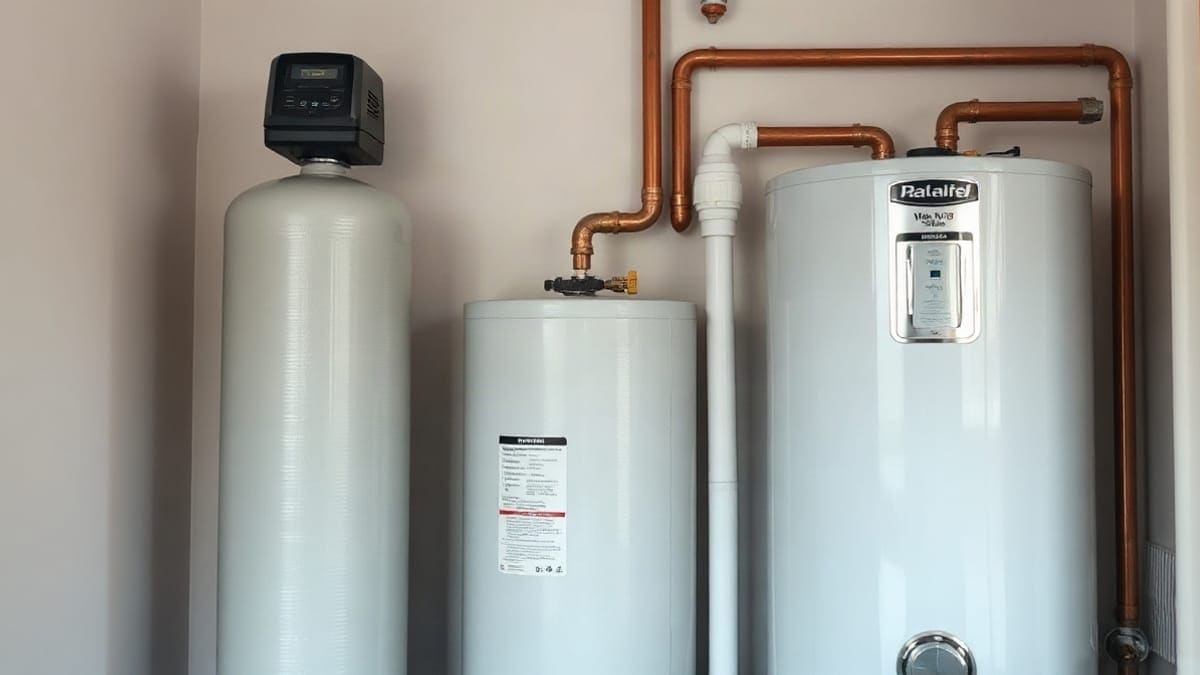
Softener size is a capacity in grains: how much hardness the resin can hold before the unit must recharge itself with brine. Too little and the unit recharges every few days or lets hard water through. Too much costs more and takes more floor space. The right number comes from three facts you can look up: how many people live in the house, how hard the water is, and how many days you want between recharges. The calculator below does the arithmetic. The rest of this page shows the formula, ready-made tables, what iron adds, and which models fit each size.
Size your softener
4,500 grains a day to remove (4 people x 75 gallons x 15 gpg); 31,500 grains over 7 days.
Pick a 32,000-grain softener: at full rated capacity it regenerates about every 7.1 days.
Salt: about 41 to 53 lb a month, depending on the salt setting per regeneration.
Sodium added: about 28 mg per 8 oz glass (113 mg per quart).
Softeners from our published guides rated for at least that capacity:
- Aquasure Harmony 32,00032,000 grains rated · Read the guideCheck price on Amazon
- Aquasure Harmony fine mesh32,000 grains rated · Read the guideCheck price on Amazon
- Fleck 5600SXT48,000 grains rated · Read the guideCheck price on Amazon
How do you use a water softener size calculator?
Water check
Enter people, gallons per person (75 by default), hardness in grains per gallon and iron in ppm. The tool returns grains per day, the capacity for your target interval, the size to buy, and a salt and sodium estimate.
Type hardness as your report prints it; a ppm or mg/L figure is divided by 17.1. With no number yet, use how to test water hardness at home or your city report through the EPA's consumer confidence report page. The water hardness converter shows every unit. The tool rounds up to a size sold for homes.
What size water softener do I need?
Water check
You need grains per day times days between regenerations, rounded up. Grains per day equal people times 75 gallons times hardness in gpg. Four people at 10 gpg use 3,000 grains daily, so a 7-day gap needs 21,000 grains.
This is the method Penn State Extension's water softening guide uses. Its worked example has four people, 75 gallons each and 10 gpg: 75 times 10 times 4 is 3,000 grains a day, and a 20,000-grain unit then lasts 6 to 7 days. The federal EPA WaterSense page says the average American family uses more than 300 gallons a day at home, which is 75 gallons for each of four people, so the default is sound for an average household.
Here is the full chain for a family of four on 15 gpg water:
- Gallons per day: 4 people times 75 gallons is 300 gallons.
- Grains per day: 300 gallons times 15 gpg is 4,500 grains.
- Capacity for 7 days: 4,500 times 7 is 31,500 grains.
- Size to buy: the next size sold is 32,000 grains.
Seven days is a convenient target, not a rule. A longer gap saves rinse water, because Penn State estimates about 50 gallons of water per regeneration. A shorter gap keeps the resin fresher but regenerates more often. Heavy users can raise the 75 gallons: Penn State lists 25 to 60 gallons per person for baths and showers and 20 to 33 gallons for laundry loads.
How big of a water softener do I need by household and hardness?
Water check
Grains per day run from 375 for one person at 5 gpg to 11,250 for six people at 25 gpg. For a 7-day gap that means sizes from 24,000 grains up to 80,000, as the two tables below show.
The first table is the daily load, using 75 gallons per person. Find your headcount, move across to your hardness, and read grains removed every day.
| People | 5 gpg | 10 gpg | 15 gpg | 20 gpg | 25 gpg |
|---|---|---|---|---|---|
| 1 | 375 | 750 | 1,125 | 1,500 | 1,875 |
| 2 | 750 | 1,500 | 2,250 | 3,000 | 3,750 |
| 3 | 1,125 | 2,250 | 3,375 | 4,500 | 5,625 |
| 4 | 1,500 | 3,000 | 4,500 | 6,000 | 7,500 |
| 5 | 1,875 | 3,750 | 5,625 | 7,500 | 9,375 |
| 6 | 2,250 | 4,500 | 6,750 | 9,000 | 11,250 |
Multiply each cell by 7 days and round up to a size sold, and you get the second table. The sizes are the usual home steps of 24,000, 32,000, 40,000, 48,000, 64,000, 80,000 and 96,000 grains, and the smallest cell is 24,000 because we found no smaller whole-house size in the guides we cover.
| People | 5 gpg | 10 gpg | 15 gpg | 20 gpg | 25 gpg |
|---|---|---|---|---|---|
| 1 | 24,000 | 24,000 | 24,000 | 24,000 | 24,000 |
| 2 | 24,000 | 24,000 | 24,000 | 24,000 | 32,000 |
| 3 | 24,000 | 24,000 | 24,000 | 32,000 | 40,000 |
| 4 | 24,000 | 24,000 | 32,000 | 48,000 | 64,000 |
| 5 | 24,000 | 32,000 | 40,000 | 64,000 | 80,000 |
| 6 | 24,000 | 32,000 | 48,000 | 64,000 | 80,000 |
Two cautions apply to every cell. First, the grain label is the most a unit can hold, at its highest salt dose. The Rheem RHS32 manual lists 13,000 grains at 2.6 lb of salt, 27,600 at 8.3 lb and 33,000 at 14.1 lb, so a "32,000-grain" unit run at a low salt setting holds far less (Rheem RHS32 manual). Second, these are the sizes for a 7-day gap. If you accept a 4-day gap you can drop one size, and if you want 10 days you may need to add one.
What does grain mean on a water softener?
Water check
A grain is a unit of weight, 1/7,000 of a pound. On a softener it counts hardness minerals: a 32,000-grain unit can hold 32,000 grains of calcium and magnesium before it must regenerate.
One gpg of hardness in one gallon of water fills one grain of capacity. A 32,000-grain unit on 15 gpg water therefore treats about 2,133 gallons (32,000 divided by 15) between regenerations, about 7 days for a family using 300 gallons a day. The number is capacity, not a salt weight or a tank volume, and it depends on the salt dose per regeneration.
What is considered hard water in grains per gallon?
Water check
Penn State calls water hard from 7.0 gpg and very hard above 10.5 gpg. USGS puts the hard line at 121 mg/L, about 7.1 gpg. Most people shop for a softener once water passes about 7 gpg.
One grain per gallon is about 17.1 mg/L, so you convert by dividing mg/L or ppm by 17.1. The table converts five common levels and applies both scales, from USGS (milligrams per liter as calcium carbonate) and Penn State Extension.
| Hardness | Same in mg/L | Penn State class | USGS class |
|---|---|---|---|
| 5 gpg | 86 | Moderately hard | Moderately hard |
| 10 gpg | 171 | Hard | Hard |
| 15 gpg | 257 | Very hard | Very hard |
| 20 gpg | 342 | Very hard | Very hard |
| 25 gpg | 428 | Very hard | Very hard |
If your report gives hardness as total hardness in ppm, divide by 17.1 before using the tables above. Typing 171 into a gpg box when you meant 171 ppm makes the answer 17 times too large. The water hardness converter in grains per gallon guide explains each unit, and the water hardness map by ZIP code shows regional ranges, which are a starting point and not your own number.
What size water softener for a family of 4?
Water check
Four people at 10 gpg need about 21,000 grains for a week, so a 24,000 or 32,000-grain unit fits. At 15 gpg the weekly load is 31,500 grains, a 32,000 unit; at 20 gpg it is 42,000, a 48,000 unit.
A family of four is the case most buyers have, so here is how the common sizes behave. The table shows days between regenerations for four people (300 gallons a day) at each hardness, on four sizes, at full rated capacity.
| Hardness | Grains per day | 24,000 grains | 32,000 grains | 48,000 grains | 64,000 grains |
|---|---|---|---|---|---|
| 5 gpg | 1,500 | 16.0 days | 21.3 days | 32.0 days | 42.7 days |
| 10 gpg | 3,000 | 8.0 days | 10.7 days | 16.0 days | 21.3 days |
| 15 gpg | 4,500 | 5.3 days | 7.1 days | 10.7 days | 14.2 days |
| 20 gpg | 6,000 | 4.0 days | 5.3 days | 8.0 days | 10.7 days |
| 25 gpg | 7,500 | 3.2 days | 4.3 days | 6.4 days | 8.5 days |
Read across the 15 gpg row: a 32,000 unit regenerates about every week, a 48,000 about every 10 days, and the 24,000 every 5 days. The same family on 25 gpg water sits at the edge of a 48,000-grain unit, where a regeneration comes every 6.4 days. Many people accept that. If you want a longer gap, the 64,000 size reaches 8.5 days.
For this household, "how many grain water softener" has two answers. On city water between 5 and 10 gpg, 24,000 to 32,000 grains is enough. On 15 to 20 gpg, plan for 32,000 to 48,000 grains. Models at each size: best 32,000-grain water softener and best 48,000-grain water softener.
What size water softener for a family of 5 or 6?
Water check
At 15 gpg, five people remove 5,625 grains a day and six remove 6,750, so a 48,000-grain unit regenerates every 8.5 and 7.1 days. At 20 gpg the same unit drops to 6.4 and 5.3 days, which is why 64,000 grains is often the better fit.
Headcount raises the daily load in a straight line, so a family of six on 20 gpg water uses 9,000 grains a day, 50 percent more than four people on the same water. The table shows 5 and 6 people on three sizes at the two hardness levels where size decisions get hard.
| Household | Hardness | Grains per day | 48,000 grains | 64,000 grains | 80,000 grains |
|---|---|---|---|---|---|
| 5 people | 15 gpg | 5,625 | 8.5 days | 11.4 days | 14.2 days |
| 5 people | 20 gpg | 7,500 | 6.4 days | 8.5 days | 10.7 days |
| 6 people | 15 gpg | 6,750 | 7.1 days | 9.5 days | 11.9 days |
| 6 people | 20 gpg | 9,000 | 5.3 days | 7.1 days | 8.9 days |
Do small homes need a full-size water softener?
Water check
No. One or two people at 5 to 15 gpg use 375 to 2,250 grains a day, so a 24,000-grain unit regenerates every 11 to 64 days. Sizing down saves money and floor space.
One person at 10 gpg removes 750 grains a day, so a 24,000-grain unit lasts 32 days. The best small water softener guide lists compact units. Compact does not mean low flow, though: if the tub, dishwasher and washer run together, a printed flow below that demand gives hard water at peak even when the grains are fine.
How does iron change the size?
Water check
Iron uses resin capacity too. Softener makers add 4 to 5 gpg per ppm of iron, depending on the maker, so 15 gpg water with 1 ppm of iron sizes like 19 to 20 gpg. It is a maker rule of thumb, not a national standard.
Resin grabs dissolved iron the way it grabs calcium and magnesium, so the iron takes space that hardness would have used. The table shows the effective hardness and the grains per day for a family of four (300 gallons) at three base levels. Whirlpool, GE, Rheem and EcoPure say 5 gpg per ppm and other makers use 4; we add 4 gpg per ppm, the low end of the range, to each base figure, and the size calculator does the same.
| Iron | 10 gpg | 15 gpg | 20 gpg |
|---|---|---|---|
| 0 ppm | 10 gpg, 3,000 grains | 15 gpg, 4,500 grains | 20 gpg, 6,000 grains |
| 0.5 ppm | 12 gpg, 3,600 grains | 17 gpg, 5,100 grains | 22 gpg, 6,600 grains |
| 1 ppm | 14 gpg, 4,200 grains | 19 gpg, 5,700 grains | 24 gpg, 7,200 grains |
| 2 ppm | 18 gpg, 5,400 grains | 23 gpg, 6,900 grains | 28 gpg, 8,400 grains |
| 3 ppm | 22 gpg, 6,600 grains | 27 gpg, 8,100 grains | 32 gpg, 9,600 grains |
At 10 gpg with 2 ppm of iron, a 48,000-grain unit lasts about 9 days where the hardness alone would suggest 16. The EPA's secondary standard for iron is 0.3 mg/L, the level where stains and metallic taste start (EPA secondary standards; the rule is in 40 CFR 143.3). It is an aesthetic limit and far below what a softener tolerates.
The well water treatment finder puts the steps in order, and the water softener for well water guide covers models.
What monthly salt does the size you pick imply?
Water check
About 41 to 53 pounds a month for four people on 15 gpg water. The spread comes from grains removed per pound: 3,350 at an efficient setting, about 2,600 at the maximum salt dose of a typical cabinet unit.
Salt use follows the grains you remove and the dose per regeneration, not the tank size. The NSF/ANSI 44 efficiency tier needs at least 3,350 grains per pound of salt (PNNL's guide). The Rheem RHS42 manual shows the other end: 42,400 grains on 16.3 pounds, about 2,600 per pound (Rheem RHS42 manual). We divide grains per month (daily grains times 30.4 days) by each figure.
| People at hardness | Grains per day | Salt per month at 3,350 grains per lb | Salt per month at 2,600 grains per lb |
|---|---|---|---|
| 2 at 10 gpg | 1,500 | about 14 lb | about 18 lb |
| 4 at 10 gpg | 3,000 | about 27 lb | about 35 lb |
| 4 at 15 gpg | 4,500 | about 41 lb | about 53 lb |
| 4 at 20 gpg | 6,000 | about 54 lb | about 70 lb |
| 6 at 25 gpg | 11,250 | about 102 lb | about 132 lb |
A 40 lb bag therefore lasts about 23 to 30 days for four people on 15 gpg water, and 69 to 87 days for two people at 10 gpg. Maker manuals print their own figures: the EcoPure EP31 is rated 5,125 grains per pound at its lowest dose, so it can use less than the table at that setting. The how much salt does a water softener use page goes through settings and bag types, and how often a softener should regenerate explains the controller.
How many mg of sodium are in a glass of softened water?
Water check
About 7.5 mg per quart for each gpg removed, so an 8 oz glass of 15 gpg water carries about 28 mg of sodium. The FDA Daily Value for sodium is 2,300 mg, so the added amount is small for most people.
The figure is from Penn State Extension: the exchange of hardness minerals for sodium adds 7.5 milligrams per quart for each gpg removed. An 8 oz glass is a quarter of a quart. The daily limit comes from the FDA's sodium page and the Dietary Guidelines for Americans 2025 to 2030, which advise less than 2,300 mg a day for people 14 and older.
| Raw hardness | Per 8 oz glass | Per 2 quarts | Share of 2,300 mg |
|---|---|---|---|
| 5 gpg | 9 mg | 75 mg | 3.3% |
| 10 gpg | 19 mg | 150 mg | 6.5% |
| 15 gpg | 28 mg | 225 mg | 9.8% |
| 20 gpg | 38 mg | 300 mg | 13.0% |
| 25 gpg | 47 mg | 375 mg | 16.3% |
The size you choose does not change sodium per glass; hardness does. Read can you drink softened water for the full question.
Is it bad to buy a softener that is too big?
Water check
Rarely a water-quality problem, but it costs more and takes more room. A 64,000-grain unit on four people at 10 gpg regenerates about every 21 days, while a 32,000 unit already reaches 10 days.
Tanks grow with capacity: SpringWell lists the SS1 at 9 in by 48 in, the SS4 at 10 in by 54 in and the SS+ at 13 in by 54 in (SpringWell). A bigger unit regenerates less, which saves rinse water: at about 50 gallons a cycle, that home uses roughly 142 gallons a month on 32,000 grains and 71 on 64,000. We found no printed maximum gap between regenerations in the manuals; ask the maker if the valve forces one. Undersizing is the costlier error, so when the tables fall between two sizes, take the larger.
What size Fleck water softener do I need?
Water check
WQA lists the Fleck 5600 SXT valve in five sizes from 0.75 to 2.0 cubic feet of resin. One reseller sells a 48,000-grain kit with 1.5 cu ft, which fits four to six people on moderately hard water.
Pentair makes the valve and resellers build the kits, so the size is the resin volume and grain rating the builder prints. The WQA listing shows NSF/ANSI 44 efficiency rating on a page dated 17 November 2026. A Pace Supply listing gives 13 GPM for the 48,000-grain kit, while other sellers print 12 to 14 GPM, so ask for your kit's figures.
Does flow rate matter as much as grains?
Water check
For big homes, yes. Grains set how often the unit regenerates; flow sets how much soft water you get when several taps run at once. Printed flows run from 7.2 GPM on the EcoPure EP31 to 20 GPM on the SpringWell SS+.
Rheem and EcoPure manuals print a rated service flow with a pressure drop: 7.2 gpm for the EP31, 7.9 gpm for the RHS32 and 8.2 gpm for the EP42. SpringWell prints 11 GPM for the SS1, 13 for the SS4 and 20 for the SS+, and Aquasure 10 GPM for the Harmony. SpringWell's size guide quotes 9 GPM for the SS1 and 12 for the SS4, so ask which figure your unit carries. Salt-free conditioners are sized by flow; see salt vs salt-free water softener.
When do you need a twin-tank softener?
Water check
When soft water must never pause, or demand is very high. A twin-tank unit has two resin tanks, so one can regenerate while the other supplies soft water. For most homes, one metered tank sized by the tables is enough.
Makers say one tank softens while the other waits on standby (SoftPro's explanation). It means a second tank to buy and fit, and the brands we cover sell single tanks. Size each tank for the full load in the tables, not half.
Which water softeners fit each size?
Water check
For about 32,000 grains: SpringWell SS1, Rheem RHS32, EcoPure EP31 and Aquasure Harmony. For 42,000 to 48,000: SpringWell SS4, Fleck 5600SXT and EcoPure EP42. For 80,000: SpringWell SS+. No model at 64,000 is in our guides yet.
Figures match the best water softener guide. Capacity is the maker's top-dose number.
32,000 grains: 1 to 4 people, up to about 15 gpg
The SpringWell SS1 prints 32,000 grains, 11 GPM and 1 in ports, with a 25 to 80 psi range. The SpringWell SS1 review has the rest. The Rheem RHS32 lists 33,000 grains at 14.1 lb of salt and 7.9 gpm; the EcoPure EP31 lists 31,300 grains at 12.9 lb and 7.2 gpm (EcoPure product page). The Aquasure Harmony AS-HS32D is a 32,000-grain, 10 GPM metered unit for up to 3 people (Aquasure), and its fine mesh version claims iron removal up to 10 ppm (Aquasure fine mesh), a maker claim with no certification found.
Best for: two to four people at up to about 15 gpg. Not for: six people or a well with heavy iron.
Check price on Amazon · Check price on Amazon · Check price on Amazon · Check price on Amazon · Check price on Amazon
42,000 to 48,000 grains: 4 to 6 people, 12 to 20 gpg
The SpringWell SS4 prints 48,000 grains and 13 GPM for 4 to 6 bathrooms. The Fleck 5600SXT kit above is 48,000 grains with 1.5 cu ft of resin. The EcoPure EP42 lists 42,200 grains at 17.4 lb and 8.2 gpm, with a clear-water iron limit of 11 ppm.
Best for: four to six people on 15 to 20 gpg water. Not for: a two-person home, where the unit idles for weeks.
Check price on Amazon · Check price on Amazon · Check price on Amazon
64,000 to 80,000 grains: 5 or more people on 20 to 25 gpg
The SpringWell SS+ prints 80,000 grains and 20 GPM, with a 13 in by 54 in tank, for 7 or more bathrooms. We have no verified 64,000-grain model with a Check price link yet; the best water softener guide will add one when it passes our checks. The sizes also depend on salt: the best high efficiency water softener page covers units that earn the NSF/ANSI 44 efficiency rating.
4 common mistakes when sizing a water softener
Water check
The costliest sizing errors are reading the top-dose grain label as everyday capacity, leaving out iron, mixing up ppm and gpg, and ignoring flow. Each moves the answer, and iron alone can add 80 percent to the load.
Sizing on the grain label alone
A "32,000-grain" label is the top salt dose. The Rheem RHS32 is rated 13,000 grains at its lowest dose, 2.6 lb, so at that setting the capacity is 39 percent of the label. Read the manual's table of capacity by salt dose before you trust the number.
Ignoring iron
Two ppm of iron adds 8 to 10 gpg under the maker rule (8 at the 4 gpg low end). On a 10 gpg home that is 80 percent more load. The size from the tables is then too small, and the unit regenerates much more often.
Mixing up ppm and gpg
A report that says 171 ppm means 10 gpg. Using 171 as gpg gives a load 17 times too high and a size no home sells. Divide ppm or mg/L by 17.1 first.
Counting people but not flow
Two homes with four people can need different units if one has four bathrooms and a big tub. Check the printed GPM against your busiest hour.
Frequently asked questions
How big of a water softener do I need for a family of four?
For four people on 10 gpg water, 24,000 to 32,000 grains. On 15 gpg, 32,000 grains. On 20 gpg, 48,000 grains. These keep the gap at about a week. See the family of four section above for the days between regenerations at each size.
How many days does a 40 lb bag cover at your size?
For four people on 15 gpg water, about 23 to 30 days (the full answer is on how much salt a water softener uses), since the unit uses 41 to 53 pounds a month. For two people on 10 gpg water the same bag lasts 69 to 87 days. The salt setting changes this, so check yours.
How big of a home is a 48,000-grain water softener?
By our formula, it suits four to six people on 10 to 20 gpg water. SpringWell lists its 48,000-grain SS4 for 4 to 6 bathrooms. Count people and hardness first, since bathrooms only guide flow.
Do I size by people or by bathrooms?
By people and hardness for grains, and by bathrooms and fixtures for flow. SpringWell sizes by bathrooms, which is a flow guide. You need both numbers.
Should I round up or down?
Up. A unit rounded down regenerates more often than planned or runs short before its cycle.
Does a bigger softener use more salt?
Not for the same water. Salt follows the grains removed and the dose per regeneration, so a bigger tank just regenerates less often.
Is the size different for city water and well water?
The formula is the same. Wells add two unknowns: hardness changes, and iron. EPA says private well owners must test their own water, and iron adds 4 to 5 gpg per ppm.
How accurate does my hardness number need to be?
As close as you can get. A drop kit reads 1 gpg per drop, while a strip reads a range and not an exact number, so a drop kit or lab report is better for sizing. Read the best water hardness test kit guide for ranges.
Does a softener size change if I run a lot of laundry?
Raise the gallons per person above 75. Penn State lists 20 to 33 gallons per laundry load, so a laundry-heavy house sits above average. The water softener for washing machine and laundry page goes deeper.
What size reverse osmosis system, filter tank or water conditioner do I need?
Those are sized differently, by flow, production or tank volume, and not by grains. See the best reverse osmosis system, the best well water filtration system and the best whole house water filtration system guides.
How we researched this page
Water check
The formula and sodium figure come from Penn State Extension, the hardness classes from USGS and Penn State, and the model figures from maker pages and manuals read in November 2026. We have not tested any softener, and we publish no prices.
We read the Penn State Extension water softening guide, the USGS hardness page, the EPA pages on secondary standards, private wells and water use, the PNNL softener guide, the SpringWell specification and warranty pages, the EcoPure and Rheem RHS32 manuals, the Aquasure listings and the WQA listing for Fleck. All tables are our arithmetic from these figures, not measurements.
Not confirmed: the Rheem RHS42 manual figure of 42,400 grains on 16.3 lb comes from our earlier read of the PDF, which our tool could not reopen. The twin-tank claims come from one maker page found through a search result. We found no printed maximum number of days between regenerations for the models above. SpringWell's size guide and spec table disagree on flow. If you buy through a Check price button, this site earns a commission and the price does not change.
Sources
Our sources by topic
Public agencies and universities
- Penn State Extension, Water Softening: sizing formula, 75 gallons, 50 gallons per regeneration, 7.5 mg of sodium per quart.
- USGS, Hardness of Water: hardness classes.
- EPA, How We Use Water, secondary standards, private wells and consumer confidence reports.
- PNNL, Water Softeners; FDA, Sodium in Your Diet.
Certification and standards bodies
- WQA, Pentair listing; NSF, certified products.
Manufacturers, retailers and other references
- Rheem manuals: RHS32 and RHS42; EcoPure manual.
- SpringWell, salt-based softener specifications; Aquasure, Harmony 32,000.
Keep comparing
 Salt-Free Water SoftenerEight salt-free water conditioners compared by flow in GPM, hardness limit in gpg
 Water Softener InstallationPipe sizes, bypass, drain air gap, psi limits, first regeneration, DIY or plumber
 How Much Does a Water Softener Cost? Price GuideSalt, rinse water, power, warranty years and install work counted in pounds
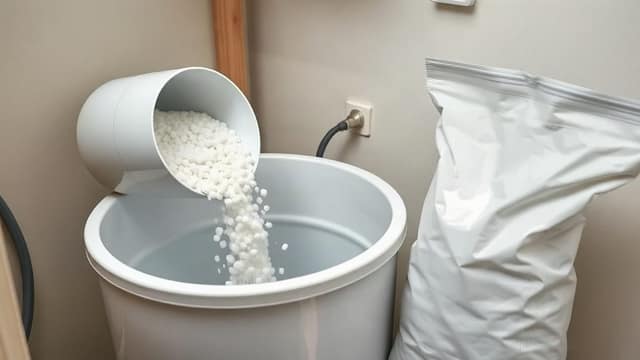 Water Softener SaltTen water softener salts in 40 lb bags compared by form, stated purity, iron additive and NSF listing
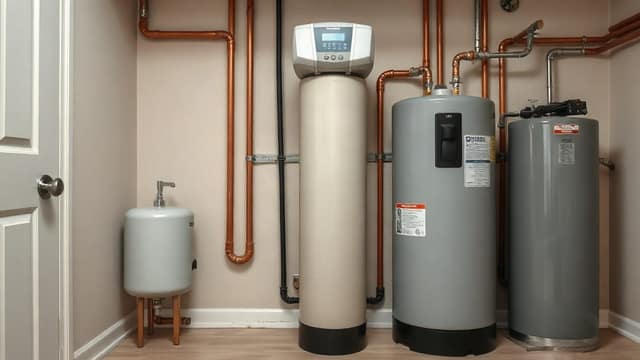 Water Softener Maintenance Checklist (Monthly, Yearly)Salt checks every 2 to 4 weeks, cleaner every 4 months, brine tank yearly, resin life
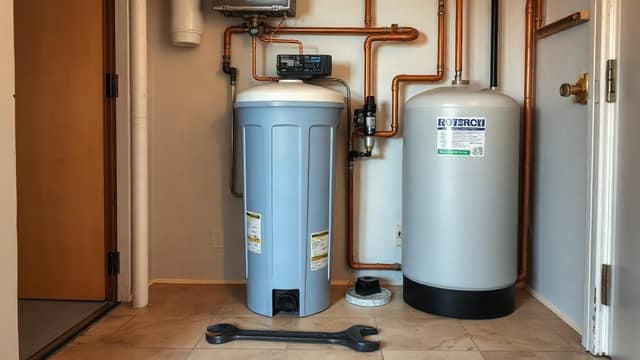 Water Softener RepairA symptom, cause, test and fix table, salt bridge and brine tank steps, error codes, who to call