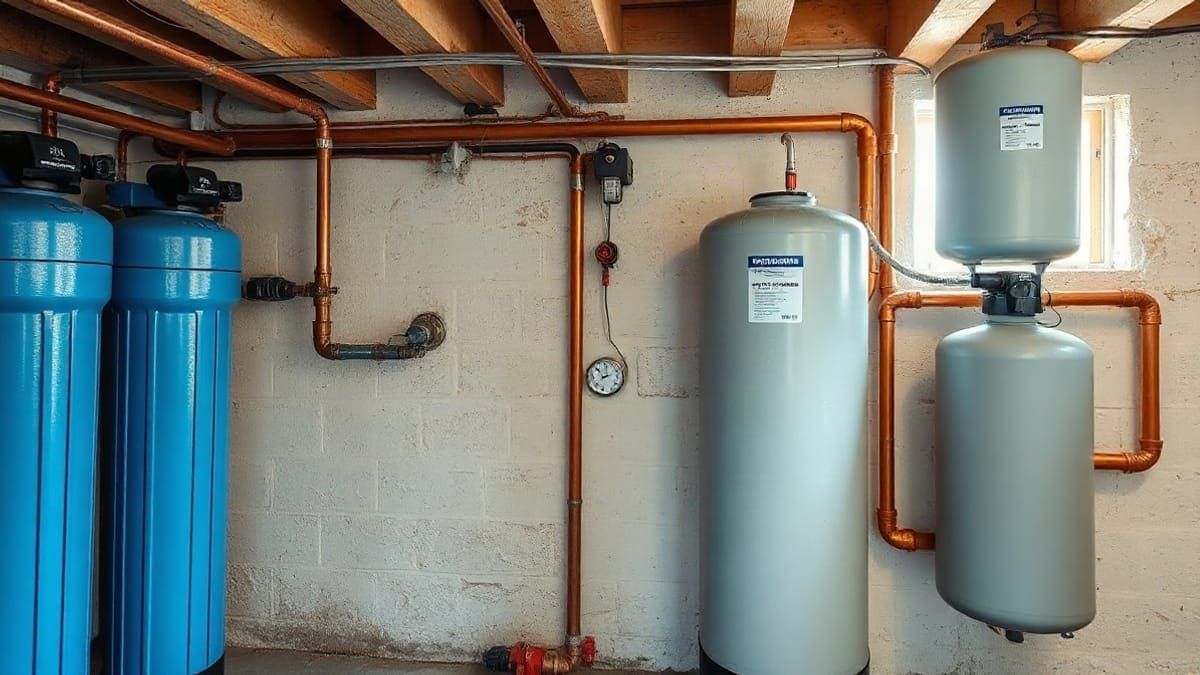
Iron filters differ by how they oxidize iron, which pH they need, how much water they flush each cycle and how much flow your well can give them. Every figure is taken from a maker page, a manual, a state or university guide or EPA, and a conflict between two of them is named in the text. No prices appear. Enter your lab report in our well water treatment finder for a short list, then read on for the reasoning.
Which iron filter suits most wells?
Water check
There is no single winner. SpringWell WS1 (12 GPM, 7 ppm iron) and WS4 (20 GPM) suit moderate iron on larger flows, AFWFilters air injection tanks and the iSpring WCFM500K print higher limits, and the Fleck 2510AIO is the plumber's valve.
A printed ppm limit is a claim, not a listing, and the makers do not state the same test conditions, so compare each with your lab report, not with each other.
| Filter | Technology | Iron, manganese, sulfur printed | Flow printed | Pipe |
|---|---|---|---|---|
| SpringWell WS1 | Air injection, greensand fusion media | 7 ppm, 1 ppm, 8 ppm | 12 GPM service | 1 in |
| SpringWell WS4 | Same, larger tank | 7 ppm, 1 ppm, 8 ppm | 20 GPM service | 1 in |
| iSpring WCFM500K | Air only, 3 micron stage | 12 ppm, 20 ppm, 20 ppm | not confirmed | not confirmed |
| AFWFilters air injection, 1 cu ft | Catalytic carbon, Fleck 5600SXT head | 12 ppm, 2 ppm, 10 ppm | not listed | 1 in bypass |
| AFWFilters air injection, 1.5 cu ft | Same, larger bed | 12 ppm, 2 ppm, 10 ppm | not listed | 1 in bypass |
| Fleck 2510AIO kits | Air injection, three media options | no upper iron limit in the manual | 2 to 5 GPM service | 3/4 in |
| AFWFilters Iron Pro 2 (64,000 grains) | Fine mesh softener resin | 6 ppm iron | 10 GPM service, 15 peak | 3/4 or 1 in |
| SpringWell MWS1 set | WS1, CF1 carbon and SS1 softener | see WS1 | 9 to 12 GPM by part | 1 in |
What is an iron filter for well water, and how does it work?
Water check
An iron filter turns dissolved iron into solid particles, usually with air, then traps them in a media bed and flushes them out in a backwash. The tank, not a cartridge, does the work, so it needs a drain, power and a pump that can feed the flush.
Dissolved iron is invisible. Once oxygen reaches it, it becomes the rust-colored solid that stains tubs and laundry, and the EPA secondary standard describes it as rusty color, sediment, metallic taste and reddish or orange staining at 0.3 mg/L.
The Fleck 2510AIO manual describes the air injection version. The valve keeps a bubble of compressed air at the top of the tank, water passes through it and then through the bed, and each regeneration backwashes the trapped iron, draws a fresh bubble of air and rinses. Factory settings run a 14 minute backwash, a 40 minute air draw and a 4 minute rapid rinse, usually at 1:00 a.m.
An iron filter is not a sediment filter and not a softener, and it does not disinfect. The water softener vs water filter page shows where each tool stops.
What kind of iron is in your well water?
Water check
Wells carry clear-water (ferrous) iron, red-water (ferric) iron, iron bacteria and organic iron, and the Minnesota Department of Health says treatment differs for each. A lab report that separates them saves you from buying the wrong tank.
Minnesota Department of Health gives treatment by iron type and says iron is usually below 10 mg/L. Penn State Extension says 17% of sampled private supplies had excessive iron. The Fleck manual adds bacterial iron and says its air injection filter can filter all three forms.
| Form | What you see | What works, per the sources |
|---|---|---|
| Ferrous (clear-water) | Clear from the tap, rust after standing | Softener, oxidizing filter, or oxidation plus filtration (MDH) |
| Ferric (red-water) | Rusty or cloudy at once | Iron filter up to 10 to 15 mg/L; aeration or chemical oxidation above 10 mg/L (MDH) |
| Iron bacteria | Red-brown slime, biofilm | Disinfect the well, then treat the iron; killing bacteria does not remove iron (MDH) |
| Organic (tannin-bound) | Yellow or brown tint | Chemical oxidation then filtration may work; softeners and iron filters may not (MDH) |
Iron bacteria slime can clog a filter, per the Georgia Extension guide. Penn State's shock chlorination page says to retest 10 to 14 days after disinfecting a well, and again 2 to 3 months later. Tannins above about 0.5 ppm coat the media, per the Fleck manual; see our tannin filter page.
Which iron filter type fits your water: air injection, Birm, greensand or chlorine?
Water check
Match type to chemistry: softener under 5 mg/L dissolved iron, catalytic carbon under 1.0 mg/L, greensand for 3 to 10 mg/L of iron plus manganese, and oxidation then filtration above 10 mg/L. Air injection tanks claim more, on makers' own terms.
Penn State's iron and manganese guide gives the general ranges, and the Georgia Extension guide gives pH ranges and media capacity. The last row is what a maker prints, shown for contrast.
| Method | Range the source gives | pH and other conditions | Source |
|---|---|---|---|
| Water softener | Dissolved iron under 5 mg/L; 3 to 20 gpg hardness | pH above 6.7 | Penn State |
| Catalytic carbon | Dissolved iron under 1.0 mg/L | At least 4.0 mg/L dissolved oxygen | Penn State |
| Manganese greensand | Iron plus manganese 3 to 10 mg/L | pH 6.2 to 8.8; 10,000 mg iron per cu ft | Penn State, Georgia |
| Birm | Iron to 10 ppm; 25,900 to 32,300 mg iron per cu ft | pH 6.8 or higher for iron, 7.5 for manganese; dissolved oxygen at least 15% of the iron level | Penn State, Georgia |
| Filox-R | 312,000 mg iron per cu ft | pH 3 to 12 | Georgia |
| Chemical oxidation, then filter | Combined iron and manganese above 10 mg/L | Chlorine poorly suits high manganese | Penn State |
| Air injection tank | 7 to 12 ppm printed by SpringWell, AFWFilters, iSpring | maker pH ranges 6.5 to 10 (SpringWell) | Makers |
Two details change a decision. Birm handles no hydrogen sulfide in the Georgia table and needs 1.5 ppm of dissolved oxygen for 10 ppm of iron, and greensand is regenerated with potassium permanganate, while Birm and Filox-R need no chemical regenerant.
The Fleck manual adds a third path inside one tank: standard media that raises pH by itself, Birm for high-pH water, or "nextSand", which traps precipitated iron down to 3 to 5 microns. The pH-raising media dissolves as it works, so under the worst conditions it needs replenishing 2 to 4 times a year. For acidic water, see acid neutralizing filters.
What filter takes iron and manganese out of well water?
Water check
Use an oxidizing filter sized for the sum of both metals: EPA's manganese level is 0.05 mg/L, Georgia Extension warns against these media above 15 ppm combined, and makers print 1 ppm (SpringWell), 2 ppm (AFWFilters) and 20 ppm (iSpring).
Manganese stains black or brown, and EPA lists a bitter metallic taste at 0.05 mg/L. The Fleck manual says as little as 0.05 ppm can stain, and that manganese tends to coat the media so that it stops raising pH and removing iron. Manganese oxidizes at higher pH than iron, which is why Penn State puts Birm at pH 7.5 or more for manganese, and why chlorine is a poor fit for very high manganese.
| Source | Iron | Manganese | Hydrogen sulfide |
|---|---|---|---|
| Georgia Extension, oxidizing media in general | no more than 10 ppm | iron plus manganese no more than 15 ppm | no more than 5 ppm |
| SpringWell WS1 and WS4 | 7 ppm | 1 ppm | 8 ppm |
| AFWFilters air injection | 12 ppm | 2 ppm | 10 ppm |
| iSpring WCFM500K | 12 ppm | 20 ppm | 20 ppm |
| Fleck 2510AIO, reseller listing | 30 ppm | 15 ppm | 10 ppm |
| Fleck 2510AIO, instruction manual | no apparent upper limit | not given | 2 to 3 ppm, not advised alone |
The last two rows show how far a claim can drift: the reseller Mid Atlantic Water prints 30 ppm for a Fleck 2510 AIO with Katalox Light media, while the manual's "30,000" is a capacity in ppm-gallons between regenerations, not a concentration.
How much iron is too much in well water?
Water check
EPA's secondary standard is 0.3 mg/L for iron and 0.05 mg/L for manganese, with pH 6.5 to 8.5. They are not enforced and describe taste, color and stains, but they are the targets a filter is sized to meet.
EPA's secondary standards page, last updated May 26, 2026, says EPA does not enforce them and that these contaminants are not considered a risk to human health at those levels. The standard appears in 40 CFR 143.3. Private wells fall under no federal rule, so the figures work as targets for your own lab report.
| Substance | Level | Type | What it does at that level |
|---|---|---|---|
| Iron | 0.3 mg/L | EPA secondary | rusty color, sediment, metallic taste, orange stains |
| Manganese | 0.05 mg/L | EPA secondary | black or brown color, black stains, bitter taste |
| pH | 6.5 to 8.5 | EPA secondary | low pH adds metallic taste and corrosion |
| Iron, typical well | below 10 mg/L | MDH | most wells fall here |
| Hydrogen sulfide | smell well below 0.5 mg/L | Penn State | no EPA standard |
Penn State's hydrogen sulfide page, updated December 10, 2024, says oxidizing filters work to roughly 2 to 3 mg/L, activated carbon under about 1.0 mg/L, and continuous chlorination above 6.0 mg/L with at least 20 minutes of contact. Makers print 8 to 20 ppm, so an iron tank is no guaranteed sulfur fix; our rotten egg smell guide handles that problem.
How do you size an iron filter for a well?
Water check
Size on three numbers: service flow above your peak draw, backwash flow your well can deliver (about 5.5 GPM for Birm in a 10 in tank), and iron capacity. A 1.0 cu ft Fleck bed holds 30,000 ppm-gallons between regenerations.
What flow does the tank need during service?
Service ratings are not stated alike. The Fleck manual rates the 1.0 cu ft unit at 3 GPM service and 6 GPM peak, with a pressure drop under 15 psi at the stated peak, while SpringWell prints 12 GPM for the WS1 in its spec table and 9 GPM in its size guide. Ask each maker what "service" means.
How much backwash flow does the well need?
The Georgia guide says backwash usually needs more than double the normal service flow, and gives rates per square foot of bed: Birm 10 gpm, greensand 12 gpm and Filox-R 15 to 18 gpm. The result for common tanks is our calculation from the Georgia rates.
| Tank diameter | Bed area | Birm at 10 gpm per sq ft | Greensand at 12 | Fleck manual at 60°F |
|---|---|---|---|---|
| 8 in | 0.35 sq ft | 3.5 GPM | 4.2 GPM | 6 GPM |
| 10 in | 0.55 sq ft | 5.5 GPM | 6.5 GPM | 9 GPM |
| 12 in | 0.79 sq ft | 7.9 GPM | 9.4 GPM | 13 GPM |
| 13 in | 0.92 sq ft | 9.2 GPM | 11.1 GPM | not listed |
The Fleck rate depends on water temperature: a 10 in tank needs 7 GPM at 40°F and 12 GPM at 80°F. Its flow controls are 3.5, 4, 5 and 7 GPM for the standard 0.75 to 2.0 cu ft media and 5, 7, 8 and 12 GPM for nextSand, with at least 30 psi at the inlet. SpringWell and AFWFilters publish no backwash flow on the pages we read, so ask before ordering and compare the answer with your well's sustained yield on the driller's report.
How often will the tank regenerate?
Fleck's manual gives a method: capacity in ppm divided by two for reserve, divided by the compensated iron ppm, gives gallons between regenerations, with a maximum of 12 days. The manual's example is five people at 75 gallons each and 4 ppm. Here is the same method for four people (300 gallons a day), our arithmetic.
| Iron in water | Iron load a day | 1.0 cu ft (15,000) | 1.5 cu ft (22,500) | 2.0 cu ft (30,000) |
|---|---|---|---|---|
| 4 ppm | 1,200 | 12 days (cap) | 12 days (cap) | 12 days (cap) |
| 6 ppm | 1,800 | 8.3 days | 12 days (cap) | 12 days (cap) |
| 10 ppm | 3,000 | 5.0 days | 7.5 days | 10 days |
| 12 ppm | 3,600 | 4.2 days | 6.3 days | 8.3 days |
The manual's lowest entry for compensated iron is 4, and manganese counts toward it, so read this as an iron-only floor. Each cycle also uses water: at the 1.5 cu ft setting (5 GPM), a 14 minute backwash plus a 4 minute rinse is about 90 gallons, before the air draw.
Where does a softener stop and an iron filter begin?
Water check
Only a little. Penn State says a softener alone suits dissolved iron under 5 mg/L at pH above 6.7, MDH says the common limit is 2 to 5 mg/L, and the softener maker rule is to add 4 to 5 gpg to the hardness setting for each ppm of iron.
Penn State's iron and manganese guide lists softeners for hardness of 3 to 20 gpg and dissolved iron below 5 mg/L. MDH says manufacturers report up to 10 mg/L, but a more common limit is 2 to 5 mg/L. Oxidized iron plugs the resin, and the Fleck manual says a softener installed to deal with iron loses both hardness and iron capacity once the bed fouls, and describes cleaning the resin when the filter goes in.
The compensation rule counts iron as extra hardness. Whirlpool, GE, Rheem and EcoPure manuals say 5 gpg per ppm, other makers use 4, so name your maker. Here are the numbers for four people at 75 gallons each on 10 gpg water, with a 32,000-grain softener, our arithmetic.
| Iron | Effective hardness at 4 gpg | Days between regenerations | Effective hardness at 5 gpg | Days between regenerations |
|---|---|---|---|---|
| none | 10 gpg | 10.7 | 10 gpg | 10.7 |
| 1 ppm | 14 gpg | 7.6 | 15 gpg | 7.1 |
| 2 ppm | 18 gpg | 5.9 | 20 gpg | 5.3 |
| 3 ppm | 22 gpg | 4.8 | 25 gpg | 4.3 |
| 5 ppm | 30 gpg | 3.6 | 35 gpg | 3.0 |
At 5 ppm a softener regenerates about every 3 to 4 days, spending salt and flushing 50 gallons a time by Penn State's estimate, which is why a dedicated filter ahead is the answer above roughly 3 to 5 ppm. Sizing math for the softener itself is in what size water softener do I need and the softener size calculator.
Where does an iron filter go in the treatment chain?
Water check
After the pressure tank and any sediment stage, before the softener, carbon and UV. Penn State says raw water must not meet air or chlorine ahead of a softener meant to take out dissolved iron, and UV makers need iron under 0.3 ppm.
SpringWell and Aquasana both state that their UV units need iron under 0.3 ppm, hardness under 7 gpg and tannins under 0.1 ppm at the lamp. If sand or silt reaches the tank, add a whole house sediment filter ahead of it. The full chain, with every stage, is in the well water filtration system guide, and filter and softener combos shows pre-built sets.
The eight iron filters in detail
Water check
The eight filters run from a 3/4 in Fleck 2510AIO valve rated 2 to 5 GPM service to the SpringWell WS4 at 20 GPM. Each section gives size, limits, the conditions makers attach and who should look elsewhere.
SpringWell WS1: the air injection tank with the lowest limits
The WS1 is a 10 in by 54 in tank (64 in with head) with a 1 in connection, rated 12 GPM service, and states 7 ppm iron, 1 ppm manganese and 8 ppm hydrogen sulfide at 25 to 80 psi, 36 to 120°F and pH 6.5 to 10. SpringWell's page lists chemical-free air injection oxidation, greensand fusion media with a stated life of 10 years or more, Bluetooth control and a scheduled backwash to a drain. Its size guide says 9 GPM for the same unit, so the two tables disagree.
The warranty is lifetime on covered parts, 5 years on the electronic head on the product page (7 years on the warranty page), with a 6 month money-back guarantee and performance promise. The conditions list hydrogen sulfide, oils and copper above 1.30 mg/L among the water conditions that void coverage, which sits oddly next to the 8 ppm sulfur claim, so ask in writing. SpringWell requires a well water test before it ships. No backwash flow or certification is printed. See the WS1 review and the SpringWell brand guide.
Best for: a one to four bathroom house with a lab-confirmed iron and manganese problem under the printed limits. Not for: bacteria, pH below 6.5 or heavy sulfur.
SpringWell WS4: the same chemistry for four or more bathrooms
The WS4 is a 13 in by 54 in tank (64 in with head), rated 20 GPM, with the same 25 to 80 psi, 36 to 120°F, pH 6.5 to 10 and 7, 1 and 8 ppm claims as the WS1. SpringWell's size guide lists 12 GPM for the larger size, so check which figure applies.
Best for: four or more bathrooms on a well that can feed a large backwash. Not for: a small house, where the WS1 does the same job.
iSpring WCFM500K: the highest manganese and sulfur claim
iSpring says the WCFM500K reduces iron up to 12 ppm and manganese and hydrogen sulfide up to 20 ppm, uses 3 micron sediment filtration and regenerates with air only, for up to 10 years or 500,000 gallons. iSpring's page says the unit does not soften or reduce TDS, should go ahead of a softener, and wants a pre-filter for large particles.
Flow, pipe size and pressure were not readable when we fetched it, so none is printed here, and stock read as out on November 18, 2026. A 20 ppm manganese claim sits above the 15 ppm combined limit in Georgia's guidance, so ask for the test basis. See the iSpring WCFM review.
Best for: manganese or sulfur above the SpringWell limits, with a pre-filter. Not for: a buyer who needs a published flow rate or bacteria control.
AFWFilters air injection tank, 1 cu ft: the 12 ppm catalytic carbon bed
The 1 cu ft model has a 10 in by 54 in fiberglass tank (60 in tall), a Fleck 5600SXT air injection head, 1 cu ft of "upgraded Centaur catalytic carbon" and prints iron to 12 ppm, manganese to 2 ppm and hydrogen sulfide to 10 ppm. The AFWFilters listing says the valve backwashes once a day, ships with a 1 in plastic bypass and arrives with media loaded. It states no service flow, backwash flow, pressure range, pH range, warranty or certification.
Penn State puts catalytic carbon at dissolved iron under 1.0 mg/L with 4.0 mg/L of dissolved oxygen; an air head supplies oxygen, but AFWFilters gives no test conditions behind 12 ppm.
Best for: moderate iron with some sulfur in a small house, bought from a dealer that answers flow questions. Not for: a buyer who needs published flow or warranty terms.
AFWFilters air injection tank, 1.5 cu ft: the same claim on a bigger bed
The 1.5 cu ft version uses a 12 in by 52 in tank (60 in tall) and 1.5 cu ft of the same catalytic carbon, with the same 12, 2 and 10 ppm limits and the same Fleck 5600SXT air injection head. AFWFilters lists a 1 in plastic bypass as standard and optional stainless steel 3/4 in or 1 in female fittings. Flow, warranty and certification are again not stated, and its stock field did not load.
A 12 in bed needs about 7.9 to 9.4 GPM by Georgia's rates, and the Fleck manual lists 13 GPM at 60°F, so take the larger figure into the well-yield conversation.
Best for: iron near 6 to 12 ppm in a house with four people or more. Not for: a well that cannot feed a flush near 8 to 13 GPM.
Fleck 2510AIO: the plumber's valve, three media options
The Fleck 2510AIO manual lists four sizes, 0.75 to 2.0 cu ft, in tanks from 8 by 47 to 12 by 52 in, with 3/4 in pipe, 2 to 5 GPM service, 4 to 15 GPM peak, 24 VAC power, 80 psi maximum pressure and 110°F maximum water temperature. The manual rates iron capacity at 22,500, 30,000, 45,000 and 60,000 ppm between regenerations and sets standard media, Birm or nextSand as options. The valve sheet states 19 GPM continuous and a 17 GPM maximum backwash.
The manual sets no hard iron limit but warns about high iron combined with very low pH or manganese, tannins above about 0.5 ppm, and hydrogen sulfide as the only problem, though 2 to 3 ppm is handled. A reseller's 30 ppm figure is not in it. Sellers assemble these kits, so warranty and media vary with whoever packs them.
Best for: a buyer with a plumber, or one who wants a serviceable valve with parts from many sellers. Not for: a one-company responsibility, or a sulfur-only problem.
AFWFilters Iron Pro 2: a softener with fine mesh resin for low iron
The Iron Pro 2 (64,000 grains) is a Fleck 5600SXT softener with fine mesh, 10% crosslink resin, a 12 in main tank and an 18 in by 33 in brine tank, rated 10 GPM service and 15 GPM peak, and printed for iron up to 6 ppm. The AFWFilters page calls that "low levels" of iron, states 5 years on the head and 10 years on the tank, and names no certification. It does not mention ferric iron.
The store's own blog puts standard resin at typically up to 1 ppm of dissolved iron, and 6 ppm sits above the 2 to 5 mg/L MDH calls common for softeners, so use it only on clear-water iron, with a compensated hardness setting.
Best for: hard water with 1 to 3 ppm of clear-water iron where one tank is wanted. Not for: red water, bacterial iron, sulfur or iron above 5 ppm.
SpringWell MWS1: iron filter, carbon and softener in one order
The MWS1 pairs a WS1 iron filter (12 GPM), a CF1 carbon filter (9 GPM) and an SS1 softener (11 GPM, 32,000 grains), so the set's bottleneck is the 9 GPM carbon tank. SpringWell's combo page holds the order until a well water test is complete and lists the larger MWS4 with a WS4, CF4 and SS4. No certification is named.
The CF1 and SS1 figures were carried over from our well water filtration page, not read a second time here.
Best for: iron and hardness arriving together, ordered as one chain. Not for: a house that needs more than 9 GPM from the whole chain.
What about Pelican and Crystal Quest?
Pentair's page for the Pelican WF4-P (1 to 3 bathrooms, 10 GPM) and WF8-P (4 to 6 bathrooms, 15 GPM) iron and manganese systems is marked discontinued and prints no ppm limit. Pelican's own page lists different flows, so neither is a pick. Crystal Quest's metal removal tank has a manganese dioxide ore bed, but its page refused our requests and showed no ppm limit in the results we could read, so it is absent too.
How do you choose an iron filter for your well?
Water check
Start from your lab report: iron and manganese in ppm, hydrogen sulfide, pH and hardness. Then match the printed limits and the backwash flow your well can feed, and ask for the maker's terms in writing.
Under 7 ppm of iron and 1 ppm of manganese, the SpringWell WS1 fits the printed limits. The AFWFilters tanks print 12 ppm and 2 ppm, so leave a margin under the number. With iron under 3 ppm and hardness above 7 gpg, a softener sized for iron may do both jobs.
Which certifications can anyone look up for iron filters?
Water check
NSF's database returns no listing for Fleck or Pelican and none for SpringWell or iSpring iron filters. A maker's ppm limit is a claim, and the only public benchmark is WQA's, which Georgia Extension says asks soluble iron at 0.2 ppm or less.
On November 18, 2026 we looked up each maker in the NSF certified drinking water treatment unit database, starting with Fleck and Pelican. Both returned no matching products.
| Filter | What the maker says | What we could look up |
|---|---|---|
| SpringWell WS1, WS4, MWS1 | No certification on the page | NSF returns no SpringWell products |
| iSpring WCFM500K | Limits printed, none named | NSF lists iSpring reverse osmosis models only |
| AFWFilters air injection, Iron Pro 2 | None stated; page cites a WQA specialist for guidelines | Not queryable |
| Fleck 2510AIO kits | Valve specifications only | NSF: no Fleck products |
| Pentair WF4-P (discontinued) | Clack bypass fittings to NSF/ANSI 61, materials only | A materials listing, not iron removal |
NSF/ANSI 61 covers materials safety, not iron removal. We could not query WQA's search form or IAPMO's directory, so a listing held only there would not appear here. Check your model in WQA's product search and the IAPMO directory before you rely on one.
How much does an iron filter for well water cost to own?
Water check
No price is printed here, since none could be checked when you read this. What you can count are the running items: backwash water, a yearly valve kit on Fleck units, media every 5 to 10 years and a yearly lab test.
Use the Check price buttons for today's numbers, then read the whole house water filter cost guide and the well water filtration system cost page for what drives the total; upkeep schedules sit in whole house filter maintenance and replacement. Three recurring items belong in any budget. Backwash water comes first: roughly 90 gallons a cycle on a 1.5 cu ft Fleck at factory settings, plus the air draw. Media is second: SpringWell states 10 years or more, Pentair's WF4-P page 5 years and a reseller 6 to 8 years for Fleck media, and the Fleck valve needs a yearly service kit. The third is testing, which Georgia Extension puts at once or twice a year after installation and EPA at every year.
How do you install an iron filter on a well?
Water check
Put it on the main line after the pressure tank, with a bypass, a drain with an air gap and a power outlet nearby. The Fleck manual wants 20 to 50 psi in normal use, at least 30 psi for backwash, and a place the tank cannot freeze.
The Fleck manual says to sit the unit near a floor or laundry tub drain, run a 1/2 in inside diameter drain line with an air gap, and secure that line during regeneration because the tank's air escapes through it. Raw water bypasses the filter during backwash, so avoid using water around 1:00 a.m. SpringWell lists a 1 in connection and a power supply, with a range of 36 to 120°F.
The manual also says to clean old iron out of the plumbing: resin cleaner through a fouled softener, a water heater flush and treated toilet tanks. Full steps are in how to install and change a well water filter and the whole house water filter installation guide.
Iron filters for well water: our conclusion
Water check
Match the tank to your lab report: the SpringWell WS1 for iron up to 7 ppm, the AFWFilters air injection tanks for higher printed limits, and a softener first when iron is under 3 ppm. Above 5 ppm, a softener alone fails.
A one to four bathroom house with iron and manganese under the printed limits takes the SpringWell WS1 (12 GPM) Check price on Amazon; four or more bathrooms on a well that can feed a large backwash take the WS4 (20 GPM) Check price on Amazon. Manganese or sulfur above SpringWell's limits points to the iSpring WCFM500K with a pre-filter Check price on Amazon. Iron near 6 to 12 ppm in a house of four or more suits the AFWFilters 1.5 cu ft tank Check price on Amazon.
6 common mistakes with iron filters
Water check
Six mistakes cost buyers most: choosing by the printed ppm, skipping the lab test, ignoring backwash flow, treating bacteria as iron, using a softener alone above 5 ppm and forgetting manganese.
- Choosing by the highest printed limit. Makers claim 7, 12, 20 and 30 ppm for similar tanks, and Georgia Extension warns against these media above 10 ppm of iron. Cost: a tank that fouls early. Fix: leave a margin under the number.
- Skipping the lab test. SpringWell holds an order until a test is on file. Fix: test for iron, manganese, hardness, pH, hydrogen sulfide and coliform.
- Ignoring backwash flow. A 12 in bed wants roughly 8 to 13 GPM. A well that gives 5 GPM leaves the bed unflushed. Fix: get the maker's backwash number.
- Treating iron bacteria like iron. MDH says killing the bacteria does not remove the iron, and the tank does not fix the well. Fix: disinfect, then filter.
- Using a softener alone above 5 ppm. At 5 ppm it regenerates every 3 to 4 days on 10 gpg water. Fix: filter first.
- Forgetting manganese. As little as 0.05 ppm stains, and it coats the media. Fix: read the manganese line and keep pH high enough.
Frequently asked questions
Does an iron filter remove manganese?
Most oxidizing filters claim it: SpringWell 1 ppm, AFWFilters 2 ppm, iSpring 20 ppm. Georgia Extension limits these media to 15 ppm of iron and manganese combined, and manganese needs higher pH than iron.
Does an iron filter remove hydrogen sulfide and the rotten egg smell?
Partly. Penn State says oxidizing filters reach about 2 to 3 mg/L, though makers print 8 to 20 ppm. Above that, chlorination and filtration are used.
Does an iron filter remove bacteria?
No. Disinfect the well, retest, and see the UV purifier guide.
Do you need a whole house filter for a well?
Only if your test or fixtures show a problem. EPA says to test yearly. The decision is covered in the well water filtration guide. Whole-house filters in general are in the whole house water filtration system guide. An iron tank does not target GenX or other PFAS; see best water filter for PFAS.
What pH does an iron filter need?
Birm needs 6.8 or higher for iron and 7.5 for manganese. Greensand works at 6.2 to 8.8 and Filox-R at 3 to 12. SpringWell prints 6.5 to 10.
How often does an iron filter backwash?
The Fleck manual's factory setting is 1:00 a.m. and about 15 minutes, with a maximum of 12 days between regenerations. SpringWell describes a scheduled backwash to a drain.
Will an iron filter lower my water pressure?
The Fleck manual states a pressure drop under 15 psi at its stated peak flows. Pressure falling beyond that points to a fouled bed or an undersized tank.
Will an iron filter fix existing orange stains?
Not on its own. Stains in fixtures need cleaning, and the Fleck manual lists resin cleaner for toilet tanks and flushing the water heater.
Do you need a softener after an iron filter?
Only if hardness is high. Penn State puts scale and soap film below 7.0 gpg as unlikely to matter. See best water softener.
Is iron in well water dangerous to drink?
Minnesota's health department says iron usually presents no health risk, and EPA says its secondary level is not a risk to health. It can matter if harmful bacteria have entered the well.
Can reverse osmosis remove iron?
MDH says it can remove any type, but heavy iron plugs it quickly. See reverse osmosis for well water.
Which is better, air injection or greensand?
Greensand holds 10,000 mg of iron per cu ft and needs potassium permanganate, per Georgia Extension. The Fleck manual's 30,000 ppm-gallons for 1 cu ft converts to about 113,550 mg of iron (3.785 liters a gallon, our arithmetic) with no chemical, though test conditions differ.
What is the cheapest way to remove iron from well water?
If the iron is dissolved and under about 5 mg/L at pH above 6.7, a softener you need anyway can handle it, per Penn State Extension, so you pay for no second tank. Above that, or with iron bacteria or sulfur, a softener fouls and a dedicated iron filter ahead of it is the lower long-run cost.
How we researched this page
Water check
Eight filters were chosen from brands in our Impact program and Amazon US, all sold in the United States as far as we could confirm. We read maker pages, a Fleck manual, the NSF database by maker, EPA, Penn State, Minnesota and Georgia guides. We did not test any filter and publish no ratings.
Not confirmed: the iSpring WCFM500K flow, pipe size and pressure, because its page refused repeat requests; the SpringWell MWS1 combo figures, repeated from a sister page; flow, warranty and certification for the AFWFilters air injection tanks; backwash flow for SpringWell and AFWFilters tanks. The Fleck 2510AIO manual and valve sheet are copies hosted by a reseller. Minnesota's iron bacteria page refused our request, so it is read through search results only. WQA and IAPMO forms were not available to our tools, and CDC and CPSC pages were not opened. No recall of an iron filter was known to us in our November 18, 2026 CPSC search; see the recall page. Pelican and Crystal Quest could not be read. Check price links may pay this site a commission. Figures were read on November 18, 2026; terms are in the glossary.
Sources
Our sources by topic
Public agencies and universities
- U.S. EPA, secondary standards, protect your home's water and 40 CFR 143.3.
- Penn State Extension, iron and manganese, hydrogen sulfide and shock chlorination.
- Minnesota Department of Health, iron in well water; University of Georgia Extension, iron, manganese and hydrogen sulfide (B 1563).
Certification and standards bodies
Manufacturers, retailers and other references
- SpringWell, WS1 and WS4 iron filter and Ultra combo; iSpring, WCFM500K.
- AFWFilters, air injection 1 cu ft, 1.5 cu ft and Iron Pro 2.
- Fleck, 2510AIO manual and 2510 valve sheet; Mid Atlantic Water, Fleck 2510 AIO comparison; Pentair, WF4-P and WF8-P.
Keep comparing
 Well Water Filtration System for the Whole HouseNine well water systems compared by flow, stated iron, manganese and sulfur limits, and certifications
 Water Softener for Well WaterTen well water softener setups compared by grains, GPM, printed iron limits and NSF or WQA listings
 Whole House Water Filtration SystemEight whole house water filters compared by rated flow in GPM, capacity in gallons
 Reverse Osmosis System for HomeEight reverse osmosis systems compared by NSF-listed output, drain water, feed pressure and certification
 Water SoftenerEleven water softeners sold in the US compared by grains, GPM, salt use and certification
 Salt-Free Water SoftenerEight salt-free water conditioners compared by flow in GPM, hardness limit in gpg