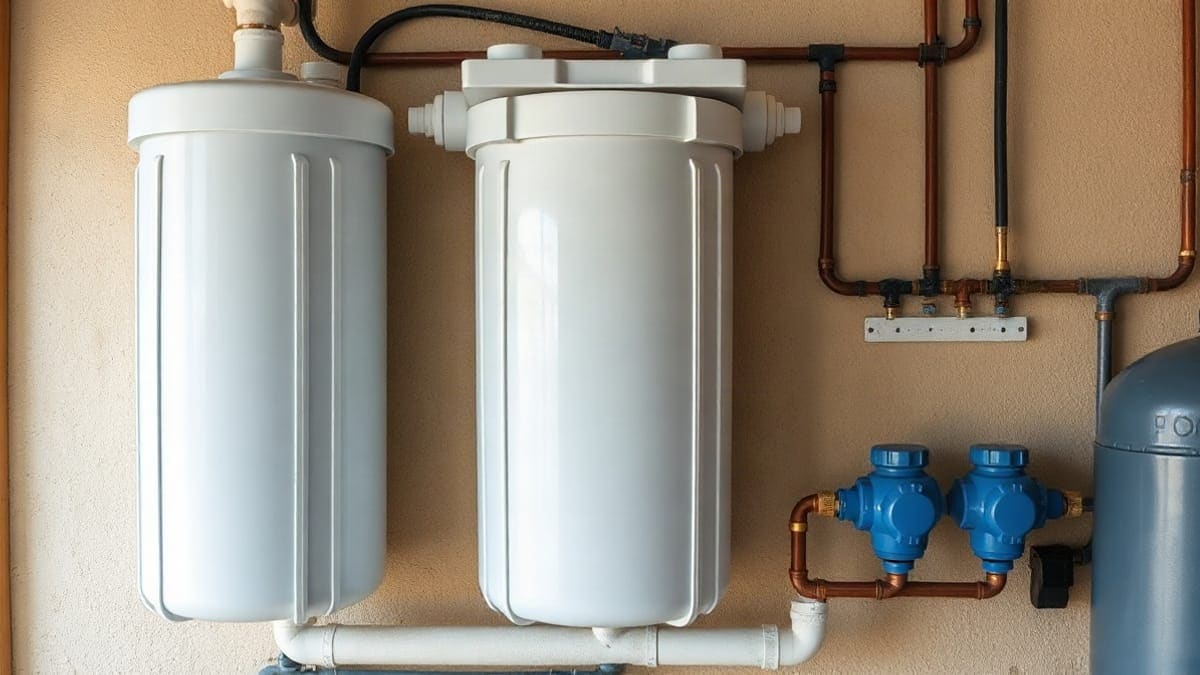
Waterdrop sells reverse osmosis systems, filters, pitchers and even a softener under one name, so the useful question is which product has paperwork behind it. NSF lists hundreds of Waterdrop filters by trade name, yet none of its reverse osmosis systems or its softener, and the certifications Waterdrop names for those rest on other bodies we could not search. This page sorts the range by what a database shows and what only the maker says, using Waterdrop's own pages, searches of NSF's listings by company and by trade name, a third-party record of its certifier files and the federal recall list. No prices appear here, and the Check price buttons earn the site a commission.
Who is Waterdrop, and is it an American company?
Water check
Waterdrop is sold in the United States by Ecolife Technologies, Inc., 1951 S Lynx Pl, Ontario, California. Waterdrop says it has worked on water purification since 2015, and its first reverse osmosis system, the G3, came in 2019.
Waterdrop's service policy page names Ecolife Technologies, Inc. and the Ontario, California address. Its About page says "Since 2015, Waterdrop Filter has been committed to a mission of developing innovative water purification technologies," and gives no headquarters, founding date or factory. TapWaterData's brand record describes Ecolife as a privately held California company with no parent, handling U.S. customer service, warehousing and retail, and dates the consumer brand's U.S. launch to 2015 and the G3 tankless system to 2019. The About page also lists a 2024 Red Dot design award for the X Series, a design prize that says nothing about water quality.
So yes, the seller is an American company with a U.S. warehouse and support line, and it is not an American manufacturer. This site earns a commission when you buy through our links, and where another brand does the job better the sections below say so.
What country is Waterdrop from, and where are its filters made?
Water check
Waterdrop filters are made by Qingdao Ecopure Filter Co., Ltd. in Jimo, Qingdao, China, according to TapWaterData, and NSF lists that same company as the holder of the Waterdrop trade name. Ecopure has made filters since 2011.
The TapWaterData record gives the manufacturer of record as Qingdao Ecopure Filter Co., Ltd., No. 13 Yishengbai Road, Jimo, Qingdao 266201, and says the same plant makes private-label filters for other names. NSF agrees on the company: a search of NSF's database by the trade name Waterdrop returns 555 listings, all held by Qingdao Ecopure Filter Co., Ltd. in Qingdao, China. The name resembles EcoPure, the brand from Water Channel Partners that appears on our best under sink water filter page, but the two are different companies in NSF's records. Waterdrop does not publish a per-product origin, so we cannot say where a given membrane or pump is made.
Is Waterdrop a good brand, and what is it good for?
Water check
Waterdrop is good at tankless reverse osmosis with high output and low drain water on paper, long cartridge cycles and a broad range. It is weak on verifiable certifications for its RO and under sink lines, which no database lets you check.
Judge it on three things. The strongest point is output: the G3P800 is rated 800 GPD at 3:1 pure to drain, against the iSpring RO500AK-BN at 500 gpd and up to 2:1 on our iSpring review. The second is cartridge life: the WD-15UA runs 24 months, the longest cycle among the direct-connect filters on our under sink page. The third is range, which lets you buy a pitcher, an RO system and filters from one seller.
The weak point is paperwork. NSF lists Waterdrop pitchers and refrigerator filters for chlorine, taste, odor and, on refrigerator filters, lead and other claims. It lists no Waterdrop reverse osmosis system, under sink filter or softener. Waterdrop's pages name IAPMO R&T for some systems, and we could not search IAPMO's directory to confirm it. For most buyers on city water, the sensible reading is that Waterdrop makes a reasonable product with maker claims, so buy it for the specifications and the cartridge cycle and not for the badge. Where a certification decides the purchase, the competitors below are better.
Which Waterdrop products are sold in the United States?
Water check
Waterdrop sells tankless RO (G3P600, G3P800, D6, X8, X12, X16), a countertop RO dispenser (A2G), under sink filters (WD-10UA, 15UA, 17UA, TSA), the Lucid pitcher, whole-house WHF filters, a WHR01 softener and refrigerator filters.
The table lists what we found on Waterdrop's own pages and in listings that cite them. Models marked "maker figure" come from Waterdrop's page, and "third party" means TapWaterData's reading of a manual.
| Group | Models | What the page or record says |
|---|---|---|
| Tankless reverse osmosis | G3P600, G3P800, D6, X8, X12, X16 | 600, 800, 600, 800, 1,200 and 1,600 GPD |
| Countertop reverse osmosis | A2G (hot and cold dispenser) | no plumbing, A2RFG filter up to 12 months |
| Under sink filters | WD-10UA, WD-15UA, WD-17UA, TSA-UF | 11,000, 19,000 and 24,000 gallons on the UA line |
| Pitchers | Lucid 10-cup PT-07 | 200 gallons or 3 months per filter |
| Whole-house filters | WD-WHF21-PG, WD-WHF3T-PG, WD-WHF2E-FC | 2, 3 and 5 stages, 15 GPM on most pages |
| Softener | WHR01A, WHR01B, WHR01C | 32,000, 48,000 and 64,000 grains |
| Refrigerator filters | many, such as the WD-F45 | listed under NSF 42, 53 and 401 |
Refrigerator filters are the one family with real NSF depth, including lead and cyst claims, so match your refrigerator's model to the NSF listing if you need one. The Waterdrop reverse osmosis systems compared page covers the RO family in more depth.
Which Waterdrop RO model fits which household?
Water check
Pick by household size and cabinet space: the G3P600 makes 600 GPD at 2:1, the D6 fits the smallest cabinet at 11.97 inches wide, the G3P800 makes 800 GPD at 3:1, and the X12 makes 1,200 GPD with UV and a mineral stage.
All four are tankless: a pump pushes water across the membrane, so they work from 14.5 psi against 40 psi or more for a tank system, and they need an outlet in the cabinet. Compare the figures Waterdrop publishes before the picture on the box.
| Model | Output | Drain ratio | Feed pressure | Stages and extras | Size (in) |
|---|---|---|---|---|---|
| G3P600 | 600 GPD, 0.42 GPM | 2:1 | 14.5 to 87 psi | 8 stages, 65 dB at most | 18.11 x 5.67 x 17.73 |
| G3P800 | 800 GPD | 3:1 | 14.5 to 87 psi | 9 stages in the headline, UV | 18.06 x 5.65 x 17.75 |
| D6 | 600 GPD, 0.42 GPM | 1.5:1 or 2:1 | 14.5 to 87 psi | one WD-D6RF cartridge | 11.97 x 5.98 x 15.98 |
| X12 | 1,200 GPD | 3:1 | not listed | 11 stages, UV, alkaline minerals | 16.72 x 6.25 x 18.2 |
Drain water is the running cost you cannot see. At 4 gallons of drinking and cooking water a day, a 3:1 ratio sends about 1.33 gallons to the drain and a 2:1 ratio sends 2, which is about 487 and 730 gallons a year. The D6 at 1.5:1 sends 2.67 gallons a day, or about 973 gallons a year. These are ratios from Waterdrop's own pages at its test conditions, and a worn membrane or low feed pressure raises them. For a household of four the gap between the G3P800 and the D6 is 486 gallons a year. Penn State Extension puts drinking and cooking water at about 1 gallon per person per day, so 4 gallons is a fair family figure. Other costs are on reverse osmosis system cost.
Waterdrop G3P800: the high-output pick
Waterdrop's G3P800 page lists 800 GPD, 3:1, 41 to 100°F feed water, 14.5 to 87 psi, a 0.0001 micron membrane, UV at a 99.9% rate and a smart-display faucet. Filters are 6 months for the sediment and carbon stage, 12 months for the carbon stage and 24 months for the membrane. The page says NSF/ANSI 58 and 372 certified, adds "SGS & CSA Tested," and gives no gallon limits, TDS limit or hardness limit. It calls the system 9 stage in its headings and describes a 3-filter setup in the FAQ. The manual, as TapWaterData reads it, caps hardness at 7 gpg and TDS at 750 ppm. See our G3P800 review.
Best for: a household of 5 or more that wants fast fills and the lowest drain water. Not for: a buyer who needs a database listing, or water harder than 7 gpg. Check price on Amazon
Waterdrop G3P600: the same frame at lower output
The G3P600 page lists 600 GPD, 0.42 GPM, 2:1, 15.44 lb, a pump no louder than 65 dB at 14.5 to 87 psi, and filters at 6 months or 550 gallons, 12 months or 1,100 gallons and 24 months or 2,200 gallons. It names NSF/ANSI 58 for TDS reduction and 372 for lead-free materials. Its product page states a one-year warranty on manufacturing defects. See the G3P600 review.
Best for: 2 to 4 people who want the Waterdrop pump and cartridges at lower output. Not for: a family that fills large pots often. Check price on Amazon
Waterdrop D6: the compact one
The D6 is the smallest of the four at 11.97 x 5.98 x 15.98 in and about 22.2 lb, with one WD-D6RF composite cartridge. TapWaterData's reading of the manual gives 600 GPD, 0.42 GPM, 110 to 120 V at 85 W, no more than 55 dB, a 40 minute continuous run limit and a cartridge of 12 months or 1,000 gallons. Waterdrop's own pages give the ratio as both 1.5:1 and 2:1, and TapWaterData found no D6 listing at NSF, WQA or IAPMO.
Best for: a cramped cabinet and one cartridge to change. Not for: anyone who wants a verifiable certification, or the lowest drain water. Check price on Amazon
Waterdrop X12: 1,200 GPD with UV and minerals
The X Series page lists 1,200 GPD, 3:1, 11 stages, auto-sensing UV, an alkaline mineral stage, a 2 year warranty, and filters at 6 months, 1 year and 2 years. It states NSF/ANSI 42, 58 and 372 and says IAPMO R&T issued the 58 and 372 certification, while its FAQ says SGS certified the removal of over 1,000 impurities, so which lab covers which claim is unclear. The same page shows 1,600 GPD for the X16 and 800 GPD for the X8. TapWaterData notes that the brand's own certification table does not show 42 for the X12, though a retail listing does. It adds 110 to 240 V and the 7 gpg and 750 ppm limits.
Best for: a large household, or a kitchen with a pot filler. Not for: a small cabinet, or a buyer who needs a published feed pressure. Check price on Amazon
Is there a Waterdrop you can set on the counter?
Water check
Yes. The A2G is a hot and cold countertop RO dispenser that needs no plumbing, uses an A2RFG filter rated up to 12 months, and shows no certification we could confirm. Stage counts read 6 on Waterdrop's UK listing and 5 elsewhere.
A countertop RO system is a real product category: you fill a tank with tap water and it makes drinking water on the counter, which suits a renter. The A2G product page lists the system with its replacement filter. Waterdrop's UK listing says 6 stages and a 0.0001 micron membrane with UV, a Walmart listing gives 3:1, and a spec sheet for its sibling WD-A2 says 100 GPD and a 200 oz tank, so we treat the A2G's own output and tank figures as unconfirmed. Our countertop reverse osmosis page lists no certification for the A2G in NSF's database. For a counter unit from a brand with firmer paperwork, read the AquaTru review.
Best for: a renter who wants hot and cold RO water without plumbing. Not for: a buyer who needs a published certification or output figure. Check price on Amazon
What do Waterdrop's under sink filters do?
Water check
The UA line is a direct-connect carbon filter on the cold line: the WD-10UA runs 11,000 gallons or 12 months, the 15UA 19,000 gallons or 24 months and the 17UA 24,000 gallons or 36 months. None of them reduces TDS.
Waterdrop's UA filter page lists the 15UA at a 0.75 GPM rating, 2.0 gpm at 60 psi in its tested-flow claim, a 10 to 125 psi feed range and 3.9 x 3.6 x 16.7 in. It is built for cold lines only, which matches EPA's lead page advice not to run hot water through a filter. The UF version adds a 0.01 micron membrane, and TSA-UF is the three-stage ultrafiltration model. The page states NSF/ANSI 42 and 372. A 42 claim covers chlorine, taste and odor, and 372 covers lead-free materials, so the 15UA is not a lead filter.
TapWaterData says IAPMO's file for the 15UA (W-11590) lists one claim, chlorine taste and odor, and that the TSA-UF and TST-UF records show 372 only. That is a third-party reading, so ask Waterdrop for the data sheet. See the Waterdrop under sink filter review and the best under sink water filter comparison.
Best for: the fewest cartridge changes, one every 24 months. Not for: a buyer who needs a lead or PFAS claim, or a hot line. Check price on Amazon
Is the Waterdrop Lucid pitcher worth considering?
Water check
The Lucid 10-cup pitcher uses the WD-PF-01A Plus filter rated 200 gallons or 3 months, and NSF lists it for chlorine taste and odor at 200 gallons. It is not a lead or fluoride filter.
NSF's database lists the WD-PF-01A Plus filter with the WD-PT-07 pitcher models, under NSF/ANSI 42 for chlorine, taste and odor at 200 gallons, in a search of the Waterdrop trade name. That corrects our own best water filter pitcher page, which says NSF lists no Waterdrop pitcher: it does, for 42 only. Waterdrop's pages add a 372 claim, and retail listings disagree on 53, which NSF does not show for the pitcher. Water Filter Guru, as our pitcher page reports, measured 8.40 gph and 51 oz of usable water and saw fluoride rise from 1.0 to 1.2 ppm. At 1 gallon a day, one filter lasts 200 days, so the 3 month limit changes the filter 4 times a year. Compare it with the Brita Elite, which NSF lists for lead at 120 gallons, on our Brita pitcher review.
Best for: a busy kitchen that wants few filter changes and fast filling. Not for: lead, PFAS or fluoride. Check price on Amazon
Does Waterdrop make whole-house filters or a water softener?
Water check
Waterdrop sells 2, 3 and 5 stage whole-house filters rated 15 GPM on most pages, and the WHR01 salt softener in 32,000, 48,000 and 64,000 grains. NSF lists no Waterdrop whole-house filter under 42 and no softener under 44.
The three whole-house filters are the WD-WHF21-PG (2 stage, sediment and carbon, with an iron and manganese cartridge option), the WD-WHF3T-PG (3 stage, 15 GPM) and the WD-WHF2E-FC (5 stage for well water, 15 GPM, 1 in FNPT ports). Waterdrop's Singapore page for the WHF21-PG says up to 12 GPM and 25 to 90 psi, so the flow depends on the page. None of these filters softens water. For the category, see our best whole house water filtration system page and water softener vs water filter.
The WHR01 softener page lists WHR01A at 32,000 grains, WHR01B at 48,000 and WHR01C at 64,000, and gives no flow, pressure, port size or hardness limit. A Waterdrop product listing, as search results quote it, gives resin volumes of 28, 42 and 56 L and up-flow regeneration, and the site-wide warranty section lists a resin tank of 10 years and a control valve of 5 years without tying them to the WHR01. NSF returns no Waterdrop row under NSF/ANSI 44, so its capacity and salt efficiency are maker claims. We give it no button. Size any softener with the water softener size calculator and compare listed models on the best water softener page.
Is Waterdrop certified? What NSF, IAPMO and WQA records show
Water check
NSF lists 555 rows under the Waterdrop trade name, all for chlorine, taste, odor and refrigerator filters, and none under standard 58 or 44. Waterdrop's RO and under sink certifications rest on IAPMO R&T claims we could not check.
On November 17 and 18, 2026 we searched NSF's drinking water treatment unit list by company and by trade name. NSF dated its listings November 17, 2026.
| Search | Result |
|---|---|
| Trade name Waterdrop, all standards | 555 listings, company Qingdao Ecopure Filter Co., Ltd. |
| NSF/ANSI 42, trade name Waterdrop | 176 rows without refrigerator filters: 4 faucet mount, 27 plumbed-in, 145 pour-through |
| NSF/ANSI 53 and 401 | refrigerator filters only, 200 to 316 gallons |
| NSF/ANSI 58, company Waterdrop | No Matching Products Found |
| NSF/ANSI 58, trade name Waterdrop | No Matching Products Found |
| NSF/ANSI 44, trade name Waterdrop | No Matching Products Found |
Two lessons come out of the table. First, Waterdrop is not absent from NSF, as earlier pages on this site said after searching the company name only: the listings sit under the manufacturer's name and the Waterdrop trade name. Second, the listings are about the cheap end of the range. The pitcher and faucet-mount rows carry chlorine, taste and odor only, and the plumbed-in rows run 1,400 to 3,000 gallons at 0.5 gpm and carry no model number from the UA line. Refrigerator filters carry the health claims, such as lead, cysts and, under 401, ibuprofen and bisphenol A.
IAPMO and WQA keep their own directories, and our tools could not search either. TapWaterData's brand record says Waterdrop's About pages claim IAPMO R&T certification to NSF/ANSI 42, 53, 58 and 372 for the G3P800 and G3P600, while its certification tables show no active listing, and the 15UA's IAPMO file W-11590 lists a chlorine claim only. Waterdrop attended the 2023 WQA convention, which is a trade show visit and not a listing. A report from SGS or CSA is a lab result, not a certificate in a database. Treat every Waterdrop certification as an affirmation until you can find the model number in the issuing body's own directory. Our best reverse osmosis system page shows how the competitors compare, and the glossary explains the standards.
Does a Waterdrop system remove fluoride, PFAS and microplastics?
Water check
Waterdrop says its membranes are 0.0001 micron and its systems reduce more than 1,000 contaminants, but we found no Waterdrop 58 listing, so claims for fluoride, PFAS and microplastics rest on the maker. EPA's limit for PFOA and PFOS is 4.0 ppt.
A reverse osmosis membrane does reduce dissolved solids, and several contaminant groups follow from that, as our what is reverse osmosis page explains. The question for a Waterdrop is proof, not principle. The G3P800 page says 58 and 372 and "SGS & CSA Tested," and gives no contaminant list or percentage that we could read. EPA's PFAS page sets enforceable limits of 4.0 ppt for PFOA and PFOS, a level few home filters publish a result for. If one of these is your reason to buy, ask Waterdrop for the lab report on your exact model and look up your utility's report on EPA's water quality report page. Then read the dedicated pages on fluoride, PFAS and microplastics.
When does each Waterdrop cartridge expire?
Water check
Waterdrop's RO pre-filters run 6 to 12 months and the membrane 24 months, the 15UA runs 24 months or 19,000 gallons, and the Lucid filter 3 months or 200 gallons. Both the gallon limit and the calendar limit apply.
| Part | Interval | Source |
|---|---|---|
| G3P800 and X12 sediment and carbon | 6 months | maker page |
| G3P800 and X12 carbon block | 12 months | maker page |
| G3P800 and X12 membrane | 24 months | maker page |
| G3P600 stages | 6 months or 550 gal, 12 months or 1,100 gal, 24 months or 2,200 gal | maker page |
| D6 cartridge | 12 months or 1,000 gal | TapWaterData |
| WD-10UA, 15UA, 17UA | 12 months or 11,000 gal, 24 months or 19,000 gal, 36 months or 24,000 gal | maker page |
| A2G filter | up to 12 months | maker page |
| Lucid filter | 3 months or 200 gal | maker page |
A family of four using 4 gallons of RO water a day draws 1,460 gallons a year, so a 550 gallon pre-filter on the G3P600 reaches its gallon limit in about 137 days, before its 6 month limit. Penn State gives roughly 6 to 12 months for carbon blocks and 12 to 24 months for RO cartridges, which matches the maker. The general schedule is on our reverse osmosis filter replacement schedule page and the membrane steps on reverse osmosis membrane replacement.
What does Waterdrop's warranty cover?
Water check
Most Waterdrop RO systems carry a 1 year limited warranty and eligible X Series systems 2 years. Returns run 30 days in the continental U.S., with a 10% restocking fee afterward, and orders from third-party sellers such as Amazon are excluded from the return policy.
Waterdrop's service policy says coverage and duration vary by model and that lifetime technical support applies to eligible models only. It covers defects in design, materials or workmanship, not filters as consumables, misuse or breakage. A search result quoting the policy adds that coverage applies to units bought from Waterdrop's U.S. website and that non-municipal water such as well or river water is excluded, with a TDS limit of 750 ppm and hardness limit of 7 gpg. The part of the page we could read did not show those lines, so confirm them. The policy also asks you to report a defect within 30 days.
The practical point is the channel. Waterdrop's return policy excludes orders from third-party sellers, including Amazon. Before you use a button that leads to a retailer, ask who honors the warranty and the 30 day return. The G3P800 page states no warranty term, but Waterdrop's comparison page, read November 18, 2026, gives it 1 year, as the G3P600 product page does for that model.
What should you buy first, by situation?
Water check
Match the household to one model: 5 or more people, G3P800; a cramped cabinet, D6; 2 to 4 people, G3P600; a pot filler or UV and minerals, X12; the fewest cartridge changes, WD-15UA; no plumbing, A2G.
| Your case | Take | Why | Check before buying |
|---|---|---|---|
| Large household, low drain wanted | G3P800 | 800 GPD, 3:1 | hardness under 7 gpg, no database listing |
| Very large household or pot filler | X12 | 1,200 GPD, 3:1, UV | published pressure, 110 to 240 V |
| 2 to 4 people, standard cabinet | G3P600 | 600 GPD, 0.42 GPM, 65 dB | 2:1 drain ratio |
| Small cabinet | D6 | 11.97 in wide | 1.5:1 or 2:1, 40 minute run limit |
| Renter, no drilling | A2G | countertop, hot and cold | output and stage count unconfirmed |
| One tap, cold line, fewest changes | WD-15UA | 24 months | chlorine claim only |
| Chlorine taste, fast pitcher | Lucid | 200 gal, 3 months | 42 only |
Check your sink pressure (under 40 psi favors a tankless pump model), your hardness with the water hardness converter and your cabinet depth. Above 7 gpg the manuals' limit applies, so soften first. Pressure ranges across brands are on the best tankless reverse osmosis system page, and tanks on tank vs tankless reverse osmosis.
Is Waterdrop better than iSpring, Frizzlife, AquaTru or Brita?
Water check
It depends on the job: iSpring has 14 NSF/ANSI 58 listings, Waterdrop has the higher output and lower drain ratio on paper, AquaTru sits on the counter, and Brita has the NSF lead listing for a pitcher.
We compared maker pages and NSF's database read on November 17 and 18, 2026. Competitor numbers are maker claims unless stated.
| Brand and model | Output | Drain claim | Feed pressure | Certification we could read |
|---|---|---|---|---|
| Waterdrop G3P800 | 800 GPD | 3:1 | 14.5 to 87 psi | none in the NSF 58 list |
| iSpring RO500AK-BN | 500 GPD | up to 2:1 | 15 to 70 psi | NSF/ANSI 58, TDS, 500 gpd |
| Frizzlife PD600-TAM3 | 600 GPD | not read | not read | no NSF row |
| AquaTru Classic | countertop | efficiency rate in its FAQ | none needed | no NSF row |
| Brita Elite filter OB06 | pitcher | not applicable | not applicable | NSF/ANSI 53 lead, 120 gal |
The iSpring Water Systems review shows the clearest paperwork in this group: 14 models in NSF's 58 list, though the base RCC7AK is listed at 21.04 gpd against 75 GPD advertised. Waterdrop wins on drain ratio and flow, but you cannot verify it in the database. The Frizzlife PD600-TAM3 uses 85 W and the PD800-TAM4 120 W, and also stops after a continuous run, 30 minutes on the PD800, per TapWaterData as read on our tankless page. AquaTru's FAQ says its Classic is certified by IAPMO to NSF standards for 84 contaminants, which we could not confirm either, and it needs no plumbing: see the AquaTru review. For pitchers, the Waterdrop vs Brita page makes the full case, and the best water filtration brands and companies page lines up more names.
Who should skip Waterdrop?
Water check
Choose another brand if you need a reverse osmosis system with an NSF/ANSI 58 listing, a lead claim you can look up on a pitcher, a softener with an NSF/ANSI 44 listing, or a well-water system with published iron limits.
- A database listing for RO: iSpring appears in NSF's 58 list, and Express Water's two tank models do too; see the Express Water review and the APEC review.
- Lead in a pitcher: the Brita Elite filter (OB06) is NSF-listed at 120 gallons for lead, which the Lucid is not.
- Whole house and well water: SpringWell publishes more detail; see the SpringWell review and the best well water filtration system page.
- Softening: pick from the best water softener list, where models print NSF/ANSI 44 data.
- A custom filter for your city: Hydroviv builds around your local water report.
- The silo head: for the grocery-store names, read the Culligan consumer water products review.
Has Waterdrop had a product recall?
Water check
No. A search of the Consumer Product Safety Commission recall database for the product name and the recall title "waterdrop" returned an empty list on November 18, 2026, and no CPSC recall of an RO system or filter is known.
We searched the CPSC database by product name and by recall title and got [] both times. The CPSC lists only recalls it has issued, so this is not a clean bill of health. See the water softener recalls page, which we update with each batch of pages.
6 common mistakes with Waterdrop systems
Water check
Most Waterdrop problems come from reading the label wrong: expecting a lead claim from a chlorine filter, trusting "NSF 58" without a listing, or installing a hard-water home without a softener first.
Buying the WD-15UA for lead
Its claim is chlorine taste and odor. Use a lead-listed filter instead, and read the badge by standard number.
Counting "NSF certified" as a listing
Waterdrop's RO pages name NSF/ANSI 58, and NSF lists no Waterdrop 58 product. Ask for the data sheet and match the model number in the IAPMO directory.
Ignoring the 7 gpg hardness limit
The manuals, as TapWaterData reads them, limit feed hardness to 7 gpg and TDS to 750 ppm. Water at 12 gpg scales the membrane, so soften first.
Using it on well water
The policy excludes non-municipal sources, and Waterdrop says well water needs pre-filtration. Test the water (EPA private wells) before you buy.
Buying through a channel that voids the return
The 30 day return does not apply to third-party orders. Ask who covers the warranty before you buy through a retailer.
Skipping the calendar limit
A 550 gallon pre-filter reaches its limit in about 137 days at 4 gallons a day, and the 6 month limit also applies. Change both parts on time.
How we researched this page
Water check
We read Waterdrop's About, service policy, G3P800, G3P600 and X Series pages, NSF's database under three search names, TapWaterData's records and the CPSC database on November 17 and 18, 2026. We did not run any Waterdrop product ourselves.
Waterdrop's site returned "too many requests" on several product pages, so the X12 specifications come from the X Series page and the 15UA, D6 and softener details from earlier readings of Waterdrop's pages and from TapWaterData. We could not read the WD-15UA page again, the WHR01 product page, the IAPMO and WQA directories, or the A2G manual. The NSF database was read through a page summarizer, and NSF warns that site text can be manipulated, so confirm any listing at info.nsf.org. We did not confirm the A2G's output and stage count, the WHR01's resin volume, or the TDS and hardness limits in Waterdrop's own policy text. Competitor numbers are maker claims. No prices are printed.
Frequently asked questions
Is Waterdrop a good reverse osmosis system?
It is a reasonable system on paper: the G3P800 lists 800 GPD at 3:1 and 14.5 psi minimum feed. It is not in NSF's 58 list, so its certification is a maker claim. Buy it for output and cartridge life, not for the badge.
Is Waterdrop actually good for you?
Filtered water is only as good as the claim behind the filter. Waterdrop's pitcher and faucet filters are NSF listed for chlorine taste and odor, and RO removes minerals as well as contaminants. Ask your doctor if you have a medical reason to avoid low-mineral water, and see is reverse osmosis water good for you.
What does a Waterdrop RO installation involve?
Waterdrop sells tankless systems for under sink installation, with a faucet hole and a cabinet outlet, and G3P800 filter changes take about 3 seconds per its page. The steps for any brand are in our reverse osmosis installation guide.
Can a reverse osmosis filter be mounted in any direction?
The Waterdrop pages we read give no mounting direction for the filters, so follow the manual and the flow arrows on the housings. The general rules are in the installation guide.
How do you replace the filters on a Waterdrop reverse osmosis system?
Shut off the feed, relieve the pressure at the faucet and swap the cartridges at 6, 12 and 24 months. The G3P800 page says a change takes about 3 seconds, and the steps are on our filter replacement schedule page.
How do you use a Waterdrop countertop reverse osmosis filter?
Fill the tank with tap water, plug it in and draw cold or hot water from the dispenser. Replace the A2RFG filter up to every 12 months, and follow the A2G manual for rinsing.
Does Waterdrop make a water softener?
Yes. The WHR01A, B and C are salt softeners at 32,000, 48,000 and 64,000 grains, and NSF lists no Waterdrop product under NSF/ANSI 44. See the best water softener page for listed models.
Are Waterdrop refrigerator filters NSF certified?
Many are. NSF lists Waterdrop refrigerator filters under 42, 53 and 401, such as EFF-6002S and EFF-6048S. Match your refrigerator's model to the NSF listing before you buy.
Do Waterdrop filters work on well water?
Waterdrop's RO manuals limit use to municipal water, and its policy excludes well water. The WHF2E-FC is the whole-house filter it sells for wells. Test first and read the well water treatment finder.
How much drain water does a Waterdrop send down the sink?
Yes. A 3:1 ratio sends about 1.33 gallons to the drain per 4 gallons of pure water, about 487 gallons a year, and a 2:1 ratio about 730. See the table above.
Can you buy Waterdrop on Amazon and keep the warranty?
Waterdrop's return policy excludes third-party sellers including Amazon, and its warranty applies to its own website purchases, per the policy. Ask the seller who covers it.
Is Waterdrop better than Brita?
For pitchers, Brita's Elite filter has an NSF lead listing and Waterdrop's Lucid lasts 200 gallons for chlorine taste. See Waterdrop vs Brita.
Sources
Our sources by topic
Public agencies and universities
- EPA PFAS and drinking water
- EPA private wells
- EPA consumer confidence reports
- Penn State Extension, water softening
- CPSC recall database search
Certification and standards bodies
Manufacturers, retailers and other references
Keep comparing
 Boroux Water Filter ReviewLegacy and Legacy Compact gravity systems, Foundation and fluoride filters, WQA certifications, lab data
 Rorra Water Filter ReviewA gravity countertop filter, not reverse osmosis
 Cloud Water Filters ReviewIt sells one under-sink reverse osmosis system, no softener and no whole house filter
 Water SoftenerEleven water softeners sold in the US compared by grains, GPM, salt use and certification
 Salt-Free Water SoftenerEight salt-free water conditioners compared by flow in GPM, hardness limit in gpg
 Water Softener InstallationPipe sizes, bypass, drain air gap, psi limits, first regeneration, DIY or plumber