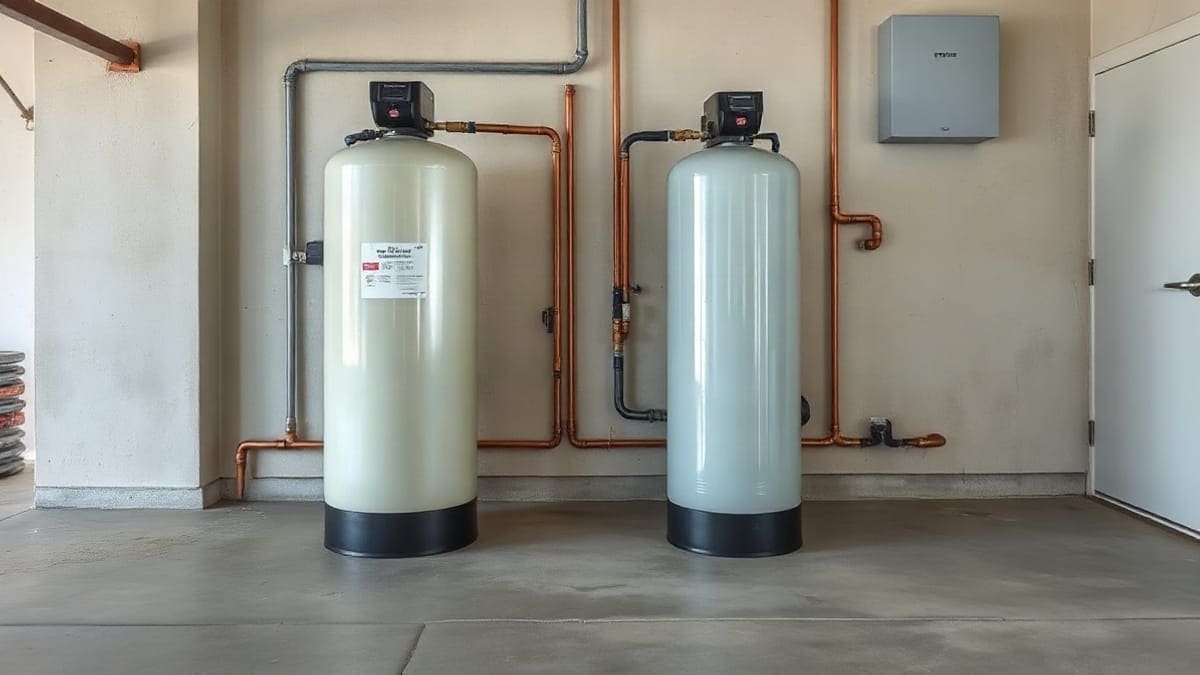
People type "salt vs salt-free water softener" when they have a hard water problem and two very different boxes in front of them. One removes the minerals, the other leaves them in the water and changes how they behave. The gap in performance is larger than the marketing suggests, and the gap in upkeep is real too. Both come in whole-house sizes and both are sold in the United States. This page puts both side by side in gpg, pounds, gallons and grams, shows the lab evidence for scale, quotes the California statute on brine discharge, then gives a verdict by profile and three models from each side.
What does each type do to the minerals in your water?
Water check
A salt-based softener swaps calcium and magnesium for sodium (or potassium) on resin beads and flushes them with brine. A salt-free system leaves both minerals in the water and tries to stop them forming hard scale. Hardness in gpg stays the same.
The EPA WaterSense technical sheet describes the first kind: cation exchange softeners swap hardness ions for sodium or potassium ions, then regenerate to flush the excess. That step is why they need salt, a drain and power. The detail is in how a water softener works.
Salt-free systems come in four families. TAC and catalytic media turn dissolved minerals into microscopic crystals (University of Nebraska Extension). Polyphosphate and citric cartridges hold them in solution. Magnets and electronic coils act on the pipe. None changes your gpg. See TAC water conditioner explained and magnetic and electronic water softeners.
Is a water conditioner the same as a water softener?
No. A conditioner changes how minerals behave and leaves them in the water; a softener removes them. "Salt-free softener" is a sales phrase, so check the spec page for the words "removes hardness" and a gpg figure.
SpringWell's FutureSoft page says its salt-free system "converts" hardness minerals and "conditions" them so they do not stick, and it says the system prevents up to 95 percent of scale, not that it removes hardness (SpringWell). The same page notes that salt-free systems will not make water feel slick or stop spotting. For the marketing terms, see water descaler vs water softener.
Salt vs salt-free water softener: the side-by-side table
Water check
Twelve rows cover what changes with each type. The salt-based unit removes hardness, uses brine and power, and needs refills. The salt-free unit leaves hardness at 100 percent, uses no salt, and its scale claims rest on thinner proof.
Numbers come from Penn State Extension, the ASU report, NSF/ANSI 44 summaries and maker pages. Examples use a home of 4 people on 10 gpg water.
| Row | Salt-based softener | Salt-free conditioner |
|---|---|---|
| What it takes out | Calcium and magnesium by ion exchange | Nothing: 0 gpg removed |
| Hardness on a test strip | Falls | Unchanged |
| Soap and lather | Better; hardness ions cut soap's effect (Penn State) | Unchanged, makers say |
| Heater scale, ASU lab | 0.79 g vs 13.36 g untreated (94% less) | TAC 0.48 g (96% less); magnetic 7.56 g (43% less) |
| Sodium added | 7.5 mg per quart per gpg removed; 19 mg per 8 oz at 10 gpg | None |
| Salt for 4 people at 10 gpg | About 18 to 37 lb a month, by dose setting | None |
| Regeneration water | About 50 gal per cycle (Penn State); at most 5.0 gal per 1,000 grains if efficiency rated | None; SpringWell lists no drain |
| Electricity | 120 VAC through a 12 VDC transformer (Fleck manual) | None on the SpringWell FS1 |
| Upkeep | Refill salt, clean brine tank, check resin | Replace media (5+ years SpringWell, 3 to 5 years APEC) or cartridges |
| Water and iron limits | Rheem RHS32: hardness to 105 gpg, clear iron to 8 ppm | SpringWell: 75 gpg, 0 ppm iron |
| Local limits | Can be restricted by ordinance (California) | No brine discharge; ask your district |
| Certification | NSF/ANSI 44 for hardness and efficiency | No NSF scale standard; IAPMO Z601 and DVGW W 512 exist |
The table's first two rows decide most cases. If the goal is lower hardness, only one column does it. The other rows decide which downsides you can live with.
What does the lab evidence say about scale and hardness?
Water check
In the one controlled study we read, ion exchange cut heater scale about 94 percent and a TAC device 96 percent, while magnetic and electronic units cut roughly 43 to 50 percent. The study measured scale on a heater, not spots or soap.
The study is WateReuse Research Foundation project 08-06, led by Peter Fox at Arizona State University, with its full report. It followed the German DVGW W 512 protocol: 700 gal over 21 days into a 14 L heater with a 1,200 W element. The report does not name the devices.
| Device | Tempe tap, 80°C: scale | Less scale than untreated (our arithmetic) | Removes hardness? |
|---|---|---|---|
| No treatment | 13.36 g | 0% | n/a |
| Ion exchange (salt-based) | 0.79 g | 94% | Yes |
| TAC | 0.48 g | 96% | No |
| Electrically induced precipitation | 6.72 g | 50% | No |
| Magnetic | 7.56 g | 43% | No |
The report says plainly that "some salt-free alternatives do not remove hardness, whereas ion exchange and CDI do". Three limits apply. Ion exchange was tested on one water only, so the 94 percent comes from one run. The tests ran 21 days, not the years makers rate their media. And a conditioner that protects a heater element says nothing about spots on a shower door.
Do saltless water softeners actually work?
They work at one job, reducing scale, and do not work at the other, softening. A TAC unit cut heater scale 89 to 97 percent across three waters, yet the water kept its hardness and its effect on soap.
The 89 to 97 percent range comes from the report's grams on the Tempe, Colorado River and Scottsdale waters, which are our arithmetic. The Bavarian environment agency adds that the method cannot be observed directly, so a device is judged only by how much scale it prevents. The full verdict is on do salt-free water softeners work.
What do you give up with a salt-based softener?
Water check
Five costs recur: added sodium, salt to buy and carry, wastewater and brine sent to the drain, upkeep, and a ban in some places. None is dangerous for most homes, and each can be sized with arithmetic.
Penn State names sodium as the main health issue for people on low-sodium diets (Penn State Extension). It also warns about "the additional load on your drainage field" for homes on septic, and notes that timed models waste salt and water because they regenerate whether the resin needs it or not.
Upkeep is the fifth cost. Penn State says all softeners need proper maintenance: brine must be mixed and stored in the brine tank, and resin can clog with mud, clay, bacteria, fungi or oxidized iron. The routine of cleaning, refilling and checking is in the water softener maintenance checklist, and the drain and air gap rules are in the water softener installation guide.
How much sodium does a salt softener add?
Penn State puts the sodium at 7.5 mg per quart for each gpg removed. At 10 gpg that is about 19 mg in an 8 oz glass, 150 mg in two quarts, or 6.5 percent of the 2,300 mg daily limit.
| Raw hardness | Per 8 oz glass | Per 2 quarts | Share of 2,300 mg |
|---|---|---|---|
| 5 gpg | 9.4 mg | 75 mg | 3.3% |
| 10 gpg | 18.8 mg | 150 mg | 6.5% |
| 20 gpg | 37.5 mg | 300 mg | 13.0% |
The limit comes from the Dietary Guidelines for Americans 2025 to 2030. Drinking water is a small share next to food for most people, which answers "are salt water softeners bad for your health" for the general case. It does not for someone told to cut sodium.
For drinking and cooking, read can you drink softened water.
Are salt-based water softeners banned in California?
Water check
Not statewide. California law lets a local agency ban new residential softeners that discharge to a sewer, but only after findings and an independent study. The Santa Clarita Valley did, in ordinances that took effect March 27, 2003.
Health and Safety Code section 116786 says a local agency may restrict or ban new units, but must find the limit necessary to meet a regional water board's discharge requirements, must back it with an independent study of all salinity sources, and cannot order removal of units installed before the ordinance. Section 116785 sets the general rule: demand-controlled regeneration and at least 4,000 grains of hardness removed per pound of salt for units installed on or after January 1, 2002 (3,350 for those installed on or after January 1, 2000), plus water conservation devices.
In the Santa Clarita Valley, exchange-tank units regenerated off site were exempt, as were filtration, carbon and reverse osmosis (WaterTech). The reason was chloride in the Santa Clara River, which kept rising as self-regenerating units multiplied. The valley sits in Los Angeles County, and the sources we read name no ban for the city of Los Angeles itself.
The Los Angeles County Sanitation Districts say on their chloride compliance page that nearly all chloride from rock salt or potassium crystals in self-regenerating units ends up in the river. We read that statement in a search result, because the page refuses automated readers. A salt-free unit never regenerates, so it sends no brine to a drain, but we found no ordinance that names conditioners either way. Call your sanitation district before buying anything in an area with a salt limit. The EPA WaterSense sheet also says some jurisdictions limit softeners.
Are salt-based water softeners bad for the environment?
Brine adds sodium and chloride to wastewater. EPA WaterSense says too much can burden septic systems or a community's discharge limits, which is why efficiency matters: a rated unit uses at most 5.0 gal of water per 1,000 grains removed.
The sheet says higher salt efficiency means fewer ions discharged. Our worked numbers are in the next section. In a place without a salt limit, an efficiency-rated, demand-controlled unit keeps the load low. See best high efficiency water softener.
What do you give up with a salt-free conditioner?
Water check
Four downsides recur: hardness is not removed, iron must be 0 ppm on the SpringWell FS1, no NSF scale standard backs the claims, and media or cartridges need replacing. The 75 gpg limit is wide; the 5 or 25 gpg limits on others are not.
SpringWell lists 0 ppm iron and manganese, 20 to 80 psi and pH 7.0 to 9.5 for the FS1, and a warranty void if limits are broken. The APEC Futura-10 lists 25 gpg and 0 mg/L iron; its media is replaced every 3 to 5 years, per APEC. Aquasure says its Serene conditioner "may not completely remove hardness minerals" (Aquasure).
What do the certifications cover on each side?
NSF/ANSI 44 certifies a softener's hardness reduction and, if rated, 3,350 grains per pound or better. No NSF scale standard exists for conditioners. The Fleck 5600SXT has a WQA listing we opened, and NSF's database lists the Rheem RHS32 and EcoPure models under Water Channel Partners.
| Model | Claim we saw | Where | Proof level |
|---|---|---|---|
| Fleck 5600SXT | NSF/ANSI 44, efficiency rated | WQA listing, 17 Nov 2026 | Listing opened |
| Rheem RHS32 | NSF/ANSI 44, efficiency, barium, radium | Maker manual and NSF database (Water Channel Partners) | Listing opened |
| SpringWell SS1 | None found | Maker page | Claim absent |
| SpringWell FS1 | None; outside NSF/ANSI 44 | Maker page | Claim absent |
| APEC Futura-10 | Media to NSF/ANSI 61 by WQA | APEC FAQ | Materials, not scale |
| Aquasure Serene | No NSF listing found for the unit | NSF database | Claim absent |
NSF/ANSI 61 covers materials in contact with drinking water, not scale. The scale protocols are IAPMO/ANSI Z601, which, as WaterWorld describes it, uses a 70 percent pass mark, and DVGW W 512, where the Bavarian agency says "tested to W 512" is not a certification. No maker page we read cites either. See what certifications to look for on the pillar page.
What does each type cost to run in salt, water and power?
Water check
For 4 people on 10 gpg water, a softener removes 90,000 grains a month and burns 18 to 37 lb of salt, about 145 to 365 gal of regeneration water by Penn State's 50 gal figure, and some power. A salt-free unit burns none of those.
The math is Penn State's: 4 people at 75 gal a day and 10 gpg is 3,000 grains a day, or 90,000 a month. The EcoPure EP31 manual prints rated capacity at three salt doses, and the figures below are our arithmetic from it, as shown on the best water softener page.
| Salt dose (EP31 manual) | Regenerations a month | Salt a month | Salt a year | Months per 40 lb bag |
|---|---|---|---|---|
| Lowest, 2.4 lb | 7.3 | 17.6 lb | about 211 lb | 2.3 |
| Highest, 12.9 lb | 2.9 | 37.1 lb | about 445 lb | 1.1 |
Regeneration water: 7.3 cycles at about 50 gal is 365 gal a month, and 2.9 cycles is 145 gal. For an efficiency-rated unit the ceiling is 5.0 gal per 1,000 grains, so 90,000 grains cost at most 450 gal a month, or 5,400 gal a year. The lowest dose uses half the salt per grain removed but regenerates 2.5 times as often. Salt types and delivery are in how much salt does a water softener use and best water softener salt.
Electricity: the Fleck 5600SXT manual says the control needs an uninterrupted 120 VAC supply through a transformer giving 12 VDC, and needs at least 20 psi for brine draw (Fleck manual). It prints no wattage, so we give no running cost. SpringWell says the FS1 needs "no electricity", no drain and no backwashing. Media life is 5+ years for SpringWell and 3 to 5 for APEC, so factor a replacement into long-term cost: salt-free water softener cost and water softener cost guide carry that.
Which is better, a water softener with salt or without salt?
Water check
For hardness, salt wins: it is the only type that removes calcium and magnesium. For scale on a water heater with no iron, salt-free can match it on the lab results. Local rules, sodium limits and upkeep can flip the choice.
There is no winner for every home, and the lab study is the only controlled evidence we read. Salt-based units show a result on a test strip, which a conditioner never will. A conditioner shows its result as less scale, which takes months to judge. If you have not measured your water yet, start with what is hard water, the water hardness converter and your utility's annual quality report. Penn State's classes put 7.0 to 10.5 gpg at "hard" and above 10.5 at "very hard"; USGS says soft is 0 to 60 mg/L and very hard is over 180.
Salt vs salt-free water softener: the verdict by profile
Water check
Choose salt-based if hardness is 7 gpg or more and you want soft-water results. Choose salt-free if scale on a heater is the only worry, iron is 0 ppm, and you need no salt, drain or power.
The gpg cut-off is our judgment from Penn State's classes, not a standard. EPA WaterSense advises avoiding softeners where hardness does not call for one.
| Your profile | Choose | Why |
|---|---|---|
| City water 10 gpg or harder, spotting and dry-feeling laundry | Salt-based | Removes the minerals; sized with the size calculator |
| Moderate city water, tankless heater, scale only | Salt-free | TAC cut heater scale 89 to 97 percent in the lab |
| Low-sodium diet | Salt-free, or softener plus a separate drinking tap | 0 mg added versus 19 mg per 8 oz at 10 gpg |
| Salt limit in your sewer district | Ask first; salt-free has no brine | Brine ban in the Santa Clarita Valley |
| Well with iron above 0 ppm | Salt-based plus an iron filter | SpringWell FS1 takes 0 ppm; Rheem RHS32 takes 8 ppm |
| Hardness above 25 gpg | Salt-based | APEC limit is 25 gpg |
| Septic system | Check with an installer | Penn State flags the drainage field load |
| Renter, no drain or outlet | Salt-free | No power, no drain |
Choose salt-based if you want lower hardness, you will carry salt, and your area allows brine. Choose salt-free if you want scale control without upkeep and accept hard water by every test. If a well is involved, read best water softener for well water first.
Which salt-based and salt-free models should you look at?
Water check
For salt-based: SpringWell SS1 (32,000 grains, 11 GPM), Fleck 5600SXT (48,000-grain kit, WQA listing) and Rheem RHS32 (7.9 GPM). For salt-free: SpringWell FS1 (12 GPM), APEC Futura-10 (10 GPM) and Aquasure Serene (10 GPM).
We print no prices. The button shows the day's price. Figures come from maker pages and the sibling pages of this site, where conflicts are noted.
| Model | Type | Flow | Key limit | Proof |
|---|---|---|---|---|
| SpringWell SS1 | Salt-based, 32,000 grains | 11 GPM (size guide says 9) | 25 to 80 psi | No listing found |
| Fleck 5600SXT 48K kit | Salt-based, 48,000 grains | 13 GPM on one seller's kit | 20 psi minimum | WQA listing for Pentair models |
| Rheem RHS32 | Salt-based | 7.9 gpm in the manual, 8 gpm in NSF's entry | 105 gpg, 8 ppm iron | NSF/ANSI 44 listed |
| SpringWell FS1 | Salt-free, TAC | 12 GPM (size guide says 9) | 75 gpg, 0 ppm iron | No listing found |
| APEC Futura-10 | Salt-free, catalytic | 10 GPM | 25 gpg, 0 mg/L iron | Materials only |
| Aquasure Serene 10 GPM | Salt-free | 10 GPM | No limits printed | No listing found |
SpringWell SS1. Best for a family of 2 to 4 on city water up to about 10 gpg; the tank is 9 in by 48 in on 1 in connections, per SpringWell. Not for a home that needs a listing number. More in the SpringWell SS1 review. Check price on Amazon
Fleck 5600SXT. Best for a home that wants a serviceable valve with a published efficiency listing; the WQA listing covers Pentair's models, not every reseller's kit. Not for anyone wanting one company to answer for the tank, valve and brine tank. Check price on Amazon
Rheem RHS32. Best for a buyer who wants the manual's three rated capacities (13,000 grains at 2.6 lb, 27,600 at 8.3 lb, 33,000 at 14.1 lb). Not for a three-bath home on hard water, where 7.9 gpm is tight. Check price on Amazon
SpringWell FS1. Best for 1 to 3 bathrooms on city water with no iron and a 75 gpg ceiling; 6 in by 35 in tank, lifetime warranty against defects. Not for a well with iron or a buyer who needs a certified scale result. See SpringWell. Check price on Amazon
APEC Futura-10. Best for 1 to 3 bathrooms under 25 gpg that want a 10 year limited warranty, if stock returns: APEC's site showed it sold out on November 18, 2026. Not for a buyer who needs a scale-performance certificate. See APEC. Check price on Amazon
Aquasure Serene 10 GPM. Best for a buyer who wants a pre-filter bundled with a 5 year warranty if activated within 60 days. Not for a buyer who needs published limits, since Aquasure prints none. Check price on Amazon
More salt-free options: best salt-free water softener. A softener and a filter together: water softener vs water filter.
6 common mistakes when choosing between salt and salt-free
Water check
Six mistakes cost buyers the most: expecting soft water from a conditioner, ignoring iron, running the salt dose too high, forgetting a local rule, skipping sizing and trusting "complies with" language. Each is avoidable with a number.
Expecting soft water from a conditioner
A conditioner leaves 100 percent of the calcium and magnesium in the water, so a strip reads the same before and after. Judge it by scale, not by the strip. See hard water vs soft water.
Putting a conditioner on water with iron
SpringWell lists 0 ppm of iron and APEC 0 mg/L. A well with trace iron needs an iron filter first.
Running the salt dose at maximum
On the EP31 the highest dose uses about 37 lb of salt a month for 4 people at 10 gpg, twice the 18 lb of the lowest, for the same hardness removed. Check how often it regenerates.
Forgetting the sewer district
California lets districts ban new brine discharge. A salt softener bought before checking can be a wasted unit in an affected area.
Sizing by bathrooms alone
Both SpringWell models show two flow figures (11 or 9 GPM for the SS1, 12 or 9 for the FS1). Ask which is the service flow, and size grains with the Penn State formula.
Trusting "complies with NSF" wording
A listing number you can search is proof; "complies with" is not. Search the NSF database by model.
Frequently asked questions
Do salt water softeners remove chlorine?
No. Ion exchange targets calcium and magnesium, as the EPA WaterSense sheet describes. Chlorine and chloramine need a carbon filter; see water softener vs water filter.
Do salt water softeners make water taste salty?
At 10 gpg the added sodium is about 19 mg in an 8 oz glass, from Penn State's 7.5 mg per quart per gpg. We found no source giving a taste threshold, so we do not claim one. Harder water adds more.
Are salt-based water softeners bad for you?
For most people the sodium is a small part of the 2,300 mg daily limit: 6.5 percent in two quarts at 10 gpg. Penn State names low-sodium diets as the exception, so ask your doctor.
Is water from a salt softener safe to drink?
Generally yes within the sodium limits above. For infants, kidney disease or a capped sodium intake, ask a doctor first. The full question is on can you drink softened water.
Can you use potassium in a salt water softener?
Many units accept potassium chloride, but check the manual first. Health Canada warns about potassium intake for people with kidney dysfunction. Pellet types are covered in best water softener salt.
What happens if a softener has no salt?
The resin cannot regenerate, and Penn State says spent resin "will no longer soften water". Hard water passes through, with no damage described in what we read. For troubleshooting see the repair guide.
Does a salt softener damage pipes?
We found no source in what we read showing that softened water damages pipes. Penn State says hard water can plug pipes and damage water heaters. For a specific tankless heater, check its manual.
Are salt-based water softeners obsolete?
No. EPA WaterSense still describes them and sets an efficiency tier. What has changed is local rules and efficiency expectations, such as the 4,000 grains per pound that California requires.
Is there a water softener that does not use salt?
Salt-free conditioners use no salt but do not soften: they prevent scale. A softener that uses potassium chloride is still a regenerating softener. See water softening methods compared.
Should I switch from a salt softener to a salt-free conditioner?
Only if scale protection is enough for you. You will lose lower hardness, soap lather and fewer spots. If sodium or a local limit is the reason, compare a conditioner against a softener with a separate drinking tap.
Do salt-free systems work in Phoenix?
The ASU study used Tempe tap, Colorado River and Scottsdale groundwater and found TAC cut heater scale 89 to 97 percent. We did not read the hardness of those waters, so test yours and check the unit's gpg limit.
Is a salt-free system safe for a septic tank?
A salt-free unit sends no brine to the drain. Penn State warns that backwashing and regeneration add load to a drainage field, which applies to salt-based units. Ask your installer either way.
How we researched this page
Water check
We read the ASU and WateReuse report, Penn State Extension, EPA WaterSense, the California statute text, six maker pages and manuals, and the NSF and WQA listings we could open. We have not tested any system.
We could not open the Los Angeles County Sanitation Districts page, or the City of Santa Clarita code, so the statements about them come from search results and the WaterTech article. Section 116787, which lets the Santa Clarita district order removal later, was read in a search summary only. We found official text for California only; other states may have rules we did not check. SpringWell's spec table and size guide disagree on flow, and the FutureSoft page names TAC while the FS1 spec table does not. Our scale evidence is one lab report, and it does not name the devices it ran. Buying through a Check price button earns this site a commission from the maker or retailer, with no extra charge to you.
Sources
Our sources by topic
Public agencies and universities
- Penn State Extension, Water Softening; USGS water hardness; EPA, WaterSense technical sheet and consumer confidence reports.
- Dietary Guidelines for Americans 2025 to 2030; Health Canada, potassium and water softeners.
Manufacturers, retailers and other references
- WateReuse Research Foundation, Project 08-06 and full report, Fox et al., 2014.
- Bayerisches Landesamt fur Umwelt, Merkblatt 1.6/5, 2010; University of Nebraska Extension, salt-free alternatives; WaterWorld, Testing for scale.
- California Health and Safety Code, section 116785 and section 116786; WaterTech, Santa Clarita Valley ordinances; LA County Sanitation Districts, chloride compliance FAQ.
- SpringWell, salt-based and salt-free softeners; APEC, Futura-10; Aquasure, Serene 10 GPM.
- Rheem RHS32 manual; Fleck 5600SXT manual; WQA listing, Pentair; NSF certified products.
Keep comparing
 Water Hardness Test Kits and StripsTen water hardness tests compared by range in ppm and gpg, tests per pack
 Water SoftenerEleven water softeners sold in the US compared by grains, GPM, salt use and certification
 Salt-Free Water SoftenerEight salt-free water conditioners compared by flow in GPM, hardness limit in gpg
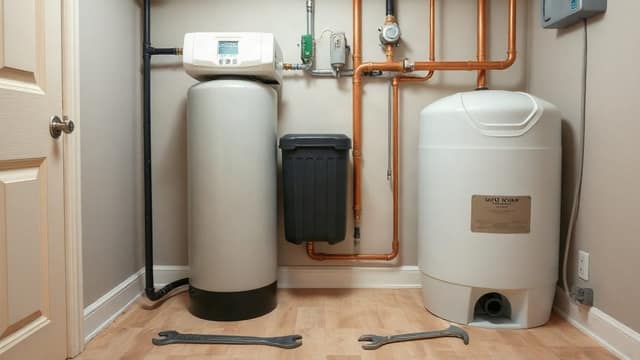 Water Softener InstallationPipe sizes, bypass, drain air gap, psi limits, first regeneration, DIY or plumber
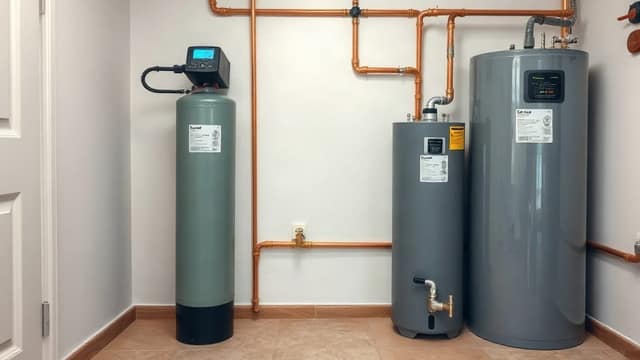 How Much Does a Water Softener Cost? Price GuideSalt, rinse water, power, warranty years and install work counted in pounds
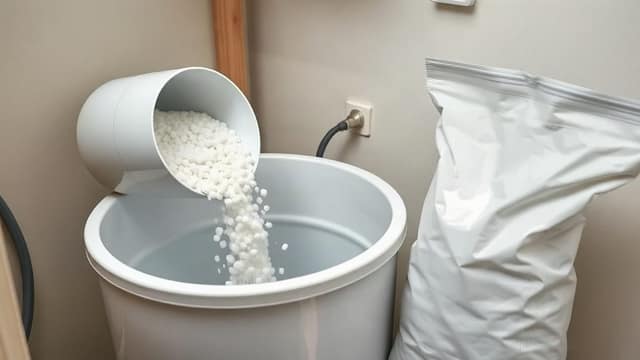 Water Softener SaltTen water softener salts in 40 lb bags compared by form, stated purity, iron additive and NSF listing