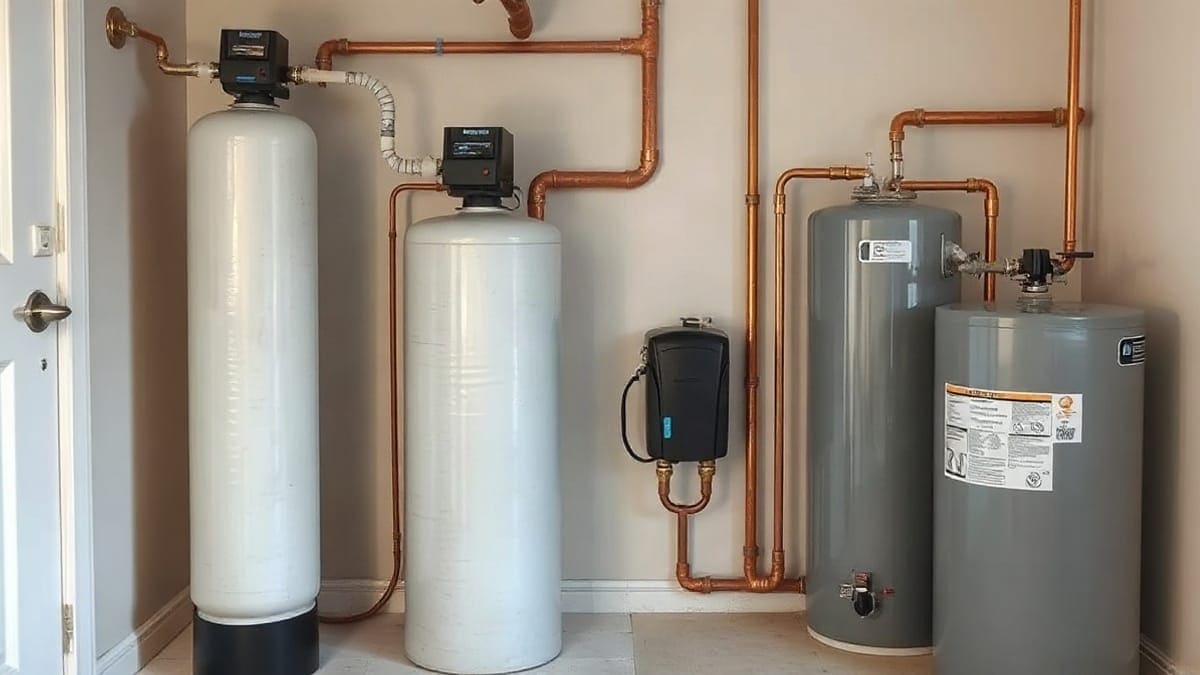
A water softener is an ion exchange tank: resin beads swap calcium and magnesium for sodium, and a salt brine recharges them. Eleven models sold in the United States are set side by side here, by grains, GPM, resin, salt dose and the paperwork behind each claim. The figures come from manuals, maker pages and one WQA listing; where two sources disagree, the page says so. There are no prices. The sizing math follows Penn State Extension, and we run it for 2, 4 and 6 people on water from 5 to 20 gpg. Your own hardness number matters more than any brand, so start with the water hardness converter if you only have a report in ppm, and use the water softener size calculator to run the sizing math below.
Which water softeners are worth buying in 2026?
Water check
Eleven models fit most US homes: nine salt-based units from 31,000 to 80,000 grains at 7.2 to 20 GPM, plus two salt-free conditioners at 12 and 15 GPM. Pick the type first, then the size from your hardness and headcount.
The table lists each model with the capacity its maker advertises, the flow it prints and the home it targets. Where a maker prints several figures, the lowest rated one from its own manual is used for flow.
| Model | Type | Advertised capacity | Flow | Home it targets |
|---|---|---|---|---|
| SpringWell SS1 | Salt-based | 32,000 grains | 11 GPM | 1 to 3 bathrooms |
| SpringWell SS4 | Salt-based | 48,000 grains | 13 GPM | 4 to 6 bathrooms |
| SpringWell SS+ | Salt-based | 80,000 grains | 20 GPM | 7 or more bathrooms |
| Fleck 5600SXT 48,000-grain kit | Salt-based | 48,000 grains, 1.5 cu ft resin | 13 GPM in one seller listing | 3 to 5 people (our sizing math) |
| Rheem RHS32 | Salt-based | 32,000 grains (33,000 at top salt dose) | 7.9 GPM rated | 2 to 4 people (our sizing math) |
| EcoPure EP31 | Salt-based | 31,000 grains (31,300 at top salt dose) | 7.2 GPM rated | 1 to 4 people |
| EcoPure EP42 | Salt-based | 42,000 grains (42,200 at top salt dose) | 8.2 GPM rated | 3 to 5 people (our sizing math) |
| Aquasure Harmony 32,000 | Salt-based | 32,000 grains | 10 GPM | 1 to 3 people |
| Aquasure Harmony 32,000 fine mesh | Salt-based, iron claim | 32,000 grains | 10 GPM | 1 to 4 people, well water |
| SpringWell FS1 | Salt-free conditioner | no grain rating | 12 GPM | 1 to 3 bathrooms |
| SpringWell FS4 | Salt-free conditioner | no grain rating | 15 GPM | 4 to 6 bathrooms |
The grain figures are "up to" numbers, and the gap between them and daily use is where buyers go wrong. The what size water softener do I need guide goes through the same math model by model, and our salt vs salt-free comparison covers the type choice.
Pick by home and water
Sizes assume the Penn State figure of 75 gallons per person per day.
| Your situation | Hardness | Pick | Why |
|---|---|---|---|
| 2 people, city water | 5 to 15 gpg | SpringWell SS1 | 32,000 grains lasts 14 to 43 days between regenerations |
| 4 people, city water | 10 gpg | SpringWell SS1 or EcoPure EP31 | 3,000 grains per day, a regeneration every 10 to 11 days |
| 4 people, hard city water | 15 to 20 gpg | SpringWell SS4 or Fleck 5600SXT | 4,500 to 6,000 grains per day, 8 to 11 days on 48,000 grains |
| 6 people | 10 to 15 gpg | SpringWell SS4 | 4,500 to 6,750 grains per day on a 13 GPM unit |
| Large house, 7 or more baths | any | SpringWell SS+ | 80,000 grains at 20 GPM |
| Well with 2 ppm iron | 10 gpg | Aquasure Harmony fine mesh, or an iron filter first | Iron adds about 8 gpg of load under the maker rule of thumb |
| Efficiency printed in the manual | any | Rheem RHS32, EcoPure EP31 | Rated 5,000 to 5,125 grains per lb at the lowest salt dose |
| Scale control only, no salt | under 20 gpg, no iron | SpringWell FS1 | Does not remove hardness minerals |
The table is a shortlist, not a ranking. Read the row that matches you, check the catch in the last column, then confirm the claim against the manual or the listing before you pay.
Brand pages are in our SpringWell water systems review and the water softener brands guide.
Which water softener is the right pick for most homes?
Water check
For most one-to-three bathroom homes on city water, a 32,000-grain salt-based softener with a rated flow of 7 to 11 GPM is enough. The SpringWell SS1 runs 11 GPM, the Rheem RHS32 7.9 GPM and the EcoPure EP31 7.2 GPM.
A salt-based softener is the only type here that removes hardness minerals, so it is the only one that makes water measurably soft. A 32,000-grain unit serves a four-person home up to about 10 gpg, and it is the smallest size where the numbers hold up. Anything much below 30,000 grains regenerates so often that it wastes salt and water. If your hardness is above 15 gpg or you have more than four people, step to 48,000 grains: the SpringWell SS4 or the Fleck 5600SXT.
The EcoPure EP31 manual lists a rated service flow of 7.2 gpm and a pressure drop of 14.9 psig at that flow. If two showers and a washer run at once, a 7.2 GPM softener is already near its limit, so a household with 3 or more bathrooms should look at the 11 and 13 GPM units.
The salt-based softeners in detail
Water check
The salt-based models below range from 31,000 to 48,000 grains and from 7.2 to 13 GPM. Each section gives size, flow, certification and the home that should look elsewhere.
SpringWell SS1: the plain 32,000-grain pick for 1 to 3 bathrooms
The SS1 is a 32,000-grain softener with a tank of 9 in by 48 in (57 in with the head), a brine tank of 18 in by 33 in, 1 in service connections and 11 GPM service flow. SpringWell's spec table lists operating pressure of 25 to 80 psi, operating temperatures of 36 to 120°F and a pH range of 6.5 to 10. The same page's size guide calls the entry model "9 GPM, up to 3 bathrooms", which conflicts with the 11 GPM in the table, so ask SpringWell which figure your unit carries.
The page lists no NSF or WQA certification for the SS1, and we found none, so a hardness-reduction claim rests on the maker alone. Warranty wording is lifetime against defects, with 10 years on tanks 14 in or larger and an electronic head warranty of 5 years on the product pages but 7 years on the warranty page; the product page also offers a 6-month money-back guarantee. Read our SpringWell SS1 review for the rest.
Best for: a family of two to four on city water up to about 10 gpg. Not for: a home that needs a certification number to show an inspector, or a well with more than a few ppm of iron.
SpringWell SS4: 48,000 grains and 13 GPM for 4 to 6 bathrooms
The SS4 is a 48,000-grain unit with a tank of 10 in by 54 in (63 in with the head), 13 GPM service flow and 1 in connections, on the same 25 to 80 psi and 6.5 to 10 pH limits as the SS1. The brine tank is the same 18 in by 33 in. SpringWell sizes it for 4 to 6 bathrooms in the same spec table.
At 15 gpg a family of five uses 5,625 grains a day (5 x 75 x 15), so 48,000 grains lasts about 8.5 days: a regeneration every 8 or 9 days and about 3.5 a month. Like the SS1, it has no listing we could find, and the warranty terms match the SS1 above. The SS+ goes to 80,000 grains and 20 GPM with a 13 in by 54 in tank for homes with 7 or more bathrooms.
Best for: four to six people on 12 to 20 gpg city water. Not for: a small house, where 48,000 grains of resin regenerates far more often than it needs to.
Fleck 5600SXT: the valve plumbers know, with a WQA listing
The Fleck 5600SXT is a metered digital valve from Pentair; WQA lists "5600 SXT" in five sizes from 0.75 to 2.0 cu ft as NSF/ANSI 44 efficiency rated, on a listing page dated 17 November 2026. The WQA listing names Pentair Residential Filtration, LLC, with the claim "Hardness" and the product types DIR-efficiency rated, fully automatic and point-of-entry.
Complete kits are assembled by resellers around this valve. One seller lists the 48,000-grain kit with 1.5 cu ft of resin at 13 GPM on 120 VAC, while other sellers print 12 to 14 GPM, so the flow depends on who builds the kit. The WQA listing covers Pentair's models, not every reseller's assembled kit, so ask the seller whether your exact kit carries it.
Best for: a home that wants a serviceable valve with a published efficiency listing and easy parts. Not for: anyone who wants one company to answer for the tank, valve and brine tank.
Rheem RHS32: the manual with the full performance table
The Rheem RHS32 prints three rated capacities: 13,000 grains at 2.6 lb of salt, 27,600 at 8.3 lb and 33,000 at 14.1 lb, with 0.88 cu ft of resin and a rated service flow of 7.9 gpm. The RHS32 manual gives a maximum hardness of 105 gpg, a clear-water iron limit of 8 ppm, a pressure range of 20 to 125 psi and a temperature range of 40 to 120°F. It says the system is tested and certified by NSF International against NSF/ANSI 44 for hardness reduction, efficiency and the reduction of barium and radium 226/228, and to NSF/ANSI/CAN 372, with WQA certification against CSA B483.1.
The manual's table prints 4,940 grains per pound at the lowest dose; dividing the rounded 13,000 grains by 2.6 lb gives 5,000, so we use the printed 4,940. NSF's database lists the RHS32 under Water Channel Partners (Eagan, Minnesota) for NSF/ANSI 44, with barium and radium 226/228 claims, at 8 gpm against the manual's 7.9, which we quote.
Best for: a buyer who wants the claims in print and a variable salt dose set by the controller. Not for: a three-bath home on hard water, where 7.9 GPM is tight.
EcoPure EP31: 31,000 grains and the same NSF claims
The EP31 lists 12,300 grains at 2.4 lb of salt, 26,200 at 7.7 lb and 31,300 at 12.9 lb, with 0.81 cu ft of resin, 7.2 gpm rated service flow and a pressure drop of 14.9 psig. The EcoPure manual sets the maximum hardness at 110 gpg, clear-water iron at 8 ppm and supply pressure at 20 to 125 psi. It says the systems are tested and certified by NSF International against NSF/ANSI 44 for hardness reduction and efficiency, and to NSF/ANSI/CAN 372, with WQA certification to CSA B483.1. NSF's database lists the EP31 at 7.2 gpm under Water Channel Partners, the same maker the manual names.
The EcoPure product page targets one to four people.
Best for: a one-to-four person home that wants a modest tank and a printed rating. Not for: a home with more than 8 ppm of ferrous iron.
EcoPure EP42: the step up with the same claims
The EP42 is rated 16,600 grains at 3.3 lb, 35,300 at 10.3 lb and 42,200 at 17.4 lb of salt, with 1.09 cu ft of resin and 8.2 gpm service flow. The same manual lists a clear-water iron limit of 11 ppm and a maximum hardness of 110 gpg. It prints the same NSF/ANSI 44 and 372 statements as the EP31, and NSF's database lists the EP42 at 8.2 gpm under Water Channel Partners.
At 15 gpg and four people, 4,500 grains a day means a regeneration every 9 days at the top dose (42,200 grains) but every 3.7 days at the lowest dose (16,600 grains). So the salt setting changes the schedule by a factor of 2.5.
Best for: three to five people with hard water and a need for 8.2 gpm. Not for: a house that needs more than about 8 GPM at peak.
Aquasure Harmony 32,000: a 10 GPM unit with 160 lb of salt capacity
The Aquasure Harmony AS-HS32D is a 32,000-grain metered softener with a 10 GPM maximum flow, 110 gpg maximum hardness and 160 lb of salt capacity, in 3/4 in or 1 in NPT. Aquasure's page sizes it for 1 to 2 bathrooms and up to 3 people, uses cross-link resin and a digital metered head, and asks owners to register within 60 days for the extended warranty.
The page does not mention NSF/ANSI 44 and we found no listing, so treat any certification claim as unproven until the maker supplies a number. Warranty wording varies: the site footer says 4 years extended, and a buyer review mentions 5 years in total.
Best for: a one-to-three person home that wants a lower-cost entry with the maker's own spec sheet. Not for: a buyer who needs a certification number on file.
Aquasure Harmony fine mesh: the well-water variant
The AS-HS32FM is a 32,000-grain Harmony pre-filled with fine mesh resin that Aquasure says removes up to 10 ppm of iron, for 1 to 3 bathrooms and up to 4 people. Aquasure's listing uses the same metered head and 10 GPM flow.
Compare the claims: the EcoPure and Rheem manuals cap clear-water iron at 8 ppm and say Wisconsin requires more treatment above 5 ppm, and Penn State warns that oxidized iron clogs resin. Aquasure's 10 ppm is a maker claim without a certification behind it, so use the iron section below and a lab report before trusting it.
Best for: a private well with iron under about 5 ppm that is clear when drawn. Not for: red water or bacterial iron, which no ion exchange softener removes.
Salt-based or salt-free: do conditioners belong on a softener list?
Water check
Salt-free conditioners such as the SpringWell FS1 (12 GPM) and FS4 (15 GPM) change how scale forms but do not remove calcium or magnesium, so the water stays hard by every test. They suit scale control on city water with no iron.
The maker's table lists the FS1 for 1 to 3 bathrooms (tank 6 in by 35 in, 12 GPM, 9 in the size guide), the FS4 for 4 to 6 bathrooms (9 in by 48 in, 15 GPM, 12 in the size guide) and the FS+ for 7 or more bathrooms (13 in by 54 in, 20 GPM). All three list an operating pressure of 20 to 80 psi, a temperature range of 34 to 120°F, a pH range of 7.0 to 9.5, a maximum free chlorine of 3 ppm, and zero iron, manganese, copper, oil and hydrogen sulfide.
| Limit on the incoming water | FS1, FS4 and FS+ | What it means |
|---|---|---|
| Iron and manganese | 0 ppm | A well with any iron needs a filter ahead of it |
| Free chlorine | 3 ppm | Fine for most city water |
| pH | 7.0 to 9.5 | Acidic well water is outside the range |
| Hydrogen sulfide, oil, copper | 0 ppm | Rotten egg smell must be treated first |
| Operating pressure | 20 to 80 psi | Needs a regulator on high-pressure lines |
| Hardness | 75 gpg on SpringWell's FutureSoft page, 81 gpg on its combo page | Far above US tap water, but see the evidence below |
The evidence is thin and mostly from sellers. The NSF/ANSI 44 standard covers cation exchange softeners regenerated with sodium or potassium chloride, per NSF's technical summary, so a salt-free conditioner sits outside that listing by design. Sellers cite lab results from DVGW W512 protocols and an Arizona State University evaluation. We read the ASU and WateReuse report (08-06) in full: it measured scale as grams of calcium and found 96, 97, 92 and 89 percent less depending on the water, and it does not name the devices tested. We could not open the DVGW reports, and we found no university extension or government study of residential results. So the honest summary is: scale reduction is plausible, unproven for any model on this page, and it is not softening. Our do salt-free systems work guide goes further.
Best for: a scale-prone tankless heater on soft-to-moderate city water, with no salt to carry. Not for: anyone who wants soap to lather, spot-free glass or lower hardness on a test strip.
What is a water softener and what does it do?
Water check
A water softener is a tank of resin beads that trades calcium and magnesium for sodium, cutting hardness to near 0 gpg. It does not filter chlorine, lead or bacteria, and it adds about 7.5 mg of sodium per quart for each gpg removed.
Hard water carries dissolved calcium and magnesium. USGS calls water soft at 0 to 60 mg/L as calcium carbonate, moderately hard at 61 to 120, hard at 121 to 180 and very hard above 180. A softener pushes the water past resin beads that hold sodium; the beads grab the hardness ions and release sodium. When the beads fill up, the controller flushes them with a salt brine, rinses, and the cycle starts again.
It stops scale in pipes and water heaters, lets soap lather and takes spots off glass, and NSF/ANSI 44 certifies its hardness reduction and, for some models, salt efficiency. It is not a drinking water filter: chlorine, chloramine, lead, PFAS and nitrates need a different device, which our water softener vs water filter page lays out. For the full mechanism, read how a water softener works, and for the hard water side what is hard water and hard water vs soft water.
How hard is your water, in gpg and mg/L?
Water check
One grain per gallon is about 17 mg/L, so 10 gpg is about 170 mg/L. Penn State calls water hard from 7.0 gpg and very hard above 10.5 gpg; USGS puts the hard line at 121 mg/L, which is 7.1 gpg.
| Class | Penn State, gpg | Penn State, ppm | USGS, mg/L as CaCO3 |
|---|---|---|---|
| Soft | under 1.0 | under 17 | 0 to 60 |
| Slightly hard | 1.0 to 3.5 | 17 to 60 | (inside soft) |
| Moderately hard | 3.5 to 7.0 | 60 to 120 | 61 to 120 |
| Hard | 7.0 to 10.5 | 120 to 180 | 121 to 180 |
| Very hard | over 10.5 | over 180 | over 180 |
The two scales differ only at the bottom: USGS has one soft band up to 60 mg/L, while Penn State Extension splits it into soft and slightly hard. Where to find your figure:
- City water: the annual Consumer Confidence Report. EPA's CCR page links a lookup for your system. The report may print hardness in ppm, mg/L or grains.
- Private well: EPA says private well water is not regulated by the federal government, so you test it yourself. Use a state-certified lab, and see our well water treatment guide.
- At home: a strip or drop kit gives a rough number; see how to test water hardness at home and the best water hardness test kit.
- By ZIP code: the water hardness map shows regional ranges, which are a starting point and not a substitute for your report.
Convert units with the water hardness converter, and see the water treatment glossary for terms such as grains, gpg and ppm.
Sizing a softener: the Penn State formula for 2, 4 and 6 people
Water check
Grains removed per day equal people times 75 gallons times hardness in gpg. Four people on 10 gpg water remove 3,000 grains a day, so a 32,000-grain unit regenerates about every 10 to 11 days and a 48,000-grain unit about every 16.
Penn State Extension gives the worked example: 75 gallons per person per day at 10 gpg for 4 people is 3,000 grains per day, and a 20,000-grain softener then lasts 6 to 7 days. We run the same formula for three household sizes and four hardness levels, and divide by 32,000 and 48,000 grains of nominal capacity.
| People | Water at 5 gpg | 10 gpg | 15 gpg | 20 gpg |
|---|---|---|---|---|
| 2 (150 gal per day) | 750 grains, 43 or 64 days | 1,500 grains, 21 or 32 days | 2,250 grains, 14 or 21 days | 3,000 grains, 11 or 16 days |
| 4 (300 gal per day) | 1,500 grains, 21 or 32 days | 3,000 grains, 11 or 16 days | 4,500 grains, 7 or 11 days | 6,000 grains, 5 or 8 days |
| 6 (450 gal per day) | 2,250 grains, 14 or 21 days | 4,500 grains, 7 or 11 days | 6,750 grains, 5 or 7 days | 9,000 grains, 4 or 5 days |
Each cell reads grains removed per day, then days between regenerations on 32,000 grains or on 48,000 grains. Most softeners do not regenerate on a calendar, so read these as the average gap. A 6 person home at 20 gpg runs a 32,000-grain unit every 3.6 days, which is why that home buys 48,000 grains or more.
Three adjustments change the table:
- Nominal versus rated capacity. A "32,000-grain" label is the maximum at the highest salt dose. The Rheem RHS32 is rated 13,000 grains at 2.6 lb of salt, 27,600 at 8.3 lb and 33,000 at 14.1 lb. A softener set to save salt has less capacity between regenerations.
- Iron. The rule of thumb used by softener makers is to add 4 to 5 gpg per ppm of iron, depending on the maker (Whirlpool, GE, Rheem and EcoPure say 5). At the low end, 10 gpg and 2 ppm iron plan for 18 gpg: four people then use 5,400 grains a day, and 48,000 grains lasts about 9 days. This is a maker rule, not a standard.
- Reserve. Penn State's example does not add a reserve. Many controllers regenerate a day early to avoid running out, which is why the figures above are a maximum interval.
Above 3 to 5 ppm of iron, put a dedicated iron filter upstream and size the softener on hardness alone; see best iron filter for well water. The full method is in what size water softener do I need, and the water softener size calculator runs the same formula for your numbers.
How much salt and water will a softener use?
Water check
At 4 people and 10 gpg, a softener removes 90,000 grains a month. On an EcoPure EP31 that is about 18 lb of salt a month at the lowest dose and 37 lb at the highest, from 7 or 3 regenerations.
Salt use depends on the dose the controller picks, and the manuals print the numbers. We compute: monthly grains divided by rated capacity at a dose gives regenerations, and regenerations times pounds of salt gives the monthly salt.
| Dose setting (EcoPure EP31) | Rated capacity | Regenerations per month | Salt per month | Grains per lb |
|---|---|---|---|---|
| Lowest, 2.4 lb | 12,300 grains | 7.3 | 17.6 lb | 5,125 |
| Middle, 7.7 lb | 26,200 grains | 3.4 | 26.5 lb | 3,403 |
| Highest, 12.9 lb | 31,300 grains | 2.9 | 37.1 lb | 2,426 |
The same math on the Rheem RHS32 (13,000 at 2.6 lb, 27,600 at 8.3 lb, 33,000 at 14.1 lb) gives 18.0, 27.1 and 38.5 lb a month. The lesson holds on both: the lowest dose uses half the salt for the same hardness removed, but regenerates 2.5 times as often.
The NSF/ANSI 44 efficiency rating exists to reward that. PNNL's guide states the efficiency-rated tier: demand-initiated regeneration, a rated salt efficiency of at least 3,350 grains per pound, and no more than 5.0 gallons of regeneration water per 1,000 grains removed. The EcoPure manual prints 2.5 gallons per 1,000 grains at its minimum dose and 31.1 gallons total at the maximum dose, and Penn State estimates about 50 gallons of water per regeneration in general.
On a yearly basis, the EP31 at the middle dose runs about 41 regenerations, which at the maker's 31.1 gallons per maximum-dose regeneration is up to about 1,280 gallons of rinse water a year. Our how much salt does a water softener use page and the best water softener salt guide cover bag types, and how often a softener should regenerate explains the controller. See also the best high efficiency water softener page.
How much sodium does softened water add?
Water check
A softener adds 7.5 mg of sodium per quart for each gpg removed. A 10 gpg home gets about 19 mg in an 8 oz glass and 150 mg in 2 quarts, which is 6.5 percent of the 2,300 mg daily limit.
The figure comes from Penn State Extension. Multiply by your hardness and by the quarts you drink.
| Raw hardness | Per 8 oz glass | Per 2 quarts | Share of 2,300 mg |
|---|---|---|---|
| 5 gpg | 9.4 mg | 75 mg | 3.3 percent |
| 10 gpg | 18.8 mg | 150 mg | 6.5 percent |
| 15 gpg | 28.1 mg | 225 mg | 9.8 percent |
| 20 gpg | 37.5 mg | 300 mg | 13.0 percent |
| 30 gpg | 56.3 mg | 450 mg | 19.6 percent |
The limit is the one in the Dietary Guidelines for Americans 2025 to 2030, which advise people 14 and older to take in less than 2,300 mg of sodium a day. The 2010 edition lowered the goal to 1,500 mg for people with high blood pressure, diabetes or kidney disease. The softener is therefore a small contributor next to food for most people, but the share rises with hardness.
For the drinking question in full, read can you drink softened water.
Which softener works on well water with iron?
Water check
Ion exchange softeners handle limited clear-water iron: 8 ppm on the Rheem RHS32 and EcoPure EP31, 11 ppm on the EP42, and a claimed 10 ppm on the Aquasure fine mesh unit. Salt-free conditioners such as the FS1 take 0 ppm.
Iron is the line between "a softener is enough" and "treat the water first". EPA lists a secondary standard of 0.3 mg/L for iron and 0.05 mg/L for manganese, with 6.5 to 8.5 for pH, in its secondary drinking water standards, updated 26 May 2026. These are aesthetic limits, not federally enforceable, and far below what a softener tolerates.
| Model | Iron limit printed | Source type | Catch |
|---|---|---|---|
| Rheem RHS32 | 8 ppm clear-water iron | Maker manual | Wisconsin requires extra treatment above 5 ppm |
| EcoPure EP31 | 8 ppm clear-water iron | Maker manual | Same Wisconsin note |
| EcoPure EP42 | 11 ppm clear-water iron | Maker manual | Same Wisconsin note |
| Aquasure Harmony fine mesh | up to 10 ppm | Maker product page | No certification found |
| SpringWell SS1, SS4 | none printed | Spec table | Page says iron oxidizes media in the FutureSoft line |
| SpringWell FS1, FS4 | 0 ppm | Spec table | Pretreatment advised if iron is present |
| Fleck 5600SXT | none confirmed | Seller listings | Ask the kit builder |
Both the Rheem and EcoPure manuals separate four iron types and say the softener will not remove ferric (red water), bacterial or colloidal iron, which are handled by filtration or oxidation instead. Penn State likewise says oxidized iron clogs the resin. The sizing rule of thumb of 4 to 5 gpg per ppm applies to ferrous iron the resin does remove, and above 3 to 5 ppm a dedicated filter upstream is the safer design. See best iron filter for well water, the well water softener guide and best well water filtration system for the order of equipment, and the well water treatment finder for a report-by-report answer.
EPA also reminds owners that private wells are their own responsibility: EPA says private well water is not regulated under the Safe Drinking Water Act and cites a USGS study finding that about one in five wells had at least one contaminant above a human-health benchmark. A softener fixes none of those contaminants, so test the well before spending.
How do the certifications compare, and what do they prove?
Water check
NSF/ANSI 44 certifies hardness reduction and, in its efficiency-rated tier, 3,350 grains per pound of salt or better. The Fleck 5600SXT (WQA) and the Rheem and EcoPure models (NSF, under Water Channel Partners) have listings we opened; the SpringWell and Aquasure models have none we could find.
"Tested to NSF standards" is not a certification, and a maker's logo is not a listing.
| Model | Claim we saw | Where | Listing opened |
|---|---|---|---|
| Fleck 5600SXT | NSF/ANSI 44, efficiency rated, hardness | WQA listing dated 17 Nov 2026 | Yes |
| Rheem RHS32 | NSF/ANSI 44 (hardness, efficiency, barium, radium 226/228), NSF/ANSI/CAN 372, WQA to CSA B483.1 | Maker manual and NSF database (Water Channel Partners) | Yes, NSF |
| EcoPure EP31 and EP42 | NSF/ANSI 44 (hardness, efficiency), NSF/ANSI/CAN 372, WQA to CSA B483.1 | Maker manual (Rev. D, 2024) and NSF database (Water Channel Partners) | Yes, NSF |
| SpringWell SS1, SS4 | none found | Maker page | No |
| Aquasure Harmony | none found | Maker page | No |
| SpringWell FS1, FS4 | none; outside NSF/ANSI 44 | Maker page, NSF scope | No |
Three standards recur. NSF/ANSI 44 covers cation exchange softeners regenerated with sodium or potassium chloride. NSF/ANSI/CAN 372 is the lead-free materials standard, and CSA B483.1 is a drinking water treatment systems standard that WQA certifies against. The PNNL guide states that all residential cation exchange softeners sold in the United States must meet the general requirements of NSF/ANSI 44, or the essentially identical WQA S-100. By that reading an unlisted model is a gap to ask about, not proof of a failure. Verify any model yourself on NSF's certified products or WQA's product search by model number. The listing, not the box, is the proof.
What do softener spec sheets leave out?
Water check
Spec sheets print a flow, a capacity and a warranty, and leave out the conditions behind them. On this page they disagree on flow, warranty length and certification, so ask for the manual, the listing number and the warranty in writing.
SpringWell prints 11 GPM for the SS1 in one table and 9 GPM in its size guide, lists no NSF or WQA certification, and gives its electronic head 5 years on the product pages but 7 on the warranty page. Rheem's manual says 7.9 gpm where NSF's entry says 8. Fleck kit sellers print 12 to 14 GPM for the same valve, and the WQA listing covers Pentair's models, not every assembled kit. Aquasure's page never mentions NSF/ANSI 44, and its warranty reads 4 years extended on the footer and 5 in total in a buyer review. Iron limits differ too: 8 ppm in the Rheem and EcoPure manuals, 11 ppm on the EP42, a claimed 10 ppm for Aquasure fine mesh. A listing tells you the model, not your kit.
Have any water softeners been recalled?
Water check
No CPSC recall of a water softener, reverse osmosis system or whole-house water filter was known on 18 November 2026. The nearest recalls are a UV valve kit in 2019, well pumps in 2023 and lead faucets in 2025.
On 18 November 2026 we searched the CPSC recall database for softener, water filter, filtration, osmosis, purifier and water treatment. "No record found" is information with a date, not a guarantee, so check your model before buying. See also the water softener recalls page.
What does owning a softener involve beyond the purchase?
Water check
Running costs are salt (18 to 38 lb a month for 4 people at 10 gpg), rinse water (up to 31 gallons a regeneration on an EP31) and resin that sellers say lasts 10 to 15 years. We print no prices because we found no reliable US source.
| Ownership item | What we can state | Where it comes from |
|---|---|---|
| Salt | 17.6 to 37.1 lb a month on the EcoPure EP31, 18.0 to 38.5 lb on the Rheem RHS32, at 90,000 grains a month | Our math from the manuals |
| Regeneration water | 2.5 gallons per 1,000 grains at the lowest dose, 31.1 gallons per regeneration at the highest (EP31) | EcoPure manual |
| Resin | 0.81 cu ft (EP31), 0.88 cu ft (RHS32), 1.09 cu ft (EP42), 1.5 cu ft (Fleck 48,000-grain kit) | Manuals and seller listing |
| Warranty | SpringWell: lifetime against defects, 10 years on tanks 14 in or more, head 5 or 7 years by page | SpringWell warranty page |
| Warranty | Aquasure: extended term when registered within 60 days | Aquasure product page |
| Installation | Pressure limits of 20 to 125 psi (Rheem, EcoPure) and 25 to 80 psi (SpringWell) set what the line needs | Manuals and spec table |
| Service life | Sellers say 10 to 15 years for resin; we found no university or government figure | Seller pages |
Pressure matters at install: the Rheem manual says that if daytime pressure is over 80 psi, nighttime pressure may exceed the maximum, and it recommends a pressure reducing valve, noting that this may reduce flow. For purchase and install figures, read the water softener cost guide, the installation cost guide, water softener rental vs buying and when to replace a water softener. The installation guide covers plumbing, and the maintenance checklist lists what to service each year, including resin cleaner (see best water softener resin cleaner).
If you are not sure the purchase makes sense, start with do I need a water softener and do salt-free water softeners work. For the years that follow, how long do water softeners last covers lifespan, how to clean a water softener covers the brine tank and resin, and how to tell if your water softener is working covers the checks. Controller questions are in water softener settings, hardness and programming and how to reset a water softener; how to bypass or remove a water softener covers shutting one off. Problems are in why a water softener makes water salty and water softener full of water. Handy owners can read best DIY water softener system, and anyone wondering about the bag of salt in the garage can read can you use water softener salt to melt ice.
Does softened water help skin and eczema?
Water check
The best trial found no extra benefit for children with eczema: a 336-child randomised trial in hard water areas measured a change of -5.0 points on its SASSAD score with a softener and -5.7 with usual care at 12 weeks.
The strongest test we could find is the Softened Water Eczema Trial (SWET), published in PLoS Medicine in 2011 by Thomas and colleagues. It enrolled 336 children with moderate to severe eczema in hard water areas. The Brighton research record and UCL's summary report that the authors found no additional clinical benefit over usual care.
A softener may feel better to some households, but the trial does not support buying one to treat eczema. If a child has eczema, ask a dermatologist. Hard water and skin is covered further in the hard water guide and the best shower filter for hard water page, while do shower head water softeners work explains why a shower head cannot soften.
How to choose a water softener: five checks
Water check
Check hardness (gpg), then size by Penn State's formula, then flow (7.2 to 20 GPM here), then iron and certification. Only after those five does the brand matter, and a 32,000-grain unit suits most four-person homes.
- Hardness. Get a number from a report or a lab, not a map. Convert it to gpg: 10 gpg is about 170 mg/L.
- Size. People times 75 gallons times gpg gives grains a day. Divide the unit's real capacity at your salt dose by that. Aim for a regeneration every 5 to 14 days, far from both extremes.
- Flow. Add up fixtures that run together. A 7.2 or 7.9 GPM softener suits two bathrooms, an 11 or 13 GPM one suits three or four, and 20 GPM suits seven or more.
- Iron and chemistry. Above 3 to 5 ppm of iron, treat it first. Check pH and chlorine against the printed limits.
- Proof. Ask for the listing: NSF/ANSI 44 or WQA S-100 for the softener itself, and the efficiency tier if you care about salt.
For a small flat see best small water softener, for a camper best water softener for RV and camper, and for a filter and softener in one package best water softener and filter combo.
Which softener for which buyer?
Water check
A small family takes the SpringWell SS1 or the EcoPure EP31, a large family the SS4 or Fleck 5600SXT, a well owner an iron filter plus a softener, and a scale-only buyer the FS1. Each pick below states the catch.
| Buyer | Pick | Catch |
|---|---|---|
| Two to four people, city water, up to 10 gpg | SpringWell SS1 | No listing found; spec conflict of 9 versus 11 GPM |
| Wants NSF/ANSI 44 efficiency printed | Rheem RHS32 or EcoPure EP31 | 7.2 to 7.9 GPM only |
| Four to six people, 12 to 20 gpg | SpringWell SS4 | No listing found |
| Wants a serviceable valve with a WQA listing | Fleck 5600SXT kit | Flow and warranty depend on the kit builder |
| Three to five people, hard water, wants 8.2 GPM | EcoPure EP42 | Salt dose changes regeneration interval 2.5 times |
| Entry unit with 160 lb brine tank | Aquasure Harmony 32,000 | No certification found |
| Well with iron under 5 ppm | Aquasure fine mesh, or a filter plus softener | 10 ppm is a maker claim |
| Scale control, no salt | SpringWell FS1 or FS4 | Does not remove hardness |
Match your water, not the brand, and ask for the manual, the listing and the warranty in writing. A softener is one part of whole-house treatment: for chlorine and chloramine see best whole house water filter for chlorine and chloramine, and for a combined system best whole house water filter and softener combo or the best whole house water filtration system guide.
Water softeners: our conclusion
Water check
Choose by household and water: the SpringWell SS1 for most one to three bathroom homes, the Rheem RHS32 or EcoPure EP31 if you want NSF/ANSI 44 numbers, an iron filter first on a well, and the FS1 only if scale control will do.
Two to four people on city water up to 10 gpg take the SpringWell SS1 Check price on Amazon; four to six people at 12 to 20 gpg take the SS4 Check price on Amazon. A buyer who wants efficiency printed takes the Rheem RHS32 Check price on Amazon or the EcoPure EP31 Check price on Amazon, and three to five people on hard water who want 8.2 GPM take the EcoPure EP42 Check price on Amazon. The Fleck 5600SXT kit has a WQA listing, with flow and warranty set by the kit builder Check price on Amazon. The FS1 prevents scale and does not remove hardness Check price on Amazon.
7 common mistakes when buying a water softener
Water check
Seven mistakes cost buyers most: sizing on the label, ignoring iron, running the salt dose at maximum, forgetting flow, buying a conditioner as a softener, softening outdoor taps and skipping the hardness test.
Sizing on the grain label alone
A "31,000-grain" EcoPure EP31 is rated 12,300 grains at its lowest salt dose and 31,300 at its highest. If you buy on the label and then set the controller to save salt, you get 40 percent of the capacity you counted. Size on the capacity at the dose you will run.
Ignoring iron
Iron adds 4 to 5 gpg of load per ppm by the makers' rule of thumb, so 2 ppm turns 10 gpg water into an 18 to 20 gpg load. Ferric and bacterial iron are not removed at all. Test the well, and fit a filter upstream above 3 to 5 ppm.
Running the salt dose at maximum
On the EP31 the highest dose uses 37.1 lb a month at 90,000 grains a month, against 17.6 lb at the lowest. The efficiency tier of NSF/ANSI 44 exists because the extra pounds buy little extra capacity.
Forgetting flow
A 7.2 GPM softener with a 14.9 psig drop at rated flow is fine for two bathrooms and strained for four. The EP31 and RHS32 are not the right pick for a house where three showers and a washer overlap.
Buying a conditioner as a softener
The SpringWell FS1 lists zero iron and does not remove calcium or magnesium. If you want soap to lather and a test strip to read soft, buy a salt-based unit.
Softening outdoor taps and toilets
Penn State notes that toilets, outside spigots and basement sinks can be bypassed, while showers, sinks and laundry should be softened.
Skipping the hardness test
A ZIP code map is a range. A lab or strip result for your tap is a number. Buying a 48,000-grain unit for 6 gpg water wastes salt and water on every regeneration.
Frequently asked questions
Is a water softener worth it?
If your water is above about 7 gpg and you see scale on fixtures, spotted glass or heater scale, a salt-based softener solves those problems. It is not a health device: the one randomised trial we found showed no extra benefit for eczema.
Do water softeners filter water?
No. A softener removes hardness minerals by ion exchange and, on some models, barium and radium 226/228 per the Rheem manual. It does not claim to remove chlorine, lead, PFAS or bacteria, so a drinking water filter is a separate purchase. See water softener vs water filter.
Does a water softener remove chlorine?
None of the manuals or spec tables we read claims chlorine reduction for a salt-based softener. The SpringWell FS tables list free chlorine only as a limit of 3 ppm on the incoming water. Use a carbon filter for chlorine, such as those in our chlorine and chloramine filter guide.
How do I know which water softener to get?
Get your hardness in gpg, count the people at 75 gallons a day each, and divide capacity by the daily grains. Then check flow, iron and the printed certification.
Which water softener suits a family of four?
At 10 gpg a four-person family removes 3,000 grains a day, which a 32,000-grain unit like the SpringWell SS1 or EcoPure EP31 serves with a regeneration every 10 to 11 days. At 15 to 20 gpg move up to 48,000 grains, the SpringWell SS4 or Fleck 5600SXT.
Can a water softener remove iron from well water?
Within limits. The Rheem RHS32 and EcoPure EP31 manuals print 8 ppm of clear-water iron, the EP42 11 ppm, and none of them removes ferric, bacterial or colloidal iron. Above 3 to 5 ppm put an iron filter upstream. See best iron filter for well water.
Is a salt-free conditioner as good as a salt-based softener?
It does a different job. A conditioner such as the SpringWell FS1 changes how scale forms but leaves calcium and magnesium in the water, and we found no independent residential study. A salt-based softener removes hardness and can be verified on the NSF/ANSI 44 or WQA lists. Salt vs salt-free water softener compares them.
What certifications should a water softener have?
Look for NSF/ANSI 44, or WQA S-100, for hardness reduction, and the efficiency-rated tier (3,350 grains per pound of salt or more, 5.0 gallons of rinse water or less per 1,000 grains; EPA WaterSense uses 4 or less). NSF/ANSI/CAN 372 covers lead-free materials. Verify on the NSF or WQA site by model number.
Does a water softener waste water?
A regeneration rinses the resin. The EcoPure manual prints 2.5 gallons per 1,000 grains at its lowest dose and 31.1 gallons per regeneration at its highest, and Penn State estimates about 50 gallons in general. At 41 regenerations a year, that is on the order of 1,300 to 2,000 gallons.
Can I soften only part of the house?
Yes. Penn State says toilets, outside spigots and basement sinks can be bypassed, while showers, sinks and laundry hookups probably should be softened. Many controllers also let you blend softened and unsoftened water to a target hardness.
Should I buy a used water softener?
Ask for the model code, the age of the resin and the valve, and the NSF or WQA listing for that model. Sellers put resin life at 10 to 15 years, so a ten-year-old tank may be close to its end. A used unit also lacks the maker warranty, which on SpringWell is limited to the original registered owner.
Where can I find independent water softener reviews?
This page uses manuals, maker pages and the WQA listing rather than owner ratings, and we publish no store ratings. Owner threads and Consumer Reports are useful for service experience but not for a hardness-reduction claim. Kinetico and dealer-installed Culligan units are not reviewed here. See water softener brands.
Why do grain ratings differ between listings?
Capacity depends on salt dose. The Rheem RHS32 is rated 13,000 grains at 2.6 lb, 27,600 at 8.3 lb and 33,000 at 14.1 lb of salt, yet is sold as a 32,000-grain unit. Flow ratings also differ: the Fleck 5600SXT is listed at 12 to 14 GPM by sellers.
What is the difference between a 32,000-grain and a 48,000-grain softener?
At 4 people and 10 gpg, 32,000 grains regenerates every 10 to 11 days and 48,000 grains every 16. The larger tank has more resin and usually more flow (SpringWell 13 GPM against 11), which suits hard water and larger households and wastes salt in a small one.
Is the SpringWell SS1 or the SS4 the better buy?
It depends on hardness and headcount, not quality. The SS1 (32,000 grains, 11 GPM) fits two to four people up to about 10 gpg. The SS4 (48,000 grains, 13 GPM) fits four to six people or water from 12 to 20 gpg.
Do water softeners work with a septic tank?
The manuals we read give no septic guidance, and Penn State's figure of about 50 gallons of rinse water per regeneration is the volume a septic system would receive. Ask your septic installer and the softener maker before connecting the drain, and check local rules on discharge.
What is the downside of a water softener?
It adds a little sodium (7.5 mg per quart for each gpg removed, per Penn State), needs salt every few weeks, sends brine to the drain at each regeneration and filters no chlorine or lead. The cost guide and maintenance checklist cover the rest.
How we researched this page
Water check
Eleven models were read from maker pages, manuals and the WQA listing, on sale in the United States as of 18 November 2026. We have not tested any of them, we publish no prices and no store ratings, and we list below what we could not confirm.
We read the SpringWell spec table and warranty page, the Aquasure product listings and spec fields, the EcoPure Rev. D manual, the Rheem RHS32 manual and the WQA listing for Pentair's Fleck models. Hardness classes come from USGS and Penn State Extension, secondary standards from EPA, the efficiency tier from PNNL, the eczema trial from the Brighton and UCL records, and recalls from the CPSC database.
Not confirmed: the WQA records behind the Rheem and EcoPure CSA B483.1 claims; any listing for the SpringWell SS1, SS4 and the Aquasure Harmony; the Fleck kit's flow (12 to 14 GPM across sellers); SpringWell's SS1 flow (11 GPM table, 9 GPM size guide) and head warranty (5 years on the product pages, 7 years on the warranty page); the DVGW W512 reports for salt-free media; the full text of the 2025 to 2030 Dietary Guidelines and the NSF technical summary, which refused our request. A Whirlpool softener was dropped because its manual could not be opened. If you buy through a Check price button, this site earns a commission and the price you pay does not change.
Sources
Our sources by topic
Public agencies and universities
- Penn State Extension, Water Softening; USGS, Hardness of Water; PNNL, Water Softeners resource guide.
- EPA, secondary drinking water standards, private wells and Consumer Confidence Reports.
- Dietary Guidelines for Americans 2025 to 2030; Health Canada, guidance on potassium from water softeners.
- Thomas KS et al., Softened Water Eczema Trial, PLoS Medicine 2011, via the University of Brighton record and UCL summary.
- CPSC, VIQUA UV valve kits, DynaDrive well pumps and BASDEHEN faucets.
Certification and standards bodies
- WQA, Pentair Residential Filtration listing for NSF/ANSI 44 and product search; NSF, certified products and NSF/ANSI 44 technical requirements.
Manufacturers, retailers and other references
- SpringWell Water, salt-based water softener specifications, salt-free conditioner specifications and warranty.
- Aquasure, Harmony 32,000 grains and Harmony with fine mesh resin.
- EcoPure, EP31 and EP42 manual Rev. D and EP31 product page.
- Rheem, RHS32 installation and operation manual.
- Pace Supply, Fleck 5600SXT 48,000-grain listing.
Keep comparing
 Salt-Free Water SoftenerEight salt-free water conditioners compared by flow in GPM, hardness limit in gpg
 Water Softener SaltTen water softener salts in 40 lb bags compared by form, stated purity, iron additive and NSF listing
 Water Softener BrandsWater softener brands compared by who builds them, NSF and WQA listings, valve
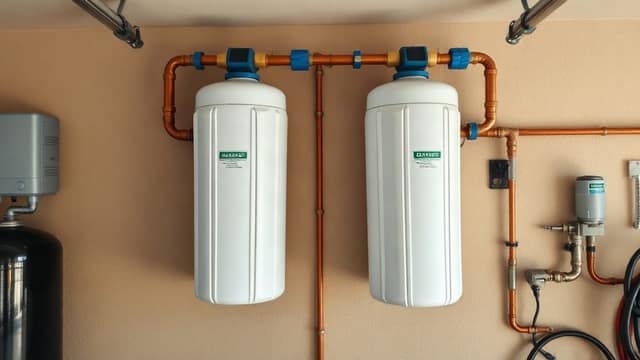 Whole House Water Filtration SystemEight whole house water filters compared by rated flow in GPM, capacity in gallons
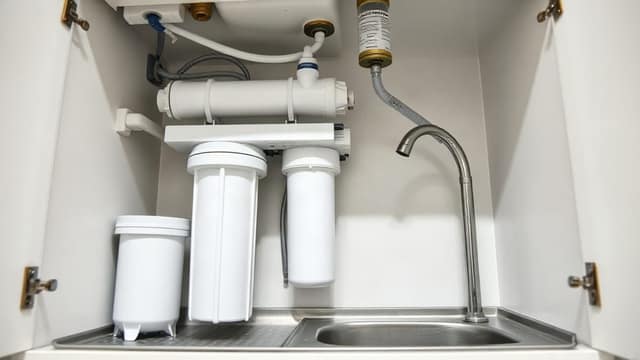 Reverse Osmosis System for HomeEight reverse osmosis systems compared by NSF-listed output, drain water, feed pressure and certification
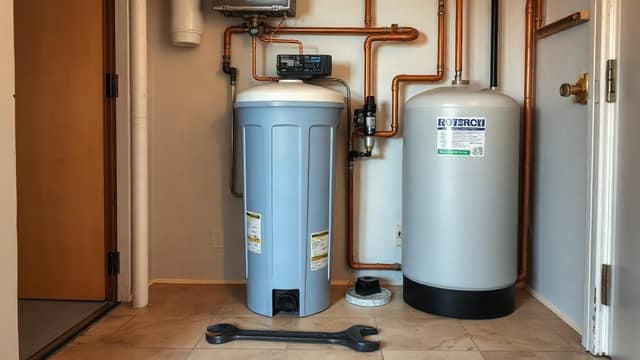 Water Softener RepairA symptom, cause, test and fix table, salt bridge and brine tank steps, error codes, who to call