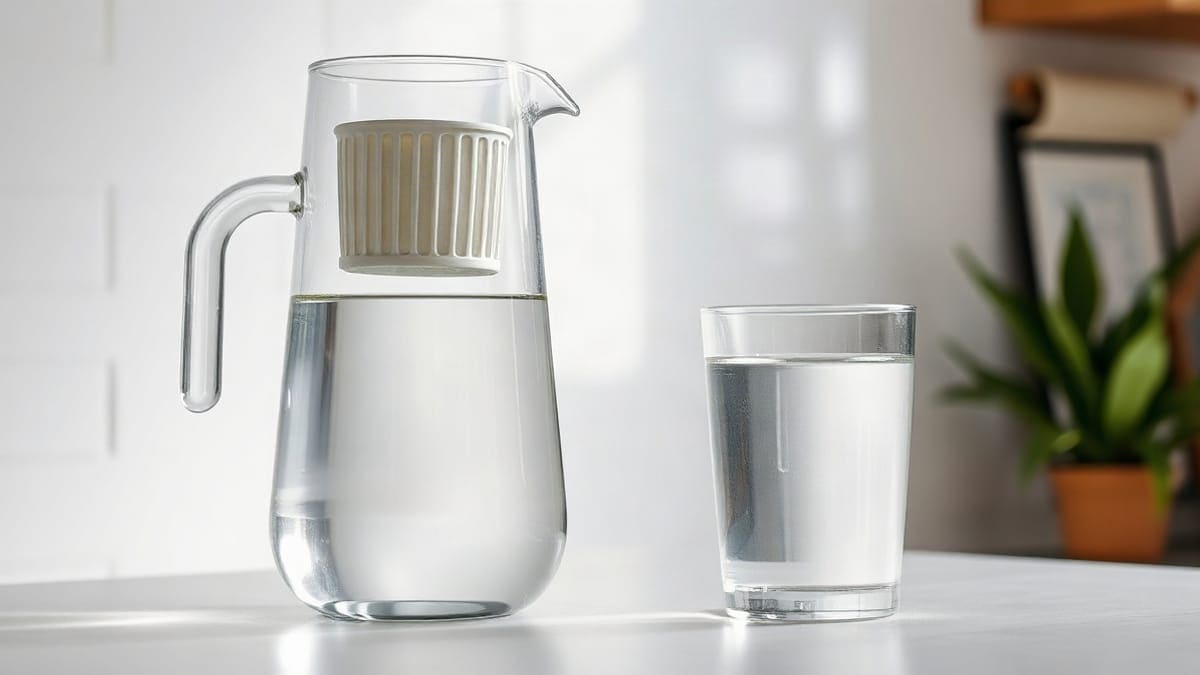
A pitcher is the cheapest upgrade for drinking water, and the easiest to get wrong. Makers print "NSF certified" on boxes whose certificate covers chlorine taste and nothing else, and cartridge ratings run from 20 to 200 gallons. For eight pitchers sold to US buyers we read every maker page that opened, looked each one up in NSF's public database on November 18, 2026, and worked out the cartridges a household uses in a year. We print no prices, and every figure is traced to a page or listing named below. Start with the certification table, move to the yearly cartridge count, and choose the model after both.
Eight water filter pitchers at a glance
Water check
Eight pitchers hold 7 to 10 cups and use cartridges rated from about 20 to 200 gallons. Only the Brita Elite has a lead claim in NSF's database; the other seven rest on a maker-named certifier, a lab report or a marketing claim.
The table gives each pitcher's size, the rated cartridge life, the filtering speed measured by the independent lab review site Water Filter Guru where it published one, and the certification as each maker words it. "Not read" means we found no figure on a page we could open.
| Pitcher | Size | Rated cartridge life | Flow measured by Water Filter Guru | Certification as the maker words it |
|---|---|---|---|---|
| Brita Tahoe with Standard filter | 10 cups (2.4 L) | 40 gal or 2 months | Not read | No standard named, "See certifications" |
| Brita Pacifica with Elite filter | 10 cups (2.4 L) | 120 gal or 6 months | 2.92 gph (Elite) | Lead claim in NSF's database; maker data sheet names WQA |
| PUR Plus | 7 or 11 cups on retailer listings | 40 gal or 2 months | Not read | NSF 42, 53 for chlorine and others; WQA for lead and 401 |
| ZeroWater 10-cup | 10 cups (2.4 L) | About 20 gal, set by the TDS meter | 2.62 gph (legacy filter) | NSF/ANSI 53 on IAPMO certificate W-17155 (ZEROP07 to P12); no NSF listing |
| Culligan with ZeroWater Technology | 10 cups (2.4 L) | About 20 gal | 1.9 to 2.68 gph | IAPMO R&T W-17155: NSF/ANSI 53; 42 and 401 on the data sheet, certificates not read |
| LifeStraw Home glass | 7 cups (1.7 L) | 40 gal or 2 months | Not read | WQA lists NSF 42, 53 (lead) and 401; P473 claimed, not listed |
| Clearly Filtered | 10 cups (2.4 L) | 100 gal | 0.97 gph | NSF 42 and 372 only |
| Waterdrop Lucid 10-cup | 10 cups (2.4 L) | 200 gal or 3 months | 8.40 gph | NSF listing for 42 only (chlorine, taste and odor, 200 gal); 372 named by the maker |
Which pitcher should a family of three or four start with?
A typical family of 3 or 4 that wants a lead claim without a laboratory report suits the Brita Elite, and one that wants the fewest dissolved minerals suits the Culligan ZeroWater. For a larger or more permanent setup, see the countertop water filter and the under sink water filter pages. For a bottle you carry, see the water filter bottle.
Which pitcher certifications can you verify?
Water check
NSF's database lists the Brita Elite filter (OB06) for lead at 120 gallons, the PUR PPF951K for 42 and 53 claims at 40 gallons, and Clearly Filtered for chlorine taste and odor only. It lists no pitcher for ZeroWater, Culligan or LifeStraw (IAPMO certifies the first two, WQA lists the LifeStraw glass), and the Waterdrop pitcher only for chlorine taste and odor.
We searched the NSF drinking water treatment unit database by company on November 18, 2026; NSF states its listings are current as of November 17. The table copies what the Brita Products Company listing, the PUR listing and the Clearly Filtered listing say.
| Filter | NSF/ANSI 42 (taste and odor) | NSF/ANSI 53 (health effects) | NSF/ANSI 401 (emerging compounds) |
|---|---|---|---|
| Brita Elite OB06 in Pacifica OB41 and Tidal OB63 | Not listed | Lead; 120 gal | Not listed |
| PUR PPF951K and PPF900Z | Chlorine, Class VI particulate, zinc; 40 gal | Benzene, cadmium, copper, mercury, simazine and 6 more; 40 gal | Not listed |
| Clearly Filtered pitcher filter | Chlorine, taste and odor; 100 gal | Not listed | Not listed |
| Epic NanoXP pitcher filter | Listed for material safety only | Not listed | Not listed |
| ZeroWater, Culligan ZeroWater, LifeStraw, Waterdrop | Nothing found under these company names | Nothing found | Nothing found |
Standard 42 covers aesthetics such as chlorine taste, which tells you nothing about lead. Standard 53 is about health effects, and each substance is listed on its own, so a PUR filter with a benzene claim is not a lead filter in NSF's records. Standard 401 covers compounds such as drugs and plasticizers. Note that the Brita Elite claim is attached to named pitcher systems: NSF lists it for the Pacifica and Tidal, so a lead claim does not travel to every Brita pitcher that fits the cartridge.
Two details matter. First, PUR's own performance data sheet says its lead reduction (99.4% at pH 8.5 and 99.7% at pH 6.5) is certified by WQA, not NSF, and the same sheet says the 40 gallon capacity and a rated service flow of 2 gallons per day. Second, Clearly Filtered's own help page says the pitcher is certified by NSF International to 42 and 372 and "independently tested" against 365 or more contaminants. Testing is not certification, a point the Penn State Extension buying guide makes when it says to ask vendors for written proof of NSF or WQA certification.
Why do so many claims go unconfirmed?
A body other than NSF can certify to an NSF/ANSI standard, and IAPMO and WQA do. So a missing NSF listing is not proof that a claim is false. It means we could not confirm it. The IAPMO search page gave us no result, but we read certificate W-17155 and the WQA entry for LifeStraw. Third-party site TapWaterData says ZeroWater is certified by IAPMO and WQA, not NSF, and the IAPMO certificate we read confirms IAPMO for NSF/ANSI 53, while Water Filter Guru calls the same filter NSF certified. Ask the maker for the data sheet and look the model up in the issuing body's own list.
What does a water filter pitcher remove, and what does it leave?
Water check
A pitcher cartridge reliably cuts chlorine taste. Lead needs a certified claim: the Brita Elite, PUR Plus and the Culligan ZeroWater name one. Hardness minerals pass through every carbon pitcher, while ZeroWater type ion exchange removes nearly all of them.
A dash means the maker makes no such claim in the pages we could read.
| Pitcher | Chlorine taste and odor | Lead | PFOA and PFOS | Dissolved minerals (TDS) |
|---|---|---|---|---|
| Brita Standard | Yes | No lead claim | No claim | Not reduced |
| Brita Elite | Yes | Certified, 120 gal | Not claimed on Brita's page | About 2% in a lab review (134 ppm left of 137) |
| PUR Plus | 97.5% | 99.4% at pH 8.5 (WQA) | No claim on the data sheet | Not claimed |
| ZeroWater 10-cup | Yes | Certified, IAPMO W-17155 | Total PFAS, same certificate | 8 ppm left of 137 in a lab review |
| Culligan ZeroWater | Yes | 98.9% at pH 6.5, 98.8% at pH 8.5 (IAPMO, maker) | 99.7% of total PFAS (IAPMO, maker) | 5 ppm left of 137 in a lab review |
| LifeStraw Home glass | Yes (WQA 42) | WQA 53 lists lead | P473 claimed, not listed | Not claimed |
| Clearly Filtered | Certified (NSF 42) | Maker claim, not in NSF's list | Maker claim, not in NSF's list | Not claimed |
| Waterdrop Lucid | Certified claim (42) | Not confirmed | Marketing claim only | Not claimed |
What does the lead number mean for your tap?
The EPA sets the lead goal for drinking water at zero, because low exposure can harm a child's learning, behavior and growth, and its action level is 15 ppb, lowered to 10 ppb by the 2024 rule (EPA's lead rule improvements Q&A). For lead the EPA says to use a filter "certified to remove lead", to follow replacement directions, and not to run hot water through it. PUR's data sheet gives a usable range of 34 to 82°F (1 to 28°C), so keep hot water out of the pitcher. If lead is your main worry, the water filter for lead page ranks filters by that claim.
Can a pitcher meet the EPA PFAS limit?
The EPA's 2024 rule sets enforceable limits of 4.0 ppt for PFOA and 4.0 ppt for PFOS, with monitoring due by 2027. A filter certified to NSF/ANSI 53 for PFOA and PFOS is tested to a combined 20 ng/L (20 ppt) effluent limit, as Penn State Extension explains, and Penn State adds that this certification does not show whether a device meets the current EPA limits. So a pitcher can carry a PFOA/PFOS certificate and still leave you above 4 ppt. For a full ranking, see the water filter for PFAS page.
Does a water filter pitcher filter hard water?
Water check
Standard carbon pitchers such as Brita do not remove hardness: a lab review found calcium and magnesium nearly unchanged. ZeroWater type pitchers remove 99% or more of calcium and all magnesium, but hold only about 20 gallons and strip minerals you may want.
Hardness is calcium and magnesium, measured in mg/L or grains per gallon. The USGS calls water hard above 120 mg/L and very hard above 180 mg/L, and 1 grain per gallon is about 17 ppm. Water Filter Guru's side by side measured a 137 ppm TDS source with 25.6 ppm calcium and 6.32 ppm magnesium. The Brita Elite left 134 ppm TDS, 25.1 ppm calcium and 6.45 ppm magnesium. The Culligan ZeroWater left 5 ppm TDS, and the legacy ZeroWater 8 ppm, with 0.2 ppm calcium and no magnesium for ZeroWater.
| Measure in the lab review (one tap water) | Source water | Brita Elite | ZeroWater |
|---|---|---|---|
| TDS | 137 ppm | 134 ppm | 5 to 8 ppm |
| Calcium | 25.6 ppm | 25.1 ppm | 0.2 ppm |
| Magnesium | 6.32 ppm | 6.45 ppm | 0 ppm |
Brita itself says that with hard water "you may need to change filters more often." ZeroWater's meter also reads 0 where the reviewer's lab found 8 ppm, so treat the meter as a guide. A pitcher cannot protect a dishwasher, a kettle or a shower from scale, because only a few gallons a day pass through it. The hard water filter page explains what actually works for scale, and the hard water vs soft water page covers what hardness does. Convert your own report with the water hardness converter.
How many cartridges does a pitcher use in a year?
Water check
At 1 gallon per person per day, 2 people use 730 gallons a year and 4 people use 1,460. That is 7 Brita Elite filters for 2 people against 19 Brita Standard filters, and 13 Elite filters for 4 people against 37 Standard.
Penn State Extension puts drinking and cooking at about 1 gallon per person per day. Filters per year equals people times 365 gallons, divided by the rated gallons, rounded up. Where the maker also sets a calendar limit, the limit that comes first applies.
| Filter | Rated life | Days per filter, 2 people | Days per filter, 4 people | Filters a year, 2 people | Filters a year, 4 people |
|---|---|---|---|---|---|
| Brita Standard | 40 gal or 2 months | 20 | 10 | 19 | 37 |
| PUR Plus | 40 gal or 2 months | 20 | 10 | 19 | 37 |
| LifeStraw carbon and ion filter | 40 gal or 2 months | 20 | 10 | 19 | 37 |
| ZeroWater and Culligan ZeroWater | About 20 gal | 10 | 5 | 37 | 73 |
| Brita Elite | 120 gal or 6 months | 60 | 30 | 7 | 13 |
| Clearly Filtered | 100 gal | 50 | 25 | 8 | 15 |
| Waterdrop PF-01A Plus | 200 gal or 3 months | 90 (calendar limit) | 50 | 4 | 8 |
The ZeroWater figure is the weakest in the table: Water Filter Guru uses 20 gallons for the Culligan filter and 25 for the legacy one, retailer listings say 15 to 20, and the maker's own meter decides, so hard or mineral rich water ends the cartridge sooner.
Filling time adds up too. At 1 gallon a day, a family of 4 pours 4 gallons, or 64 cups, which is 6.4 fills of a 10 cup pitcher. At Water Filter Guru's measured 0.97 gph, Clearly Filtered needs about 4 hours of dripping for 4 gallons. At 8.40 gph the Waterdrop needs under 30 minutes. At 2.92 gph the Brita Elite needs about 1 hour 22 minutes.
The eight water filter pitchers in detail
Water check
Eight pitchers are on sale to US buyers, with specs read on a maker page where one opened. Only the Brita Elite has a lead claim in NSF's database; the Culligan ZeroWater has the longest maker-stated list.
Check price links may earn this site a commission at no cost to you; the models are in because they fit a use.
Brita Tahoe with Standard filter: the cheapest way in
Brita's replacement filter page rates the Standard filter at 40 gallons or about 2 months and lists chlorine taste and odor, mercury, copper and cadmium. The refillable system page gives the Tahoe as a 10-cup pitcher made without BPA, with the filter life at 40 gallons. Brita does not name a certifying standard on either page, and the page says the Original filter is not described as a lead filter, pointing to the Elite for that. NSF's database lists no Standard filter under Brita's company name.
Good for: a renter or a household that only wants less chlorine taste. Not for: lead, PFAS or hard water, or a family of 4, since 40 gallons last 10 days at 4 gallons a day. Check price on Amazon
Brita Pacifica with Elite filter: the lead claim in NSF's database
Brita's Elite page says "Removes 99% of Lead," rates the filter at 120 gallons or about 6 months, and names chlorine, mercury, cadmium, asbestos, benzene and Class I particulates. NSF lists the OB06 element for lead at 120 gallons in the Pacifica OB41 and Tidal OB63 pitchers, and flags the Pacifica row as certified to NSF/ANSI/CAN 372 for lead free materials. Brita's page names no certifying body for the other claims; Water Filter Guru says the Elite is certified for 15 of the 33 contaminants on Brita's data sheet, so read the data sheet. A lab review measured 2.92 gph and about 2% TDS reduction. Retailer listings give the Pacifica 10 cups and an electronic filter indicator.
Good for: a lead claim you can look up and a 6 month change cycle. Not for: PFAS, fluoride or hard water, or a buyer who wants a claim on a Tahoe, since the NSF rows name the Pacifica and Tidal. Check price on Amazon
PUR Plus: a data sheet with percentages
PUR's performance data sheet lists the PPF951K filter at 40 gallons, with 97.5% chlorine reduction, 99.4% lead at pH 8.5, 99.7% at pH 6.5 and 99.3% copper at pH 6.5, plus 401 compounds such as bisphenol A, ibuprofen and naproxen. It states the lead and 401 claims are certified by WQA, and NSF lists the 42 and 53 claims. Retailer listings sell the PUR Plus in 7 and 11 cup sizes, so check the size before you buy. The sheet carries a standing warning: no microbes are filtered.
Good for: a buyer who wants a printed lead percentage at the same filter size as Brita's Standard. Not for: a low-maintenance household, since 40 gallons last 20 days for 2 people. Check price on Amazon
ZeroWater 10-cup: five stages and a TDS meter
The five stage filter ends in ion exchange, and a built-in meter tells you when to change it. A listing quotes a change at a reading of 006 and a 99.6% claim on total dissolved solids for the Ready-Pour round pitcher. IAPMO certificate W-17155 lists the ZEROP10 for NSF/ANSI 53 claims including lead, fluoride and total PFAS; TapWaterData lists the legacy filter at 42 and 53, with no NSF listing. Water Filter Guru measured 2.62 gph and 8 ppm TDS left from 137. The maker page is zerowater.com; it refused our requests, so we report listing wording only.
Good for: very low dissolved solids, with the lab review measuring 8 ppm left from 137. Not for: a thrifty family, since a 20 gallon cartridge means 73 a year for 4 people. Check price on Amazon
Culligan with ZeroWater Technology: the longest certification list
The Culligan shop page is quoted in search results as saying the pitcher is IAPMO certified to NSF/ANSI 42, 53 and 401, with 98.9% lead removal at pH 6.5, 98.8% at pH 8.5 and 99.7% of total PFAS, and the page itself refused our request. Water Filter Guru lists 42, 53, 401 and 372, a 20 gallon filter, a 2.68 gph flow and 100% fluoride removal. NSF's database lists no pitcher for Culligan International, because the pitcher is certified through IAPMO: we read IAPMO R&T certificate W-17155 (effective December 2025, revised June 26, 2026, valid to December 2030), which lists NSF/ANSI 53-2024 for pitchers ZEROP07, P08, P10 and P12 (cadmium, copper, fluoride, lead, mercury, total PFAS, hexavalent chromium, nitrate and nitrite). IAPMO notes the certificate is not evidence of current listing. The 42 and 401 claims on the data sheet are not backed by a certificate we read.
Good for: a household that wants lead, PFAS and fluoride in one pitcher and will accept a short cartridge life. Not for: a family that fills a pitcher several times a day, or a drinker who wants minerals in the glass. Check price on Amazon
LifeStraw Home glass pitcher: glass with a WQA lead and cyst listing
LifeStraw says the glass pitcher is WQA certified to NSF/ANSI 42, 53, 401 and P473, with a 40 gallon or 2 month carbon and ion exchange filter and a 264 gallon membrane changed yearly (LifeStraw's help pages). WQA's own entry, read November 18, 2026, lists the Glass 7-Cup for 42, 53 (cadmium, copper, cysts, lead, mercury) and 401, but not P473, PFAS or bacteria. IAPMO R&T's May 2019 P473 lab report is a test, not a listing, and its 10 ppt detection limit sits above EPA's 4.0 ppt. NSF's database lists no LifeStraw product. See the LifeStraw Home pitcher review and the maker page.
Good for: a small household that wants glass and a WQA lead listing in a 7 cup size. Not for: a family of 4, since 7 cups hold under 2 liters and 40 gallons last 10 days. Check price on Amazon
Clearly Filtered: a 100 gallon filter that drips slowly
NSF lists the pitcher replacement filter at 100 gallons for chlorine taste and odor, with a footnote for NSF/ANSI/CAN 372. The maker's help page says the certification covers exactly those two standards and that its 365 or more contaminants are independently tested, not certified. A lab review measured 0.97 gph, removed fluoride fully and scored the pitcher on build quality. Its page also reports a faster previous model at 2.27 gph.
Good for: fluoride, a 100 gallon cartridge and a pitcher you want to look good. Not for: a lead or PFAS claim you can confirm, or anyone in a hurry. Check price on Amazon
Waterdrop Lucid 10-cup: the longest cartridge and the fastest flow
Waterdrop lists a 200 gallon filter life, the WD-PF-01A Plus replacement and 42 and 372 certifications, per search results and retailer listings, which disagree on whether NSF/ANSI 53 appears. NSF's database, searched by trade name, lists the WD-PT-07 pitchers (filter WD-PF-01A Plus, 200 gallons) for NSF/ANSI 42 chlorine, taste and odor reduction only. Water Filter Guru says only 42 (chlorine taste and odor) applies, measured 8.40 gph and 51 oz of usable water, and noted fluoride rose from 1.0 to 1.2 ppm. See the Waterdrop water filters review.
Good for: a busy kitchen that wants few cartridge changes and fast filling. Not for: lead, PFAS or fluoride, where its claim is unconfirmed. Check price on Amazon
How do you choose a water filter pitcher?
Water check
Start with your city report: lead, PFAS and fluoride decide the claim you need. Then check the certification, divide rated gallons by your daily gallons, and pick a size that fits your fridge shelf.
- Read your annual report. Your utility's consumer confidence report lists lead, PFAS and other detections. If you cannot find lead, ask the utility whether your home has a lead service line.
- Name the claim. Chlorine taste needs NSF/ANSI 42, lead and PFOA/PFOS need 53 or a P473 listing, and drugs and plasticizers need 401.
- Check the certifier. Look the exact model up in the NSF, WQA or IAPMO list. Certification can attach to a named pitcher, as the Brita Elite does.
- Do the cartridge math. Divide rated gallons by the gallons your household pours. Under 20 days between changes means a bigger filter.
- Check the speed. A 10 cup pitcher that takes 4 hours per 4 gallons will sit empty.
- Check your water. If it is hard, plan on shorter filter life, and if it comes from a well, test it first with a state-certified lab, as the Penn State Extension buying guide advises.
If you drink more than 2 gallons a day, a pitcher stops making sense and a countertop or under sink filter does. See the drinking water filtration system for home page.
Which water filter pitcher fits which household?
Water check
Match the household to the claim: lead points to the Brita Elite or PUR Plus, fluoride and dissolved solids to a ZeroWater type pitcher, glass to LifeStraw, and the fewest cartridge changes to the Waterdrop at 200 gallons.
| Your situation | Pick | Watch for |
|---|---|---|
| Lead claim found in NSF's database | Brita Pacifica with Elite | NSF row names Pacifica and Tidal |
| Printed lead and 401 percentages | PUR Plus | WQA certifies lead and 401, not NSF |
| Fewest dissolved minerals | Culligan with ZeroWater | 20 gal cartridge |
| Fluoride | Culligan ZeroWater or Clearly Filtered | Slow drip on Clearly Filtered |
| Chlorine taste only | Brita Tahoe with Standard | No lead claim |
| Glass pitcher, small household | LifeStraw Home glass | 7 cups, lead on WQA listing |
| Fewest cartridge changes | Waterdrop Lucid | 42 claim only |
| Family of 4 or more | Brita Elite or Waterdrop | Still 13 or 8 filters a year |
For the Culligan brand see its consumer products review, and for camp and travel the portable and gravity water filter page.
Pitcher or another type of filter: when is a pitcher the wrong tool?
Water check
A pitcher suits 1 to 2 gallons a day. Penn State Extension gives pour-through pitchers about 8 to 350 gallons per cartridge; countertop and under sink units run 300 to 500 gallons and faucet units about 1,320 gallons or 12 months.
The figures come from the Penn State PFAS guide.
| System type | Replacement interval | Best when |
|---|---|---|
| Pour-through pitcher | About 8 to 350 gal or 3 to 6 months | 1 to 2 gal a day, renter, no plumbing |
| Countertop or under sink dispenser | About 300 to 500 gal or 6 months | 3 to 4 gal a day |
| Faucet-connected system | About 1,320 gal or 12 months | Steady daily use, one tap |
| Refrigerator filter | About 200 gal or 6 months | Ice and fridge water only |
| Reverse osmosis | Carbon block 6 to 12 months, RO membrane 12 to 24 months | Dissolved solids, nitrate, PFAS |
If your water has nitrate, high dissolved solids or PFAS above the 4 ppt limit, a carbon pitcher is not the answer. The reverse osmosis system page covers the case, the water filter for nitrates page covers nitrate, and the water filter for fluoride page covers fluoride. For your whole house, see the whole house water filtration system and the water softener vs water filter comparison.
Which pitchers did we leave out, and why?
Water check
Four names were left out: Epic Pure and Rorra for claims we could not confirm, the Boroux glass pitcher because it holds no filter, and alkaline pitchers, which have their own guide.
| Name | Why it is not in the eight | What we found |
|---|---|---|
| Epic Pure | Certification wording is inconsistent | NSF lists the NanoXP pitcher filter for material safety only; the maker says 42 and 372 certified and 53, 401 and P231 lab tested |
| Rorra filtered pitcher | No certification listing confirmed | The maker names a 200 gallon filter and 50 plus contaminants; no listing for the pitcher found |
| Boroux glass pitcher | No filter included | The maker's page sells a 64 oz borosilicate glass pitcher to store filtered water |
| Alkaline pitchers | Different purpose | See the alkaline water pitcher and filter page |
The Epic Pure page and the NSF Epic listing disagree on scope, and Rorra's pitcher page and Boroux's glass pitcher page are the sources for the other two rows. See also the Rorra review and the Boroux review.
How do you use and clean a Brita pitcher?
Water check
Flush a new Brita Original filter with cold water for 15 seconds, discard the first three containers of filtered water, hand-wash the pitcher with mild detergent, and change the filter at 40 gallons (Original) or 120 gallons (Elite).
Brita's pitcher FAQ gives these steps. The Elite filter needs only cold tap water added, then the same three discarded containers; Original filters older than a year should soak for 15 minutes first. Carbon dust in the first fillings is normal.
How often should you clean a water filter pitcher?
Brita says to hand-wash the pitcher, lid and reservoir "periodically" with mild detergent, rinse well, remove the filter first and skip abrasive cleaners; it gives no schedule. Washing at each filter change, every 2 months for the Original and 6 for the Elite, is a practical habit. Brita pitchers are not dishwasher safe. Any filter can slow or clog on sediment such as sand or rust, and Brita says the Elite may need replacing more often in that case.
Water filter pitchers: our conclusion
Water check
Take the Culligan with ZeroWater 10-cup for the longest certification list and the fewest dissolved minerals, the Brita Elite in a Pacifica for a lead claim in NSF's database, and the Waterdrop Lucid for the fewest cartridge changes.
The Culligan with ZeroWater also suits fluoride, but a family of 4 uses up its 20 gallon cartridge every 5 days Check price on Amazon. The Brita Pacifica with Elite lasts 120 gallons or about 6 months Check price on Amazon. Printed lead and 401 percentages come with the PUR Plus, certified by WQA, not NSF Check price on Amazon. Chlorine taste only points to the Brita Tahoe with Standard Check price on Amazon. A small household that wants glass takes the LifeStraw Home, 7 cups, whose lead claim is on its WQA listing Check price on Amazon. The Waterdrop Lucid runs 200 gallons per cartridge Check price on Amazon.
7 common mistakes with water filter pitchers
Water check
Seven mistakes cost buyers most: reading "NSF certified" as every claim, changing the cartridge late, pouring hot water, buying for hardness, trusting the ZeroWater meter blindly, trusting a pitcher on a private well and skipping the three-pitcher flush.
Reading "NSF certified" as every claim
Clearly Filtered's certificate covers chlorine taste and odor and lead free materials, and Waterdrop's covers chlorine taste and odor in Water Filter Guru's reading. Look for the substance you care about, not the badge.
Changing the cartridge late
A Brita Standard or PUR filter reaches 40 gallons in 10 days for a family of 4, not in 2 months. Count gallons, because an expired filter is less effective, as the EPA notes for lead filters.
Pouring hot water
PUR's sheet caps water temperature at 82°F (28°C), and the EPA says to use only cold water for drinking, cooking and baby formula, since boiling does not remove lead.
Buying a pitcher for hardness
A Brita left 134 ppm of 137 ppm TDS in a lab review. A pitcher does not protect a kettle from scale. Use the how to treat hard water at home page.
Trusting the ZeroWater meter blindly
The meter read 0 where a lab found 8 ppm. It is a change signal, not a lab result.
Trusting a pitcher on a private well
None of these cartridges is certified to disinfect, and PUR says so. Test the well first with the well water treatment finder.
Skipping the first flush
Brita says to discard the first three containers.
Frequently asked questions
What is the best water filtration pitcher?
For most households the Culligan with ZeroWater Technology, and for a lead claim we found in NSF's database the Brita Elite in a Pacifica. No pitcher wins on every point, so match the claim to your water. See the drinking water filtration system for home.
Who makes the best water filtration pitcher?
No maker wins on every point. Brita has the NSF lead listing, PUR has the printed percentages, Culligan with ZeroWater has the longest maker-stated list and Waterdrop has the longest cartridge.
Do water filter pitchers actually work?
Yes for chlorine taste, and for lead or PFOA/PFOS only when the exact model holds a certified claim. A pitcher works within its rated gallons, so counting gallons is part of the answer. They do not make unsafe water safe.
Are water filtration pitchers really necessary?
Not for everyone. If your city report shows no lead, PFAS or other detections and you only dislike chlorine taste, a Standard filter or a sink filter is enough. If your pipes may contain lead, a certified pitcher is a cheap precaution, per the EPA's advice to use a lead-certified filter.
What do water filtration pitchers remove?
Carbon pitchers cut chlorine, taste and odor, and the certified models list metals such as lead, mercury, copper and cadmium. ZeroWater type pitchers also remove dissolved minerals and fluoride. None removes microbes, per PUR's data sheet.
Which water filter pitcher removes the most contaminants?
On certified claims the Culligan with ZeroWater Technology lists the most: 42, 53 and 401 with lead and total PFAS. In Water Filter Guru's lab work it removed all health related contaminants it found, including fluoride and uranium. Clearly Filtered claims 365 contaminants but certifies one standard.
What is the healthiest water filtration pitcher?
No pitcher is healthiest for everyone. For a home with lead pipes, pick a certified lead claim. For a home with high fluoride, pick a pitcher with measured fluoride removal. Ask your doctor about infants, pregnancy and dialysis.
Does a ZeroWater pitcher take out lead?
ZeroWater and Culligan say yes. Culligan states 98.9% at pH 6.5 and 98.8% at pH 8.5 under NSF/ANSI 53 by IAPMO, per search results quoting its shop page. NSF lists no pitcher for it, but the IAPMO certificate W-17155 lists NSF/ANSI 53 for lead and total PFAS, so ask for the data sheet to see the 98.9% figures.
Does the Clear2O pitcher take out lead?
We could not confirm it. NSF's database returned no Clear2O product on November 18, 2026, and we opened no maker page for it. A lead claim needs NSF/ANSI 53 for lead on the exact model.
Do water filter pitchers take out microplastics?
WQA lists microplastics under NSF/ANSI 401 for the LifeStraw Home Glass; we could not confirm it for the other seven. Brita's Elite page lists microplastics in a comparison table without naming a standard.
Is there a filter pitcher for hard water?
A ZeroWater type pitcher is the only kind that lowered calcium and magnesium in a lab review, to 0.2 ppm and 0 ppm. Its cartridge lasts about 20 gallons. For scale in appliances read the hard water filter page.
What do filtered water pitchers filter out of well water?
Only what their certificates claim, and none is certified against bacteria. Well water can hold iron, nitrate and microbes that a pitcher does not handle. Read the well water filtration system page and test first.
How do you use a Brita water filtration pitcher?
Flush a new Original filter with cold water for 15 seconds, seat it, fill the reservoir with cold tap water and discard the first three containers. See the Brita pitcher review.
How do you clean a Brita water filtration pitcher, and how often?
Remove the filter, hand-wash the pitcher, lid and reservoir with mild detergent, and rinse. Brita gives no schedule; washing at each filter change is practical.
Can hard water be filtered?
Yes, but a pitcher filter is not how. Ion exchange softening and reverse osmosis remove hardness, and a ZeroWater type pitcher handles a few gallons of drinking water. See the water softener vs water filter page.
Do filtered shower heads help with hard water?
A shower filter treats shower water, not a pitcher, so the answer lives on the shower filter for hard water page, which reports what shower filters do to hardness.
How we researched this page
Water check
The page rests on maker pages we could open, NSF's database as of November 17, 2026, PUR's data sheet, Brita's FAQ, EPA and Penn State pages and Water Filter Guru's lab reviews. No pitcher was run in a lab by us, and no store ratings appear.
ZeroWater, Culligan, LifeStraw and Waterdrop pages returned a rate limit error, so for them we report listing and search result wording and say so. Other IAPMO and WQA certifications are reported as the makers word them. Water Filter Guru is an independent reviewer that sells through affiliates, and its measurements come from one water supply each. No retailer prices were gathered. We know of no CPSC recall of a water filter pitcher as of November 18, 2026; the only Brita recall in the CPSC list is the 2014 children's water bottle recall, a different product. See the recalls page and the glossary.
Sources
Our sources by topic
Public agencies and universities
- U.S. EPA, lead in drinking water, PFAS, private wells and water quality reports; USGS, hardness of water.
- Penn State Extension, Water Softening, Home Water Treatment for PFAS and Tips for Buying Water Treatment Equipment; CPSC, Brita children's water bottle recall.
Certification and standards bodies
- NSF International, drinking water treatment unit database, Brita listings, PUR listings, Clearly Filtered listings, Epic listings and Culligan listings.
- Certification bodies not reached by our requests: IAPMO listings and WQA find products; independent lab reviews: Water Filter Guru, pitchers and Water Filter Guru, ZeroWater vs Brita; third-party summary: TapWaterData, is ZeroWater NSF certified.
Manufacturers, retailers and other references
Keep comparing
 Whole House Water Filtration SystemEight whole house water filters compared by rated flow in GPM, capacity in gallons
 Reverse Osmosis System for HomeEight reverse osmosis systems compared by NSF-listed output, drain water, feed pressure and certification
 Under Sink Water Filters (Without Reverse Osmosis)Nine under sink filters with no drain water compared by rated gallons, flow
 Shower Filter for Hard WaterNine shower filters compared by rated flow, cartridge life and NSF/ANSI 177 status
 Countertop Reverse Osmosis Systems, No InstallationTen plug-in countertop reverse osmosis systems compared by tank size, drain water
 Whole House Water Filter and Softener ComboEight packaged whole house filter and softener combos compared on flow in GPM, grains, filter life in gallons