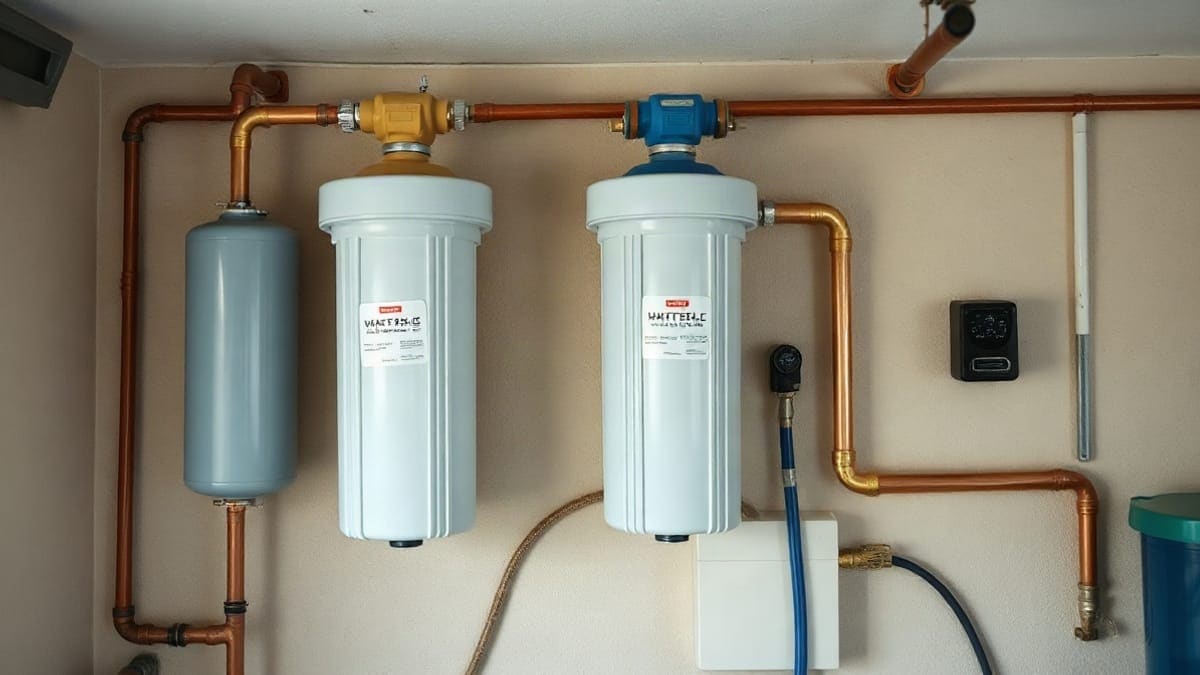
People type "water softener vs water filter" because both are sold as water treatment and both are plumbed into the main line. They answer different questions. One deals with the minerals that make scale; the other deals with what else is in the water, such as chlorine, sediment and named contaminants. Below you get a line-by-line table, the numbers behind it (sodium, resin life, drain water), a plan for when you need both and in what order, and a verdict by profile. Each figure carries its source, no price appears anywhere, and where makers contradict themselves the page names both numbers.
What is the difference between a water softener and a water filter?
Water check
A softener exchanges calcium and magnesium for sodium to stop scale. A filter holds back particles and chemicals such as chlorine on media. Neither does the other's job, which is why many homes run both.
Hardness is dissolved calcium and magnesium. USGS calls water hard from 121 mg/L as calcium carbonate, and Penn State Extension puts one grain per gallon (gpg) at about 17 mg/L, so hard starts near 7 gpg. A salt-based softener passes water through resin beads that swap those minerals for sodium. The result is near 0 gpg, soap that lathers and heaters that stay clear.
A filter works another way. Sediment stages trap sand and rust, carbon adsorbs chlorine and organic chemicals, and special media or a membrane go after named contaminants. Water leaves the filter with its calcium and magnesium intact, so a kettle still scales. For how the resin works, see how does a water softener work; for the hardness side alone, see hard water vs soft water.
Water softener vs water filter: the side-by-side table
Water check
Fourteen rows compare a salt softener, a whole house carbon filter and a reverse osmosis tap. The softener wins on hardness only; the filter wins on chlorine and sediment; the RO tap wins on dissolved solids at one faucet.
"Filter" here means the usual whole house cartridge or carbon tank. Reverse osmosis (RO) is a third column because it is the usual answer to "what about drinking water". Figures are maker numbers read in November 2026 unless a source is named.
| Row | Salt-based softener | Whole house carbon filter | RO drinking tap |
|---|---|---|---|
| Main job | Swaps hardness for sodium | Adsorbs chemicals, traps particles | Pushes water through a membrane |
| Hardness (calcium, magnesium) | Cut to near 0 gpg | Left in the water | Removed at that tap; hardness scales the membrane |
| Chlorine and chloramine | Not its job; chlorine wears the resin | Reduced by catalytic carbon (CF1 page lists both) | Depends on the model's carbon stages |
| Lead | No | Only a filter listed to NSF/ANSI 53 | Only the claims on the listing |
| PFAS | No | Only named claims (CF1 page claims PFOA and PFOS; no listing found) | AquaTru's FAQ lists PFOA and PFOS |
| Sediment | Needs clean water in | Yes, 5 micron stage is common | Sediment pre-filter stage |
| Sodium added | 7.5 mg per quart per gpg removed | None | None |
| Standard | NSF/ANSI 44 | NSF/ANSI 42, 53, 401 | NSF/ANSI 58 |
| Consumables | Salt; resin lasts years | Sediment stage every 6 to 9 months; carbon 1,000,000 gal (CF1) | Cartridge set on the maker's schedule |
| Water to drain | About 50 gal per regeneration | None on cartridge units | 3 gal per gal made (iSpring RCC7AK, 1:3) |
| Power and drain | 120 V adapter and a drain line | None on cartridge units | None on the RCC7AK |
| Where it goes | Main line | Main line | One faucet |
| Flow class | 7.2 to 11 GPM (models below) | 9 to 15 GPM | 75 GPD rated (RCC7AK) |
| Who it protects | Heater, pipes, soap use | Skin, taste, resin | The glass you drink from |
The rows come from Penn State's softening page, SpringWell's CF1 page, the AquaTru FAQ and iSpring's RO table.
Can a water softener do a filter's job?
Water check
No. A softener is an ion exchanger, not a filter. Penn State says softeners do not necessarily remove the more serious drinking water problems, so chlorine, lead, PFAS and bacteria need a different device.
Penn State's wording is that water softeners "will not necessarily remove any of the more serious drinking water contamination problems". The resin takes calcium and magnesium and leaves nearly everything else untouched.
Does a water softener remove chlorine, lead or PFAS?
No on all three. Chlorine passes through and slowly damages the resin, lead has its own certified filter claim, and PFAS need media or a membrane with a named test. Test your water before you assume.
EPA says more than one in five Americans drinks water treated with chloramines, a disinfectant that a softener does not remove. For lead, EPA's page gives an action level of 15 ppb (the 2024 revision of the rule lowers it to 10 ppb, with a later compliance date that the page does not print) and a health goal of zero, and it tells households to use a filter certified to remove lead. For PFAS, EPA's April 2024 rule sets 4.0 ppt for PFOA and PFOS, and a May 18, 2026 proposal would extend compliance to 2031 and rescind four other limits. None of those is a softener's job.
Does a water filter soften hard water?
Water check
No. Carbon and sediment filters leave calcium and magnesium in the water, so scale and spotting stay. A reverse osmosis tap removes minerals at one faucet but is not a whole house softener.
A cartridge holds contaminants on media, and calcium and magnesium are not what it is built to hold. For the whole-house version of this answer, see hard water filter.
Can reverse osmosis make hard water soft?
At one tap, yes, but hardness scales the membrane. AquaTru states its countertop unit is meant for water under 10 gpg, and Vermont's health department says hardness can cut the efficiency of RO and UV treatment.
AquaTru's FAQ says to soften first or descale regularly above 10 gpg, and Vermont says a softener may be needed before such treatment. So on hard water, RO is often the second device behind a softener, not a replacement. See reverse osmosis vs water softener for the full comparison.
Which NSF/ANSI standard covers a softener, and which a filter?
Water check
NSF/ANSI 44 covers cation exchange softeners, 42 aesthetic effects, 53 health effects, 58 reverse osmosis and 401 emerging compounds. A listing is checkable by model number; "tested to NSF standards" is not a listing.
The titles come straight from NSF's database page. Search the model number there, and for WQA or IAPMO claims use the maker's document and the WQA product finder.
| Standard | Title on the NSF page | What a listing proves | Example in this page |
|---|---|---|---|
| 44 | Cation exchange water softeners | Hardness reduction, and efficiency if rated | Rheem RHS32, EcoPure EP31 manuals |
| 42 | Aesthetic effects | Chlorine, taste, odor | Filters that name 42 |
| 53 | Health effects | Named contaminants such as lead | Aquasana HealthShield (maker says WQA) |
| 401 | Emerging compounds | Trace chemicals | Aquasana HealthShield (maker says WQA) |
| 58 | Reverse osmosis | Reduction claims for RO units | iSpring RCC7AK: TDS only, 21.04 gpd |
For softeners, an "efficiency rated" mark means at least 3,350 grains of hardness removed per pound of salt at the salt settings tested (NSF definition; see the Rheem RHS32 manual). California asks for 4,000 grains per pound. The RHS32 and EcoPure EP31 carry 44 claims in their manuals; we found no listing for the SpringWell SS1 or CF1 in the NSF database on November 18, 2026.
What does each one protect, and which goes first?
Water check
The carbon filter protects the softener's resin from chlorine, and the softener protects heaters, RO membranes and plumbing from scale. On city water, the filter goes first, then the softener.
Purolite, a resin maker, says little resin life is lost at 0.3 mg/L of free chlorine in cold water, and that at 1 mg/L the life of premium resin falls by 50%, with another 50% for each added mg/L. It is a guideline, not a lab result for your resin.
Starting from a 10-year resin, our arithmetic gives about 5 years at 1 mg/L (10 x 0.5), about 2.5 years at 2 mg/L (10 x 0.5 x 0.5) and about 1.25 years at 3 mg/L. At 0.3 mg/L in cold water Purolite expects little loss.
On a well with iron, the order changes. Penn State says filtration before softening keeps oxidized iron out of the softener. See water filter before or after water softener for each case, and the best iron filter for well water picks.
How much sodium, water and upkeep does each add?
Water check
A softener adds sodium and sends about 50 gallons to the drain per regeneration. A cartridge filter adds no sodium and no drain water, but its media runs out: the CF1 is rated 1,000,000 gallons, about 9 years for four people.
Start with sodium. Penn State says a softener adds 7.5 mg per quart for each gpg removed. At 10 gpg that is 75 mg per quart, or about 19 mg in an 8 oz glass; at 30 gpg it is 225 mg per quart. The Dietary Guidelines for Americans put the adult limit at 2,300 mg a day, so one glass is small, but a strict low-sodium diet is the reason to keep one unsoftened tap.
Now water and salt. Four people at 75 gallons each and 10 gpg use 3,000 grains a day (Penn State's sum), so a 32,000-grain softener regenerates about every 10.7 days, or 34 times a year. At 50 gallons a cycle, that is about 1,700 gallons to the drain each year.
| Cost of running | Salt softener, 32,000 grains | CF1 carbon filter | iSpring WGB32B cartridges |
|---|---|---|---|
| Rated life | Resin lasts years | 1,000,000 gal or 10 years | 100,000 gal or up to 12 months |
| Years for 4 people (109,500 gal a year) | n/a | About 9.1 | About 0.9 |
| Sodium | 75 mg per quart at 10 gpg | 0 | 0 |
| Drain water at 10 gpg | About 1,700 gal a year | 0 | 0 |
| Regular job | Keep brine tank stocked | Sediment stage every 6 to 9 months | Swap the set |
Run the sums for your house in the water softener size calculator, and turn a report's ppm into gpg in the water hardness converter. The upkeep lists are in the water softener maintenance checklist and whole house water filter maintenance and replacement.
Do you need both a water softener and a water filter?
Water check
Yes when the water is hard (over about 7 gpg) and also carries chlorine, chloramine, sediment or a contaminant. If you have only one of those problems, buy only the device that fixes it.
The test is two numbers. Hardness comes from a strip, a drop kit or your utility's annual report (EPA's CCR page shows how to find it). The second number is whatever your report lists besides hardness. Private wells have no report: EPA says owners test their own water.
Soft, chlorinated city water (under 3.5 gpg) needs a filter only. Hard, chlorinated city water (over 7 gpg) needs the filter first and the softener second. Hard water with nothing else on the report needs a softener only. On a well with clear water iron, treat iron first, then soften; with sulfur or bacteria, test and treat those before anything else (see the well water guide). Lead or PFAS on the report call for a certified filter or RO tap whatever the hardness.
A pre-built pair saves matching pipe sizes: our best whole house water filter and softener combo page compares eight, and best whole house water filtration system ranks the filter alone.
Do you still need a water filter if you have a water softener?
Yes, if chlorine, chloramine, sediment, lead or PFAS matter to you. A softener handles none of them, and chlorine shortens the resin's life, so the filter also protects the softener.
For the drinking glass alone, an under-sink filter or an RO tap is enough, and the whole house unit then serves showers and appliances.
Do you need a water softener with reverse osmosis?
Only if your water is hard enough to scale the membrane. AquaTru's limit is 10 gpg, and Vermont says hardness can lower RO efficiency, so very hard water points to a softener first.
Under that, an RO tap often runs without one: see do you need a water softener with reverse osmosis.
Should a softened home use an RO tap for drinking?
Water check
For a low-sodium household, yes: an RO tap or an unsoftened kitchen cold tap keeps sodium out of the glass. Vermont says the kitchen cold faucet can bypass the softener.
Vermont's health department gives 0.46 mg of sodium added per mg of hardness removed. At 170 mg/L of hardness that is about 78 mg/L. See can you drink softened water for the health detail, and ask your doctor if you are on a sodium limit or mixing infant formula.
The iSpring RCC7AK, for example, is a six-stage under-sink system rated 75 GPD with a 1:3 pure to drain ratio (one iSpring page says up to 1:2) and no power needed. NSF lists the base model at 21.04 gpd for TDS reduction only, so read the exact suffix you buy.
Water softener vs water filter: the verdict by profile
Water check
Soften when hardness is the problem, filter when chlorine or contaminants are, and do both on hard chlorinated city water. A well is a test first: iron and sulfur change the order. Pick by your report, not by the product category.
| Your situation | Choose | Why |
|---|---|---|
| City water, 12 gpg, chlorine taste | Filter, then softener | Hardness and chlorine are separate; carbon protects resin |
| City water, 2 gpg, chlorine taste | Filter only | Soft already; a softener has nothing to remove |
| City water, 15 gpg, no complaints | Softener only | Scale is the problem; size by grains |
| Hard well with 2 ppm iron | Iron filter, then softener | Add 4 to 5 gpg per ppm of iron to the softener setting |
| Hard well, untested | Test first | Iron, sulfur and bacteria decide the plan |
| Lead worry in an old house | Certified filter or RO tap | A softener does not remove lead |
| Low-sodium diet, hard water | Softener plus unsoftened or RO tap | Keeps sodium out of the drinking glass |
| Kettle scale only, 5 gpg | Neither | Under 7 gpg, major scale is unlikely (Penn State) |
Choose a softener if…
Your tested hardness is above about 7 gpg, scale shows on heaters and fixtures, and your water report has nothing else you want removed.
Size it from people x 75 gallons x gpg. See what size water softener do I need and best water softener.
Choose a filter if…
Your water is soft or moderately hard but has chlorine, chloramine, sediment, PFAS or lead on the report, or you smell chlorine in the shower.
Match the claim to a listing. The chlorine and chloramine filter guide and the PFAS filter guide cover the named claims, and do you need a whole house water filter is the short test.
Choose both if…
The water is hard above 7 gpg and chlorinated or contaminated. Put the carbon filter ahead of the softener, each with a bypass, and keep one drinking tap treated as your health needs say.
The SpringWell combo page lists the CF1 and SS1 on 1 in connections, 25 to 80 psi each.
Which softeners, filters and combos fit each side?
Water check
Three salt softeners (7.2 to 11 GPM) handle hardness, three filters (5.7 to 15 GPM) handle the rest, and two pairs combine them. The CSS1 runs at its filter's 9 GPM. No prices: use the buttons.
Figures come from maker pages and manuals read in November 2026. A dash means we found no printed figure.
| Model | Job | Flow or capacity | Certification found | Note |
|---|---|---|---|---|
| SpringWell SS1 | Salt softener | 32,000 grains, 11 GPM (size guide says 9) | None in NSF or WQA | 1 in ports |
| Rheem RHS32 | Salt softener | 32,000 grains, 7.9 GPM | NSF/ANSI 44 in manual | Three salt doses printed |
| EcoPure EP31 | Salt softener | 31,000 grains, 7.2 GPM | NSF/ANSI 44 in manual | Tight for 3 baths |
| SpringWell CF1 | Carbon filter | 9 GPM, 1,000,000 gal | None found | Claims chlorine, chloramine, PFAS |
| iSpring WGB32B | Cartridge filter | Up to 15 GPM, 100,000 gal | "Tested", not listed | Leaves minerals in |
| Aquasana HealthShield | PFAS and solvent filter | 5.7 GPM, 165,000 gal | Maker names WQA 53 and 401 | 120 V outlet needed |
| SpringWell CSS1 | Filter plus softener | 9 GPM filter, 11 GPM softener | None found | Carbon tank first |
| Aquasure Harmony 48 SCP | Softener with pre-filter | 48,000 grains | None found | No flow printed |
| iSpring RCC7AK | RO tap | 75 GPD rated, 21.04 gpd listed | NSF/ANSI 58, TDS only | 45 to 70 psi |
The softener side: SpringWell SS1, Rheem RHS32 and EcoPure EP31
For one to four people on 10 to 15 gpg water, a 32,000-grain unit is the usual size. The RHS32 and EP31 print NSF/ANSI 44 claims in their manuals; the SS1 flows the most at 11 GPM but has no listing we found.
SpringWell's table lists 25 to 80 psi and 1 in connections. The RHS32 manual prints 13,000 grains at 2.6 lb of salt and 33,000 at 14.1 lb, and the EP31 manual lists 7.2 GPM.
Best for: SS1, 1 to 3 bathrooms; RHS32 and EP31, printed efficiency numbers. Not for: a well that smells of sulfur or carries several ppm of iron.
The filter side: SpringWell CF1, iSpring WGB32B and Aquasana HealthShield
The CF1 (9 GPM) suits chlorine in a 1 to 3 bathroom house, the WGB32B (up to 15 GPM) is the cartridge route, and the HealthShield is the one whose maker names WQA certification for PFAS. None softens.
SpringWell's CF1 page lists chlorine, chloramine, PFAS, PFOA and PFOS, 9 GPM, and names no certification. The WGB32B page lists a 5 micron stage and two carbon blocks, and its FAQ says minerals stay in. Aquasana's HealthShield is rated 5.7 GPM, 165,000 gallons, and needs an outlet.
Best for: CF1, chlorine; WGB32B, a handy owner who wants flow; HealthShield, PFAS on the utility report. Not for: hardness, or a private well without a test.
Both in one purchase: SpringWell CSS1 and Aquasure Harmony 48 SCP
The CSS1 joins the 9 GPM CF1 and the 32,000-grain SS1 on 1 in connections, so the pair runs at 9 GPM. The Aquasure bundle adds a pre-filter to a 48,000-grain softener but prints no flow.
The CSS1 page lists 36 to 120°F, a pre-filter change every 6 to 9 months and a lifetime warranty against defects, with no certification named. Aquasure's own pages disagree on how many bathrooms the bundle suits, so confirm with the maker.
Best for: CSS1, a city house with hard, chlorinated water; Aquasure, a larger home that wants a softener bundled with a pre-filter. Not for: an untested well, or a buyer who needs a printed flow or a listing.
The drinking tap: iSpring RCC7AK
An RO tap treats one faucet. The RCC7AK needs 45 to 70 psi under the sink and wastes about 3 gallons per gallon made on iSpring's ratio; NSF lists the base model for TDS reduction only.
Our best reverse osmosis system page ranks eight, and is reverse osmosis water good for you covers the mineral question.
Best for: a sodium-limited household or a drinking tap on softened water. Not for: hard water above the unit's limit without a softener.
Where are the reverse osmosis, pitcher and shower filter questions answered?
Water check
Each has its own page: how RO works, its filter schedule and cost, fluoride and lead claims, pitchers, shower filters and installation. This page keeps to softener against filter and sends the rest on.
How a membrane works, and what it rejects, is in what is reverse osmosis; the filter swap schedule is in reverse osmosis filter replacement schedule and the money side in reverse osmosis system cost. Fluoride claims are on best water filter for fluoride and lead claims on best water filter for lead. Pitchers, including whether Brita cartridges help with hard water, are on best water filter pitcher; showerheads on best shower filter for hard water. Brand questions go to the Culligan reverse osmosis review, the Rorra review and the Boroux review, and fitting a whole house tank to the installation guide.
6 common mistakes with water softener vs water filter
Water check
The costliest errors are expecting a softener to filter, expecting a filter to soften, plumbing the softener first on chlorinated water, skipping the test and softening the only drinking tap in a low-sodium home.
Buying a softener to fix chlorine taste
Resin does not remove chlorine, and 1 mg/L can halve premium resin life by Purolite's rule. Fit a carbon filter.
Buying a whole house filter to stop scale
Hardness stays in the water, so the kettle still scales. Test above 7 gpg and soften.
Plumbing the softener ahead of the carbon
On city water the carbon goes first. At 2 mg/L of chlorine, a 10-year resin falls to about 2.5 years on the guideline.
Trusting "tested to NSF standards"
It is not a listing. Search the model number in the NSF database, and ask for the WQA or IAPMO record.
Ignoring iron on a well
Treat iron first, then soften, and add 4 to 5 gpg per ppm of iron to the setting.
Softening the only drinking tap
Softening 10 gpg water puts roughly 75 mg of sodium in each quart. Leave one cold tap unsoftened or add an RO tap.
Frequently asked questions
Are a softener and a filter two names for one device?
No. A softener swaps hardness minerals for sodium, and a filter holds back chlorine, sediment or listed contaminants. NSF puts softeners under standard 44 and filters under 42, 53 and 401.
Can a softener replace my filter?
No. Penn State says softeners will not necessarily remove the more serious drinking water problems. Pair one with a filter if chlorine, lead or PFAS matter.
Do I still need a water filter if I have a water softener?
Yes if chlorine, chloramine, sediment, lead or PFAS are on your report. A softener does none of that, and a carbon filter ahead of it protects the resin.
What are the drawbacks of owning a softener?
It adds sodium, 7.5 mg per quart per gpg removed (Penn State), uses about 50 gallons per regeneration, needs salt and a drain, and does nothing for chlorine or contaminants.
Do plumbers recommend water softeners?
We found no survey of plumbers, so we make no claim. Ask a licensed plumber who has seen your pipes, and bring your hardness in gpg.
Are you not supposed to drink softened water?
Most adults can. People on a strict low-sodium diet, and parents mixing infant formula, should ask a doctor and use an unsoftened or RO tap. A 10 gpg supply adds about 19 mg in 8 oz.
Will a cartridge filter lower my hardness?
No. A cartridge filter leaves calcium and magnesium in the water. Only ion exchange lowers hardness for a whole house; RO does it at one tap.
Will a filter stop scale on my kettle?
No. Scale comes from hardness, which carbon and sediment stages do not hold. A salt softener removes the cause; a salt-free conditioner only aims at scale formation.
Why does chlorine matter to a softener?
Chlorine passes through the resin and shortens its life, about 50% per 1 mg/L on Purolite's guideline for premium resin, so a carbon filter goes ahead of it.
How do I check which standard my softener or filter holds?
Search the exact model number in the NSF database, then ask the maker for the WQA or IAPMO record. A sentence that says "tested to" with no listing number is not a certification.
Is a filter worth adding to a softened home?
It is worth it when chlorine, chloramine, sediment or a listed contaminant is in your supply. It is not a hardness fix. See how much does a whole house water filter cost.
Which goes first, the filter or the softener?
The carbon filter, on city water. On a well with iron, treat iron first, then soften. See water filter before or after water softener.
Can you filter hard water for drinking?
Yes, with RO at one tap, if the water is under the unit's hardness limit (10 gpg for the AquaTru Classic). Above that, soften first.
How we researched this page
Water check
We read the Penn State, EPA, USGS, Vermont health department and Purolite pages, the NSF database page and the maker pages for nine models in November 2026. We have not used any system ourselves.
Not confirmed: the Aquasure page refused our reader (error 429), so its bundle details come from a page of ours that read it earlier; the Rheem, EcoPure, iSpring and Aquasana figures are repeated from our model pages and not reopened for this one; WQA and IAPMO records could not be queried by model; the EPA PFAS page lists May 2026 proposals that are not final; no source on plumbers' recommendations was found. The resin-life table is our arithmetic on a guideline. No prices are printed.
Sources
Our sources by topic
Public agencies and universities
- Penn State Extension, Water Softening; USGS, Hardness of Water; Vermont Department of Health, Hardness in drinking water.
- EPA, PFAS and the drinking water rule, lead in drinking water, chloramines, CCR and private wells; Dietary Guidelines 2025 to 2030.
Certification and standards bodies
- NSF, certified drinking water treatment units; WQA find products; Purolite, resin life factors.
Manufacturers, retailers and other references
- Makers: SpringWell CF1, salt softeners and combo; Rheem RHS32 manual; EcoPure EP31 manual; iSpring WGB32B; Aquasana HealthShield; AquaTru FAQ.
Keep comparing
 Countertop Reverse Osmosis Systems, No InstallationTen plug-in countertop reverse osmosis systems compared by tank size, drain water
 Tankless Reverse Osmosis SystemsNine tankless reverse osmosis systems compared by GPD, flow in GPM, drain ratio
 Water SoftenerEleven water softeners sold in the US compared by grains, GPM, salt use and certification
 Salt-Free Water SoftenerEight salt-free water conditioners compared by flow in GPM, hardness limit in gpg
 Water Softener InstallationPipe sizes, bypass, drain air gap, psi limits, first regeneration, DIY or plumber
 How Much Does a Water Softener Cost? Price GuideSalt, rinse water, power, warranty years and install work counted in pounds