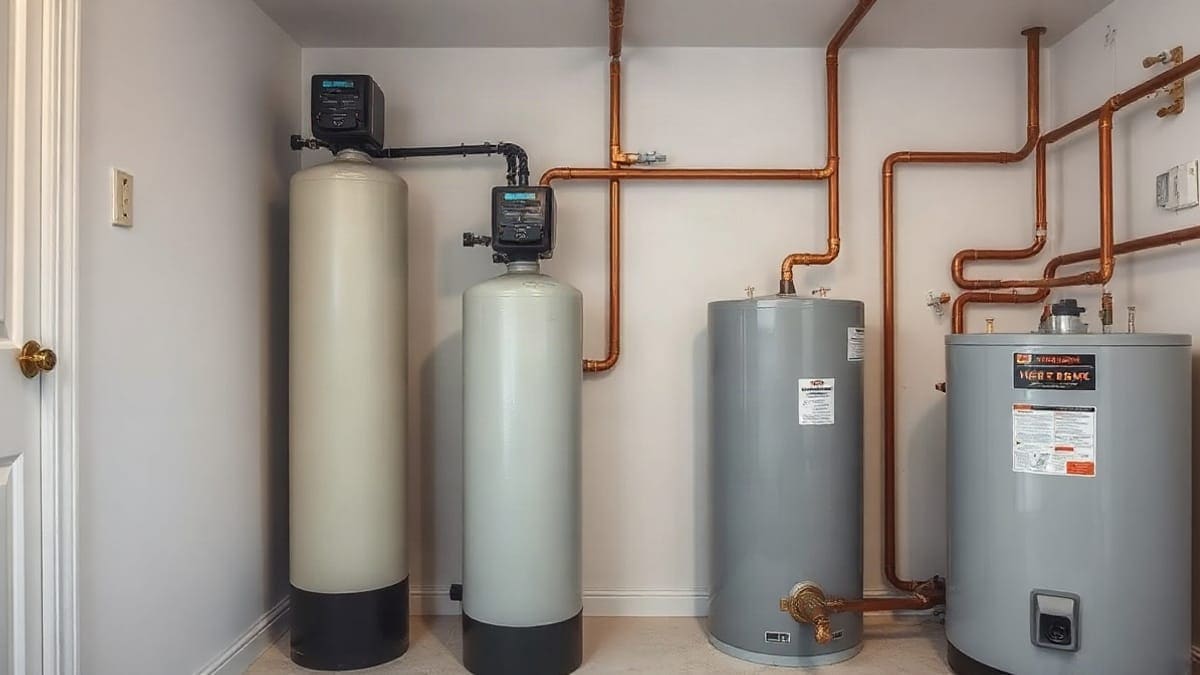
A water softener is two tanks and a valve. One tank holds a bed of resin beads, the other holds salt and brine, and the valve decides when to run brine through the beads. The whole job is one swap: calcium and magnesium out, sodium in. This page explains the swap with numbers, then follows a regeneration step by step with the times, flows and water volumes that Penn State, a water treatment company and the Rheem, EcoPure, Fleck and SpringWell documents print. It also says what a softener leaves in the water, and which models show the parts clearly. Our size calculator sizes one; the water treatment glossary explains the terms.
How does a water softener work in plain terms?
Water check
Hard water enters the resin tank, where beads coated with sodium swap it for calcium and magnesium. Soft water leaves. When the beads are full of hardness, brine washes it off, the beads take up sodium again, and the cycle repeats.
Penn State Extension describes the resin as a sand-like material coated with sodium ions. Hardness ions replace the sodium as water passes through. Once the sodium sites are used up, the resin is flushed with a salt solution, the brine runs through in reverse, and the calcium and magnesium go to the drain. PNNL calls this cation exchange and says potassium can replace sodium.
Hardness is what you are removing. USGS calls water soft at 0 to 60 mg/L as calcium carbonate and very hard above 180 mg/L. Penn State uses gpg: hard from 7.0 gpg, very hard above 10.5 gpg, with 1 gpg equal to about 17 mg/L. If you are not sure what your water carries, start with what is hard water.
Nothing is simply taken out: one set of ions is exchanged for another, which is why salt and a drain line are part of the system. Salt-free and electronic units work differently; the types of water softeners page sorts them.
What is the ion exchange behind a water softener, in numbers?
Water check
Each calcium or magnesium ion carries two positive charges, so it takes two sodium ions to replace it. By weight that is 0.46 g of sodium for each gram of hardness removed, which is why Penn State puts the added sodium at 7.5 mg per quart per gpg.
This is our arithmetic, and it matches Penn State. Two sodium ions weigh about 46 (2 x 23). Hardness is counted as calcium carbonate, which weighs 100 per unit of hardness. 46 divided by 100 is 0.46. One gpg is about 17.1 mg/L, and a quart is 0.946 L, so one quart at 1 gpg holds about 16.2 mg of hardness. Multiply by 0.46 and you get about 7.4 mg of sodium, against the 7.5 mg that Penn State prints.
| Raw hardness | Sodium per 8 oz glass | Sodium per 2 quarts | Share of 2,300 mg a day |
|---|---|---|---|
| 5 gpg | 9 mg | 75 mg | 3.3% |
| 10 gpg | 19 mg | 150 mg | 6.5% |
| 15 gpg | 28 mg | 225 mg | 9.8% |
| 20 gpg | 38 mg | 300 mg | 13.0% |
The daily limit for adults is 2,300 mg of sodium, per the FDA. So a glass of softened 10 gpg water adds about 19 mg, a small share for most people. If a doctor has capped your sodium, ask whether to leave one tap unsoftened. The full question is on can you drink softened water.
What is water softener resin and how much hardness does it hold?
Water check
Resin is a bed of small beads, described by one resin maker as strong acid cation resin. Maker manuals rate it by grains per salt dose: the Rheem RHS32 holds about 14,800 grains per cubic foot at 2.6 lb of salt and 37,500 at 14.1 lb.
The resin is the only part that touches the hardness, so its volume sets the capacity. The table divides each manual's rated capacity by its resin volume. All the per-cubic-foot figures are our arithmetic from the printed numbers.
| Model | Resin volume | Capacity at lowest dose | Per cu ft | Capacity at highest dose | Per cu ft | Salt per cu ft at top dose |
|---|---|---|---|---|---|---|
| Rheem RHS32 | 0.88 cu ft | 13,000 grains at 2.6 lb | 14,773 | 33,000 at 14.1 lb | 37,500 | 16.0 lb |
| EcoPure EP31 | 0.81 cu ft | 12,300 at 2.4 lb | 15,185 | 31,300 at 12.9 lb | 38,642 | 15.9 lb |
| EcoPure EP42 | 1.09 cu ft | 16,600 at 3.3 lb | 15,229 | 42,200 at 17.4 lb | 38,716 | 16.0 lb |
| Fleck 5600SXT 48,000-grain kit | 1.5 cu ft | not read | not read | 48,000 (label) | 32,000 | not read |
The figures come from the Rheem RHS32 manual, the EcoPure manual and a Pace Supply listing for the Fleck kit. The pattern is plain: salt buys capacity. About 3 lb of salt per cubic foot gives roughly 15,000 grains, and about 16 lb gives roughly 38,000. The high dose holds 2.5 times as much but uses about 5.4 times as much salt, which is why makers print the low-dose efficiency.
Resin wears from chlorine and iron. Purolite says a premium resin can run over ten years, that each 1 mg/L of chlorine cuts its life by 50 percent, and that iron binds strongly and slowly cuts capacity. The page on water softener resin goes through types and replacement.
What are the resin tank, brine tank and control valve for?
Water check
The resin tank holds the beads, the brine tank holds salt and makes brine, and the control valve switches water between them. On a SpringWell SS1 the resin tank is 9 in by 48 in and the brine tank 18 in by 33 in.
It looks like a tall, narrow tank beside a shorter, wider one. The SpringWell setup guide lists the SS1 at 9 in wide and 48 in tall (57 in with the head), 11 GPM service flow, 1 in connections and a 2 GPM backwash rate. The SS4 is 10 in by 54 in (63 in with the head), 13 GPM and 2.4 GPM backwash. Both use the same 18 in by 33 in brine tank and a 25 to 80 psi range.
The roles are simple. In the resin tank, hardness goes onto the beads. In the brine tank, salt sits in water and dissolves into brine, which is drawn into the resin tank only during a regeneration. On top, the valve and its controller open and close ports in a set order. Rheem requires at least 3 gallons per minute at the inlet, and its drain flow tops out at 2.0 gpm, which is why a floor drain and an air gap matter. The parts and components explained page names every piece, and the brine tank guide covers the salt side.
How does the control valve know when to regenerate?
Water check
Three ways: a timer that regenerates every set number of days, a meter that counts gallons and regenerates when capacity is used, or a meter that waits for a set hour. Meter types save salt and water because they only run when needed.
The Fleck 5600SXT service manual names the options. A time clock delayed control regenerates when the days since the last run equal the override value, at the set hour. A meter immediate control regenerates as soon as the calculated capacity is used up. A meter delayed control waits for the programmed hour and keeps a reserve so you do not run out of soft water first. A day-of-week control uses a weekly schedule. The control works out capacity as unit capacity divided by hardness, minus the reserve.
| Control | What starts a regeneration | Effect on salt and water |
|---|---|---|
| Time clock | Fixed interval (days since last run) | Runs whether or not the resin is full |
| Meter immediate (volumetric) | Gallons used reach calculated capacity | Runs only when needed, soft water may pause |
| Meter delayed | Capacity used, then the set hour (often night) | Runs only when needed, reserve covers the gap |
PNNL says time clock units typically run every four days to weekly regardless of use, which wastes water, and they cannot earn the NSF/ANSI 44 efficiency rating. That rating requires a flow meter or hardness sensor to start the regeneration, at least 3,350 grains per pound of salt, and no more than 5.0 gallons of water per 1,000 grains removed. The Rheem manual says its demand initiated feature meets those performance specifications. Kinetico says its softeners regenerate on demand with no timers or electrical parts. How a unit is set is covered on how often a water softener should regenerate.
The SpringWell guide shows the inputs a metered control wants: resin capacity of 32,000 grains (SS1) or 48,000 (SS4), a reserve of 10 percent, a regeneration day override of 14 days and a brine refill of 8 minutes (SS1) or 10 minutes (SS4). Here is what that reserve does for four people on 15 gpg water, using 75 gallons each:
| Unit | Rated capacity | Reserve (10%) | Usable between cycles | Gallons softened | Days at 4,500 grains a day |
|---|---|---|---|---|---|
| SpringWell SS1 | 32,000 grains | 3,200 | 28,800 | 1,920 | 6.4 |
| SpringWell SS4 | 48,000 grains | 4,800 | 43,200 | 2,880 | 9.6 |
These are our figures from the guide's settings, using the Penn State method: 4 people x 75 gallons x 15 gpg is 4,500 grains a day. The override of 14 days is a ceiling. If water use is low, the unit regenerates at 14 days anyway. Pick the size on the what size water softener do I need page.
What happens during water softener regeneration, step by step?
Water check
Four steps: backwash loosens the bed, brine draw and slow rinse swap hardness for sodium, a fast rinse clears the brine, and a refill makes new brine. SpringWell times a forced regeneration of its SS1 and SS4 at 90 minutes.
The table combines a water treatment company's published pattern (Solenis) with figures from the manuals. Solenis flows are per cubic foot of resin.
| Step | What happens | Flow (per cu ft resin) | Time we found |
|---|---|---|---|
| 1. Backwash | Water runs upward, expands the bed about 50% and flushes sediment | SpringWell backwash rate 2 GPM (SS1), 2.4 GPM (SS4) | About 10 min (Solenis); 10 min at Fleck start-up |
| 2. Brine draw and slow rinse | 8 to 12% brine strips hardness off the beads and loads sodium | 0.5 to 1.0 gpm | About 20 min (Solenis) |
| 3. Fast rinse | Fresh water flushes leftover brine and hardness to drain | 1.5 to 2.0 gpm | 5 min at Fleck start-up; 20 to 50 min (Solenis) |
| 4. Brine refill | Water refills the brine tank to make brine for next time | Set by a flow control | 8 min (SS1), 10 min (SS4) |
The times disagree because they are set per model. Fleck's valve lets each step run from 0 to 199 minutes (manual). EcoPure lets you set backwash and fast rinse from 1 to 30 minutes, with defaults that depend on the model (EcoPure manual), and Rheem lets you add up to 15 minutes to each. Both warn that rinse times set too low can leave salty-tasting water. We did not find a total cycle time printed in the Rheem or EcoPure manuals; both show minutes remaining on the display from the brine step on. SpringWell's own number is 90 minutes for a manual regeneration, during which its guide says you cannot use water.
If brine does not draw, hardness stays on the beads. Below 20 psi of line pressure the Fleck valve cannot draw brine, which is why the repair guide starts with pressure; start-up steps are in the installation guide.
How much water and salt does one regeneration use?
Water check
Penn State estimates about 50 gallons of water per regeneration. Manuals print less: 1.9 gallons per 1,000 grains at the lowest salt dose and 33.3 gallons in total at the highest on the Rheem RHS32, and 2.5 and 31.1 on the EcoPure EP31.
| Model | Water per 1,000 grains at lowest dose | Total water at highest dose | Salt at highest dose |
|---|---|---|---|
| Rheem RHS32 | 1.9 gal | 33.3 gal | 14.1 lb |
| EcoPure EP31 | 2.5 gal | 31.1 gal | 12.9 lb |
| NSF/ANSI 44 efficiency-rated limit | 5.0 gal | not applicable | not applicable |
Sources: the Rheem RHS32 manual, the EcoPure manual and PNNL. The total at the highest dose is the water for one full-size cycle. At the lowest dose a cycle is smaller but happens more often: the EP31's 12,300 grains per 2.4 lb run about 5,125 grains per pound, against about 2,426 at the top dose (31,300 divided by 12.9). Rated efficiency applies only at the minimum dose, and Rheem notes that real-world efficiency is typically lower. California requires 4,000 grains per pound, and Rheem's California setting forces its efficiency feature on.
Dose settings and bag costs are on how much salt does a water softener use.
How much salt, sodium and time does a family of 2, 4 or 6 get?
Water check
Four people on 15 gpg water remove 4,500 grains a day, so a 32,000-grain softener regenerates about every 7 days and uses 41 to 53 lb of salt a month. Two people on 10 gpg stretch the same unit to about 21 days.
Daily load is people x 75 gallons x hardness in gpg, the Penn State formula. The first table gives grains per day, then days between regenerations on a 32,000-grain unit at full rated capacity, the way the sizing page does it.
| People | 5 gpg | 10 gpg | 15 gpg | 20 gpg |
|---|---|---|---|---|
| 2 | 750 grains, 42.7 days | 1,500, 21.3 days | 2,250, 14.2 days | 3,000, 10.7 days |
| 4 | 1,500, 21.3 days | 3,000, 10.7 days | 4,500, 7.1 days | 6,000, 5.3 days |
| 6 | 2,250, 14.2 days | 4,500, 7.1 days | 6,750, 4.7 days | 9,000, 3.6 days |
For four people, take the grains for a 30.4-day month and divide by 3,350 grains per pound, the efficiency-rated floor, or by 2,600, the Rheem RHS42 maximum dose. The lower divisor is a heavier salt dose, so it gives the higher monthly figure in the last column.
| Four people at | Grains per day | Salt per month at 3,350 grains per lb | Salt per month at 2,600 grains per lb |
|---|---|---|---|
| 5 gpg | 1,500 | about 14 lb | about 18 lb |
| 10 gpg | 3,000 | about 27 lb | about 35 lb |
| 15 gpg | 4,500 | about 41 lb | about 53 lb |
| 20 gpg | 6,000 | about 54 lb | about 70 lb |
A 40 lb bag lasts roughly 23 to 30 days at 15 gpg for four people, and the sizing page has the rest of the grid. These are calculations, not measurements: your own salt setting and hardness test move them.
Why does a softener need salt to recharge?
Water check
Salt makes the brine, about 8 to 12 percent, whose sodium pushes calcium and magnesium off the beads and puts sodium back on. Potassium chloride can replace sodium chloride; Rheem's controller has a setting for it.
Potassium adds potassium to the water instead of sodium, so anyone on a potassium-restricted diet or certain medicines should ask a doctor first. Rheem lists rock, block, granulated and table salt as not recommended; pellets and crystals are compared on best water softener salt.
What is a salt-free or tankless conditioner?
Water check
They do not exchange ions. A salt-free conditioner changes how hardness minerals behave so they scale less, but the minerals stay in the water. SpringWell's FS1 and FS4 are listed at 12 and 15 GPM and carry no grain rating.
Nothing is removed, so the water is not soft by the USGS or Penn State classes, and there is no brine tank. NSF/ANSI 44 covers cation exchange softeners, per PNNL, so a salt-free unit sits outside that standard. We found no salt-free model with a performance listing against scale, so judge the claim by the maker's own test data. The full comparison is on salt vs salt-free water softener, with testing in do salt-free water softeners work.
A "tankless" softener is a marketing label for these or for electronic descalers. An ion exchange softener needs a resin tank; a product sold without one works some other way. Ask for a listing before you rely on it. Shower-head versions are on do shower head water softeners work.
Which problems can a softener not fix?
Water check
It exchanges hardness ions and nothing else. It makes no claim to remove chlorine, lead, bacteria or PFAS, and none of the manuals we read says it does. Penn State says softeners will not necessarily remove the serious drinking water problems.
| Concern | Does the softener treat it? | What does |
|---|---|---|
| Chlorine | No claim in the manuals; chlorine wears the resin | Carbon filter ahead of the softener |
| Lead | No | A filter certified for lead at the tap, plus checking your service line |
| Bacteria | No; bacteria can foul the resin bed | Disinfection such as UV, after a lab test |
| PFAS | No claim in the manuals | Treatment certified for PFAS; see best water filter for PFAS |
| Dissolved iron | Some, up to about 8 ppm clear-water iron on Rheem and EcoPure | An iron filter above 3 to 5 ppm |
Penn State warns that bacteria and fungi can form mats in resin, and that oxidized iron clogs it. Utility customers can read the annual water report on the EPA consumer confidence report page. For the filter side, the best water filter for lead, the chlorine filter guide and the reverse osmosis explainer are the next steps. For chlorine taste and odor through the whole house, the right tool is a whole house water filtration system. At the shower alone, a shower filter for hard water reduces chlorine but leaves calcium and magnesium in place. Day-to-day operation, from the hardness number to the regeneration time, is covered in water softener settings, and a salt delivery service can keep the brine tank topped up.
Which metered softeners show these parts at work?
Water check
Five salt-based models fit this page: the SpringWell SS1 and SS4 (32,000 and 48,000 grains), the Fleck 5600SXT kit (48,000, 1.5 cu ft), the Rheem RHS32 and the EcoPure EP31. All are in the main best water softener guide.
The SS1 and SS4 guides list capacity, reserve and override settings (SS1 11 GPM, SS4 13 GPM) and no certification was found. The Fleck kit is 48,000 grains with 1.5 cu ft of resin, 13 GPM in one listing, on a valve offering meter or time clock control; WQA lists the 5600 SXT as NSF/ANSI 44 efficiency rated. The Rheem RHS32 (0.88 cu ft, 7.9 gpm) and EcoPure EP31 (0.81 cu ft, 7.2 gpm) print demand initiated control and NSF/ANSI 44 claims in their manuals, claims that NSF lists.
Check any certification by model number on NSF's database or WQA's product search; a manual statement is the maker's claim, not the listing. The WQA listing for Pentair's 5600 SXT is here and covers Pentair's models, not every reseller's assembled kit. We found no CPSC recall of a water softener as of 18 November 2026; see water softener recalls.
SpringWell SS1: the metered 32,000-grain unit
The SS1 gives the clearest settings screen: capacity, reserve and override. Its guide lists 11 GPM and a 25 to 80 psi range. SpringWell's size guide says 9 GPM, so ask which figure your unit carries. Read the SpringWell SS1 review for more.
Best for: two to four people on city water up to about 10 gpg. Not for: a well with heavy iron or red water.
SpringWell SS4: 48,000 grains with a 10-minute refill
The SS4 runs 13 GPM and the same 10 percent reserve, with a 10-minute brine refill. At 4,500 grains a day it gives 9.6 days between cycles with that reserve.
Best for: four to six people on 12 to 20 gpg water. Not for: a small house, where it idles for weeks.
Fleck 5600SXT 48,000-grain kit: the valve in the manual
The Fleck valve is the one whose service manual describes every control type above. Resellers build the kit, so confirm the resin and flow with the seller.
Best for: a home that wants a serviceable valve with a published listing. Not for: a buyer who wants one company to stand behind tank, valve and brine tank.
Rheem RHS32: the cycle on paper
The RHS32 prints capacity at 2.6, 8.3 and 14.1 lb of salt and the rinse water for each, in a manual that also lists the E-codes. Its 7.9 gpm rating is tight for a three-bathroom home on hard water.
Best for: a buyer who wants the numbers printed. Not for: three bathrooms drawing water together.
EcoPure EP31: a modest tank with a 97 percent setting
The EP31 shares Rheem's text and adds an optional setting that regenerates at 97 percent of capacity (default off) per its manual.
Best for: one to four people wanting a modest tank. Not for: very hard or iron-rich supplies.
5 common mistakes people make with a water softener
Water check
The costly errors are running the top salt dose by default, cutting rinse times, skipping a hardness test, using hot water mid-cycle and expecting a filter. Each wastes salt or leaves hard or salty water.
Running the maximum salt dose
The top dose uses about 5.4 times the salt of the low dose for 2.5 times the capacity: the EP31 reaches 5,125 grains per pound at 2.4 lb and only 2,426 at 12.9 lb.
Cutting backwash and rinse times too low
Rheem and EcoPure warn that low rinse times can leave salty-tasting water. Add minutes in 1 minute steps instead.
Not testing hardness
A wrong hardness setting is a listed cause of hard water in the Rheem manual. Test raw water, and again after any change in supply. The best water hardness test kit page compares kits.
Using hot water mid-regeneration
Rheem says to avoid it, because the heater fills with hard water. Run laundry by day, not during the night cycle.
Expecting a filter
A softener will not remove chlorine, lead, bacteria or PFAS. Have private well water tested by a state-certified lab.
Frequently asked questions
What does a softener take from you in sodium, water and power?
It adds sodium, about 7.5 mg per quart per gpg removed, uses about 50 gallons of rinse water per cycle by Penn State's estimate, and needs salt, power and floor space. It also does not clean the water of lead, chlorine or bacteria. Sodium-restricted diets need a doctor's advice.
How do I know if my water softener is working?
Test softened and raw water with a hardness kit and watch the salt level. The full checklist gives the order and the causes of failure.
What is water softener regeneration?
It is the cleaning cycle: backwash, brine draw with slow rinse, fast rinse and brine refill. A SpringWell SS1 or SS4 manual regeneration runs 90 minutes.
What does a water softener look like?
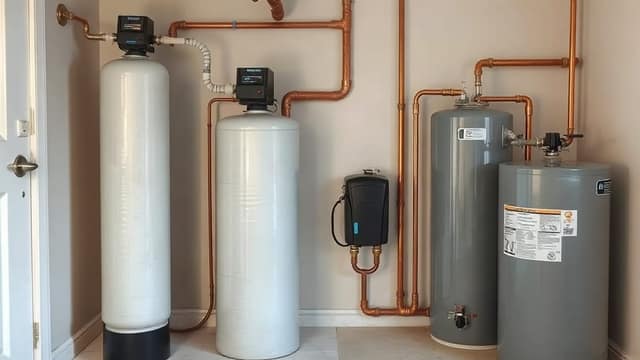
A tall, narrow resin tank beside a shorter, wider brine tank with a lid, plus a valve head on top. The SS1 stands 57 in with its head; the brine tank is 18 in by 33 in.
How many minutes does one regeneration last?
SpringWell says 90 minutes for a forced run, Rheem and EcoPure about 2 hours. Water treatment sources quote 60 to 100 minutes, but valves set each step separately, from 0 to 199 minutes on a Fleck.
Can I flush the toilet while the water softener is running?
The manuals we read give no rule for toilets. Rheem says to avoid hot water during regeneration, because the water heater fills with hard water, and SpringWell says no water use during its 90-minute forced run. A flush is a small draw, but if you can wait, wait.
How does a Kinetico water softener work?
The same exchange, but Kinetico says it uses non-electric technology with no timers, computers or electrical parts, and regenerates on demand by water use. Read the Kinetico review and cost.
How does a Culligan water softener work?
The same ion exchange. Dealer units are not reviewed here; see Culligan water softener cost and alternatives.
Do tankless water softeners work?
An ion exchange softener needs a resin tank. A "tankless" unit works another way, so ask for a performance listing; NSF/ANSI 44 covers cation exchange softeners (PNNL).
Does water softener salt work as ice melt?
That question has its own page: can you use water softener salt to melt ice.
How we researched this page
Water check
The exchange and sodium figures come from Penn State Extension, efficiency terms from PNNL and the Fleck manual, and cycle figures from Rheem, EcoPure, SpringWell and Solenis. We have not tested any softener, and we publish no prices.
The tables are our arithmetic from these documents, not measurements. Not confirmed: the Rheem and EcoPure manuals give about 2 hours for "Recharge Now", no per-step times; the Solenis step times are one vendor's pattern and its fast-rinse range disagrees with Fleck's 5-minute start-up check; NSF lists the Rheem and EcoPure models; SpringWell's setup guide and size guide disagree on flow. If you buy through a Check price button, this site may earn a commission and the price does not change.
Sources
Our sources by topic
Public agencies and universities
- Penn State Extension, Water Softening: resin, brine, 50 gallons, 7.5 mg of sodium, control types.
- PNNL, Water Softeners resource guide: cation exchange, NSF/ANSI 44 efficiency terms.
- USGS, Hardness of Water; FDA, Sodium in Your Diet.
- EPA, PFAS rule, lead, private wells and consumer confidence reports.
Certification and standards bodies
- WQA, Pentair listing and product search; NSF, certified products.
Manufacturers, retailers and other references
- Rheem, RHS32 manual; EcoPure, EP31 and EP42 manual.
- Pentair, Fleck 5600SXT service manual; Pace Supply, Fleck 48,000-grain kit.
- SpringWell, SS1 and SS4 setup guide; Kinetico, water softeners.
- Solenis, How sodium-cycle water softeners work; Purolite, factors affecting softening resin life.
Keep comparing
 Salt-Free Water SoftenerEight salt-free water conditioners compared by flow in GPM, hardness limit in gpg
 How Much Does a Water Softener Cost? Price GuideSalt, rinse water, power, warranty years and install work counted in pounds
 Water Softener Maintenance Checklist (Monthly, Yearly)Salt checks every 2 to 4 weeks, cleaner every 4 months, brine tank yearly, resin life
 Water Softener BrandsWater softener brands compared by who builds them, NSF and WQA listings, valve
 Water Hardness ConverterConvert water hardness between ppm, mg/L, grains per gallon and degrees, with ready tables from 1 to 30 gpg
 Water SoftenerEleven water softeners sold in the US compared by grains, GPM, salt use and certification