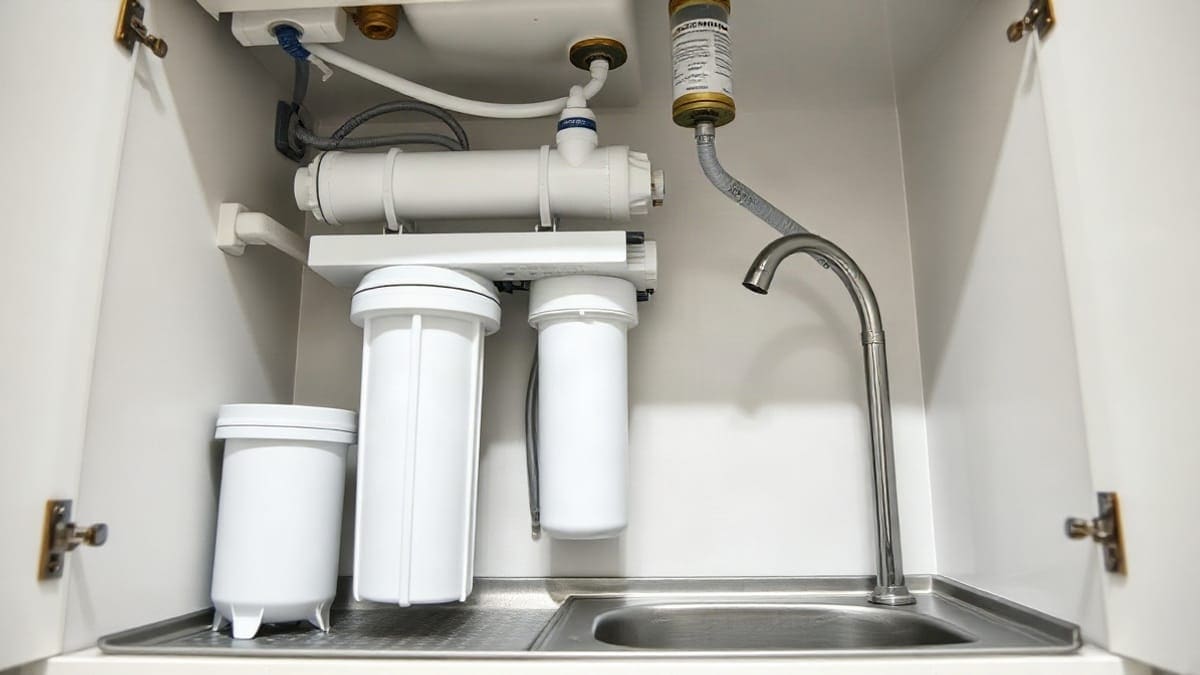
Reverse osmosis pushes tap water through a membrane that holds back dissolved solids, and it sends the rejected water down the drain. That drain water is the first thing to check, and the certification the second. We read eight systems on sale in the United States: maker pages, the NSF/ANSI 58 database as of November 17, 2026, and EPA and extension pages. No prices are printed. Several maker claims go further than the certification behind them, and each is marked below. Read the tables in order: certification first, then drain water, then pressure, and only then the format and the brand that fits your sink and your family.
Eight reverse osmosis systems at a glance
Water check
Eight systems span 75 to 800 GPD rated output and 15 to 87 psi feed pressure. Five need a power outlet. Six are plumbed under the sink, with a tank or without, and two sit on the counter with no plumbing.
The table gives the maker's rated output, the feed pressure the maker publishes, the format and the power need. Where a maker publishes no figure on the page we read, the cell says so.
| Model | Format | Rated output | Feed pressure | Power |
|---|---|---|---|---|
| iSpring RCC7AK | Under sink, tank, 6 stages | 75 GPD | 45 to 70 psi | None |
| iSpring RCC1UP-AK | Under sink, tank, pump, UV, 7 stages | 100 GPD | 30 to 70 psi | Pump, plug-in |
| iSpring RO500AK-BN | Under sink, tankless, pump | 500 GPD | 15 to 70 psi | Pump, plug-in |
| APEC ROES-50 | Under sink, 4 gal tank, 5 stages | 50 GPD at 60 psi, 30 GPD at 50 psi | 40 to 85 psi | None |
| Express Water RO10DX | Under sink, tank, 5 stages | 100 GPD | 40 to 80 psi | None |
| Waterdrop G3P800 | Under sink, tankless, pump, UV | 800 GPD | 14.5 to 87 psi | Adapter, plug-in |
| AquaTru Classic | Countertop, 0.75 gal tank, 4 stages | Not stated on the page we read | Not needed | 120 V, 60 Hz |
| CovePure CP-16 | Countertop, hot and cold, 4 stages | Not stated on the page we read | Not needed | 110 V, 1,500 W |
Which of the eight suits a typical house?
A typical city house with 45 to 70 psi at the sink and a cabinet with a free outlet suits the RO500AK-BN best. Without an outlet, the RCC7AK or the ROES-50 are the tank systems that need none. Read the best under sink reverse osmosis system page for the format, and the tankless reverse osmosis guide for pump models.
Which reverse osmosis certifications can you verify?
Water check
Only the iSpring and Express Water models appear in the NSF/ANSI 58 database, and the iSpring RCC7AK lists TDS reduction only, at 21.04 gpd. Waterdrop (searched by company and by trade name), AquaTru, APEC and CovePure were not found there on November 17, 2026.
We queried the NSF drinking water treatment unit list for NSF/ANSI 58, 53, 42, 401 and 372 under each company name. NSF stated its listings were current as of November 17, 2026. Two companies returned products under standard 58. The table copies what the iSpring listing and the Express Water listing say.
| Model on the NSF/ANSI 58 list | Daily production listed | Claims listed |
|---|---|---|
| iSpring RCC7, RCC7AK, RCC7AK-UV | 21.04 gpd | TDS reduction |
| iSpring RCC7AK-BN, RCC7AK-BLK, RCC7-BN, RCC7-BLK | 25.41 gpd | TDS, lead, fluoride, copper, barium, cadmium, trivalent chromium, selenium, asbestos |
| iSpring RO500AK-BN, RO500AK-ORB, RO500-BN, RO500-ORB | 500 gpd | TDS reduction |
| Express Water RO10DX | 21.89 gpd | TDS reduction |
| Express Water RO5DX | 12.22 gpd | TDS reduction |
The fourteen iSpring products on the list split in two. The base RCC7AK and the RO500 models claim TDS reduction alone. The BN and BLK finishes of the RCC7 line, which are separate rows, add eight metal and mineral claims. A sale page that says "certified to NSF/ANSI 58" for the RCC7AK does not tell you which claims the base model carries, so read the listing for the exact suffix you buy.
What about the four brands that are not in the NSF database?
AquaTru says its Classic is certified by IAPMO to NSF standards for 84 contaminants. Waterdrop says the G3P800 is NSF/ANSI 58 and 372 certified, and its page also says SGS and CSA tested it. The WQA directory entry for APEC, read on November 18, 2026, lists NSF/ANSI 58 for the ROES-50 at 34.8 gpd, TDS reduction only, and for the RO-Hi at 33.3 gpd with metals and fluoride claims. CovePure says SGS certified its CP-16 to NSF/ANSI 42, 53 and 58. A body other than NSF can test to an NSF/ANSI standard, so these may be valid. We could not confirm them, because the IAPMO search tool did not return results to our requests; we could read the WQA entry for APEC only. Ask each maker for the performance data sheet and look up the model in the issuing body's own database.
| Brand | Body the maker names | Standard the maker names | Checked in a database by us |
|---|---|---|---|
| AquaTru | IAPMO | NSF 42, 53, 58, 372, 401 (data sheet 10/2024) | No |
| Waterdrop | Not named on the page we read | NSF/ANSI 58 and 372 | No |
| APEC | WQA (entry read Nov 18, 2026) | ROES-50: TDS reduction, 34.8 gpd | No |
| CovePure | SGS | NSF/ANSI 42, 53 and 58 | No |
One brand outside our eight shows how a single listing reads: the Cloud Water Filters review covers the Cloud RO, listed under NSF/ANSI 58 for TDS reduction at 42.07 gpd, with every other contaminant claim resting on the maker's own lab reports.
How much water does a reverse osmosis system waste?
Water check
A typical home RO system sends 5 gallons or more down the drain per gallon it makes, and EPA says some send 10. A WaterSense RO must stay at 2.3 gallons or less. Makers here claim from 3 gallons to 0.25 gallon.
Drain water is the cost you do not see on a spec sheet. The EPA WaterSense page for point-of-use RO gives the 5 and 10 gallon figures and the 2.3 gallon limit. We found no WaterSense label on any of the eight maker pages we read.
Here is the math for a family of 4. Penn State Extension puts drinking and cooking at 1 gallon per person per day, so 4 gallons a day, or 1,460 gallons a year. Multiply by the drain water per gallon made.
| Source of the ratio | Drain per gallon made | Drain water per year at 1,460 gal |
|---|---|---|
| EPA, typical point-of-use RO | 5 gal or more | 7,300 gal or more |
| EPA, inefficient units | up to 10 gal | up to 14,600 gal |
| WaterSense label limit | 2.3 gal | 3,358 gal |
| iSpring RCC7AK, 1:3 (one iSpring page says up to 1:2) | 3 gal | 4,380 gal |
| Express Water RO10DX, 1 to 3 per gallon | 1 to 3 gal | 1,460 to 4,380 gal |
| iSpring RCC1UP-AK, 1:1.5 | 1.5 gal | 2,190 gal |
| iSpring RO500AK-BN, 2:1 | 0.5 gal | 730 gal |
| Waterdrop G3P800, 3:1 | 0.33 gal | 487 gal |
| AquaTru Classic, 75% efficiency | 0.33 gal | 487 gal |
| CovePure CP-16, 4:1 | 0.25 gal | 365 gal |
The gap between the iSpring RCC7AK and the Waterdrop G3P800 is 3,893 gallons a year for the same four people. These are maker figures at the maker's test conditions, and the APEC ROES-50 page lists no drain ratio at all. Real ratios drift with feed pressure and with how old the membrane is. For the dollar side of the same question, see reverse osmosis system cost.
Is the drain water a problem for a septic system or a drought area?
It can be. If you are on a septic tank, ask your installer about the added flow, and in a drought area favor a pump model with a 2:1 or better ratio. The best tankless reverse osmosis system page compares pump models in depth.
What does reverse osmosis remove, and what does the listing say?
Water check
A reverse osmosis membrane rejects dissolved solids broadly, but only a claim on the listing is third-party tested. For lead, EPA's action level is 15 ppb, with 10 ppb coming under its 2024 rule, and the plain iSpring RCC7AK lists no lead claim.
Makers say their membranes remove up to 99% of over 1,000 contaminants. That is a maker claim. The listing is what a lab confirmed. The Penn State PFAS guide tells buyers to look for NSF/ANSI 58 with a "PFOA Reduction" and "PFOS Reduction" claim, and notes that standards test a reduction to a combined 20 ng/L.
| Contaminant | EPA level | Where it comes from | Claim on NSF 58 list for iSpring RCC7AK-BN | On the plain RCC7AK listing |
|---|---|---|---|---|
| Lead | 15 ppb action level; 10 ppb under the 2024 rule | Old pipes and fixtures | Yes | No |
| Fluoride | 4.0 mg/L limit, 2.0 mg/L secondary | Natural and added | Yes | No |
| Arsenic | 0.010 mg/L | Natural deposits | Not on the list we read | No |
| Nitrate as nitrogen | 10 mg/L | Fertilizer, septic | Not on the list we read | No |
| PFOA and PFOS | 4.0 ppt each | Industrial | No claim for any iSpring product | No |
| TDS | 500 mg/L secondary | Minerals, salts | Yes | Yes |
The EPA values come from the national primary drinking water regulations, the secondary standards page, the EPA PFAS page and the EPA lead page. The TDS row is the only claim every NSF-listed model in this review carries, so TDS reduction is what the paperwork proves for most of them. Nitrate is a claim other systems do carry: Whirlpool WHAROS5, GE GXRQ18NBN, 3M 3MRO501 and EcoPure ECOP30 are listed for nitrate and nitrite reduction under NSF/ANSI 58, and none of our eight is.
For one-contaminant questions, see what does reverse osmosis remove, reverse osmosis and microplastics, the water filter for fluoride, the water filter for lead, the water filter for PFAS and the water filter for nitrates.
Do reverse osmosis systems work on low water pressure?
Water check
A pumpless tank system needs 40 to 45 psi or more at the sink. The iSpring RCC7AK lists 45 to 70 psi, the APEC ROES-50 40 to 85 psi, and a pump model such as the RO500AK-BN lists 15 to 70 psi.
Pressure drives the membrane. APEC prints the effect: the ROES-50 is rated 50 GPD at 60 psi but 30 GPD at 50 psi and 77°F. That is a 40% drop for 10 psi. Measure your pressure with a gauge on a hose bib before you choose. A low reading points to a pump model.
| Model | Lowest feed pressure | Highest feed pressure | Pump |
|---|---|---|---|
| iSpring RO500AK-BN | 15 psi | 70 psi | Yes |
| Waterdrop G3P800 | 14.5 psi | 87 psi | Yes |
| iSpring RCC1UP-AK | 30 psi | 70 psi | Yes |
| APEC ROES-50 | 40 psi | 85 psi | No |
| Express Water RO10DX | 40 psi | 80 psi | No |
| iSpring RCC7AK | 45 psi | 70 psi | No |
iSpring also says an extra pressure regulator is needed at 70 psi or above on the RCC1UP-AK. A tank refills slowly at the low end: a 4 gallon APEC tank at 30 GPD refills in about 3.2 hours and at 50 GPD in about 1.9 hours, from tank size divided by output. For the pump itself, see the reverse osmosis booster pump guide, and for tank size see the storage tank guide.
The eight reverse osmosis systems in detail
Water check
Eight models are on sale in the United States with specs read on the maker's page. The iSpring RO500AK-BN and RCC7AK carry NSF 58 TDS listings; the AquaTru Classic and CovePure CP-16 sit on the counter with no plumbing.
Each card says what we could verify. Buying through a Check price link pays this site a commission and costs you nothing extra.
iSpring RO500AK-BN: the tankless pick for city homes
The iSpring RO500AK-BN page rates it at 500 GPD, 0.4 gallons per minute, with a 2:1 pure to drain ratio and an 8 oz cup in 10 seconds. It adds an alkaline mineral stage. The NSF list shows 500 gpd for TDS reduction. The warranty is 1 year, and the maker adds a 30-day money-back guarantee.
Best for: a family that wants fast flow, no tank and low drain water. Not for: anyone without an outlet in the cabinet, or who needs a lead or fluoride claim, since the listing is TDS only. Check price on Amazon
iSpring RCC7AK: the classic tank system with no power
The RCC7AK is a 6-stage tank system rated at 75 GPD, with a 1:3 pure to drain ratio (iSpring's RCC7AK page says "up to 1:2") and a 45 to 70 psi feed range from iSpring's comparison table. A third-party summary of iSpring data gives a 3.2 gallon tank. NSF lists the base model at 21.04 gpd for TDS reduction. Replacement sets run on 6 month, 1 year, 2 year and 3 year cycles (iSpring RCC7AKF3 page). The iSpring RCC7AK review goes deeper.
Best for: a cabinet with no outlet and 45 psi or more. Not for: low pressure, or buyers who need a fluoride or lead claim on the plain model. Check price on Amazon
iSpring RCC1UP-AK: the pump model for 30 psi
iSpring rates this 7-stage system at 100 GPD, with a 1:1.5 ratio, a booster pump, a UV stage and a 30 to 70 psi feed range, and says the pump gives about 50% faster fills and 50% less waste. It is not in the NSF 58 list we read. See the RCC1UP-AK review.
Best for: pressure of 30 to 44 psi, or a well that needs a UV stage after testing. Not for: buyers who need a database listing. Check price on Amazon
APEC ROES-50: a 5-stage tank system with a pressure table
The APEC ROES-50 page lists 50 GPD at 60 psi, 30 GPD at 50 psi, a 4 gallon tank (11 x 11 x 15 in), 40 to 85 psi feed, 40 to 100°F, 2,000 ppm maximum TDS, 15.5 x 5.25 x 17 in, 26 lb and a FILMTEC membrane. WQA's entry for APEC lists it at 34.8 gpd for TDS reduction only. It states no drain ratio. See the APEC ROES-50 review and the APEC Water Systems review.
Best for: a household with 60 psi or more and a plan to read APEC's WQA listing. Not for: low pressure or a tight water budget. Check price on Amazon
Express Water RO10DX: 100 GPD from a plain tank system
The Express Water page lists 100 GPD, 0.8 gallons per minute, 40 to 80 psi, 1 to 3 gallons of drain per gallon made, 12.8 lb, 17 x 15 x 5 in and a 1 year warranty. It lists both a 3.2 gallon capacity and a 4 gallon tank, which conflict. NSF lists the RO10DX at 21.89 gpd for TDS reduction. See the Express Water review.
Best for: a shopper who wants an NSF-listed tank system with a wide drain range stated. Not for: pressure below 40 psi. Check price on Amazon
Waterdrop G3P800: the high-output tankless system
The Waterdrop G3P800 page lists 800 GPD, a 3:1 pure to drain ratio, 14.5 to 87 psi feed, 18.06 x 5.65 x 17.75 in, a UV stage and an included power adapter. It fills an 8 oz cup in 6 seconds. Filters are listed at 6 months (sediment and carbon block), 12 months (carbon) and 24 months (membrane). The page says NSF/ANSI 58 and 372, and its stage count is described as both 9 and 10. See the Waterdrop RO systems compared and the G3P800 review.
Best for: a large household and the lowest drain water of the under-sink models. Not for: buyers who need a database listing we could verify. Check price on Amazon
AquaTru Classic: the countertop that needs no plumbing
The AquaTru Classic page lists 12 x 14 x 14 in, about 17 lb, a 0.75 gallon tank and 120 V, and the AquaTru FAQ gives 75% efficiency and a limit of 10 gpg of hardness, since scale clogs the membrane above it. It is certified by IAPMO to NSF standards for 84 contaminants, per the maker, and its October 2024 data sheet lists NSF 42, 53, 58, 372 and 401 while the FAQ lists a "41". The RO filter lasts up to two years. See the AquaTru Classic review.
Best for: renters and anyone who cannot drill. Not for: a family that drinks and cooks a lot, since the tank holds 0.75 gallon, or water above 10 gpg without a softener. Check price on Amazon
CovePure CP-16: hot and cold on the counter
The CovePure CP-16 page lists 16.54 x 9.13 x 16.54 in, 22.04 lb, 110 V, 1,500 W, a 5 L raw water tank, a 0.5 L cold tank, a 1.8 L pitcher and a 4:1 pure to drain ratio. It has 4 stages, ending in an alkaline polish, and its membrane is rated for up to 24 months. The maker says SGS certified it to NSF/ANSI 42, 53 and 58. See the CovePure review.
Best for: a small kitchen or office that wants hot water as well. Not for: a household with a hard-water problem, or buyers who need an NSF database listing. Check price on Amazon
Under sink, tankless or countertop: which format fits?
Water check
Choose under sink with a tank if you have 45 psi and no outlet, under sink tankless if you want fast flow and low drain, and countertop if you rent. A format guide per case is below.
Each format trades space, power and drain water against the others. The tank vs tankless comparison goes further, and the under sink water filter guide shows when a plain filter is enough.
| Your situation | Format to choose | Model from this page |
|---|---|---|
| Owner, 45 to 70 psi, no outlet in the cabinet | Under sink, tank | iSpring RCC7AK, APEC ROES-50 |
| Owner, 30 to 44 psi | Under sink with pump | iSpring RCC1UP-AK |
| Owner, large family, low drain wanted | Under sink, tankless | iSpring RO500AK-BN, Waterdrop G3P800 |
| Renter or no drilling allowed | Countertop | AquaTru Classic |
| Small kitchen, office, hot water wanted | Countertop, hot and cold | CovePure CP-16 |
| Whole house, not just the kitchen | Whole house RO | Whole house reverse osmosis |
How do you choose a reverse osmosis system?
Water check
Test your water, measure your pressure, count your gallons, then compare certifications. A family of 4 needs about 4 gallons a day, so a 21 gpd NSF-listed rate is already more than needed; the tank refill time matters more.
Follow this order. It takes one afternoon.
- Get your numbers. Read your annual water quality report or test a well with a state lab. Convert hardness with the water hardness converter or the well water treatment finder. A water hardness test kit gives a fast check.
- Measure pressure. Under 45 psi means a pump model.
- Count gallons. 1 gallon per person per day for drinking and cooking (Penn State). A 4 person home needs 4 gallons a day.
- Read the listing, not the sales page. Penn State advises buyers to look for NSF and WQA certification.
- Check hardness. The AquaTru limit is 10 gpg, and APEC's maximum is 2,000 ppm TDS. Above that, soften first. See what is hard water and the water softener sizing tool.
Do you need a softener as well as reverse osmosis?
Often yes on very hard water, and sometimes the other way around, for sodium. Penn State says a salt softener adds 7.5 mg of sodium per quart for each grain per gallon removed. At 15 gpg that is 112.5 mg a quart and 450 mg a gallon, about 20% of the 2,300 mg daily value on FDA's sodium page. An RO tap removes most of that sodium. Read do you need a water softener with reverse osmosis, can you drink softened water, and the water softener vs water filter page. Our best water softener pillar covers the softener side.
Is reverse osmosis water good to drink, and does it need minerals?
Water check
Reverse osmosis strips most minerals, and WHO notes that point-of-use RO devices remove virtually all of them. A December 2025 review found limited and inconsistent evidence that water below 50 mg/L TDS harms the general population.
The Nutrients review says drinking water with very low mineral content, defined as TDS below 50 mg/L, has not been associated with health risks for the general population, though some groups, such as people on very unbalanced diets, may differ, and two studies on schoolchildren found shorter height and weaker bone markers. The WHO hardness document discusses water hardness and magnesium. The evidence is mixed. If you worry, the iSpring AK stage, the AquaTru VOC and mineral options and the CovePure alkaline stage return some minerals. Ask your doctor if a child or a person on a restricted diet drinks it every day.
The full answers sit on the is reverse osmosis water good for you page, the reverse osmosis remineralization guide and reverse osmosis vs distilled water.
What does owning a reverse osmosis system involve?
Water check
Plan on a sediment and carbon change every 6 to 12 months and a membrane change every 24 months, per the Waterdrop page. CovePure and AquaTru quote up to 24 months for the membrane.
Intervals come from the maker pages. The Waterdrop G3P800 lists 6 months for the sediment and carbon block, 12 months for the carbon and 24 months for the membrane. iSpring sells sets for 6 months, 1, 2 and 3 years. For the schedule see reverse osmosis filter replacement schedule and reverse osmosis membrane replacement, and for the install see the reverse osmosis installation guide. Whether it is worth it is covered in is reverse osmosis worth it.
A used or aging membrane rejects less and wastes more. Replace on the interval, and use a TDS meter to watch it (TDS meter and ppm). There is no CPSC recall of a reverse osmosis system on record as of November 18, 2026; see the water softener recalls page.
Reverse osmosis systems: our conclusion
Water check
Take the iSpring RO500AK-BN for most homes with a cabinet outlet, the iSpring RCC7AK when there is no power and 45 psi or more, and the AquaTru Classic on the counter if you rent. Read the listing before the box.
The RO500AK-BN is tankless, NSF-listed at 500 gpd for TDS reduction, 2:1 pure to drain, and works down to 15 psi Check price on Amazon. The RCC7AK is the classic tank system with no electricity Check price on Amazon. Between 30 and 44 psi, the iSpring RCC1UP-AK adds a pump Check price on Amazon. A large family that wants low drain water can also look at the Waterdrop G3P800 Check price on Amazon, and a renter who wants hot and cold water at the counter the CovePure CP-16 Check price on Amazon. On very hard water, test first: a softener may be needed as well.
6 common mistakes with reverse osmosis systems
Water check
Six mistakes cost buyers most: trusting rated GPD, skipping the pressure check, reading "NSF certified" as every claim, ignoring drain water, buying a tank system for a big family and putting a membrane on hard water.
Trusting the rated GPD
The iSpring RCC7AK is rated 75 GPD but NSF lists 21.04 gpd. The Express Water RO10DX is rated 100 GPD and NSF lists 21.89 gpd. Use the listed rate to plan, and tank size to plan the refill.
Skipping the pressure check
APEC's ROES-50 falls from 50 to 30 GPD between 60 and 50 psi. Measure at the sink before you buy.
Reading "NSF certified" as every claim
The plain RCC7AK lists TDS reduction only. Look for the contaminant you care about, such as lead or PFOA.
Ignoring drain water
At 1:3 a family of 4 sends 4,380 gallons a year down the drain. At 4:1 it sends 365.
Buying a small tank for a big family
A 0.75 gallon AquaTru tank suits 1 to 2 people. Cooking multiplies the need.
Putting a membrane on hard water
AquaTru stops at 10 gpg. Scale clogs membranes, so soften or pre-treat first.
Frequently asked questions
What is the best reverse osmosis system for home?
For most city homes the iSpring RO500AK-BN, for a no-power tank system the iSpring RCC7AK, and for renters the AquaTru Classic. Read the certification for your contaminant before you buy. See the best under sink reverse osmosis system.
Is a reverse osmosis system worth it?
It is worth it if your test shows dissolved solids, lead or nitrate you want out of your drinking water, and you accept the drain water. For a milder problem a carbon filter is enough. See is reverse osmosis worth it.
Where are the basic reverse osmosis questions answered?
What the system is and how it works, how much drain water it sends away and what it does to minerals and chlorine are on what is reverse osmosis and how does it work. The cost of owning one is on reverse osmosis system cost; the drain figures for these eight are in the table above.
Does reverse osmosis remove fluoride?
Yes, if the listing says so. The iSpring RCC7AK-BN lists a fluoride claim, and the plain RCC7AK does not. See the water filter for fluoride.
Does reverse osmosis remove lead and nitrates?
Lead only where a lead claim is listed. EPA's lead action level is 15 ppb (10 ppb under the 2024 rule, per EPA's lead rule improvements Q&A), and the nitrate limit is 10 mg/L as nitrogen. See the water filter for lead and the water filter for nitrates.
Is reverse osmosis water safe to drink and the same as distilled water?
It is safe from a clean source, and it is not the same as distilled water, which is made by boiling. Evidence on very low mineral water is limited. See reverse osmosis vs distilled water.
Do I need reverse osmosis for city water?
Not always. Read your water quality report first. If it shows lead risk, nitrate or high TDS, an RO tap helps. Otherwise a carbon filter may do.
How often do reverse osmosis filters need changing?
The Waterdrop G3P800 lists 6, 12 and 24 months for three of its parts, and iSpring sells 6 month to 3 year sets. See the filter replacement schedule.
Where can I buy reverse osmosis water?
You can buy it in jugs or refill machines in many stores, or make it at home. A home system pays back when you drink several gallons a week. See the best drinking water filtration system for home.
Can I install a reverse osmosis system myself?
Most under-sink systems are made for DIY, with push-to-connect fittings, in a couple of hours. See the installation guide.
Do I need a whole house reverse osmosis system?
Rarely. Whole house units are large and waste a lot. See whole house reverse osmosis and the whole house water filter.
What are the downsides of a reverse osmosis water filter, and why might you feel thirsty after drinking it?
The downsides are practical: drain water (see the drain table above), a pressure floor, filter changes and the loss of most minerals. We found no source that ties reverse osmosis water to thirst, and the December 2025 Nutrients review says low-mineral water has not been associated with risk for the general population, while two child studies in it found shorter height and weaker bone markers. If the flat taste bothers you, a remineralizing stage changes it. The full answer is on is reverse osmosis water good for you.
How we researched this page
Water check
We read the maker pages for eight systems, the NSF/ANSI 58 database as of November 17, 2026, and EPA and extension pages. We have not tested any of them and we publish no store ratings.
A figure was dropped if we could not find it on a page we opened. We could not open the IAPMO and WQA search tools, the iSpring page for the RCC7AK base model, or the CDC pages, so the brands that use those bodies are marked "not checked". Several details come from a third-party summary and are labeled. The tank size of the RCC7AK is from tapwaterdata. We know of no CPSC recall of a reverse osmosis system as of November 18, 2026. Buying through a Check price link pays this site a commission.
Sources
Our sources by topic
Public agencies and universities
- U.S. EPA, WaterSense point-of-use RO, primary drinking water regulations, secondary standards, PFAS, lead, private wells and water quality reports.
- Penn State Extension, Water Softening, Home Water Treatment for PFAS and Tips for Buying Water Treatment Equipment; Oregon State Extension, Nitrate in Your Drinking Water.
- FDA, Sodium in Your Diet; Nutrients 2025 review on very low mineral water; WHO, Hardness in drinking-water.
Certification and standards bodies
- NSF International, NSF/ANSI 58 listings for iSpring and Express Water, product database.
- Certification bodies not reached by our requests: IAPMO listings and WQA find products; third-party summary: tapwaterdata, iSpring RCC7AK.
Manufacturers, retailers and other references
Keep comparing
 Whole House Water Filtration SystemEight whole house water filters compared by rated flow in GPM, capacity in gallons
 Under Sink Water Filters (Without Reverse Osmosis)Nine under sink filters with no drain water compared by rated gallons, flow
 Shower Filter for Hard WaterNine shower filters compared by rated flow, cartridge life and NSF/ANSI 177 status
 Countertop Reverse Osmosis Systems, No InstallationTen plug-in countertop reverse osmosis systems compared by tank size, drain water
 Whole House Water Filter and Softener ComboEight packaged whole house filter and softener combos compared on flow in GPM, grains, filter life in gallons
 Water Filter PitchersEight water filter pitchers compared by cartridge gallons, flow and the certification each maker names