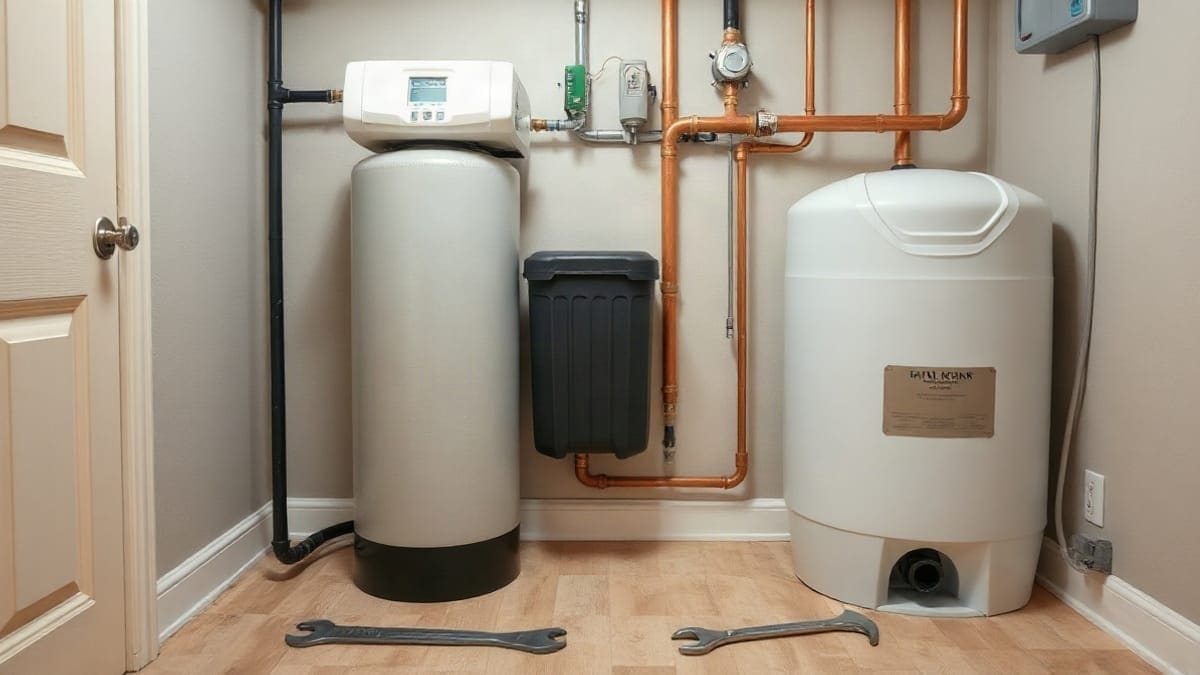
"Water softener installation" is mostly a search for a local installer, and this page is not one. It gives the real steps and numbers printed in the manuals of the SpringWell SS1, the Rheem RHS32, the EcoPure EP31 and the Fleck 5600 SXT valve: pipe sizes, bypass, drain, power, pressure and start-up. It says what a handy owner can do, what a licensed plumber should do, what the plumbing codes ask for, and which models are easiest to fit. Every figure is tied to a manual or an agency page, and where two sources disagree the text says so. We print no prices; for money, read the water softener installation cost page.
How do you install a water softener, step by step?
Water check
Twelve steps cover it: test pressure, pick the spot, shut off water and heater power, set the tank, fit the bypass, plumb inlet and outlet, run the drain with a 1.5 in air gap, leak test, add salt, sanitize, program and regenerate.
The order below follows the Rheem RHS32 manual (Rev. M, February 2025) and the SpringWell SS1 instructions, with the Fleck installer manual for valve details. Your own manual wins where it differs.
- Check the water first. Read supply pressure with a gauge on a hose bib: you need 20 psi or more (Rheem and EcoPure) or 25 to 80 psi (SpringWell), and at least 3 gpm of flow at the inlet. Note your hardness in gpg (your city's EPA water quality report lists it) and any iron in ppm.
- Choose the spot. On the main line, upstream of the water heater, on a flat floor, away from freezing and direct sun, within reach of a 120 V outlet and a drain.
- Shut off the main water and the power or fuel to the water heater. Open all faucets to empty the house pipes. Do not drain the water heater itself.
- Set the tank in place. Level, solid surface. Never shim under the brine tank: Rheem warns the full tank can fracture at the shim.
- Fit the bypass valve. Put a light coat of silicone grease on its O-rings (never petroleum grease, per Fleck), push it into the valve and snap in both clips.
- Plumb inlet and outlet. Hard water goes to the marked inlet. Use copper, threaded pipe, PEX, CPVC or flexible connectors, supported so no weight rests on the valve.
- Run the valve drain hose to a floor drain, standpipe or laundry tub, secured, with a 1.5 in air gap.
- Run the brine tank overflow as its own line to a drain, never tied into the valve drain.
- Leak test. Bypass on, two softened faucets open, main valve opened slowly, then bypass to service in small steps. After about 3 minutes run a hot faucet until the air clears.
- Add about 3 gal of water and salt to the brine tank. Rheem asks for nugget, pellet or coarse solar salt with under 1 percent impurities; SpringWell says 4 to 5 bags of pellets.
- Sanitize and plug in. Rheem suggests 3 oz (6 tablespoons) of household bleach in the brine well, then a manual recharge.
- Program, regenerate and flush. Set time, hardness and recharge time, run the first regeneration, then pass 50 gal through a cold tap, at least 20 minutes by Rheem's count.
Steps 6 to 8 are where most mistakes happen, and they have their own sections below. For a diagram of the pipes, see the plumbing diagram and bypass loop guide.
What parts and tools do you need to install a water softener?
Water check
Expect to buy 3 to 5 plumbing items the box does not hold: a 1 in shut-off valve, flexible connectors 24 in long, PTFE tape, PVC nipples and, if the unit lacks one, a bypass valve.
SpringWell lists its recommended supplies as two or three 1 in by 24 in corrugated connectors, a 1 in by 3 in PVC nipple, a roll of plumber's tape, zip ties and a 1 in PVC shut-off valve, and says quantities vary with the site. It notes the bypass valve is sold separately. The table adds what the Rheem and Fleck manuals call for.
| Item | Size or spec | Why it is needed |
|---|---|---|
| Bypass valve or 3-valve loop | Single valve included with Rheem; sold separately by SpringWell | Isolates the softener while keeping water in the house |
| Flexible connectors | 1 in by 24 in (SpringWell) | Fleck says valve connections must be flexible, with no pipe weight on the valve |
| Drain tubing | 3/8 in hose (Rheem), 50 ft line (SpringWell) | Carries regeneration water to the drain |
| Pipe adapters | 1 in NPT sweat adapters, not included (Rheem drawing) | Joins copper to the valve ports |
| #4 copper wire and clamps | Only with a plastic bypass on metal pipe | Restores the house ground (Rheem) |
Add a pipe cutter, wrenches and a level. PTFE tape goes on threads without an O-ring, and Fleck advises a 100 micron sediment pre-filter ahead of the valve.
Where should a water softener be installed?
Water check
Install it on the main supply line before the water heater and every other branch, except outside faucets. It needs a level floor, a drain nearby, 120 V power, a temperature range of 40 to 120°F and no direct sun.
Rheem and the EcoPure manual put the order in a drawing: well pump and pressure tank or city supply, then any sediment filter, then the softener, then the water heater. Other conditioning equipment goes between the inlet and the softener. Outside faucets stay on hard water so conditioned water and salt are not wasted on the lawn; Penn State Extension also notes toilets, outside spigots and basement sinks can be bypassed. The manuals agree on the rest, and the numbers below come from them.
| Requirement | SpringWell SS1 | Rheem RHS32 and EcoPure EP31 | Fleck 5600 SXT valve |
|---|---|---|---|
| Supply pressure | 25 to 80 psi | 20 to 125 psi | 20 to 125 psi (1.4 to 8.6 bar, converted) |
| Water temperature | 36 to 120°F | 40 to 120°F | up to 109°F (43°C, converted) |
| Minimum flow at inlet | not printed in the guide | 3 gpm | not printed |
| Power | power supply plus 9 V battery | 24 V DC plug-in on 120 V, 60 Hz | supplied transformer, grounded outlet |
| Drain | 50 ft line included | 3/8 in hose, 1.5 in air gap | 1/2 in minimum, air gap required |
| Distance to water heater | not printed | no distance, softener goes ahead of heater | 10 ft minimum pipe run, check valve before heater |
SpringWell's spec table lists the same ranges, and its guide says the unit must go on a main water supply line and asks well owners to call before installing. A softener fits a house only if you can reach the main line and a drain, so a tenant or condo owner should ask building management first. The where to install a water softener page covers basements, garages and sheds in more detail.
How do you plumb the bypass valve and loop?
Water check
A single bypass valve clips onto the head and costs no plumbing, while a 3-valve loop adds an inlet valve, an outlet valve and a bypass valve in the pipe. Both let you shut the softener off and keep water in the house.
Rheem says to always fit either its single bypass or a 3-valve set. The single valve is pushed onto the inlet and outlet ports and held by two clips. The 3-valve loop keeps the ground path of a metal main intact, which the plastic single valve does not. SpringWell notes that without any bypass you must shut off the main supply every time the softener needs service.
Two rules matter more than the layout. First, do not solder with the bypass attached: Rheem says the heat will damage the plastic valve, and Fleck says to let soldered pipes cool before attaching plastic parts and to avoid lead-based solder. Second, support the pipe so nothing pulls on the ports. If the main line is metal and you use a plastic bypass, clamp a #4 copper wire across the removed section to restore the house ground, and check local codes. See how to bypass or remove a water softener for turning one off later.
How do you set up the drain line and air gap?
Water check
The drain hose must end above the drain with a gap of 1.5 in in the Rheem and EcoPure manuals, no figure in the Fleck manual, which says only that an air gap must exist, and 1 in in California code. Never push the hose into the drain.
The gap stops sewer water from being drawn back into the softener. A floor drain is preferred; a laundry tub, sump or standpipe also works. The makers set different limits for hose length and lift.
| Source | Air gap | Preferred run | Lift above the floor |
|---|---|---|---|
| Rheem and EcoPure | 1.5 in minimum | avoid runs over 30 ft | avoid more than 8 ft |
| Fleck 5600 SXT | An air gap must exist; the manual gives no figure (1/2 in drain tube) | within 20 ft; use 3/4 in tube for 20 to 40 ft | up to 6 ft if the run is under 15 ft and pressure is 40 psi or more |
| California Plumbing Code (city summary) | 1 in minimum | not stated | not stated |
Fleck adds about 2 more feet of lift per extra 10 psi, and a 7 in loop at the far end of a lifted line that drains below the valve. The overflow line from the brine tank is separate: Rheem and Fleck both say never tie it into the valve drain, and run it to a drain no higher than the overflow fitting. Secure the end so the hose does not whip during regeneration.
The SpringWell guides we read tell you to slide the drain line into the drain and lock it with zip ties, and show no air gap step, so add one yourself where your code requires it. The water softener drain line and air gap page goes further on floor drains, standpipes and pumps.
What happens after the plumbing is done?
Water check
Fill the brine tank, sanitize with about 3 oz of bleach, plug in, set hardness, run a regeneration and flush 50 gal through a cold tap. Hot water turns fully soft only after the heater refills, usually in a few days.
Rheem's start-up page adds 3 gal of water to the brine tank before the salt, a bleach sanitizing recharge that purges air to the drain, and a flush of 50 gal that takes at least 20 minutes. The SpringWell SS1 guide has you set time and hardness in its app, set a 14-day regeneration override, a 10 percent reserve and 32,000 grains of resin capacity, then press Regenerate Now: the first run lasts 90 minutes and you cannot use water meanwhile. After the leak test, SpringWell has you run water for 5 to 10 minutes and expect a little sediment.
Hardness is the number that matters. The USGS scale and Penn State put 1 gpg at about 17 mg/L, so convert a report with the water hardness converter. If your water has clear-water iron, add to the setting: Rheem says to add 5 to the hardness number for each 1 ppm (its example turns 20 gpg and 2 ppm iron into 30), while the rule of thumb softener makers use elsewhere is 4. The water softener settings, hardness and programming guide explains the rest.
Rheem notes the water heater is full of hard water at first, so the hot water softens as it refills over a few days. To get soft hot water at once, drain the heater, following its instructions, until the water runs cold, after the first regeneration ends. Turn the heater power or fuel back on only then.
Can I install a water softener myself, or do I need a plumber?
Water check
You can do the job yourself if the house is pre-plumbed or you can cut, fit and test pipe. Hire a licensed plumber for soldering in tight spaces, cutting the main line, a new drain, electrical work or where local law requires a license.
The manuals draw a line. The Fleck installer manual says only qualified personnel should install it and that wiring must follow local codes. Rheem tells Massachusetts buyers that a licensed plumber must do the work under that state's code. Where a softener is regulated, as in California, the installer may need a contractor license: see the permit section below.
| Task | DIY owner | Plumber | Why |
|---|---|---|---|
| Fit a plastic bypass valve and flex connectors | Yes, on a pre-plumbed loop | Optional | Hand-tightened clip and O-ring fittings |
| Cut into the main line and solder copper | Only if skilled | Recommended | Heat damages plastic; leaks flood the house |
| Run a new drain with a 1.5 in air gap | Yes with a floor drain | Recommended with no drain | Codes govern drains |
| Ground wire across a plastic bypass | Check local code | Recommended | House ground depends on the pipe |
| Pressure reducing valve | If you can read a gauge | Recommended | A wrong setting overpressures the softener |
If you can shut off the main, cut pipe and make a leak-free joint, the steps above are enough. If not, a plumber on the main line and you on the rest is a sensible split.
Do you need a permit or a license to install a water softener?
Water check
It depends on your city, county and state: there is no national rule. Cutting into potable or drain lines often triggers a permit, and some places, such as California, require a licensed contractor to sign an installation certificate.
The Pleasanton, California building department states that under the 2019 California Plumbing Code (section 611) and state health and safety law, softeners must meet NSF/ANSI 44, regenerate on demand, be rated at 4,000 grains per pound of salt or better (NSF/ANSI 44 is the listing to look up), and drain to the sewer with a 1 in air gap. A C-55 or C-36 contractor completes the certificate. Rheem's manual separately names Massachusetts as a state that needs a licensed plumber. We could not open the text of the model plumbing codes, whose air gap and indirect waste rules are the usual basis, so we rely on those documents and the makers' manuals.
Call your local building department before cutting any pipe and ask whether you need a permit, whether a homeowner may pull it and whether the code adds rules for softeners.
Who installs water softeners, and does Home Depot or Lowe's?
Water check
Plumbers, water treatment dealers and some big retailers install them; the store usually sells the service with the softener. We found no maker table of cost, so check the installation cost page and ask for a written quote.
Home Depot lists water heater and treatment services on its US site, and search results describe a free water test followed by a quote from a local contractor. We did not open Lowe's, Menards or Sears service pages, so we state nothing about their programs. Ask whether a quote covers the bypass, the air gap, a pressure check, haul-away and any permit. The PNNL guide says installation should follow local regulations and the maker's instructions. The cost drivers are pipe type, drain distance, access and local labor, which is why we print no figure. The water softener cost guide covers buying the unit.
How long does it take to install a water softener?
Water check
The timed steps alone run about 100 minutes on a SpringWell SS1: 5 to 10 minutes of flow plus a 90 minute first regeneration. Add the pipe work, which depends on the house; makers publish no total.
None of the manuals give a total, so we add what they time. On the SS1, the flush is 5 to 10 minutes and the forced regeneration 90, about 95 to 100 minutes. On the Rheem RHS32, add at least 20 minutes of flushing to a sanitizing recharge whose length the manual does not state. A pre-plumbed house removes the soldering; a house that needs the main cut or a new drain takes longer.
What size water softener fits a 2,000 sq ft house?
Water check
Square footage does not size a softener: people, hardness and flow do. Four people at 10 gpg remove 3,000 grains a day (4 x 75 x 10), so a 32,000-grain unit regenerates about every 10 to 11 days.
A 2,000 sq ft house with four people on 10 gpg water suits a 32,000-grain unit; choose a higher flow rating if three or more bathrooms run together. Run your own numbers in the water softener size calculator, and read what size water softener do I need for the full method.
Does a water softener reduce water pressure?
Water check
A softener adds a pressure drop: 14.9 psig at the rated flow of 7.2 gpm on the EcoPure EP31. On a 60 psi supply that leaves about 45 psi at the outlet at full flow, enough for most homes.
The EcoPure manual (see above) lists 14.9 psig as the loss at rated service flow for the EP31 (7.2 gpm) and the EP42 (8.2 gpm). A softener also needs a minimum of 3 gpm at the inlet and 20 psi or more to draw brine; SpringWell sets 25 to 80 psi. The risk is the other way: Rheem warns that if daytime pressure exceeds 80 psi, night pressure may pass the 125 psi maximum, so add a pressure reducing valve, which can cut flow. With a backflow preventer, Rheem says fit an expansion tank under local codes.
Which water softeners are the easiest to install?
Water check
The SpringWell SS1 (1 in ports, 50 ft drain line in the box), the Rheem RHS32 and the EcoPure EP31 (single bypass and drain hose included, plug-in power) are the easiest here. The Fleck 5600SXT suits a plumber.
Ease comes from what is in the box and how forgiving the unit is of pipe and pressure; figures come from the manuals and the best water softener guide.
SpringWell SS1: easiest for a clear main line
The SS1 comes as a 9 in by 48 in tank with a 1 in connection, 11 GPM service flow and a 50 ft drain line. The installation guide asks for 1 in flexible connectors, a 1 in PVC shut-off valve and plumber's tape, sets it up through an app, and runs a 90 minute first regeneration. Its older combined guide for the SS1 and a well filter listed 3/4 in connections, so check the port size on your unit.
Best for: a one-to-three bathroom home with a pre-plumbed main and no iron. Not for: a well, where SpringWell asks you to call first.
Rheem RHS32: a complete kit with a plug-in controller
The RHS32 ships with its single bypass valve, a drain hose and a plug-in power supply, and takes a supply of 20 to 125 psi at 40 to 120°F. The manual is the most complete walk-through of the 12 steps above, down to the bleach dose.
Best for: an owner who wants every step printed. Not for: a house that needs 11 GPM or more.
EcoPure EP31: the same install on a smaller tank
The EP31 uses the same installation text as the Rheem, with 0.81 cu ft of resin, a 7.2 gpm rated flow and a 14.9 psig drop. Its manual caps the drain flow at 2.0 gpm.
Best for: a one-to-four person home. Not for: a house with three or more bathrooms in use at once.
Fleck 5600SXT kit: for a plumber
The Fleck 5600 SXT valve needs flexible piping, a drain with an air gap, a supplied transformer and a 10 ft pipe run to the water heater. Its installer manual says qualified personnel install it, and kits assembled by resellers differ.
Best for: a home with an installer and a wish for serviceable parts. Not for: a first-time DIY job.
6 common mistakes with water softener installation
Water check
Six errors cause most damage: soldering with the bypass on, no air gap, a tied-in overflow, shims under the brine tank, wrong place on the line and a broken ground. Each is named in the manuals above.
Soldering with the plastic bypass attached
Rheem says the heat will damage the plastic valve, and Fleck says to let pipes cool first. Solder dry fittings before the valve goes on. Repairing it means replacing the valve.
Pushing the drain hose into the drain
Without a 1.5 in air gap, sewer water can back up into the softener. Rheem says not to put the hose end into the drain.
Tying the overflow into the valve drain
Rheem and Fleck both say the brine tank overflow is a direct, separate line. Joined, it backs up and floods the floor during regeneration.
Shimming the brine tank
Rheem says shims under the salt tank can fracture it once full of water and salt. Level the floor, or the base, instead.
Putting the softener after the water heater, or softening outside taps
Install it between the inlet and the heater, with outside faucets left hard. Otherwise you soften lawn water and the heater scales.
Breaking the ground on a metal main
A plastic bypass breaks the cold water pipe ground. Rheem says to clamp a #4 copper wire across the gap, and the 3-valve loop keeps continuity. Check local code.
Frequently asked questions
How hard is it to install a water softener?
If you have a pre-plumbed loop, the work is fitting a bypass, two connectors, a drain hose and a power cord: about 12 steps. If the main line must be cut and soldered, a plumber is the safer choice. The SpringWell SS1 guide numbers 86 steps up to the end of the first regeneration, most of them photo captions for single actions.
Can you install a water softener in an apartment, condo or mobile home?
Only if you control the main supply line and a drain. SpringWell says the system must be on a main water supply line. In a rented or shared building, ask the landlord or association first; a softener that cannot reach the main will not condition the whole home.
Can you install a water softener outside or in a garage?
Rheem and EcoPure say not where it freezes and not where water is over 120°F, and to avoid direct sun. A garage that stays above freezing meets that. Outdoors, you need a shelter. See the where to install a water softener guide.
How do you install a water softener with a well?
Put a pressure tank first, then any sediment filter, then the softener, then the water heater. SpringWell asks well owners to call before installing, and Rheem says to raise pump output to at least 20 psi if pressure is low. Test the water first, because EPA leaves private wells to the owner and WQA lists certified products. See best water softener for well water.
How do you install a water softener with no floor drain?
Rheem lists a laundry tub, sump or standpipe as drain options, all with a 1.5 in air gap, and a rigid 1/2 in line where codes bar flexible hose. Avoid runs over 30 ft. Where no drain is near, a plumber should look at a pump.
Can you install a water softener without a loop?
Yes, with a single bypass valve on the head, as in the Rheem kit, which clips to the ports with no extra pipe. A 3-valve loop adds service ease. Without any bypass, SpringWell says you must shut off the main every time.
How do you hook up a water softener in a pre-plumbed house?
Connect the pre-plumb stubs with flexible connectors: hard line to the inlet, the home line to the outlet. SpringWell's guide uses 1 in threaded adapters, a PVC shut-off valve and corrugated connectors. Run the drain and test for leaks.
How long after installing a water softener until the water is soft?
Cold water softens once the first regeneration and flush finish. Hot water follows when the heater refills, in a few days, per Rheem, or at once if you drain the heater until it runs cold.
Where does the brine line connect during installation?
Set it beside the softener, push the brine line into the brine well, add 3 gal of water (Rheem) or 4 to 5 bags of pellets (SpringWell) and run the overflow to its own drain.
How do you uninstall a water softener?
Put the bypass in bypass, unplug it, drain and disconnect, then close the pipe or loop. See how to bypass or remove a water softener.
How we researched this page
Water check
We read the installation manuals of the Rheem RHS32, the EcoPure EP31, the SpringWell SS1 and the Fleck 5600 SXT valve in November 2026, plus a city permit document and Penn State Extension. We did not install a unit.
The Rheem manual is Rev. M (6 February 2025) and the Fleck manual is dated 23 September 2020. Fleck's numbers are metric in the source and the inch and psi values are our conversions. We could not open the model plumbing codes (IPC and UPC) or the permit pages of most cities, so permit rules are stated only where a city document was read. We found no maker installation time. Prices are left out on purpose. The model figures match the best water softener guide, and the SpringWell SS1 review covers the unit in full.
Sources
Our sources by topic
Public agencies and universities
- City of Pleasanton, water softener installation requirements.
- Penn State Extension, Water Softening; USGS, Hardness of water; U.S. EPA, private wells.
Manufacturers, retailers and other references
- Rheem, RHS32 Installation and Operation Manual; EcoPure, EP31 and EP42 manual.
- SpringWell, SS1, SS4 and SS+ installation instructions and the well filter and softener guide.
- Pentair, Fleck 5600 SXT installer manual.
- Home Depot, water heater and treatment services; NSF, certified drinking water treatment units.
Keep comparing
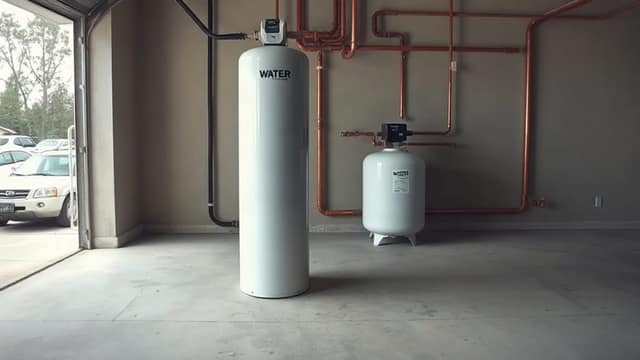 Salt-Free Water SoftenerEight salt-free water conditioners compared by flow in GPM, hardness limit in gpg
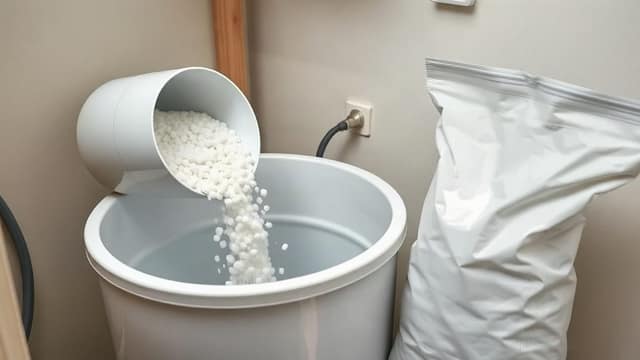 Water Softener SaltTen water softener salts in 40 lb bags compared by form, stated purity, iron additive and NSF listing
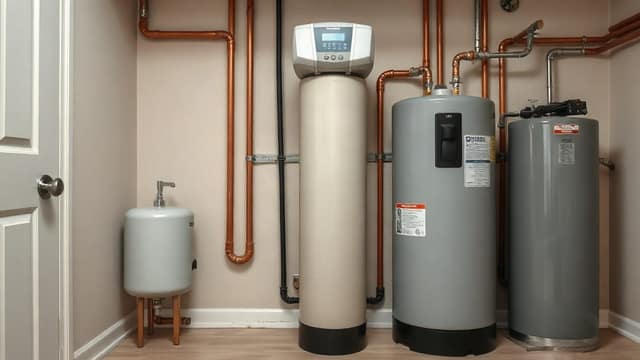 Water Softener Maintenance Checklist (Monthly, Yearly)Salt checks every 2 to 4 weeks, cleaner every 4 months, brine tank yearly, resin life
 Water Softener RepairA symptom, cause, test and fix table, salt bridge and brine tank steps, error codes, who to call
 How Does a Water Softener Work? (Ion Exchange Explained)Resin beads swap calcium and magnesium for sodium, then a brine rinse recharges them
 Water Softener BrandsWater softener brands compared by who builds them, NSF and WQA listings, valve