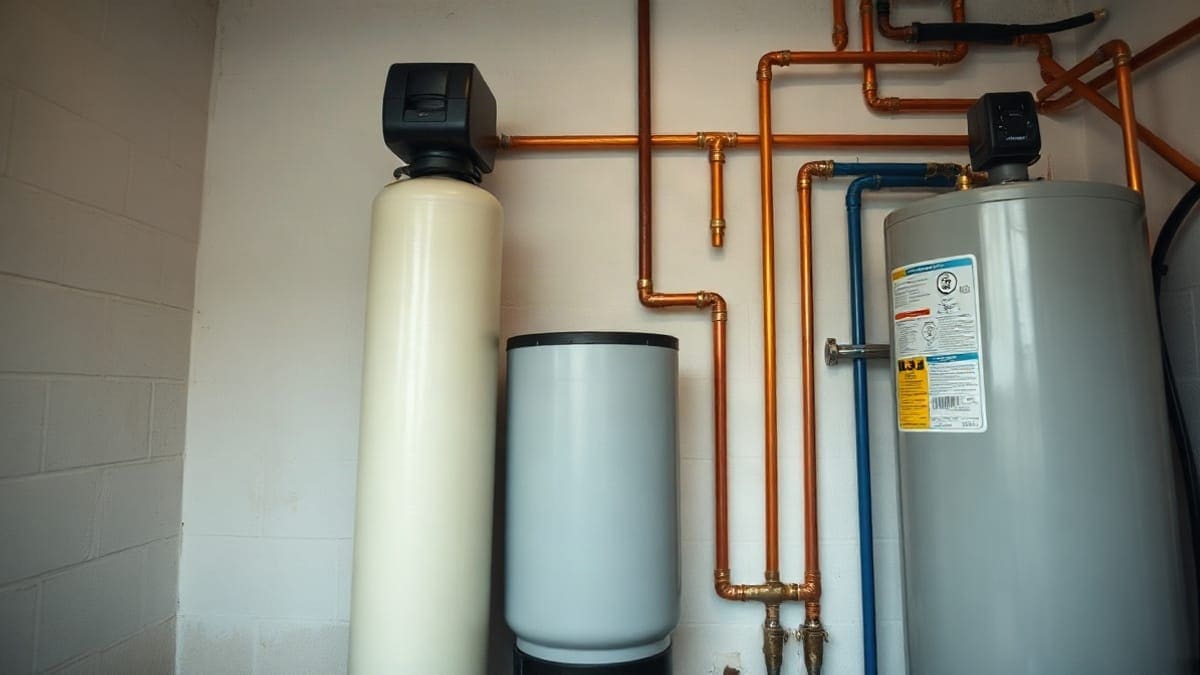
The real answer is a sum. A salt-based softener swaps hardness minerals for sodium, and how much sodium depends on how hard your water was. This page does that sum for 5 to 30 gpg and sets it against the limits the FDA, the American Heart Association and the EPA publish. It says where the evidence is thin, who should ask a doctor first, and how to keep sodium out of your glass, with five products that fit. A softener changes hardness, not safety, so the same sum also shows when a separate drinking tap is worth adding to your kitchen.
Should you drink softened water?
Water check
For most healthy adults, yes. Penn State Extension names low-sodium diets as the major disadvantage of softening, which makes softened water a question about sodium, not a poison. The amount depends on hardness, and the table below shows it.
A salt softener is an ion exchanger. Resin beads hold sodium and trade it for the calcium and magnesium in your water. Penn State Extension's water softening guide puts it in one line: the exchange adds 7.5 milligrams of sodium per quart for each gpg of hardness removed, and it calls the risk for people on low-sodium diets "the major disadvantage". It does not say softened water is unsafe for everyone else. The Vermont Department of Health says most conventional softeners add small amounts of sodium.
Two limits on that answer. A softener changes hardness, not safety: Penn State says softeners will not necessarily remove any of the more serious drinking water contamination problems. And "most healthy adults" is a judgment from the sodium arithmetic below: we found no study that followed people drinking softened tap water for years. On hardness itself, read is hard water bad for you and hard water vs soft water.
How salty is a glass of softened water, in milligrams?
Water check
An 8 oz glass gains about 1.9 mg of sodium per gpg removed: 19 mg at 10 gpg, 38 mg at 20 gpg and 56 mg at 30 gpg. Two quarts a day add 150 mg at 10 gpg, which is 6.5 percent of 2,300 mg.
The sum is Penn State's 7.5 mg per quart per gpg applied to your hardness; an 8 oz glass is a quarter of a quart. EPA's levels are in mg/L, and a quart is 0.946 L, so each gpg removed adds about 7.9 mg/L. As a cross-check, Virginia Tech's extension publication gives about 1 mg/L of sodium for every 2.1 mg/L of hardness removed. At 10 gpg, 171 mg/L of hardness divided by 2.1 is 81 mg/L, close to our 79 mg/L, so the two sources agree.
| Hardness removed | Per 8 oz glass | Per 2 quarts a day | Per liter | Share of 2,300 mg | Share of 1,500 mg | Share of 500 mg |
|---|---|---|---|---|---|---|
| 5 gpg | 9 mg | 75 mg | 40 mg/L | 3.3% | 5.0% | 15% |
| 10 gpg | 19 mg | 150 mg | 79 mg/L | 6.5% | 10.0% | 30% |
| 15 gpg | 28 mg | 225 mg | 119 mg/L | 9.8% | 15.0% | 45% |
| 20 gpg | 38 mg | 300 mg | 159 mg/L | 13.0% | 20.0% | 60% |
| 25 gpg | 47 mg | 375 mg | 198 mg/L | 16.3% | 25.0% | 75% |
| 30 gpg | 56 mg | 450 mg | 238 mg/L | 19.6% | 30.0% | 90% |
Convert a report in mg/L or ppm with the water hardness converter, dividing by 17.1 to get gpg. A softener set to leave some hardness adds less, since sodium follows what was removed. The sodium your water already carries comes on top: EPA's 2003 sodium advisory reports median public water system levels generally below 30 mg/L, with a 99th percentile of 517 mg/L in the national survey it used. The sodium question alone is in do water softeners add sodium to water.
How does that compare with the daily sodium limit?
Water check
The FDA Daily Value is under 2,300 mg a day and Americans eat about 3,400 mg. The American Heart Association aims for 1,500 mg. Two quarts of 10 gpg softened water add 150 mg, so food, not the tap, is the big source.
The FDA's sodium page says the Daily Value is less than 2,300 mg a day and that Americans eat about 3,400 mg on average. The American Heart Association recommends no more than 2,300 mg a day for most adults, with an optimal goal of 1,500 mg. The EPA's drinking-water guidance number is different: 20 mg/L, built for people limited to 500 mg of total sodium a day, and the EPA writes that it should not be extrapolated to the entire population.
| Reference | Limit | Who it is for | 150 mg from 2 quarts of 10 gpg water is |
|---|---|---|---|
| FDA Daily Value | under 2,300 mg a day | Adults generally | 6.5% |
| American Heart Association optimal goal | 1,500 mg a day | Most adults | 10% |
| Average American intake (FDA) | about 3,400 mg a day | What people actually eat | 4.4% |
| EPA drinking water guidance | 20 mg/L, tied to a 500 mg a day diet | People on very low sodium diets | 30% of the 500 mg diet |
Does softened water taste salty?
Water check
Not at modest hardness. The EPA treats 30 to 60 mg/L of sodium as a range most people do not perceive as salty. Removing about 4 to 8 gpg adds that much, so water softened from 10 gpg or more is where some drinkers notice it.
The 30 to 60 mg/L range is a taste recommendation in the EPA advisory, not a health limit. Water in that range is unlikely to be perceived as salty by most people and contributes only 2.5 to 5 percent of a 2.4 g daily sodium goal at 2 L a day. Divide by our 7.9 mg/L per gpg: 30 mg/L is about 3.8 gpg removed, and 60 mg/L about 7.6 gpg.
Taste is personal, and the sodium already in your supply counts too.
Does drinking softened water raise blood pressure?
Water check
Nobody has shown that softened tap water does. A 2025 review of 27 observational studies tied salty drinking water to blood pressure about 3.2 mmHg higher, but those studies mostly concern coastal salinity, far saltier than a softened tap.
A BMJ Global Health meta-analysis from December 2025 pooled 27 observational studies of about 74,000 people. Per the published coverage we could read, higher drinking-water salinity went with systolic pressure about 3.2 mmHg higher, diastolic about 2.8 mmHg higher, and a pooled odds ratio for hypertension of 1.26. The association was clearest in coastal populations. Observational studies show association, not cause, and none measures softener sodium.
So the honest reading is short. Sodium from any source counts toward your total, and water is a small share for most people: 150 mg a day against the FDA's 3,400 mg average. The evidence that water sodium moves blood pressure is modest and comes from much saltier water. We found no study of softened tap water and blood pressure, and we claim neither a benefit nor a harm. If your doctor set a salt target, ask them.
Who should ask a doctor before drinking softened water?
Water check
People on a sodium or potassium limit, with high blood pressure or kidney disease, and anyone mixing infant formula. Until you ask, use an unsoftened or reverse osmosis tap.
None of this is medical advice, and your care team's instructions come first.
| Group | Why it matters | Source we read | A sensible step |
|---|---|---|---|
| Low-sodium diet, such as 1,500 mg or 500 mg a day | Softened water at 10 gpg adds 10% or 30% of that in 2 quarts | Penn State, Vermont, EPA | Ask the doctor; use an unsoftened or RO tap |
| High blood pressure | Sodium counts toward the total | AHA goal of 1,500 mg | Ask the doctor about water sodium |
| Kidney disease, dialysis | Potassium softener salt adds potassium | Health Canada | Ask before any potassium salt |
| Infants on formula | ASPEN says chemically softened water is not appropriate | ASPEN 2025 | Ask the pediatrician; use another water |
| Pregnancy | We found no softened-water source | None | Tell your obstetrician about the softener |
Is softened water safe for babies and infant formula?
ASPEN's 2025 statement says chemically softened water is not appropriate for preparing infant formula because of its higher sodium. Ask your pediatrician, and mix formula with unsoftened or other safe water.
The ASPEN statement on contaminants in infant formula, dated April 16, 2025, says tap water can be used where it is deemed safe, that chemically softened water is "not appropriate for the preparation of infant formula due to the higher sodium content", and that well water is not appropriate because of sanitation and contaminant concerns. The American Academy of Pediatrics' HealthyChildren page says to use a water source your state or local government deems safe. It does not mention softened water, and we could not open a CDC page that does.
Is potassium-softened water better to drink?
Water check
It avoids added sodium, but it adds potassium instead: about 14 mg/L for each gpg removed, per Health Canada's figure. At 20 gpg, two liters carry about 560 mg. People with kidney disease or certain medicines should ask first.
Potassium chloride salt trades potassium for hardness. Health Canada's guidance on potassium and water softeners gives an example of 14 mg of potassium per liter at 17 mg/L of hardness, which is about 14 mg/L per gpg. It says people with kidney disease are most at risk, and so are people with heart disease, hypertension or diabetes who take medicines that affect potassium, such as ACE inhibitors, angiotensin II receptor blockers and potassium-sparing diuretics. It says healthy people are unlikely to develop hyperkalemia from softened water alone, and it puts adequate intake for adults at 4.7 g a day.
| Hardness removed | Potassium per liter | Per 2 liters a day | Share of 4.7 g adequate intake | Sodium for comparison, per liter |
|---|---|---|---|---|
| 5 gpg | 70 mg/L | 140 mg | 3.0% | 40 mg/L |
| 10 gpg | 140 mg/L | 280 mg | 6.0% | 79 mg/L |
| 15 gpg | 210 mg/L | 420 mg | 8.9% | 119 mg/L |
| 20 gpg | 280 mg/L | 560 mg | 11.9% | 159 mg/L |
| 30 gpg | 420 mg/L | 840 mg | 17.9% | 238 mg/L |
The table is our arithmetic from Health Canada's ratio. It shows two things. Potassium mass is nearly double the sodium mass for the same hardness, and for a healthy adult the amounts are small against 4.7 g. Health Canada notes that people on dialysis are normally held to 2 to 3 g of potassium a day, where 560 mg is 19 to 28 percent. The NIH Office of Dietary Supplements says, in text we saw only in search results, that kidney disease and drugs such as ACE inhibitors can raise blood potassium even at typical intakes. For the two salts side by side, see potassium chloride vs sodium chloride softener salt and our best water softener salt guide.
What about plants, pets and softened well water?
Water check
Sodium builds up in potted soil, so water plants from an unsoftened faucet. Pets get their own page. A softener does not disinfect: on a private well, the owner must test the water.
New Mexico State's extension says sodium concentrates in potting soil as water evaporates and suggests watering from an unsoftened faucet (NMSU). Animals have their own page, is softened water safe for dogs and pets.
On a well, the EPA says owners are responsible for delivering safe drinking water, and well quality is not regulated under the Safe Drinking Water Act. A softener removes hardness and does not treat bacteria or nitrate. Test first with a state-certified lab, use the well water treatment finder to order the steps, and see best water softener for well water for models. City drinkers can find their report through the EPA consumer confidence report page.
How do you keep sodium out of your drinking water?
Water check
Three routes work: an unsoftened cold line, a reverse osmosis tap, or potassium salt. Virginia Tech names reverse osmosis and distillation as the sodium-removal treatments. Pitcher filters and boiling are not on that list.
Virginia Tech suggests leaving cold water lines untreated for drinking and food preparation and softening only the hot water, and names reverse osmosis and distillation as the methods that remove sodium. The table sets the options side by side.
| Option | Sodium in the glass | What it costs you in effort | What to check |
|---|---|---|---|
| Unsoftened cold line to the kitchen | None added by the softener | A plumber to split the line | Your raw hardness, because hard water stays hard there |
| Reverse osmosis tap | Cut by the membrane; the listing proves 75% or more TDS reduction | Under-sink space, filter changes, drain water | NSF/ANSI 58 listing for the exact model |
| Potassium chloride salt | Sodium replaced by potassium | Salt costs, a doctor's approval if kidneys matter | Health Canada's potassium numbers above |
| Carbon pitcher or faucet filter | No sodium claim to rely on | Cartridge changes | Ask for a listing with a sodium or TDS claim |
| Boiling | More concentrated, not less | None | Do not use it to cut sodium |
What does a reverse osmosis tap actually prove?
An NSF/ANSI 58 listing proves total dissolved solids reduction, and EPA's WaterSense specification requires at least 75 percent each day. Sodium is part of dissolved solids, but the listings we read give no sodium-only figure.
The EPA WaterSense specification for point-of-use RO systems requires a TDS reduction of at least 75 percent each day, built on NSF/ANSI 58. NSF's own database lists the iSpring RCC7AK at 21.04 gpd and the RO500AK-BN at 500 gpd, each with a TDS reduction claim (NSF iSpring listing, current to November 17, 2026), and the Express Water RO10DX at 21.89 gpd (NSF Express Water listing). A TDS claim is not a sodium claim, so we say "cuts dissolved solids, which include sodium", never a sodium percentage.
Drain water is the cost: the EPA WaterSense page says a typical system sends 5 gallons or more down the drain per gallon made, and a labeled one 2.3 gallons or less. For a drinking tap it is small: Penn State puts drinking and cooking at 1 gallon per person per day. Certification detail is in best reverse osmosis system; formats in best under sink reverse osmosis system and best countertop reverse osmosis system. How the membrane works: what is reverse osmosis.
Do pitcher filters remove salt from softened water?
Not reliably. Virginia Tech lists reverse osmosis and distillation for sodium, and a carbon pitcher is not named. Look for a listing with a sodium or TDS claim before you count on one.
Carbon filters are built for chlorine taste and some metals, and we found no sodium claim for a standard pitcher. See best water filter pitcher.
Which products fit a sodium-limited household?
Water check
Four reverse osmosis systems and one potassium salt. The iSpring RO500AK-BN is NSF-listed at 500 gpd for TDS reduction, the AquaTru Classic needs no plumbing, and Diamond Crystal's 40 lb potassium chloride keeps the whole-house softener.
No prices are printed here. Buying through a Check price button earns this site a commission and does not change your price.
| Product | Format | What is verified | Power |
|---|---|---|---|
| iSpring RO500AK-BN | Under sink, tankless | NSF/ANSI 58 listed, 500 gpd, TDS reduction only; 2:1 pure to drain | Pump, plug-in |
| iSpring RCC7AK | Under sink, tank | NSF/ANSI 58 listed, 21.04 gpd, TDS reduction only; 75 GPD rated | None |
| Express Water RO10DX | Under sink, tank | NSF/ANSI 58 listed, 21.89 gpd, TDS reduction only; 100 GPD rated | None |
| AquaTru Classic | Countertop | Maker says IAPMO certified to NSF standards; not found in NSF database | 120 V |
| Diamond Crystal Potassium Chloride | Softener salt | 40 lb bag, about 99 percent potassium chloride per the maker | None |
iSpring RO500AK-BN
The RO500AK-BN page lists 2:1 pure to drain and 0.4 gallons per minute; NSF lists it at 500 gpd for TDS reduction. The pump needs a cabinet outlet. No lead or fluoride claim is listed.
Best for: a family on a sodium limit that wants fast flow at one tap. Not for: anyone who needs a metals claim on the listing. Check price on Amazon
iSpring RCC7AK
A six-stage tank system rated at 75 GPD with a 45 to 70 psi feed range, with no power. NSF lists the base RCC7AK at 21.04 gpd for TDS reduction. See the iSpring RCC7AK review.
Best for: a cabinet without an outlet and at least 45 psi. Not for: low water pressure. Check price on Amazon
Express Water RO10DX
The Express Water RO10DX is rated at 100 GPD and 40 to 80 psi, and NSF lists it at 21.89 gpd for TDS reduction. The maker page gives two different tank sizes, 3.2 and 4 gallons, so ask which one ships.
Best for: a tank system with a listing you can look up yourself. Not for: feed pressure below 40 psi. Check price on Amazon
AquaTru Classic
The AquaTru Classic sits on the counter at 12 by 14 by 14 inches and about 17 lb, holds 0.75 gallon and runs on 120 V. AquaTru says IAPMO certified it to NSF standards, which we could not confirm in a database. Its Connect model data sheet sets a 10 gpg hardness limit; check the Classic's manual.
Best for: renters and anyone who cannot drill. Not for: a big family that drinks and cooks a lot. Check price on Amazon
Diamond Crystal Potassium Chloride
The maker's page sells a 40 lb bag for water softeners. Retailer listings give 99.1 percent potassium chloride and the Cargill sell sheet 99.2. It swaps in potassium, so the potassium section above applies.
Best for: a sodium-limited household that wants a softened whole house and has doctor approval. Not for: kidney disease or potassium-affecting medicine without a doctor's yes. Check price on Amazon
6 common mistakes with drinking softened water
Water check
The costliest mistakes are softening the kitchen tap for a sodium-limited home, mixing formula with softened water, switching to potassium unprompted, trusting a pitcher, buying a reverse osmosis system by label and treating a softened well as safe.
Softening the kitchen tap in a sodium-limited home
At 20 gpg, two quarts add 300 mg of sodium, 60 percent of a 500 mg day. A split cold line avoids it.
Mixing infant formula with softened water
ASPEN's 2025 statement calls chemically softened water not appropriate for formula. Use another safe water and ask the pediatrician.
Switching to potassium salt without asking
Potassium adds about 14 mg/L per gpg, nearly twice the sodium mass. For kidney disease or ACE inhibitors, the swap is a doctor's decision.
Trusting a pitcher to remove the sodium
Virginia Tech names reverse osmosis and distillation. A carbon pitcher without a listing for sodium or TDS gives false comfort.
Buying a reverse osmosis system by the sales page
The base RCC7AK listing is 21.04 gpd, TDS reduction only, against 75 GPD rated. Read your exact model on info.nsf.org.
Treating a softened well as safe
A softener does not disinfect. Test the well at a state-certified lab, and read best well water filtration system for what comes next.
Frequently asked questions
Can softened water harm a healthy adult?
For most healthy adults, no study we found shows harm at normal softener sodium, and the added amount is small against the FDA's 2,300 mg limit. It matters most for people on a sodium or potassium limit and for infant formula. Ask your doctor if either applies.
Is drinking softened water daily a problem?
Usually yes. Two quarts at 10 gpg add about 150 mg of sodium, 6.5 percent of 2,300 mg. At 25 to 30 gpg it is 375 to 450 mg, so a bypass or reverse osmosis tap makes sense.
What if my softened water comes from a private well?
The well is the risk, not the softener, which does not treat bacteria or nitrate. Test at a state-certified lab first.
Does boiling softened water remove the sodium?
No. Boiling drives off water, so sodium becomes more concentrated. Virginia Tech lists reverse osmosis and distillation as the methods that remove sodium and chloride.
Do Brita filters remove salt from softened water?
Not reliably. A standard carbon pitcher is made for taste and some metals, and we found no sodium claim for one. See best water filter pitcher for what pitchers do cover.
Can you drink water softened with potassium chloride?
Healthy adults generally can: Health Canada says hyperkalemia is unlikely from softened water alone. Kidney disease or potassium-affecting medicines call for a doctor first.
Can you drink softened water when pregnant?
We found no source that speaks to pregnancy and softened water, so we make no claim. Tell your obstetrician you have a softener and ask how to count the sodium.
Does drinking softened water cause diarrhea or indigestion?
We found no study linking softened tap water at normal sodium levels to digestive upset. If symptoms follow a change in your water, see a doctor and have the water tested.
Is softened water better for your skin?
That is a different question, answered in hard water vs soft water. We make no skin claim here.
How do I know how much sodium is in my softened water?
Ask a state-certified lab for a sodium test of a kitchen tap sample. Or estimate: multiply your hardness in gpg by 7.9 mg/L, and add the sodium in your raw water from your annual report.
Are water softeners bad for septic systems?
Penn State says a softener uses about 50 gallons per regeneration, which "may or may not" overload a septic system. Ask your installer; how does a water softener work explains a cycle.
Should you drink softened water or filtered water?
If sodium matters, reverse osmosis. A softener fixes scale, not contaminants. See water softener vs water filter and best water softener.
How we researched this page
Water check
The sodium figures come from Penn State Extension and Virginia Tech, the limits from the FDA, the American Heart Association and the EPA, and the potassium figures from Health Canada. We have not tested any softener or filter, and we publish no prices.
We opened the Penn State, FDA, AHA, Vermont, Virginia Tech, Health Canada, EPA, ASPEN, AAP, NMSU and NSF pages named in Sources on November 18, 2026. All tables are our arithmetic from those figures, not measurements.
Not confirmed: the BMJ Global Health paper refused our request, so its figures come from published coverage; the NIH potassium page refused our request, so its statements come from search results; the CDC formula page returned an error; and AquaTru and Diamond Crystal pages refused our request, so their details come from search results and, for NSF listing of the potassium salt, our salt guide. We did not confirm iSpring's feed pressure for the RO500AK-BN. The iSpring RCC7AK and Express Water RO10DX ratings come from our reverse osmosis guide.
Sources
Our sources by topic
Public agencies and universities
- Penn State Extension, Water Softening: 7.5 mg of sodium per quart per gpg, 1 gallon per person per day, 50 gallons per regeneration.
- FDA, Sodium in Your Diet; American Heart Association, How much sodium should I eat per day.
- EPA, Drinking Water Advisory on Sodium, 2003; WaterSense RO specification; WaterSense RO page; private wells; consumer confidence reports.
- Virginia Tech, Sodium and Chloride in Household Drinking Water; Vermont Department of Health.
- Health Canada, Guidance on potassium and water softeners; NIH Office of Dietary Supplements, Potassium.
Certification and standards bodies
- NSF, iSpring listing and Express Water listing; NMSU, softened water and plants.
Manufacturers, retailers and other references
Keep comparing
 What Is Hard Water? Causes, Hard vs Soft Water and ExamplesHard water is water with dissolved calcium and magnesium
 Water Hardness Test Kits and StripsTen water hardness tests compared by range in ppm and gpg, tests per pack
 Salt vs Salt-Free Water SoftenerHardness removed, scale, sodium, salt, wastewater, upkeep, California limits and certifications
 Water SoftenerEleven water softeners sold in the US compared by grains, GPM, salt use and certification
 Salt-Free Water SoftenerEight salt-free water conditioners compared by flow in GPM, hardness limit in gpg
 Water Softener InstallationPipe sizes, bypass, drain air gap, psi limits, first regeneration, DIY or plumber