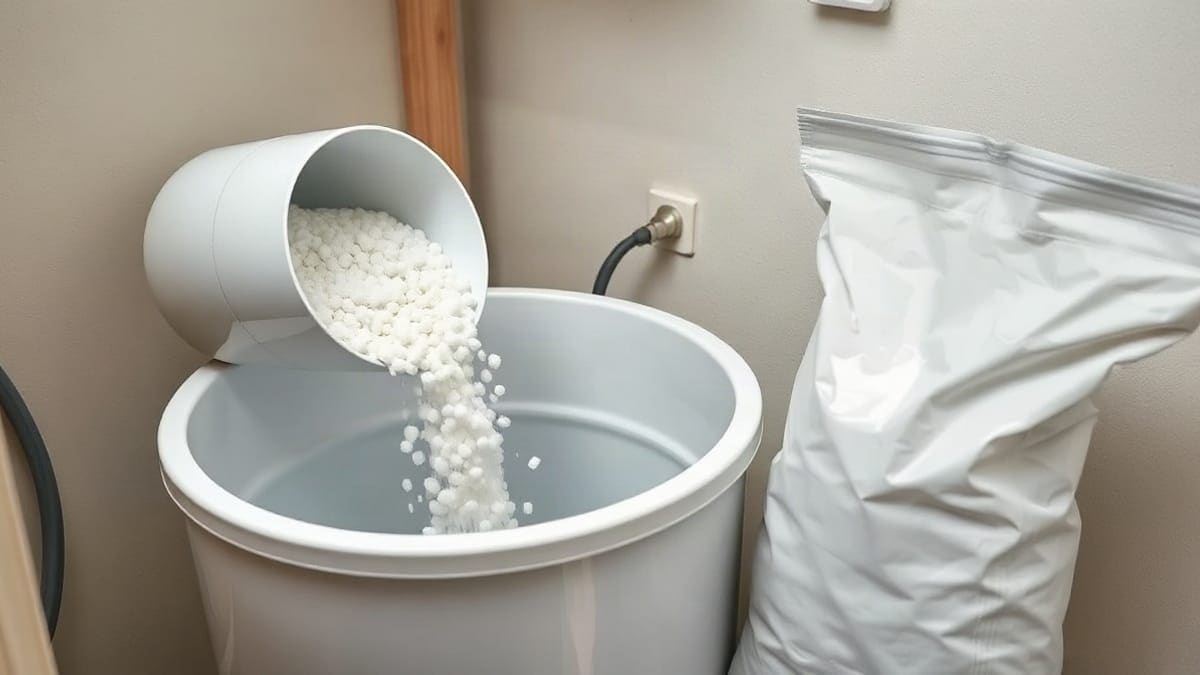
Softener salt is the brine that recharges the resin, so three things matter: how pure it is, what form it takes and whether it carries an additive your water needs. Ten salts on US shelves are compared below using each maker's printed figures and the NSF database listings we found. A salt that looks cheap on the shelf is not cheap if you burn twice the pounds, so the page also works out how much a household uses, from 6.7 lb a month for one person to 52 lb for six, on 10 gpg water. No prices appear anywhere. Run your own hardness through the water softener size calculator before you buy.
Ten water softener salts at a glance
Water check
Ten salts in 40 lb bags range from typically 99.1% to 99.8% pure where the maker prints a figure. Morton and SureSoft print none for most products, so compare listings and additives, not adjectives.
The table shows what each maker's own page says, read in November 2026. A dash means the page gives no figure. "Typically" is the maker's word, not a guaranteed minimum.
| Salt | Form | Purity as the maker states it | Additive for iron or rust | Bag |
|---|---|---|---|---|
| Diamond Crystal Bright & Soft | Pellets | Typically 99.8% | None named | 40 lb |
| Diamond Crystal Solar Naturals | Crystals | Typically 99.6% | None named | 40 lb |
| Diamond Crystal Iron Fighter | Pellets | Typically 99.6% | Rust-stain additive | 40 lb |
| Morton Clean and Protect | Pellets | Not stated | None named | 25, 40 and 44 lb |
| Morton Clean and Protect Plus Rust Defense | Pellets | Not stated | Rust Defense | 40 lb |
| Morton Pure and Natural | Crystals | "High-purity", no percentage | None named | 40 lb |
| SureSoft Extra Coarse | Crystals | "High-purity", zero additives | None | 40 and 50 lb |
| SureSoft PelletsPlus with Rust Buster | Pellets | "High-purity", no percentage | Rust Buster | 40 lb |
| Diamond Crystal Potassium Chloride | Crystals | Up to 99.1% potassium chloride | None named | 40 lb |
| Morton Potassium Chloride Pellets | Pellets | "99% sodium free" | None named | 40 lb |
Eight of the ten are sodium chloride. The last two swap sodium for potassium and are discussed in their own section below. If you would rather skip salt altogether, read the salt vs salt-free water softener comparison. The pellets vs crystals vs blocks guide explains the forms, and the Morton vs Diamond Crystal comparison goes brand against brand.
Which salt suits which home?
Match your water to a row. Hardness and iron decide the salt more than any brand does (see hard water vs soft water for the scale), and your softener's manual has the last word on form and additives.
| Your situation | Pick | Why |
|---|---|---|
| City water, no iron, pellets preferred | Diamond Crystal Bright & Soft | Stated purity of typically 99.8%, NSF listing |
| City water, crystals preferred | Diamond Crystal Solar Naturals | Solar crystals, typically 99.6% pure |
| City water, brand with wide shelf presence | Morton Clean and Protect | Sold in 25, 40 and 44 lb bags; NSF listing |
| Well water, 1 to 3 ppm clear-water iron | Diamond Crystal Iron Fighter | Additive for rust stains, typically 99.6% pure |
| Rust stains, wants the strongest iron claim in print | Morton Clean and Protect Plus Rust Defense | "10 times more iron than plain salt" per regeneration, on Morton's internal lab testing |
| Wants zero additives, crystals | SureSoft Extra Coarse | "Zero additives", NSF/ANSI/CAN 60 per the maker |
| Iron plus pellets | SureSoft PelletsPlus with Rust Buster | Rust Buster, NSF/ANSI/CAN 60 per the maker |
| Sodium-limited household | Diamond Crystal Potassium Chloride | Up to 99.1% potassium chloride, no sodium added by the salt |
Which of these salts have an NSF listing, and what does it cover?
Water check
Nine of the ten salts have a trade name in NSF's drinking water treatment chemicals database, which lists products under NSF/ANSI/CAN 60. We found no match for Morton's potassium pellets, and the database is the proof, not the bag.
On November 18, 2026 we searched NSF's drinking water treatment chemicals database by company and trade name. Each listing page reminds readers that only products bearing the NSF Mark on the product, packaging or shipping documents are certified, and to contact NSF to confirm a listing's status.
| Salt | What we found in NSF's database | Search link |
|---|---|---|
| Diamond Crystal Bright & Soft | Listed at 10 facilities, from Newark, CA to Milwaukee, WI | NSF, Cargill |
| Diamond Crystal Solar Naturals | Listed at 9 facilities | same Cargill listing |
| Diamond Crystal Iron Fighter | Listed at 7 facilities, plus a Red Out pellet with the Iron Fighter additive at Timpie, UT | same Cargill listing |
| Diamond Crystal Potassium Chloride | Listed at Buffalo, IA, White Marsh, MD and Timpie, UT | same Cargill listing |
| Morton Clean and Protect | "Clean And Protect Water Softener Pellet" listed (Glendale, AZ shown) | NSF, Morton |
| Morton Clean and Protect Plus Rust Defense | "Clean and Protect + Rust Defense" listed at 9 facilities | NSF, Morton Rust Defense |
| Morton Pure and Natural | Listed at 8 facilities | NSF, Morton Pure and Natural |
| SureSoft Extra Coarse | Listed at Duluth, MN, Ogden, UT and Milwaukee, WI | NSF, Compass Minerals |
| SureSoft PelletsPlus with Rust Buster | Listed at Lyons, KS, Duluth, MN and Ogden, UT | same Compass listing |
| Morton Potassium Chloride Pellets | No match for the trade name "potassium" under Morton | NSF, Morton potassium search |
The Morton pages we read do not mention NSF at all, while the Compass Minerals pages state "Certified to NSF/ANSI/CAN 60 by NSF". Where a Morton trade name matches, the database shows the listing even though the page we read does not mention it. For the potassium pellets we found nothing, which is a reason to ask Morton before you rely on it for drinking water contact.
What does NSF/ANSI/CAN 60 certify?
The database labels the standard "Drinking Water Treatment Chemicals, Health Effects". It checks that a chemical added to or used in the treatment of drinking water is safe at the use level. It says nothing about how well a salt dissolves, how much sludge it leaves or how many grains of hardness a pound removes.
Is NSF/ANSI 44 a salt standard too?
No. NSF/ANSI 44 certifies the softener, not the bag. Its efficiency-rated tier, per PNNL's water softener guide, asks for a rated salt efficiency of at least 3,350 grains of hardness exchanged per pound of salt, and no more than 5.0 gallons of water per 1,000 grains removed. Our best high efficiency water softener page lists the units behind that badge.
Why is "high purity" not one number?
Makers use the phrase for different grades, and only Diamond Crystal prints a figure we could trace. Treat "high-purity" without a percentage as a claim you cannot compare. The high purity water softener salt guide goes further.
The ten salts in detail
Water check
Each card below gives the form, the stated purity, the iron claim and who should look elsewhere. All ten come in a 40 lb bag, and every figure is the maker's own unless the text says it is ours.
Diamond Crystal Bright & Soft: the plain pellet
Bright & Soft is a compacted pellet that Diamond Crystal describes as typically 99.8% pure salt, more than 99.7% water soluble, in a 40 lb bag with two handles.
Diamond Crystal's product page says the pellets are made to resist mushing and bridging in the brine tank and that the product is certified to NSF/ANSI/CAN 60. The NSF database shows the trade name at 10 facilities. The page words purity as "typical", so expect small batch variation. The maker's site refuses our tools, so these figures come from search excerpts of the page and the NSF database.
Walmart, Kroger and Ace Hardware all list the 40 lb pellets in their catalogs, so it is the easiest salt here to find. It has no iron additive, so it is a plain pellet. One 40 lb bag lasts a four-person home on 10 gpg water about 35 to 45 days.
Best for: city water and a softener that takes pellets. Not for: water above 1 to 2 ppm iron, where an additive salt or an iron filter does the job. Check price on Amazon
Diamond Crystal Solar Naturals: the solar crystal
Solar Naturals is a solar-evaporated crystal salt that Diamond Crystal gives as typically 99.6% pure, sold in a 40 lb bag.
The maker's page says the crystals are made by sun and wind evaporation. NSF lists the trade name at 9 facilities. Crystals are not compacted into pellets, and some softeners and owners prefer them. The 99.6% figure sits 0.2 percentage points below the pellet's 99.8%, both being the maker's own typical values.
Ace Hardware, Scheels and BJ's list this salt.
Best for: softeners that call for crystals or owners who clean the brine tank on schedule. Not for: a softener whose manual says pellets only. Check price on Amazon
Diamond Crystal Iron Fighter: the pellet with an iron additive
Iron Fighter is a pellet made for water with iron, given as typically 99.6% pure, with an additive that helps prevent rust stains, in a 40 lb bag.
The maker's page names the additive purpose but not its chemistry in the excerpt we could read, so we do not name it. NSF lists the trade name at 7 facilities, and a Red Out pellet with the Iron Fighter additive at Timpie, UT. Costco Business Center's listing for the 40 lb bag says "Removes iron to get the red out" and gives no purity.
An additive salt helps the resin shed iron during regeneration, but it does not replace a filter at high iron. Our rule of thumb below caps this approach at about 3 to 5 ppm.
Best for: well or city water with a little iron and orange stains. Not for: water above 5 ppm iron, where the best iron filter for well water comes first. Check price on Amazon
Morton Clean and Protect: the shelf default
Morton Clean and Protect pellets come in 25, 40 and 44 lb bags and are formulated "to reduce bridging and mushing" in the resin tank, with no purity figure on the page.
Morton's product page says the pellets are formulated to prevent buildup in pipes and appliances, a claim footnoted "Based on external laboratory testing" with no details. It advises keeping the tank at least half full and adding two bags every two months. NSF lists the trade name, and the product is widely stocked, including a 25 lb size on Ace Hardware's catalog.
Best for: a plain pellet you can find anywhere, and owners who want a 25 lb bag. Not for: anyone who needs a stated purity percentage, because Morton prints none. Check price on Amazon
Morton Clean and Protect Plus Rust Defense: the iron claim in print
This 40 lb pellet claims it "removes 10 times more iron than plain salt", a claim Morton footnotes as per regeneration cycle and based on internal laboratory testing.
Morton's page lists no purity, no additive names and no NSF wording. NSF's database lists the trade name "Clean and Protect + Rust Defense" at 8 facilities, so the certification question is answered by the database, not the page. The claim compares a regeneration with this salt against one with plain salt on Morton's own tests, so it describes resin cleaning, not the iron your water carries.
Best for: moderate iron where you want a pellet you can buy at a hardware store. Not for: high iron, or water with hydrogen sulfide, where a salt additive will not be enough. Check price on Amazon
Morton Pure and Natural: the crystal option
Pure and Natural is a 40 lb bag of "high-purity, all-natural salt crystals" with no percentage printed, aimed at keeping resin tanks clean.
The Morton page gives the same tank rule as the other Morton salts: check the level, keep the tank at least half full and add two bags every two months. NSF lists the trade name at 8 facilities, plus a "Pure and Natural Plus Rust Defense" crystal at 5.
Best for: a softener that takes crystals and an owner who wants a national brand. Not for: a buyer who wants the purity figure on paper. Check price on Amazon
SureSoft Extra Coarse: the zero-additive crystal
SureSoft Extra Coarse is described as "high-purity salt with zero additives" and comes in 40 and 50 lb bags, certified to NSF/ANSI/CAN 60 according to Compass Minerals.
Compass Minerals' page gives no percentage. NSF lists SureSoft Extra Coarse at Duluth, MN, Ogden, UT and Milwaukee, WI, along with retailer-labeled versions from the same maker. This is the cleanest way to buy a salt with no additive at all.
Best for: owners who want crystals without any additive, for example on a softener whose manual warns against them. Not for: iron, since it has no iron additive. Check price on Amazon
SureSoft PelletsPlus with Rust Buster: the Compass iron pellet
SureSoft PelletsPlus with Rust Buster is a compacted 40 lb pellet whose only listed ingredient is sodium chloride, sold to "fight iron buildup inside your water softener system".
The maker's page lists no purity, says it is effective for all traditional water softener systems and carries the NSF/ANSI/CAN 60 wording. "Rust Buster" appears only as a name, so the ingredient list does not tell you what the additive is. The same line also has a Resin Clean version in 40 and 50 lb bags for owners who want residue control without iron claims.
Best for: iron and rust stains on a pellet softener. Not for: water that needs an iron filter, or anyone who needs the additive named. Check price on Amazon
Diamond Crystal Potassium Chloride: the sodium-free crystal
Diamond Crystal's potassium chloride is made with up to 99.1% pure potassium chloride and comes in a 40 lb bag as a low-sodium alternative to salt.
The maker's page says it works by swapping potassium for the hardness minerals. NSF lists the trade name, and a Sodium Shield potassium chloride, at Buffalo, IA, White Marsh, MD and Timpie, UT.
Best for: a household on a sodium limit that still wants a softener. Not for: anyone with kidney disease or on potassium-affecting medicines unless a doctor agrees. Check price on Amazon
Morton Potassium Chloride Pellets: the sodium-free pellet
Morton's potassium chloride pellets are a 40 lb bag marketed as "99% sodium free" and advertised with one bag refilled every month.
Morton's page tells owners to keep the tank at least half full and refill one bag every month. It does not mention NSF, and our database search by trade name found no match. The "99% sodium free" wording describes the product's sodium content, not its potassium purity.
Best for: a pellet softener on a sodium limit where you want a national brand. Not for: drinking-water use where you need a traceable listing, until Morton confirms one. Check price on Amazon
Which salt should you buy for iron, rust stains or well water?
Water check
A salt additive helps the resin shed iron, and makers publish claims for it, but only up to about 3 to 5 ppm of iron. Above that, put an iron filter ahead of the softener.
Iron is the common reason owners buy rust-remover salt. The EPA's secondary standard for iron in drinking water is 0.3 mg/L, set for appearance and taste, not health (eCFR 40 CFR 143.3). Softener makers publish clear-water iron limits, such as the 8 ppm printed in the Rheem RHS32 and EcoPure EP31 manuals that our best water softener page reads. And makers use a rule of thumb: add about 4 gpg of effective hardness for each 1 ppm of iron, which is a rule used by softener makers, not a standard.
| Iron in your water | Hardness | Effective hardness (rule of thumb) | Salt choice |
|---|---|---|---|
| 0 ppm | 10 gpg | 10 gpg | Plain pellet or crystal |
| 1 ppm | 10 gpg | 14 gpg | Iron Fighter, Rust Defense or Rust Buster |
| 2 ppm | 10 gpg | 18 gpg | Additive salt, check capacity |
| 3 to 5 ppm | any | add 12 to 20 gpg | Iron filter first, additive salt after |
| Above 5 ppm | any | beyond the rule | Iron filter, see water softener for well water |
Test before you buy. A water hardness test kit reads hardness (see how to test water hardness at home), and iron needs a lab or a dedicated test. The EPA's private wells page says well owners are responsible for testing their own water.
Which salt does a Culligan softener use?
Water check
NSF's database lists "Culligan Care Cubes" and "Culligan Extra Coarse" under Compass Minerals, so Culligan-branded salt can come from the same maker as SureSoft. Your owner's manual or dealer names the grade your unit needs.
The NSF listing for Compass Minerals shows Culligan Care Cubes at Lyons, KS and Ogden, UT, and Culligan Extra Coarse at Ogden, UT. We could not read Culligan's own page for a salt recommendation, so we make no claim about which grade yours wants. If a dealer delivers salt, the salt delivery vs buying bags guide compares the two routes. Culligan's consumer products are reviewed in our Culligan consumer products review.
How do you choose water softener salt?
Water check
Choose by your softener's manual first, then by iron, then by form. Any NSF-listed sodium chloride with a stated purity near 99.6% to 99.8% will do the job on city water.
Penn State Extension tells owners to check the manufacturer's instructions before putting anything extra into a softener.
Pellets, crystals or blocks?
Pellets are compacted salt, crystals are loose, and blocks are large pressed pieces. The manual names the form: the Rheem, EcoPure and Whirlpool manuals recommend pellets, nuggets or solar salt and not blocks. The full comparison is in the pellets vs crystals vs blocks guide.
Solar, evaporated or rock salt?
Solar salt is evaporated from brine by sun and wind in ponds, which is how Diamond Crystal describes Solar Naturals. Evaporated salt is made from brine in a plant, and rock salt is mined. The solar vs evaporated guide covers the trade.
Is an additive worth paying for?
Only if your water has iron. An additive adds nothing on iron-free water, and "resin cleaner" salts make claims that the makers footnote as internal tests. The best water softener resin cleaner page covers cleaning the resin directly, and the water softener resin guide explains how resin ages.
What does a month of salt look like for your household?
Water check
Four people on 10 gpg water remove 90,000 grains a month and burn about 27 to 35 lb of salt, which is roughly one 40 lb bag. The range comes from 3,350 to 2,600 grains of hardness removed per pound.
We calculate monthly salt from Penn State's formula: gallons per person per day (75 in the Penn State example) times hardness in gpg times people gives grains per day. We multiply by 30 days and divide by grains removed per pound. The upper efficiency, 3,350 grains per pound, is the NSF/ANSI 44 efficiency-rated minimum; the lower, 2,600, is what the Rheem RHS42 manual rates at its maximum dose (42,400 grains for 16.3 lb). This is our calculation from rated figures, not a measurement, and the how much salt does a water softener use page runs it dose by dose.
| Raw hardness | Grains a month, 4 people | Salt at 3,350 grains/lb | Salt at 2,600 grains/lb | One 40 lb bag lasts | Pounds a year |
|---|---|---|---|---|---|
| 5 gpg | 45,000 | 13.4 lb | 17.3 lb | 69 to 89 days | 161 to 208 |
| 7 gpg | 63,000 | 18.8 lb | 24.2 lb | 50 to 64 days | 226 to 291 |
| 10 gpg | 90,000 | 26.9 lb | 34.6 lb | 35 to 45 days | 322 to 415 |
| 12 gpg | 108,000 | 32.2 lb | 41.5 lb | 29 to 37 days | 387 to 498 |
| 15 gpg | 135,000 | 40.3 lb | 51.9 lb | 23 to 30 days | 484 to 623 |
| 20 gpg | 180,000 | 53.7 lb | 69.2 lb | 17 to 22 days | 645 to 831 |
Morton's rule of two 40 lb bags every two months equals 40 lb a month. Working backward, that fits a four-person home on roughly 12 to 15 gpg water, so a household with softer water refills less often than the bag says.
| People at 10 gpg | Grains a month | Salt a month | 40 lb bags a year |
|---|---|---|---|
| 1 | 22,500 | 6.7 to 8.7 lb | 2.0 to 2.6 |
| 2 | 45,000 | 13.4 to 17.3 lb | 4.0 to 5.2 |
| 3 | 67,500 | 20.1 to 26.0 lb | 6.0 to 7.8 |
| 4 | 90,000 | 26.9 to 34.6 lb | 8.1 to 10.4 |
| 5 | 112,500 | 33.6 to 43.3 lb | 10.1 to 13.0 |
| 6 | 135,000 | 40.3 to 51.9 lb | 12.1 to 15.6 |
Over a year, a four-person home at 10 gpg buys 322 to 415 lb of salt, which is 8 to 10 bags of 40 lb or 13 to 17 bags of 25 lb. Add iron by the rule above. A four-person home on 10 gpg water with 2 ppm iron counts as 18 gpg: 162,000 grains a month, or about 48 to 62 lb of salt. Penn State estimates about 50 gallons of water per regeneration, so a softener that regenerates often also uses more water. A softener tuned to the lowest dose can beat these figures: the EcoPure EP31 manual rates 5,125 grains per pound at its lowest dose (see best water softener).
The what size water softener do I need guide goes from salt to capacity, and the water hardness converter turns a ppm report into gpg, at about 17 mg/L per gpg.
Should you choose potassium chloride instead of sodium chloride?
Water check
Potassium chloride avoids adding sodium, but it adds potassium instead, nearly twice the mass per unit of hardness removed by the figures below. It suits sodium-limited diets, and it is a doctor's call for kidney disease.
The numbers come from two public sources. Penn State Extension says a sodium softener adds about 7.5 mg of sodium per quart for each gpg removed. Health Canada's guidance on potassium softeners assumes a potassium chloride softener adds 14 mg of potassium per liter for every 17 mg/L of hardness removed.
| Hardness removed | Sodium added (Penn State, 7.5 mg per quart per gpg) | Potassium added (Health Canada, 14 mg/L per 17 mg/L) |
|---|---|---|
| 100 mg/L (5.9 gpg) | about 46 mg/L | 82 mg/L |
| 200 mg/L (11.7 gpg) | about 93 mg/L | 164 mg/L |
Converting Penn State's figure to liters (0.946 L per quart) gives about 7.9 mg/L per gpg, so the potassium swap adds nearly twice the mass. That is chemistry, since potassium is the heavier ion.
Morton asks for one 40 lb bag of potassium pellets every month, against two 40 lb bags every two months for its sodium salts, per its own pages, so both schedules add up to about 40 lb a month. Potassium also changes the dose: NDSU puts it near 10% more per backwash, GE says raise the hardness setting 20%, and Whirlpool's WHES48 manual says not to fill above level 4. Our potassium vs sodium guide compares them in depth, and the can you drink softened water page covers the sodium question for drinking.
How full should the brine tank be, and how often do you refill it?
Water check
Morton says to keep the brine tank at least half full and to add two 40 lb bags every two months. Refill by what you use: about 27 to 35 lb a month for four people on 10 gpg water.
The tank rule is simple. Penn State says the brine solution is mixed and stored in the brine tank, so the salt goes there, never in the resin tank. Check the level monthly and top up before it drops below half. The full steps are in how to add salt to a water softener, and a crust or empty gap under the salt is a salt bridge. If water in the tank looks wrong, see water softener full of water and water softener not using salt. The water softener maintenance checklist puts the monthly check in context.
Three related jobs have their own guides. Emptying and washing the brine tank is covered in how to clean a water softener, and getting rid of old salt or an old unit in what to do with an old water softener. If you are weighing salt against no salt, do salt-free water softeners work gives the evidence, and what is reverse osmosis explains why an osmosis tap removes dissolved salt from drinking water.
Water softener salt: our conclusion
Water check
Take Diamond Crystal Bright & Soft pellets for general use, Iron Fighter or a Rust Buster salt for a little iron, and potassium chloride only if sodium is capped. A four-person home on 10 gpg water uses about 27 to 35 lb a month.
Diamond Crystal Bright & Soft is typically 99.8% pure and listed under NSF/ANSI/CAN 60 Check price on Amazon. Diamond Crystal Iron Fighter, typically 99.6% pure, suits rust stains from a little iron Check price on Amazon, and Suresoft Pellets Plus Rust Buster does the same job Check price on Amazon. Above 3 to 5 ppm of iron an additive is not enough, and an iron filter goes ahead of the softener. Diamond Crystal potassium chloride Check price on Amazon is for a softener that runs on potassium or a doctor's sodium cap; ask your doctor before you switch.
7 common mistakes with water softener salt
Water check
Seven mistakes cost owners most: buying by the bag instead of the pound, ignoring iron, never looking at the tank, mixing grades without the manual, switching to potassium unprompted, running the dose at maximum and spreading it on the driveway.
Buying by the bag instead of the pound
A 40 lb bag holds 1.6 times the salt of a 25 lb bag, so a 25 lb bag sold at the same shelf price costs 60% more per pound. Divide the shelf price by the pounds before you compare, and compare per pound of the form your softener takes.
Ignoring iron and buying plain salt
At 2 ppm iron and 10 gpg hardness the softener works as if the water were 18 gpg. Plain salt on iron-laden water leaves orange stains and a fouled resin. See the iron table above.
Never looking at the tank
Morton tells owners to check the level and keep the tank at least half full. A tank nobody opens runs dry unnoticed, and an empty tank means hard water within days. Look monthly.
Mixing salts without reading the manual
Penn State says to check the manufacturer's instructions before adding anything to a softener. Switching from pellets to crystals or adding an additive salt is fine in many units, but your manual is the authority.
Switching to potassium on your own
Health Canada flags kidney disease as the main risk of extra potassium. A doctor should sign off, and the swap adds nearly twice the mass of ions per gpg removed, by the figures above.
Running the dose at maximum
A higher dose gives more capacity, but it burns more salt per grain removed. Our best water softener page shows the lowest dose using about half the salt for the same hardness. Check the how often should a water softener regenerate page.
Spreading softener salt on the driveway
It is sodium chloride, and the runoff can harm plants near the pavement. Ice melt questions have their own guide, linked in the FAQ below.
Frequently asked questions
What is the best water softener salt?
For city water, a plain NSF-listed sodium chloride pellet or crystal with a stated purity of typically 99.6% to 99.8%, such as Diamond Crystal Bright & Soft or Solar Naturals. For iron, choose Iron Fighter, Rust Defense or Rust Buster. Your manual decides the form.
What is water softener salt made of?
Sodium chloride, the same compound as table salt, at typically 99.1% to 99.8% purity where makers state a figure. The remainder is insoluble material and, in additive salts, a cleaning or iron-fighting component. Potassium chloride salts are made from potassium chloride instead.
What does water softener salt do?
It makes the brine that recharges the resin. During regeneration the brine pushes the calcium and magnesium off the resin and out the drain, and the resin is ready to trade hardness for sodium again. The full mechanism is in how a water softener works. If your tap water tastes salty afterwards, read why a water softener makes water salty.
What type of salt do you put in a water softener?
Sodium chloride in pellets, crystals or blocks, as your manual allows, or potassium chloride if you want to avoid sodium. Additive versions help with iron or resin cleaning. Do not use ice melt or rock salt blends with other chemicals.
How much salt goes in a water softener?
Enough to keep the brine tank at least half full. A four-person home on 10 gpg water uses about 27 to 35 lb a month by our math. The how much salt does a water softener use page has the dose-by-dose table.
Can you put too much salt in a water softener?
The makers we read give a minimum, not a maximum: Morton says keep the tank at least half full. Fill no higher than the line in your manual, and check monthly for a crust or gap under the salt.
What happens if a water softener runs out of salt?
The resin can no longer be recharged with brine, so once it is full of hardness the water comes out hard again, with scale and poor lathering returning. Refill the tank and run a regeneration.
Is water softener salt edible?
It is sodium chloride, but it is sold as a water treatment product, not as food. Compass Minerals lists a separate "Special Purity Granulated Food Grade Salt" in the NSF database. Use table salt for food.
Is water softener salt safe for dogs?
Eating salt in quantity is dangerous: the ASPCA says rock salt can cause "dangerously high sodium levels" if ingested. Keep bags and spilled pellets out of reach, and call your vet or ASPCA Poison Control at (888) 426-4435 if a dog eats a meaningful amount. Source: ASPCA.
Will water softener salt kill weeds or damage concrete?
On weeds and plants, yes, it can. Wisconsin Extension says excess sodium destroys soil structure and chloride injures plant tissue, with most damage within 30 feet of salted pavement (Wisconsin Horticulture Extension). We could not open a readable source that measures softener salt on concrete, so we make no claim.
Is water softener salt the same as rock salt or ice melt?
Both are sodium chloride, but they are different products. Rock salt is mined, and ice melt is often a blend with other chemicals. Softener salt is graded for dissolving in a brine tank. The ice melt guide answers the ice questions.
Where can you buy water softener salt?
At hardware stores, home centers and warehouse clubs, or by delivery. We found Diamond Crystal pellets listed at Walmart, Kroger and Ace Hardware, Iron Fighter at Costco Business Center, and Morton in 25, 40 and 44 lb bags. Morton's 25 lb Clean and Protect bag is the smaller size to look for. For bulk, block or delivered salt, read the delivery vs bags guide and the blocks section of the pellets guide. We print no prices, so check the shelf.
How do you save money on water softener salt?
Buy the form and additive your water needs, no more. Skip iron salt on iron-free water, compare shelf prices per pound, not per bag, and lower the dose if your controller allows it, since the lowest dose can use about half the salt.
Do Culligan softeners need special salt?
Check your manual or dealer. NSF's database lists Culligan Care Cubes and Culligan Extra Coarse under Compass Minerals, so a Culligan-labeled bag can be the same maker's salt. We found no Culligan page that names a required grade.
How we researched this page
Water check
We read each maker's product page where our tools could open it, searched NSF's chemicals database for each trade name on November 18, 2026 and computed monthly salt from published formulas. Diamond Crystal's site refused our tools.
- Morton pages: read in full for the four products and the water softener hub.
- Compass Minerals pages: read for SureSoft Extra Coarse, PelletsPlus with Rust Buster, PelletsPlus with Resin Clean and the Nature's Own potassium cubes.
- Diamond Crystal pages: the site returns 403 to our tools. Purity, form and NSF wording come from search excerpts of its product pages, and the certification was cross-checked in NSF's database.
- Left out: Dura-Cube (Cargill) could not be confirmed on retail shelves, and Clean Choice (Salt Depot) had no maker page we could read.
- Not confirmed: Diamond Crystal's iron additive chemistry; any purity percentage for Morton or SureSoft; Morton potassium pellets in the NSF database; concrete effects of softener salt.
- The monthly-salt math is ours. Penn State gives the formula and 75 gallons per person per day, NSF/ANSI 44 gives the 3,350 grains per pound minimum, and the Rheem RHS42 manual gives 2,600 at its top dose.
- No price appears: we found no reliable US price source.
Sources
Our sources by topic
Public agencies and universities
- Penn State Extension, Water Softening
- PNNL, water softener guide
- Health Canada, potassium water softeners
- Dietary Guidelines for Americans 2025 to 2030
- eCFR, 40 CFR 143.3
- EPA, private wells
- USGS, hardness of water
- Wisconsin Horticulture Extension, winter salt injury
Certification and standards bodies
- NSF, drinking water treatment chemicals database
- NSF listings, Cargill
- NSF listings, Morton
- NSF listings, Compass Minerals
Manufacturers, retailers and other references
- Morton, Clean and Protect pellets
- Morton, Clean and Protect Plus Rust Defense
- Morton, Pure and Natural crystals
- Morton, Potassium Chloride Pellets
- Morton, water softener hub
- Diamond Crystal, Bright & Soft pellets
- Diamond Crystal, Solar Naturals crystals
- Diamond Crystal, Iron Fighter pellets
- Diamond Crystal, potassium chloride
- Compass Minerals, SureSoft Extra Coarse
- Compass Minerals, SureSoft PelletsPlus with Rust Buster
- Compass Minerals, SureSoft PelletsPlus with Resin Clean
- Compass Minerals, Nature's Own Potassium Cubes
- ASPCA, de-icers and dogs
- Costco Business Center, Iron Fighter pellets
Keep comparing
 Water SoftenerEleven water softeners sold in the US compared by grains, GPM, salt use and certification
 Salt-Free Water SoftenerEight salt-free water conditioners compared by flow in GPM, hardness limit in gpg
 Water Softener BrandsWater softener brands compared by who builds them, NSF and WQA listings, valve
 Whole House Water Filtration SystemEight whole house water filters compared by rated flow in GPM, capacity in gallons
 Reverse Osmosis System for HomeEight reverse osmosis systems compared by NSF-listed output, drain water, feed pressure and certification
 Water Softener InstallationPipe sizes, bypass, drain air gap, psi limits, first regeneration, DIY or plumber