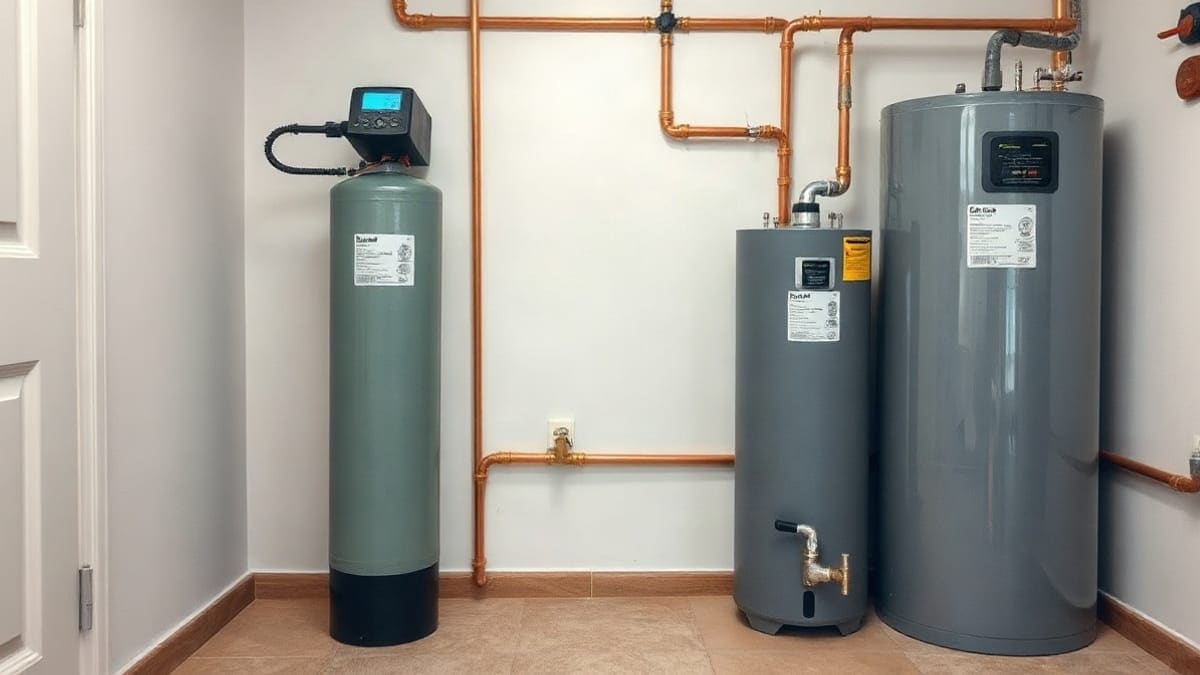
People who type "water softener cost" want one number, and a single number hides the part that repeats every month. This page carries no dollar amount, because we found no reliable US price source. It counts what a softener consumes instead: pounds of salt, gallons of rinse water, kilowatt-hours, cleaner bottles and warranty years, for 1 year and for 10. Use the counts to read any quote, and use our water softener size calculator for your own row. Models that match these numbers close the page, and the wider shortlist lives in our best water softener guide. The counts hold on every sales route, whether you buy, rent or hire a dealer.
What does a water softener cost to own?
Water check
Five items make up the cost: the unit, the installation, salt, regeneration water and electricity. Only the first two are quoted to you. For 4 people at 10 gpg the other three come to 322 to 415 lb of salt, 1,073 to 2,700 gallons and 18 to 70 kWh a year.
Penn State Extension says water softening costs depend on installation, maintenance fees and the size of the unit. That sentence explains why seller averages differ so much: one counts a bare unit, another a unit with a plumber, another a rental. A fair comparison puts every offer on the same list of items. The table does that for a reference home of 4 people using 75 gallons each a day on 10 gpg water, which removes 3,000 grains a day, or 1,080,000 grains a year, following the Penn State formula.
| Cost item | One year, 4 people at 10 gpg | Ten years | Where the figure comes from |
|---|---|---|---|
| Salt | 322 to 415 lb, 8 to 10.4 bags of 40 lb | 3,224 to 4,154 lb, 81 to 104 bags | Our math, 3,350 to 2,600 grains per lb |
| Regeneration water | 1,073 to 2,700 gal on an EcoPure EP31 | 10,730 to 27,000 gal | EcoPure manual, our math |
| Electricity | 18 to 70 kWh, not confirmed | 180 to 700 kWh | Seller estimate and our arithmetic |
| Cleaner for the 5-year warranty | 3 bottles, one every 4 months | 15 bottles to hold 5 years of cover | Rheem and EcoPure warranty pages |
| Resin | none expected | 0 or 1 change; sellers claim 10 to 15 years | Seller pages, no neutral source |
| Unit and install | quoted by the seller | quoted by the seller | Ask for them in writing |
The first rows are the ones you control. The salt row follows the same 3,350 to 2,600 grains-per-pound range as our best water softener salt page, where 3,350 is the NSF/ANSI 44 efficiency minimum and 2,600 comes from the Rheem RHS42 manual. Operational efficiency is typically lower than rated efficiency, EcoPure's manual warns, so the upper end is the safer planning figure.
How much salt will a softener use in a year?
Water check
Salt follows hardness and headcount, not tank size. A 2-person home at 10 gpg uses 161 to 208 lb a year, a 4-person home 322 to 415 lb and a 6-person home 484 to 623 lb, using 75 gallons per person per day.
Grains removed a year equal people times 75 gallons times hardness in gpg times 360 days (12 months of 30). Divide by 3,350 grains per pound for the efficient end and by 2,600 for the heavier end. Multiply the pounds by the shelf price of your bag, the one number we cannot give you. If you only have a report in ppm or mg/L, divide by 17 first, or use the water hardness converter.
| People | 5 gpg | 10 gpg | 15 gpg | 20 gpg |
|---|---|---|---|---|
| 2 | 81 to 104 lb | 161 to 208 lb | 242 to 312 lb | 322 to 415 lb |
| 3 | 121 to 156 lb | 242 to 312 lb | 363 to 467 lb | 484 to 623 lb |
| 4 | 161 to 208 lb | 322 to 415 lb | 484 to 623 lb | 645 to 831 lb |
| 6 | 242 to 312 lb | 484 to 623 lb | 725 to 935 lb | 967 to 1,246 lb |
Read across: doubling the hardness doubles the salt, and so does doubling the household. A 4-person home on 20 gpg water buys more than 15 bags of 40 lb in a year. Ten years of the 4-person, 10 gpg line is 3,224 to 4,154 lb, which is why salt, not the tank, is the cost that grows with your water. The how much salt does a water softener use guide runs the numbers by salt dose.
What does a year of softener salt add up to?
The page cannot print a shelf price, but it can print the quantity you multiply it by: a 4-person home at 10 gpg buys 322 to 415 lb a year, or 8.1 to 10.4 bags of 40 lb. Bag price, delivery fee and form (pellets, crystals, potassium chloride) are the variables; the salt delivery vs buying bags page compares the delivery route.
Does Costco sell water softeners and softener salt?
Costco Business Center lists softener salt: Diamond Crystal Iron Fighter 40 lb pellets, a Diamond Crystal 40 lb pellet bag and a Morton Clean and Protect 44 lb bag. We found no softener appliance listing in our search, and stock changes. Bag sizes differ (40 and 44 lb), so compare cost per pound.
What does a softener cost to run each month?
For a salt-based unit you own, the monthly running items are 27 to 35 lb of salt for 4 people at 10 gpg, plus about 90 to 225 gallons of rinse water. A rental is billed monthly by the company, and its terms vary; see water softener rental vs buying.
How much water does a softener use to regenerate?
Water check
Rinse water falls as the salt dose rises, while salt rises: on the EcoPure EP31, the lowest dose uses 211 lb and 2,700 gallons a year, the highest 445 lb and 1,073 gallons. Choose the dose that matches the resource you pay more for.
The regeneration water you use is on your water and sewer bill. Manuals print it two ways: gallons per 1,000 grains of capacity at the lowest salt dose, and total gallons per regeneration at the highest. We turned both into a year for the reference home of 1,080,000 grains. These are rated laboratory figures from the manuals, not measurements in a house.
| Model | Lowest dose: salt a year | Lowest dose: water a year | Highest dose: salt a year | Highest dose: water a year |
|---|---|---|---|---|
| EcoPure EP31 | 211 lb (2.4 lb per regeneration, 88 regenerations) | 2,700 gal (2.5 gal per 1,000 grains) | 445 lb (12.9 lb, 34.5 regenerations) | 1,073 gal (31.1 gal each) |
| EcoPure EP42 | 215 lb (3.3 lb, 65 regenerations) | 2,484 gal (2.3 gal per 1,000 grains) | 445 lb (17.4 lb, 25.6 regenerations) | 1,039 gal (40.6 gal each) |
| Rheem RHS32 | 216 lb (2.6 lb, 83 regenerations) | 2,052 gal (1.9 gal per 1,000 grains) | 462 lb (14.1 lb, 32.7 regenerations) | 1,090 gal (33.3 gal each) |
The pattern is the same on all three: the highest dose uses about 2.1 times the salt and about 40 to 53 percent of the water. Penn State's general figure is about 50 gallons per regeneration, which on a 32,000-grain unit at 33.75 regenerations a year is about 1,688 gallons. PNNL says an efficiency-rated softener must use no more than 5.0 gallons per 1,000 grains, and every figure in the table is below that.
How much electricity does a softener use?
Water check
Electricity is the smallest item and the least documented: the EcoPure manual says the controller runs on 24 V DC from a plug-in supply, but prints no watts. Seller estimates run from 18 to 70 kWh a year, so plan 180 to 700 kWh over 10 years.
We opened the EcoPure and Rheem manuals and found a 24 V DC plug-in power supply on a nominal 120 V, 60 Hz outlet, and no kWh rating. One seller puts the valve at 30 to 50 watts during regeneration and about 70 kWh a year. If the valve drew 50 W for 1 hour a day, our arithmetic gives 50 W times 365 hours, about 18 kWh. We treat the spread of 18 to 70 kWh as unconfirmed. Multiply by the rate per kWh on your own bill, and expect the result to be small beside salt.
What is the life expectancy of a water softener?
Water check
No university or government source gives a softener lifespan. The hard numbers are warranties: 10 years on the tanks and 3 years on the control board in the Rheem and EcoPure manuals, and a lifetime tank warranty at SpringWell. Sellers claim 10 to 15 years for resin.
Penn State says only that resin which cannot be washed clean will need to be replaced, and gives no years. Seller sites repeat 10 to 15 years, and say chlorine and iron can shorten it, but they sell resin, so we treat the figure as a claim. The written warranty is the firm number.
| Item | EcoPure EP31, EP42 and Rheem RHS32 manuals | SpringWell warranty page |
|---|---|---|
| Full warranty on parts and labor | 1 year, extendable to 5 years | Lifetime on covered items |
| Tanks | 10 years | Lifetime; 10 years on tanks 14 in or larger |
| Electronic control board or head | 3 years | 5 years (product page) or 7 years (warranty page) |
| Resin or media | no life figure printed | media listed under the lifetime warranty, no life figure |
| What voids it | Freezing, water over 120°F, pressure over 125 psi | Neglect, water beyond specifications, no registered owner |
Both Rheem and EcoPure extend the 1-year full warranty to 5 years if you use their branded cleaner, one bottle every 4 months, and keep proof of purchase for up to 3 bottles in 12 months. SpringWell's warranty counts failing to replace filters or media on time as neglect. For a buy-or-replace decision see when to replace a water softener and what it costs and how long do water softeners last.
What makes a water softener cost more or less?
Water check
Six things move a quote: capacity (32,000 to 80,000 grains), valve type, certification, flow (7.2 to 13 GPM), plumbing work and your water. Each leaves a number on the spec sheet, so compare those numbers before you compare totals.
A quote is easier to judge when you know which line each spec drives. The sizes below come from the manuals and spec tables we read; none carries an amount here.
| Driver | What changes | What the spec sheet prints | What to ask |
|---|---|---|---|
| Capacity | Tank, resin volume, regeneration gap | SpringWell SS1 32,000, SS4 48,000, SS+ 80,000 grains; resin 0.81, 1.09 and 1.5 cu ft on EP31, EP42 and a Fleck 48,000 kit | Capacity at which salt dose |
| Valve | Salt and water efficiency | NSF/ANSI 44 efficiency tier needs demand-initiated regeneration, 3,350 grains per lb and no more than 5.0 gal per 1,000 grains | Is regeneration demand-initiated or timed |
| Certification | Proof of the hardness claim | Fleck 5600SXT has a WQA listing; Rheem and EcoPure print NSF/ANSI 44; no listing found for SpringWell SS1 and SS4 | The listing number, not the logo |
| Flow | Pipe size and the number of fixtures served | 7.2 gpm (EP31), 8.2 (EP42), 7.9 (RHS32), 11 (SS1), 13 (SS4) | Flow at the pressure drop you can accept |
| Plumbing | Install labor and parts | Pressure reducing valve above 80 psi daytime, 1.5 in air gap, drain hose under 30 ft and under an 8 ft rise | A line-by-line install list |
| Your water | Salt use and extra equipment | Iron limit 8 ppm clear-water iron on EP31 and RHS32, 11 ppm on EP42 | Iron, manganese and hardness from a test |
The grain label alone misleads. The EcoPure EP31 is rated 12,300 grains at 2.4 lb of salt and 31,300 grains at 12.9 lb, so a "31,000-grain" unit set to save salt holds less than half of that between regenerations. The what size water softener do I need page does the sizing; match it to the capacity at the dose you will actually use.
How much is a water softener for a 2,000 square foot house?
Square footage does not size a softener; people and hardness do. A 4-person home on 10 gpg water needs about 3,000 grains a day (4 times 75 gallons times 10 gpg), so 32,000 grains regenerates about every 10 to 11 days. The same 4 people in a bigger house need the same grains and more flow, so count bathrooms and GPM.
How much are water softeners at Home Depot or Menards?
We print no store amounts, because we found no reliable US price source, and store listings change. What a store page should show is the grain rating at a named salt dose, the flow in GPM and an NSF/ANSI 44 or WQA listing number. Compare those three before the total, using the table above.
Does well water change what a softener costs?
Yes, through iron and pretreatment, not through the unit. The rule of thumb used by softener makers is to add 4 to 5 gpg per ppm of iron, depending on the maker (Rheem and EcoPure say 5), so 2 ppm at 10 gpg is sized as 18 to 20 gpg and uses about 80 to 100 percent more salt. The EcoPure and Rheem manuals cap clear-water iron at 8 ppm and say Wisconsin requires more treatment above 5 ppm. Above 3 to 5 ppm of iron an upstream filter is safer, and EPA says private well owners are responsible for testing their own water. See best water softener for well water.
What is the average cost of a water softener system?
We publish no average, because the averages sellers quote blend three different products: salt-based softeners, salt-free conditioners and rentals, bare or installed. Mixing them says nothing about yours. The measurable average is a consumption one: a 4-person home on 10 gpg water uses about 27 to 35 lb of salt a month, and the unit you choose changes the water and power around it.
What installation work sits behind the cost of a softener?
Water check
Install cost comes from the work around the unit: a drain with a 1.5 in air gap, a nearby 120 V outlet, a bypass valve, 3/4 in or 1 in connections and, above 80 psi daytime pressure, a pressure reducing valve. Ask for each line separately.
The EcoPure manual puts the softener between the water inlet and the water heater, close to the supply, upstream of everything except outside faucets, which should stay on hard water. It asks for a drain within reach (a floor drain, laundry tub or standpipe), a drain hose no longer than 30 feet and raised no more than 8 feet, and a minimum supply flow of 3 gpm. It also says plumbing must follow local code, and in Massachusetts a licensed plumber must do the job. Rheem's manual adds that a pressure reducing valve may reduce flow.
The question of what an installation costs has its own page, water softener installation cost, which prices the plumbing questions, and the installation guide shows the steps.
Is it expensive to put a water softener in?
It is a one-time list, short on parts: drain, outlet, bypass and, on high-pressure lines, a regulator. The repeating items weigh more in quantity: 81 to 104 bags of salt in ten years for a 4-person home at 10 gpg. The 1.5 in air gap stops sewer water flowing back into the softener, and local code decides what the drain run may look like.
Should you buy, rent or use a dealer?
Water check
Buying direct, buying at a retailer, using a dealer and renting differ in who installs, who services and what repeats, not in the water. Get the terms in writing, and price the repeating items with this page.
We found no neutral source for dealer or rental terms, so we state none. Whatever the route, the quote should name the model, the capacity at a stated dose, the install list, the warranty years and the term. SpringWell sells direct with a 6-month guarantee on its SS1 page; a retailer sale leaves warranty claims to you and the maker; a rental is billed monthly on the company's terms. The rental vs buying page owns that comparison.
Do these costs apply to reverse osmosis, whole house filters and salt-free units?
Water check
No. This page covers salt-based softeners that exchange ions for sodium. Reverse osmosis, whole house filters, salt-free conditioners and Culligan quotes each have different consumables and their own cost pages, linked below.
Salt-free units need no salt and no regeneration water, but they do not remove hardness minerals, so the salt and rinse numbers above do not apply. Read salt-free water softener cost for that route. Reverse osmosis cost is on reverse osmosis system cost, whole house filters on how much a whole house water filter costs, and a Culligan or Kinetico quote on Culligan water softener cost and alternatives. If you want one device for both, see the water softener and filter combo page.
What should a water softener quote state?
Water check
A quote worth accepting states capacity at a named salt dose, flow in GPM, a certification number, regeneration water per 1,000 grains, install items line by line, warranty years for tank and control board, and the cleaner or service the warranty needs.
Ask for these in writing: rated capacity in grains at a stated salt dose, not "up to"; service flow in GPM; an NSF/ANSI 44 or WQA listing number you can look up in the NSF database or WQA product search; salt per regeneration and water per 1,000 grains at the dose you will use; the install list; warranty years for tank, control board and resin; the cleaner schedule; and the hardness and iron readings used to size the unit. A hardness test before the visit protects you from a quote sized on a guess.
Which softeners fit these cost numbers?
Water check
Four salt-based units cover most homes: the SpringWell SS1 (32,000 grains, 11 GPM), SS4 (48,000, 13 GPM), EcoPure EP31 (31,000, 7.2 gpm) and Rheem RHS32 (33,000 at the top dose, 7.9 gpm). Pick by headcount and gpg, then price the install.
SpringWell prints no dose table, so its interval is our calculation at 3,000 grains a day: about 10.7 days on the SS1 and 16 on the SS4. For the EP31 and RHS32 the manual doses give a 4.1 to 10.4 day and a 4.3 to 11 day gap, and 17.6 to 37.1 lb and 18.0 to 38.5 lb of salt a month. Details and certification checks are in our best water softener guide. SpringWell lists no NSF or WQA certificate that we could find for these two models, while Rheem and EcoPure print NSF/ANSI 44 in their manuals and NSF's database lists them under Water Channel Partners, so match the model code on the unit to the listing before you pay.
SpringWell SS1. 32,000 grains, 11 GPM, 1 in connections, sold direct with a 6-month guarantee. Best for: 1 to 3 bathrooms on city water up to about 10 gpg. Not for: a home that needs a certification number. Check price on Amazon
SpringWell SS4. 48,000 grains, 13 GPM, about 3.5 regenerations a month for 5 people at 15 gpg. Best for: 4 to 6 people on 12 to 20 gpg water. Not for: a small house, where it regenerates far more often than it needs to. Check price on Amazon
EcoPure EP31. 31,000 grains at the top dose, 12,300 at 2.4 lb, 0.81 cu ft of resin, 7.2 gpm, manual with the full dose table. Best for: 1 to 4 people who want printed salt and water figures. Not for: a house needing more than about 7 GPM at peak. Check price on Amazon
Rheem RHS32. 33,000 grains at 14.1 lb, 0.88 cu ft of resin, 7.9 gpm, 10-year tank warranty. Best for: a buyer who wants claims and warranty in print. Not for: a three-bath home on hard water. Check price on Amazon
5 common mistakes when counting the cost of a water softener
Water check
Most overruns come from counting only the unit. Five mistakes follow, each with the quantity it hides: up to 4,154 lb of salt over 10 years, 2.1 times the salt at a top dose and 80 percent more salt from 2 ppm of iron.
Comparing a bare unit with an installed quote
A seller quoting the unit alone and another quoting the unit plus a plumber are not comparable. Put both on the item list above and ask what the install excludes: drain, air gap, bypass, regulator.
Trusting the grain label
The EP31 is rated 12,300 grains at 2.4 lb of salt, not 31,300. Salt and regeneration frequency depend on the dose you run, so ask for capacity at that dose.
Ignoring iron
At 10 gpg and 2 ppm of iron the maker rule gives 18 gpg, so salt use rises about 80 percent (18 divided by 10). Above 5 ppm treat the iron first.
Running the top salt dose by habit
On the EP31 the highest dose uses 445 lb a year against 211 lb at the lowest, 2.1 times more, for the same hardness removed. The low dose uses 2,700 gallons of water instead of 1,073, so pick what costs you more.
Relying on a seller's resin life
Sellers claim 10 to 15 years. We found no neutral source, so budget for a possible resin change, and rely on the warranty years in the table above.
Frequently asked questions
Why do sellers quote such different amounts?
They price different things. One quotes a bare 32,000-grain unit, another a 48,000-grain unit with install, another a rental, and some mix in salt-free conditioners, which do not remove hardness. Penn State says costs depend on installation, maintenance fees and size, so put every quote on the same list of items.
Does a bigger softener cost more to run?
Not for salt: salt follows grains removed, so a 4-person home on 10 gpg uses 322 to 415 lb a year on a 32,000-grain or 48,000-grain tank alike. The bigger tank regenerates every 16 days instead of every 10.7 days, and each regeneration uses more salt.
Does a lower salt setting save money?
It saves salt: 211 lb a year against 445 lb on the EP31. But the same unit uses 2,700 gallons of rinse water at that setting against 1,073, and regenerates 88 times a year instead of 34.5. Choose by which of salt and water costs you more.
Does a pressure reducing valve add to the install?
If daytime pressure is over 80 psi, Rheem and EcoPure say nighttime pressure may exceed the 125 psi maximum and ask for a pressure reducing valve. Rheem adds it may reduce flow, so ask whether the 7.9 gpm rating still holds.
Do I need the branded cleaner to keep the warranty?
For the 5-year extension, yes. Rheem and EcoPure each require their own cleaner, one bottle every 4 months, with proof of purchase, and they count no more than 3 bottles in 12 months. Another product will not extend the warranty.
Is the 32,000-grain label what I get?
Only at the top salt dose. The EP31 is rated 12,300 grains at 2.4 lb and 26,200 at 7.7 lb, and the Rheem RHS32 13,000 at 2.6 lb. A 4-person home at 10 gpg needs 3,000 grains a day, so the dose changes the regeneration gap by about 2.5 times.
Does a softener raise my water bill?
Yes, by the regeneration water: 1,073 to 2,700 gallons a year on an EP31 for 4 people at 10 gpg, or about 1,688 gallons on Penn State's 50 gallons per regeneration. Rinse water goes to the drain, so it can also appear on a sewer charge.
Does iron raise the running cost?
Yes. Makers add 4 to 5 gpg per ppm of ferrous iron to the sizing, depending on the maker, so 2 ppm at 10 gpg is sized as 18 to 20 gpg. Ferric (red-water), bacterial and organically bound iron are not removed by a softener at all, per the manuals.
How do I work out my own yearly salt?
Multiply people by 75 gallons by your gpg by 360, then divide by 3,350 and 2,600 for the low and high pounds. The water softener size calculator runs this for you, and a 4-person home at 12 gpg lands at 387 to 498 lb a year.
At what hardness does a softener use almost no salt?
Below about 3.5 gpg the water is slightly hard by Penn State's scale. A 4-person home at 2 gpg removes 216,000 grains a year, or 64 to 83 lb of salt. At that level the running cost is small, but so is the benefit; check your report with the hard water vs soft water guide.
How we researched this page
Water check
We read the EcoPure and Rheem manuals, the SpringWell spec and warranty pages, Penn State Extension, PNNL and the Costco Business Center listings in November 2026. We have not tested any unit, we print no prices and no store ratings, and the list of what we could not confirm follows.
Quantities come from rated manual figures, and every yearly figure is our arithmetic on a reference home of 4 people, 75 gallons each, at 10 gpg, with salt at 3,350 and 2,600 grains per pound.
Not confirmed: the electricity figures (the manuals print 24 V DC and no watts, and the 70 kWh is a seller estimate we read through a search result); any neutral lifespan for resin or valves; the WQA records behind the Rheem and EcoPure CSA B483.1 claims (the NSF/ANSI 44 listings themselves were read in NSF's database); SpringWell's control-head warranty (5 or 7 years across its own pages); dealer and rental terms; the Costco pages (read through search results, with stock not checked). Buying through a Check price button pays this site a commission at no change to your price.
Sources
Our sources by topic
Public agencies and universities
- Penn State Extension, Water Softening; USGS, Hardness of Water; PNNL, Water Softeners resource guide.
- EPA, private wells.
Certification and standards bodies
- NSF, certified products; WQA, product search.
Manufacturers, retailers and other references
- EcoPure, EP31 and EP42 manual, Rev. D; Rheem, RHS32 manual.
- SpringWell, salt-based softener specifications and warranty.
- SoftPro, electricity use of a softener.
- Costco Business Center, Iron Fighter 40 lb, Diamond Crystal 40 lb and Morton 44 lb.
Keep comparing
 Salt-Free Water SoftenerEight salt-free water conditioners compared by flow in GPM, hardness limit in gpg
 Water Softener Maintenance Checklist (Monthly, Yearly)Salt checks every 2 to 4 weeks, cleaner every 4 months, brine tank yearly, resin life
 Water Softener RepairA symptom, cause, test and fix table, salt bridge and brine tank steps, error codes, who to call
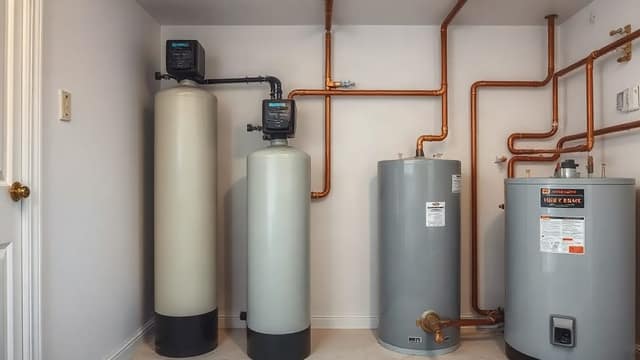 How Does a Water Softener Work? (Ion Exchange Explained)Resin beads swap calcium and magnesium for sodium, then a brine rinse recharges them
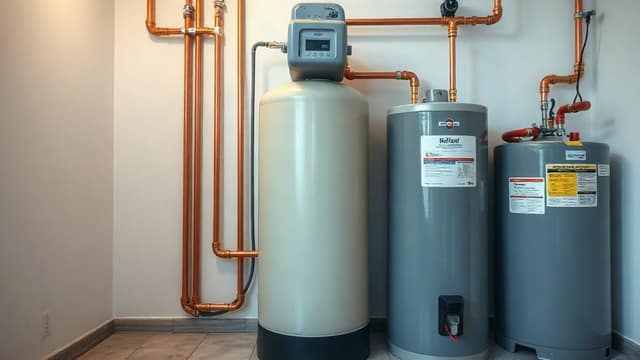 Water Softener BrandsWater softener brands compared by who builds them, NSF and WQA listings, valve
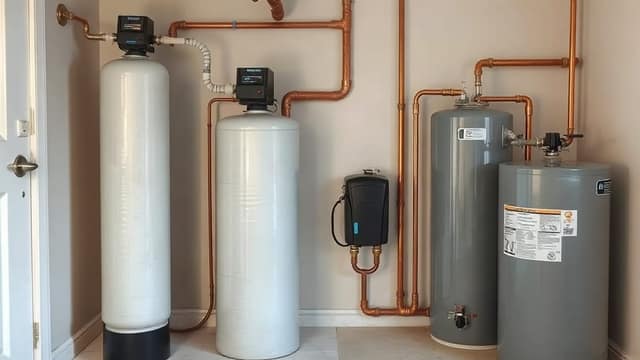 Water SoftenerEleven water softeners sold in the US compared by grains, GPM, salt use and certification