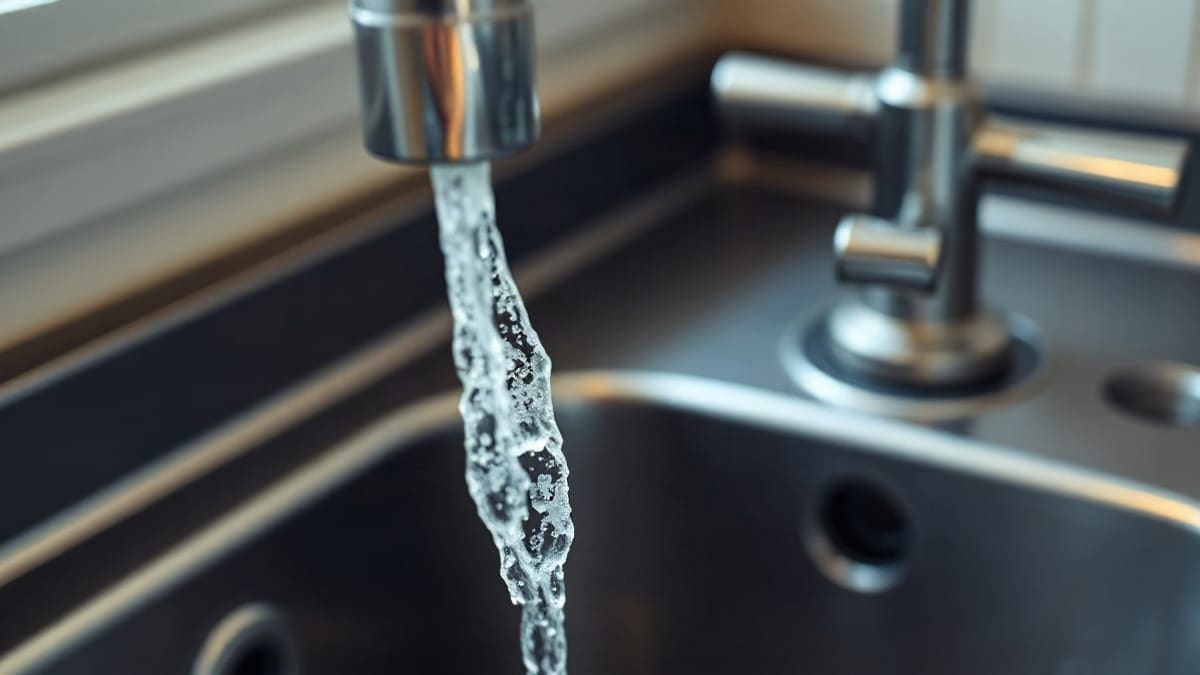
Hard water is ordinary tap or well water that picked up a lot of calcium and magnesium on its way to you. This page defines it, shows the official hardness classes, explains where the minerals come from, and tells you how to read your own number from a city report or a well test. It then sets out what hard water does, what it does not do, and which treatment fits each level, ending with five models that match. Every figure comes from a public agency or a maker page that we opened in November 2026, and where two pages disagree we say so.
What is hard water?
Water check
Hard water is water with a high concentration of dissolved calcium and magnesium. USGS defines hardness as the amount of those two minerals in the water, and the WHO adds that it is usually expressed as milligrams of calcium carbonate per liter.
USGS says hardness comes from calcium and magnesium compounds, plus a few other metals, that water dissolves as it moves through soil and rock. The WHO drinking-water guidelines describe it as the traditional measure of how much soap water can react with: hard water needs considerably more soap to make a lather. Hardness itself is not a contaminant.
Penn State Extension calls calcium and magnesium two highly soluble minerals that are essential nutrients with no adverse health effects. What people notice is the leftover: white crust on a faucet, a film on a glass, soap that will not foam.
What does water hardness mean on a report?
Water check
Hardness is one number: total calcium plus magnesium, converted into the same units as limestone. Reports print it as mg/L or ppm of calcium carbonate (CaCO3), or as grains per gallon (gpg). One gpg equals about 17.1 mg/L.
The three units are the same measurement written differently. A mg/L and a ppm are equal in water. A grain is a unit of weight, 1/7,000 of a pound, so a gallon holding one grain of hardness minerals is 1 gpg. Penn State gives the rounded conversion of 1 gpg to about 17 ppm. A lab report of 171 mg/L is therefore 10 gpg, and 250 mg/L is about 14.6 gpg. Mixing the units is the most common error: typing 171 into a box that wants gpg makes the water look 17 times harder than it is. The water hardness converter does the arithmetic for any value, and the water treatment glossary defines every term used here.
What is considered hard water?
Water check
USGS: 0 to 60 mg/L is soft, 61 to 120 moderately hard, 121 to 180 hard, and over 180 very hard. Penn State uses the same cut-offs in gpg: under 1.0 soft, 1.0 to 3.5 slightly hard, 3.5 to 7.0 moderately hard, 7.0 to 10.5 hard, over 10.5 very hard.
Both scales appear below on one table. They agree from 60 mg/L upward. Penn State splits USGS's single soft band into soft and slightly hard.
| Class | USGS, mg/L as CaCO3 | Penn State, gpg | Penn State, ppm |
|---|---|---|---|
| Soft | 0 to 60 | under 1.0 | under 17 |
| Slightly hard | (inside soft) | 1.0 to 3.5 | 17 to 60 |
| Moderately hard | 61 to 120 | 3.5 to 7.0 | 60 to 120 |
| Hard | 121 to 180 | 7.0 to 10.5 | 120 to 180 |
| Very hard | over 180 | over 10.5 | over 180 |
The sources are USGS's hardness page and Penn State's water softening guide. Federal law sets no limit for hardness at all. EPA's secondary standards page lists 500 mg/L for total dissolved solids, 0.3 mg/L for iron and 0.05 mg/L for manganese, says it does not enforce these aesthetic limits, and sets none for hardness. So "hard" is a label from agencies and softener makers, not a legal threshold.
What makes water hard, and what causes it?
Water check
Rain is almost mineral-free. Water turns hard when it dissolves calcium and magnesium from rock and soil, and groundwater does this most, especially in carbonate aquifers. Hardness is natural, not a sign of pollution.
USGS explains that water picks up the minerals as it moves through soil and rock, and that groundwater is especially prone to it. The WHO notes that mineral content runs from very low levels in rainwater and naturally soft water to higher levels in naturally hard water. In a USGS study of about 2,100 domestic wells, hard water was prevalent in the east-central and western United States, which matches the carbonate and high-dissolved-solids aquifers there (USGS). The same page warns that its national map fits regions, not one house. For a ZIP-level view, see our water hardness map page.
What are examples of hard water and soft water?
Water check
Rainwater, softened water and distilled or reverse osmosis water are soft or demineralized. Water drawn from limestone and other carbonate aquifers is typically hard. City water varies by source, so only your own report settles it.
The examples below come from the sources cited, not from city averages we could not verify. Hard vs soft water compares how each feels in use.
| Water | Hardness | Why |
|---|---|---|
| Rainwater | Very low | Little contact with minerals (WHO) |
| Water from an ion exchange softener | Near 0 gpg | Resin swaps calcium and magnesium for sodium (PNNL) |
| Distilled or reverse osmosis water | Demineralized | Treatments remove most minerals (WHO) |
| Well water from a carbonate aquifer | Often hard or very hard | Dissolves calcium and magnesium (USGS) |
| City tap water | Soft to very hard | Depends on source and treatment, so read your report |
How hard is your water, and how do you find out?
Water check
Read your city's Consumer Confidence Report, which water suppliers must deliver by July 1 each year, or test a private well yourself. Convert the figure to gpg and compare it with the classes above.
Pick the path that matches your water.
- City water: use EPA's Consumer Confidence Report page, which links a search for your supplier. The report must cover contaminants, and hardness is not regulated, so some utilities leave it out. If yours does, call the utility. Washington State's health department confirms the July 1 delivery deadline.
- Private well: EPA says well water is not regulated by the federal government and the owner is responsible for its safety. Test it at a state-certified lab.
- At home: a strip or drop test gives a quick range. The Hach Total Hardness Test Strips read 0 to 425 mg/L, 50 tests per bottle, by color. Strips give a range and not an exact number. Our water hardness test kit comparison and the how to test water hardness at home guide cover each method.
What does hard water do to pipes, heaters and soap?
Water check
Heating hard water leaves calcium carbonate scale that narrows pipes and insulates heating elements. Calcium also bonds with soap into scum, so you use more soap and detergent. Below 7 gpg, Penn State says major scaling is unlikely.
USGS lists four effects: soap scum, spots and film on dishes, scale that raises heating costs and lowers electric water heater efficiency, and long-term buildup that narrows pipes and cuts pressure. PNNL adds that scales do not conduct heat well and can reduce flow. Penn State lists gray or white scale on fixtures, curds in the washer and shorter water heater life, and says levels under 7.0 gpg probably will not cause major scaling. That threshold explains why a house at 5 gpg often needs nothing, while one at 15 gpg often does. For the visible spots and crust, see how to remove hard water stains and buildup, and for the clues in your own house, signs of hard water.
Is hard water bad for you?
Water check
No health limit exists for hardness. The WHO says it is not of health concern at levels found in drinking water, and USGS calls it a nuisance. Softening is what changes the diet, because it adds sodium.
The WHO guidelines give the reason for setting no guideline value as "not of health concern at levels found in drinking-water", while noting hardness may affect acceptability. They add that drinking water can contribute calcium and magnesium for people who are marginal on those minerals, and that the evidence linking hardness to heart disease is debated and does not prove causality. USGS repeats that hardness is a nuisance, not a health concern.
On skin, the best trial we found is the Softened Water Eczema Trial: 336 children with eczema in hard water homes, and no significant difference after 12 weeks with a softener. Our is hard water bad for you and hard water skin and hair effects pages go through the evidence.
Is well water hard water?
Water check
Not always, but often. Hard water was prevalent in USGS's sampling of domestic wells in the east-central and western states. Only a test tells you, and a well also needs checks for iron, manganese and bacteria.
A private well has no supplier report, so you test. EPA states the owner is responsible for delivering safe water. Iron over 0.3 mg/L and manganese over 0.05 mg/L stain fixtures and taste metallic according to EPA's secondary standards, and a softener is not built to handle high iron. Use the well water treatment finder to match your report, and read best water softener for well water before buying.
What should you do about hard water at each level?
Water check
Under 7 gpg, do nothing. From 7 to 10.5 gpg, a softener or a scale conditioner is worth pricing. Over 10.5 gpg, a salt-based softener is the only option that removes the minerals. Soften only the taps that need it.
The table applies Penn State's guidance to each class. It is our reading of that guidance, not a rule.
| Hardness | Class | What to do |
|---|---|---|
| Under 3.5 gpg | Soft to slightly hard | Nothing |
| 3.5 to 7.0 gpg | Moderately hard | Usually nothing; descale a kettle or showerhead now and then |
| 7.0 to 10.5 gpg | Hard | Salt-based softener, or a salt-free conditioner for scale only |
| Over 10.5 gpg | Very hard | Salt-based softener, sized to your gpg |
Penn State's options are to live with it, install an ion exchange softener, or soften part of the house and bypass toilets and outdoor faucets. It also warns that softening is not purification. A softener does not remove serious contaminants such as lead or bacteria. For every method side by side, see water softening methods compared and how to treat hard water at home. A salt vs salt-free comparison separates the two types.
Which products match each hardness level?
Water check
Five models cover the table: the SpringWell SS1 and SS4 and the Rheem RHS32 and EcoPure EP31 for salt-based softening, and the SpringWell FS1 for scale control without salt. Size by the Penn State formula: people times 75 gallons times gpg.
Four people at 10 gpg use 4 x 75 x 10 = 3,000 grains a day, so a 32,000-grain unit lasts about 10 days between regenerations. At 15 gpg the load is 4,500 grains a day, and a 48,000-grain unit lasts about 10 days (Penn State's sizing example). Run your own numbers in the water softener size calculator, and compare all picks in the best water softener guide. Prices are not shown here.
| Model | Type | Capacity or flow | Fits |
|---|---|---|---|
| SpringWell SS1 | Salt-based | 32,000 grains, 11 GPM, 1 in | 1 to 3 bathrooms, up to about 10 gpg |
| SpringWell SS4 | Salt-based | 48,000 grains, 13 GPM, 1 in | 4 to 6 bathrooms, 12 to 20 gpg |
| Rheem RHS32 | Salt-based | 33,000 grains at 14.1 lb salt, 7.9 gpm | 2 to 4 people |
| EcoPure EP31 | Salt-based | 31,300 grains at 12.9 lb salt, 7.2 gpm | 1 to 4 people |
| SpringWell FS1 | Salt-free conditioner | 12 GPM | 1 to 3 bathrooms, scale only |
SpringWell's salt-based specification table lists operating pressure of 25 to 80 psi and no certification for the SS1 or SS4. The same page gives 9 GPM for the SS1 in its size guide, so confirm the figure with SpringWell. The Rheem RHS32 manual and the EcoPure manual both state NSF/ANSI 44 certification. We read those claims in the manuals and did not find the models in the NSF listings or the WQA directory, so check the model number before relying on them.
SpringWell SS1. Best for: one to four people on city water up to about 10 gpg. Not for: a home that needs a certification number or a well with high iron.
SpringWell SS4. Best for: four to six people on 12 to 20 gpg water. Not for: a small house, where 48,000 grains recharges far less often than it needs to.
Rheem RHS32. Best for: a buyer who wants three printed capacities, 13,000 grains at 2.6 lb, 27,600 at 8.3 lb and 33,000 at 14.1 lb. Not for: a household with three bathrooms, because 7.9 gpm leaves little spare flow.
EcoPure EP31. Best for: one to four people who want a modest tank and a printed rating up to 110 gpg. Not for: a home above its 8 ppm clear-water iron limit.
SpringWell FS1. Best for: scale control on a tankless heater with no iron. SpringWell claims up to 95 percent less scale, with limits of 0 ppm iron, pH 7.0 to 9.5 and 3 ppm chlorine, but lists no third-party certification on its conditioner page. Not for: anyone who wants the water measurably softer.
No water softener, reverse osmosis system or whole-house filter has a known CPSC recall as of 18 November 2026. The water softener recalls page keeps the list.
5 common mistakes with hard water
Water check
The costliest errors are mixing ppm with gpg, buying before testing, expecting purification, softening every tap, and trusting a map over a report.
Mixing ppm with gpg
One gpg is 17.1 mg/L, so a 171 mg/L report is 10 gpg, not 171. Entering the wrong unit into a sizing tool oversizes a softener many times over. Convert first.
Buying before testing
A strip test or lab report takes minutes and shows whether you are under 7 gpg. Penn State says below that level major scaling is unlikely, so many homes do not need a softener at all.
Expecting purification
Softening is not purification. Penn State says softeners do not necessarily remove serious drinking water contaminants. Lead, bacteria and PFAS need a filter or treatment built for them.
Softening every tap
Toilets and outdoor faucets gain nothing from soft water. Penn State lists softening only showers, sinks and laundry as an option, which also keeps sodium out of water that is not used for washing.
Trusting a map over a report
USGS's map fits regions, not houses. It says so itself. Your supplier's report, or your own well test, is the number to use.
Frequently asked questions
What does hard water mean?
Water that carries a lot of dissolved calcium and magnesium. USGS counts anything above 120 mg/L, about 7 gpg, as hard. It is a measure of minerals and not of contamination.
What does water hardness mean?
It is the total calcium and magnesium, stated as mg/L of calcium carbonate or as gpg. One gpg is about 17.1 mg/L, so the same water can read 171 or 10.
What is hard water scale?
The white or gray crust left when heated hard water drops calcium carbonate. USGS says it raises heating costs, lowers electric water heater efficiency and narrows pipes over time.
What is hard water and soft water?
Hard water is high in calcium and magnesium, and soft water is low. USGS puts soft at 0 to 60 mg/L, and softeners lower hardness by swapping those minerals for sodium. Details are in hard vs soft water.
What makes hard water hard?
Calcium and magnesium dissolved from rock and soil, mostly into groundwater. It is a natural mineral load.
Is well water hard water?
Often, since hard water was prevalent in USGS's samples of domestic wells in the east-central and western states. Test the well at a state-certified lab, because EPA does not regulate private wells.
How do I find out how hard my water is?
Read your city report through EPA's CCR page, test with strips, or send a well sample to a certified lab. How to test water hardness at home covers each method.
Does the WHO set a limit for hardness in drinking water?
No. The WHO sets no health-based value for hardness, because it is not of health concern at the levels found in drinking water. Our is hard water bad for you page covers drinking, skin and hair. Ask your doctor if you are on a low-sodium diet and use a softener.
How do you tell if you have hard water?
White crust on faucets, spotted glasses and soap that will not lather are the usual clues, but only a test gives a number. See signs of hard water.
How do you treat hard water?
Under 7 gpg, usually do nothing. Above it, a softener or a conditioner. The methods are compared in how to treat hard water at home.
Does a water heater last less with hard water?
Penn State lists buildup that can shorten water heater life, and USGS says scale lowers electric heater efficiency. Neither gives a number of years, so we give none.
How we researched this page
Water check
The page rests on the USGS, Penn State Extension, WHO, EPA and PNNL pages cited here, plus maker pages and manuals for five models, all read in November 2026. We have not tested any product, and we show no prices.
We opened USGS's hardness page, Penn State's water softening guide, EPA's private wells, CCR and secondary standards pages, the WHO chemical fact sheet on hardness, the PNNL softener guide, the SpringWell specification tables, and the Rheem and EcoPure manuals. The July 1 report deadline comes from a state health department page.
Not confirmed: the WQA records for the Rheem RHS32 and EcoPure EP31 (their NSF/ANSI 44 listings are in NSF's database under Water Channel Partners); any listing for SpringWell models under its company or trade name; the SpringWell SS1 flow, 11 GPM in the table and 9 GPM in the size guide; and any city hardness figure, which we left out. If you buy through a Check price button, this site may earn a commission and your price does not change.
Sources
Our sources by topic
Public agencies and universities
- USGS, Hardness of Water.
- Penn State Extension, Water Softening.
- WHO, Guidelines for drinking-water quality, chemical fact sheet on hardness.
- EPA, Consumer Confidence Reports, private wells and secondary drinking water standards; Washington State Department of Health, Consumer Confidence Report.
- PNNL, Water Softeners resource guide.
- Thomas KS et al., Softened Water Eczema Trial, Health Technology Assessment 2011, University of Brighton record.
Certification and standards bodies
- NSF, certified products; WQA, find products.
Manufacturers, retailers and other references
- SpringWell, salt-based softeners and salt-free conditioner; Rheem, RHS32 manual; EcoPure, EP31 and EP42 manual.
Keep comparing
 Can You Drink Softened Water? Safety, Taste and AlternativesIs softened water safe to drink? Sodium worked out per glass from 5 to 30 gpg, who should ask a doctor first
 Water SoftenerEleven water softeners sold in the US compared by grains, GPM, salt use and certification
 Salt-Free Water SoftenerEight salt-free water conditioners compared by flow in GPM, hardness limit in gpg
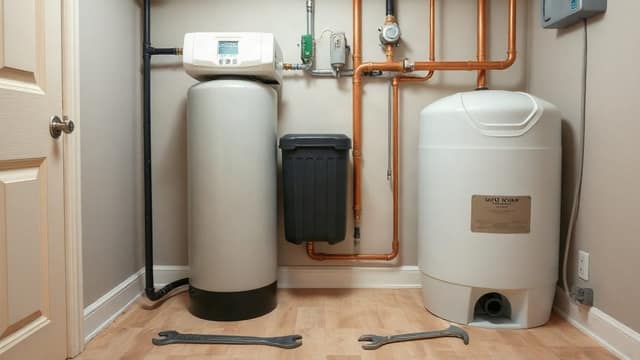 Water Softener InstallationPipe sizes, bypass, drain air gap, psi limits, first regeneration, DIY or plumber
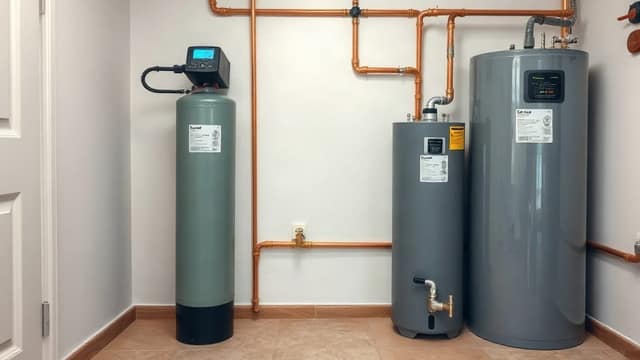 How Much Does a Water Softener Cost? Price GuideSalt, rinse water, power, warranty years and install work counted in pounds
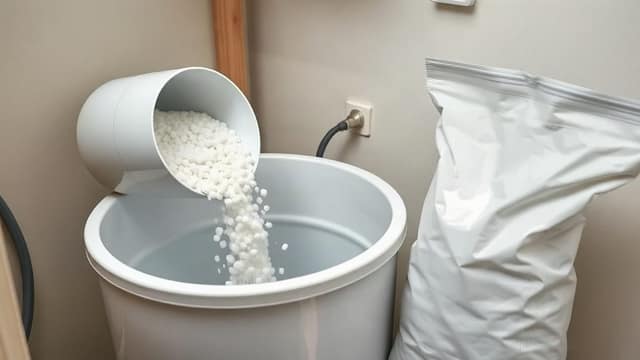 Water Softener SaltTen water softener salts in 40 lb bags compared by form, stated purity, iron additive and NSF listing