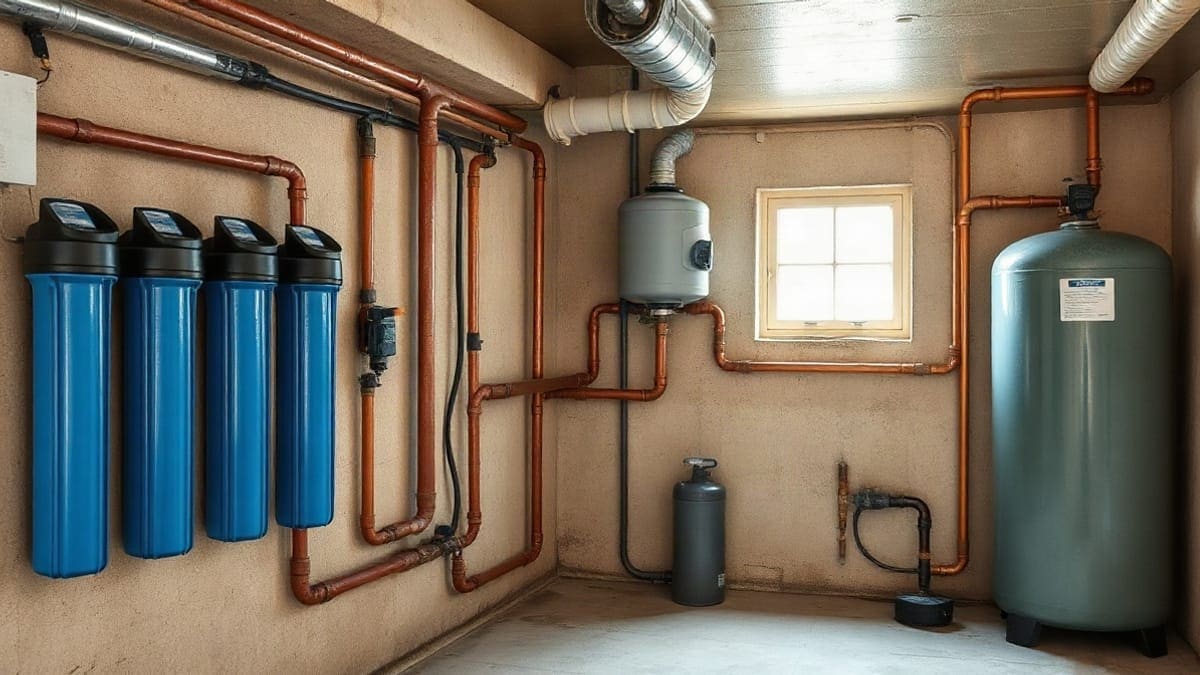
A softener on a well is a sizing and protection problem before it is a shopping problem. Well water has no utility report, so the hardness, iron, manganese, pH and sulfur numbers come from a lab, and they decide whether a softener works alone or needs an iron filter in front. Ten setups are compared by grains, flow, printed iron limits and the listings anyone can search. The figures are taken from maker pages, two manuals, the NSF and WQA databases, EPA and Penn State, and any conflict between sources is named. No prices appear. Run your own numbers in the softener size calculator and the well water treatment finder.
Which softeners are worth a look for a private well?
Water check
No softener wins on every well: the EcoPure EP42 (42,200 grains at 17.4 lb of salt, 8.2 GPM) and Rheem RHS32 (33,000 grains, 7.9 GPM) have NSF/ANSI 44 listings, while the SpringWell SS1 and SS4 suit wells already cleared of iron by a filter.
Printed iron limits are maker claims from different conditions, so compare them with your lab report, not with each other.
| System | Role on a well | Capacity | Flow stated | Iron limit printed | Listing found |
|---|---|---|---|---|---|
| EcoPure EP42 | Salt softener | 42,200 grains at 17.4 lb | 8.2 gpm | 11 ppm clear-water | NSF/ANSI 44, efficiency rated |
| Rheem RHS32 | Salt softener | 33,000 grains at 14.1 lb | 7.9 gpm | 8 ppm clear-water | NSF/ANSI 44, efficiency rated |
| Fleck 5600SXT, 1.5 cu ft kit | Valve and tank kit | 48,000 grains (kit) | 11.1 GPM (WQA), 13 GPM (kit) | none from the maker | WQA, NSF/ANSI 44 valve listing |
| SpringWell SS1 | Salt softener | 32,000 grains | 11 GPM (9 in size guide) | none; iron oxidizes media | none found |
| SpringWell SS4 | Salt softener | 48,000 grains | 13 GPM (12 in size guide) | none; iron oxidizes media | none found |
| Aquasure Harmony fine mesh | Softener with iron resin | 32,000 grains | 10 GPM | up to 10 ppm claimed | none found |
| SpringWell WS1 | Iron filter ahead | none | 12 GPM | 7 ppm iron, 1 ppm manganese, 8 ppm sulfide | none found |
| SpringWell MWS1 | Iron filter, carbon, softener set | 32,000 grains | 9 GPM size guide | see WS1 | none found |
| iSpring WCFM500K | Iron filter ahead | none | not confirmed | 12 ppm iron, 20 ppm manganese and sulfide | none found |
| Aquasana Rhino Well Water with UV | UV stage after | none | 7.0 GPM rated | UV needs iron under 0.3 ppm | UV: NSF/ANSI 55 Class B (maker) |
Which well water softener fits which test result?
Water check
Read hardness first: under 3.5 gpg needs no softener, 3.5 to 10.5 gpg suits a 32,000-grain unit for a small family, and above 10.5 gpg or with iron above 3 ppm you size up and add an iron filter ahead of it.
Hardness in gpg decides whether to buy. Penn State Extension (updated September 8, 2025) calls water above 10.5 gpg very hard and says levels below 7.0 gpg probably will not cause major scaling or soap film. If your lab reports mg/L, divide by 17 or use the water hardness converter.
| Your well test shows | Setup to look at | Why |
|---|---|---|
| Hardness 3.5 to 7 gpg, no iron, no smell | Nothing urgent, or an EP42 | Penn State puts major scaling above 7.0 gpg |
| Hardness 7 to 15 gpg, iron under 1 ppm | EcoPure EP42 or Rheem RHS32 | Both list NSF/ANSI 44 and print 8 and 11 ppm iron limits |
| Hardness above 10 gpg, 1 to 3 ppm iron, clear when drawn | EP42 with the Clean setting, or Aquasure fine mesh | Larger tank absorbs the iron compensation |
| Iron above 3 to 5 ppm, or any red stain | SpringWell WS1 or iSpring WCFM500K, then a softener | Penn State limits softeners to dissolved iron under 5 mg/L |
| Any rotten egg smell | Sulfur guide first | SpringWell requires sulfide to be absent for warranty |
| Coliform positive | Fix the source, then UV | A softener does not disinfect |
For well water that is hard and also carries a lot of iron, the water softener for well water with iron guide goes through the iron types. For the hardness numbers by region, see is well water hard water.
Do you need a water softener with well water?
Water check
Only if your lab report shows hardness above about 7 gpg and you see scale, spotting or soap film. A softener is a hardness fix; it does nothing for bacteria or nitrate, and little for sulfur.
USGS explains that groundwater picks up calcium and magnesium from soil and rock, and that scale can narrow pipes, cut flow and pressure and lower the efficiency of electric water heaters. Its classes are 0 to 60 mg/L soft, 61 to 120 moderately hard, 121 to 180 hard and over 180 very hard. A well with 4 gpg of hardness and a rust problem needs an iron filter, not a softener.
What does a softener do to well water, and what does it leave in?
Water check
A salt softener swaps calcium and magnesium for sodium (or potassium) on resin beads, cutting hardness to near zero. It does not disinfect, does not remove nitrate and does not clear sulfur gas, so a well with those problems needs other stages.
Penn State adds two well-relevant details: dissolved colorless iron is exchanged along with the hardness while oxidized red iron clogs the resin, and turbid water can foul resin with mud and clay. Bacteria and fungi can also form mats in the resin; Penn State suggests disinfecting the water first or cleaning the resin with chlorine bleach, after checking the maker's instructions.
On a hardness-only well the effect is simple: at 12 gpg, four people use 3,600 grains of capacity a day. The Rheem RHS32 listing also names barium and radium 226/228 reduction, both groundwater contaminants, though only a lab report shows whether they matter to you.
How do you soften hard well water?
Put a salt-based ion exchange softener after the pressure tank, sized to your hardness plus an allowance for iron, and put sediment and iron stages ahead of it when your lab report calls for them.
Does a softener work on well water with sulfur or a rotten egg smell?
Usually not. Penn State's hydrogen sulfide page (updated December 10, 2024) says that in rare cases a softener can even raise hydrogen sulfide because it gives sulfur-reducing bacteria a favorable home, and that a smell on hot water only usually points at the water heater's magnesium anode rod. Oxidizing filters take out about 2 to 3 mg/L, and activated carbon works below about 1.0 mg/L. See how to remove the rotten egg smell.
How much iron, manganese and sulfur can a well softener take?
Water check
Printed limits for clear-water iron run from 8 ppm (EP31, RHS32) to 11 ppm (EP42), Penn State caps softeners at dissolved iron under 5 mg/L, and SpringWell says to treat first for any hydrogen sulfide.
Iron is the line between a softener working on a well and failing on it. The EcoPure and Rheem manuals name four types: ferrous (clear water), ferric (red water), bacterial and organically bound, and colloidal. Only ferrous iron is removed. Their tables print the clear-water limit, with a footnote that Wisconsin requires additional treatment above 5 ppm. Penn State's iron and manganese page (updated May 29, 2025) gives dissolved iron under 5 mg/L, pH above 6.7 and hardness of 3 to 20 gpg as the window where a softener is suitable, and says it is critical that raw water not meet air or chlorine ahead of it.
| System | Iron limit printed | Source | What to check |
|---|---|---|---|
| Rheem RHS32 | 8 ppm clear-water | Maker manual | Wisconsin: extra treatment above 5 ppm |
| EcoPure EP31 | 8 ppm clear-water | Maker manual | Same Wisconsin footnote |
| EcoPure EP42 | 11 ppm clear-water | Maker manual | Same Wisconsin footnote |
| Aquasure Harmony fine mesh | up to 10 ppm claimed | Maker page, support | One listing marks iron reduction "No"; standard resin is 1 to 2 ppm |
| SpringWell SS1 and SS4 | none printed | Warranty page | Iron and manganese oxidize the media; sulfide must be absent |
| Fleck 5600SXT kit | none from the maker | Seller pages | SoftPro says over 2 ppm needs a filter in one place, 3 ppm in another |
SoftPro's valve review says iron above 2 ppm demands an upstream filter in one place and 3 ppm in another, and claims 1.5 ppm of ferrous iron cuts resin life nearly in half: one retailer's view, not a standard. Hydrogen sulfide has no EPA standard, and SpringWell's warranty page lists it as a condition that must be absent. Manganese has the weakest guidance: Penn State says only "small amounts", and no manual read gives a number, so treat anything above EPA's 0.05 mg/L ahead of the softener.
Where does the softener go in a well water treatment chain?
Water check
Softener after the pressure tank, with sediment and iron stages ahead of it and carbon and UV after it. UV goes last because Aquasana requires iron under 0.3 ppm and hardness under 7 gpg at the lamp, so the softener also protects the UV.
The order follows what each stage protects: sediment first for sand and silt, an oxidizing iron filter for iron above 0.3 mg/L or manganese above 0.05 mg/L, the softener for hardness above 7 gpg, carbon for taste, UV for any positive coliform test. An iron filter has to remove the oxidized particles completely, or they land on the resin. The whole-system version is on the well water filtration system page, and the iron filter guide covers the second stage.
Which EPA numbers matter for a well softener?
Water check
Seven numbers matter: iron 0.3 mg/L, manganese 0.05 mg/L, pH 6.5 to 8.5, TDS 500 mg/L, nitrate 10 mg/L, arsenic 0.010 mg/L and total coliform at no more than 5% of samples. A softener acts on only the first two, and only partly.
EPA's secondary standards (iron, manganese, pH, TDS) are aesthetic guidelines that EPA does not enforce; the health limits (nitrate, arsenic, coliform) come from EPA's national primary regulations, updated August 31, 2026. No page we read claims a softener removes nitrate or arsenic. If a result exceeds a health limit, EPA says to contact your public health department and retest.
What size water softener does a well need?
Water check
Multiply people by 75 gallons by hardness plus an iron allowance: four people on 12 gpg water with 2 ppm of iron use about 6,000 grains a day, so a 32,000-grain unit regenerates about every 5 days and a 48,000-grain unit about every 8.
The Penn State formula is grains per day = gallons per person per day (75 in its example) x hardness (gpg) x people; days between regenerations = capacity divided by grains per day. Its example is 75 x 10 x 4 = 3,000 grains a day, which a 20,000-grain unit covers in 6 to 7 days. For iron, softener makers add 4 to 5 gpg per ppm of ferrous iron, depending on the maker, a rule of thumb rather than a standard; Rheem, EcoPure, Whirlpool and GE use 5 (example: 20 gpg and 2 ppm iron set as 30). The table uses 4 gpg; at 5 gpg the same four-person house sets 22 gpg and uses 6,600 grains a day, about 4.8 days on 32,000 grains.
| Home | Hardness and iron | Effective hardness | Grains a day | 32,000 grains | 48,000 grains |
|---|---|---|---|---|---|
| 2 people | 8 gpg, no iron | 8 gpg | 1,200 | about 27 days | about 40 days |
| 4 people | 12 gpg, no iron | 12 gpg | 3,600 | about 9 days | about 13 days |
| 4 people | 12 gpg, 2 ppm iron (4 gpg rule) | 20 gpg | 6,000 | about 5 days | 8 days |
| 6 people | 15 gpg, 1 ppm iron (4 gpg rule) | 19 gpg | 8,550 | about 4 days | about 6 days |
| 4 people | 20 gpg, 3 ppm iron (4 gpg rule) | 32 gpg | 9,600 | about 3 days | 5 days |
Iron changes the schedule more than people expect: the same four-person house goes from a regeneration every 9 days to every 5 once 2 ppm is counted, with more salt, backwash water and wear. The last row is the signal to stop and put the iron filter in first. The what size water softener do I need page covers city water, and the softener size calculator runs this math with your numbers.
How much salt will a well softener burn through?
Water check
On the iron-adjusted four-person example, an EcoPure EP42 at its 10.3 lb dose regenerates about every 5.9 days: roughly 5 regenerations and 53 lb of salt a month, plus about 255 gallons of backwash water by Penn State's 50-gallon figure.
The salt dose is a setting that changes capacity and efficiency. NSF/ANSI 44 efficiency-rated softeners must deliver at least 3,350 grains per pound of salt at their minimum dose, and both manuals say the rating holds only at that dose.
| Softener and dose | Capacity | Salt | Grains per lb |
|---|---|---|---|
| Rheem RHS32, minimum | 13,000 | 2.6 lb | 5,000 by our division, 4,940 in the manual |
| Rheem RHS32, middle | 27,600 | 8.3 lb | about 3,325 |
| Rheem RHS32, maximum | 33,000 | 14.1 lb | about 2,340 |
| EcoPure EP42, minimum | 16,600 | 3.3 lb | about 5,030 |
| EcoPure EP42, middle | 35,300 | 10.3 lb | about 3,427 |
| EcoPure EP42, maximum | 42,200 | 17.4 lb | about 2,425 |
The middle RHS32 dose works out to about 3,325 grains per pound, a hair under 3,350, which is why only the minimum dose is rated. The maximum dose buys capacity at more than twice the salt per grain, so on a well with iron a bigger tank at a lower dose usually beats a small tank at its maximum. The EcoPure manual also describes a Clean feature that adds a backwash and fast rinse before each regeneration, useful with iron or sediment and to be switched off otherwise to save water.
What salt does a well water softener need?
Sodium chloride pellets are the default setting in the Rheem and EcoPure controllers, and both let you switch to potassium chloride, which dissolves at a different rate. Our water softener salt guide compares products.
Is softened well water safe to drink?
Water check
The sodium a softener adds is small for most adults: at 12 gpg it is about 90 mg per quart, so 2 quarts a day is 180 mg, under 8% of the 2,300 mg daily limit. On a sodium-restricted diet, ask your doctor first.
Penn State says softening adds 7.5 mg of sodium per quart for each gpg removed, so you can run your own number.
| Hardness removed | Sodium per quart | Per 8 oz glass | 2 quarts a day | Share of 2,300 mg |
|---|---|---|---|---|
| 10 gpg | 75 mg | 18.8 mg | 150 mg | 6.5% |
| 20 gpg | 150 mg | 37.5 mg | 300 mg | 13.0% |
The 2,300 mg limit is the adult figure in the Dietary Guidelines for Americans, described on the FDA's sodium page. This is health information, not medical advice: for hypertension, kidney disease, infants or pregnancy, ask your doctor. The full guide is can you drink softened water. On dogs, we found no study or official guidance, so ask your vet. For a drinking tap with no added sodium, see reverse osmosis for well water.
The ten systems in detail
Water check
The ten setups range from a 9 in by 48 in SpringWell tank to a 20 GPM-class iron filter and state flows of 7.0 to 13 GPM. Each section gives size, flow, limits, the listing that exists and who should look elsewhere.
EcoPure EP42: the listed softener with the higher iron limit
The EP42 is rated 16,600 grains at 3.3 lb, 35,300 at 10.3 lb and 42,200 at 17.4 lb of salt, with 1.09 cu ft of resin, 8.2 gpm service flow, 110 gpg maximum hardness and 11 ppm clear-water iron. EcoPure's manual (Rev. D, 2024) sets supply pressure at 20 to 125 psi and water at 40 to 120°F, asks for at least 3 gpm at the inlet and warns against use on microbiologically unsafe water without disinfection. NSF's database lists the EP42 at 8.2 gpm under NSF/ANSI 44, efficiency rated (current as of November 17, 2026). The WQA certification to CSA B483.1 that the manual claims we could not confirm.
Best for: hardness of 7 to 20 gpg, clear iron under about 3 ppm and a house peaking under 8 GPM. Not for: red water, bacterial iron or a sulfur smell.
Rheem RHS32: the manual with every number printed
The RHS32 lists 13,000 grains at 2.6 lb, 27,600 at 8.3 lb and 33,000 at 14.1 lb, with 0.88 cu ft of resin, 7.9 gpm rated flow, 105 gpg maximum hardness and 8 ppm clear-water iron. Rheem's manual gives 20 to 125 psi, 40 to 120°F and a 3 gpm minimum inlet flow. NSF lists it under NSF/ANSI 44 for hardness, efficiency, barium and radium 226/228 reduction, again under Water Channel Partners; a search for "Rheem" returns nothing, so use that listing. See our Rheem review.
Best for: one to three people with hardness and a slim iron allowance. Not for: a three-bath house on very hard water, where 7.9 gpm is tight.
Fleck 5600SXT: the plumber's valve with a WQA listing
WQA lists 5600 SXT in five sizes with rated flows of 9.9, 10.8, 11.6, 11.1 and 12.5 GPM for 0.75, 1.0, 1.25, 1.5 and 2.0 cu ft tanks, all NSF/ANSI 44 efficiency rated; a 1.5 cu ft, 48,000-grain kit is sold at 13 GPM. The WQA listing (page dated November 17, 2026) covers the valve, not every reseller's kit. One distributor's kit page states 13 GPM, 1.5 cu ft and 120 VAC in its title, above WQA's 11.1 GPM for that size, so ask the seller which applies. SoftPro advises a sediment pre-filter directly upstream, 5 microns in one place and 20 to 50 in another.
Best for: an owner who wants a serviceable valve with parts from many sellers. Not for: one-company responsibility, or iron over 2 ppm.
SpringWell SS1: 32,000 grains for 1 to 3 bathrooms
The SS1 holds 32,000 grains in a 9 in by 48 in tank, with an 18 in by 33 in brine tank, 1 in ports, 11 GPM service flow, 25 to 80 psi, 36 to 120°F and pH 6.5 to 10. SpringWell's table calls the Core size 9 GPM in its size guide, so two tables on one page disagree. For private wells the warranty conditions say hydrogen sulfide and oils must be absent, copper above 1.30 mg/L is unacceptable, iron and manganese oxidize the media and pretreatment is highly recommended. No ppm limit, resin type or listing is given. See the SS1 review.
Best for: 1 to 3 bathrooms on a well already cleared of iron and sulfur. Not for: a raw well with iron, oil or a rotten egg smell.
SpringWell SS4: 48,000 grains and 13 GPM for 4 to 6 bathrooms
The SS4 holds 48,000 grains in a 10 in by 54 in tank (63 in with head), runs 13 GPM (12 in the size guide) on 1 in ports and shares the SS1's pressure, pH and warranty terms. The same page sizes it for 4 to 6 bathrooms; the SS+ reaches 80,000 grains and 20 GPM. Five people at 15 gpg with 1 ppm of iron count 19 gpg, 5 x 75 x 19 = 7,125 grains a day, so the SS4 regenerates about every 6.7 days, where a 32,000-grain tank would run about every 4.5.
Best for: four to six people on 12 to 20 gpg well water after iron removal. Not for: a small house.
Aquasure Harmony with fine mesh resin: the iron-tolerant claim
Aquasure says the 32,000-grain AS-HS32FM uses fine mesh resin to reduce iron up to 10 ppm, runs 10 GPM at most, handles 110 gpg of hardness and suits about 1 to 3 bathrooms. Aquasure's page is the claim; Aquasure support, read through search, gives 1 to 2 ppm for standard resin, and one listing marks "Iron Reduction" as "No" in its spec table, so treat that field as unreliable. No certification was found.
Best for: a clear-water well with iron around 2 to 5 ppm and a small home. Not for: red water, bacterial iron or any sulfur smell.
SpringWell WS1: the iron stage that protects the softener
The WS1 serves 1 to 4 bathrooms at 12 GPM in a 10 in by 54 in tank and is listed for iron up to 7 ppm, hydrogen sulfide up to 8 ppm and manganese up to 1 ppm, at 25 to 80 psi, 36 to 120°F and pH 6.5 to 10. SpringWell's page describes greensand fusion media with a 10 plus year life and a nightly backwash. It turns dissolved iron into particles and flushes them so the resin never sees them. The warranty conditions say sulfide must be absent on private wells, at odds with the 8 ppm claim, so ask in writing. The WS4 does the same at 20 GPM for 4 or more bathrooms.
Best for: iron up to 7 ppm ahead of a softener. Not for: bacteria or pH under 6.5.
SpringWell MWS1: iron filter, carbon and softener in one order
The MWS1 pairs a WS1 (12 GPM), a CF1 carbon filter (9 GPM, 1,000,000 gallons) and an SS1 (11 GPM, 32,000 grains); the size guide calls the set 9 GPM for up to 3 bathrooms, so the carbon tank sets the pace. SpringWell's combo page holds the order until a paid well water test add-on is complete. Carbon pre-filters change every 6 to 9 months and the carbon media every 10 years; softener media life is not stated and no listing is named. The MWS4 swaps in a WS4, CF4 and SS4.
Best for: iron and hardness together, bought as one chain. Not for: a house needing more than 9 GPM from the whole chain.
iSpring WCFM500K: the higher-limit iron and sulfur tank
iSpring says the WCFM500K reduces iron up to 12 ppm and manganese and hydrogen sulfide up to 20 ppm, with 3 micron sediment filtration and air-only regeneration. The figures are on iSpring's page and retailer listings; Lowe's lists 15 GPM, which we could not confirm there. See the iSpring review.
Best for: iron above 7 ppm or manganese above 1 ppm ahead of a softener. Not for: a buyer who needs a published flow figure.
Aquasana Rhino Well Water with UV: the stage after the softener
The Rhino Well Water rates 7.0 GPM (14.7 peak) for up to 2.5 bathrooms and 4 people, lasts 500,000 gallons or 5 years, and its UV needs iron under 0.3 ppm, manganese under 0.05 ppm, hardness under 7 gpg and tannins under 0.1 ppm. Aquasana's page lists 100 psi maximum, 40 to 90°F, a lamp change every 12 months and a UV that is NSF/ANSI 55 Class B. It does not soften (KDF and carbon, not ion exchange), and the 7 gpg ceiling is why a softener sits ahead of UV on hard wells. See the UV purifier page.
Best for: a small, clear, softened well with a positive bacteria test. Not for: iron, hardness over 7 gpg or 5 or more people.
How do you choose a softener for a well?
Water check
Choose by four numbers from your lab report: hardness in gpg, clear-water iron in ppm, sulfur smell and coliform. Then check the printed iron limit, the NSF listing and the written warranty before the brand.
Hardness decides whether to buy at all: Penn State says levels below 7.0 gpg probably will not cause major scaling or soap film. Iron decides whether a filter comes first, since Penn State limits softeners to dissolved iron under 5 mg/L. Sulfur and bacteria decide whether a softener is the right tool, because SpringWell requires sulfide to be absent for warranty and a softener does not disinfect. Our best water softener page ranks softeners for city homes.
Which certifications can you look up?
Water check
NSF lists the EcoPure EP31 and EP42 and the Rheem RHS32 under NSF/ANSI 44, and WQA lists the Fleck 5600 SXT valve; no SpringWell, Aquasure or iSpring softener turned up in the databases we could read.
We searched NSF's database and WQA's listing on November 18, 2026. The EcoPure and Rheem entries sit under Water Channel Partners of Eagan, Minnesota, so a search for "Rheem" returns nothing.
| System | Claim | Where we verified it | Status |
|---|---|---|---|
| EcoPure EP42 and EP31 | NSF/ANSI 44 hardness, efficiency rated | NSF database, Water Channel Partners | Listed |
| Rheem RHS32 | NSF/ANSI 44 hardness, efficiency, barium, radium 226/228 | NSF database, Water Channel Partners | Listed |
| Fleck 5600 SXT | NSF/ANSI 44 efficiency rated valve | WQA listing, 5 sizes | Listed; not every kit |
| SpringWell SS1, SS4, WS1, MWS1 | none stated | SpringWell pages | None found |
| Aquasure Harmony fine mesh | none stated | maker page | None found |
| iSpring WCFM500K | none stated | maker page | None found |
| Aquasana Rhino Well Water UV | NSF/ANSI 55 Class B | maker page | Maker claim |
The WQA and IAPMO search forms are not queryable by our tools, so a certification held only there would not appear; check your model number at WQA before relying on it.
What separates tested from certified?
A listing names a model in a public database anyone can search; a "tested to NSF/ANSI" line points to a lab report you may never see.
Is a SpringWell softener worth it on a well?
It is well documented and unlisted: SpringWell publishes flow, size, pressure, pH and warranty terms, names no NSF or WQA standard and says hydrogen sulfide must be absent. Judge it on your lab report and its 6-month performance promise. See the SpringWell review.
Where do you buy a SpringWell softener?
Direct from SpringWell or through the Check price buttons; brands compared in water softener brands.
How do you hook up a softener to a well?
Water check
Install it on the line after the pressure tank and ahead of the water heater, with a bypass, a drain with a 1.5 in air gap, 3 gpm of inlet flow and 20 to 125 psi, leaving outside faucets on untreated water. If daytime pressure is above 80 psi, add a pressure reducer.
The EcoPure manual shows the softener between the pressure tank and the water heater, with outside faucets left on untreated water to save conditioned water and salt. Drain rules: a floor drain, laundry tub or standpipe, a 1.5 in air gap, a hose no longer than 30 ft and no higher than 8 ft above the floor. Maximum inlet pressure is 125 psi, and if daytime pressure is above 80 psi the nighttime pressure may exceed it, so use a reducing valve. Power is a 24V DC supply into a dry 120 V outlet. Steps are in the water softener installation guide.
What is the brine well on a water softener?
The brine well, written "brinewell" in the manuals, is the vertical well inside the salt storage tank. In the EcoPure manual the salt level scale sits on the brinewell, numbered 0 to 8, and the low salt light flashes at level 2 or below. Where it sits depends on the model, so check your manual.
Where does the backwash go, and can you build a dry well?
Penn State says one regeneration uses about 50 gallons and warns that this may overload a septic drainage field. We could not open an official dry well design standard, and state rules differ, so ask your local health department before you dig. The installation guide shows the common drain options.
How do you shock chlorinate a well that has a softener?
Penn State's shock chlorination page (updated May 29, 2025) says some treatment equipment can be damaged by high chlorine and to check the equipment manual about bypassing it, then to retest for coliform 10 to 14 days later and again after 2 to 3 months. It names no softener specifically.
Do salt-free conditioners, reverse osmosis or filters replace a softener on a well?
Water check
No. Salt-free conditioners do not remove calcium and magnesium, reverse osmosis treats one tap, and filters take out iron, sediment and taste, not hardness. A hard, iron-rich well usually needs a filter first and a softener second.
Conditioners are covered in the salt free water softener and salt-free conditioner for wells pages; reverse osmosis, including arsenic, in reverse osmosis for well water. Filter questions (micron ratings, changing a well filter, rust, sand, manganese, nitrate, arsenic) are answered in the well water filtration system page, how to install and change a well water filter and filters for a well pump. Purchase and running cost: water softener cost guide and well water filtration cost.
Water softeners for well water: our conclusion
Water check
Let the lab report decide: the EcoPure EP42 or Rheem RHS32 when iron stays under about 3 ppm, the SpringWell WS1 ahead of an SS1 or SS4 above that, and no softener when hardness is under 3.5 gpg or coliform is positive.
Hardness of 7 to 15 gpg with iron under 1 ppm suits the EcoPure EP42 Check price on Amazon or the Rheem RHS32 Check price on Amazon. Iron above 3 to 5 ppm or any red stain means the SpringWell WS1 Check price on Amazon or the iSpring WCFM500K Check price on Amazon, then a softener such as the SS1 Check price on Amazon or SS4 Check price on Amazon. A rotten egg smell needs the sulfur guide first, and a coliform-positive well needs UV, such as the Aquasana Rhino Well Water Check price on Amazon.
6 common mistakes with well water softeners
Water check
Six mistakes cost buyers most: skipping the lab test, putting a softener on iron-rich water, sizing without the iron allowance, running the maximum salt dose, ignoring flow and buying a conditioner as a softener.
- Skipping the lab test. SpringWell will not release a combo order until a well test is in, and EPA puts private well safety on the owner.
- Softening iron-rich water. Penn State limits softeners to dissolved iron under 5 mg/L; oxidized iron clogs the resin and can void the warranty.
- Sizing without iron. Four people on 12 gpg water regenerate every 9 days; with 2 ppm of iron, every 5.
- Running the maximum salt dose. The EP42 delivers about 2,425 grains per pound at 17.4 lb, against about 5,030 at 3.3 lb.
- Ignoring flow. Rated flows run from 7.2 to 13 GPM; add up what the shower, laundry and dishwasher draw together and leave margin.
- Buying a conditioner for hardness. Salt-free units do not remove calcium and magnesium; read the salt-free guide.
Frequently asked questions
Can you put a water softener on well water?
Yes, if the well is not microbiologically unsafe and iron, manganese and sulfur are within what the model allows. EcoPure's manual warns against use on unsafe water without disinfection.
What are the downsides of having a water softener?
Salt to buy, about 50 gallons of backwash per regeneration (Penn State), added sodium, a drain to run, and resin that iron can foul.
What type of water softener is best for well water?
A salt-based ion exchange unit sized for hardness plus iron, behind a sediment or iron stage when your test calls for one.
How much does a water softener system for well water cost?
This site prints no prices. Use the Check price buttons and the water softener cost guide; running costs are salt, about 50 gallons of water per regeneration and an annual lab test.
Why does soap not lather well with hard water?
Calcium and magnesium react with soap and leave a film, which Penn State says is unlikely to matter below about 7.0 gpg.
Is hard well water safe to drink?
Hardness is a scale and soap issue and says nothing about bacteria or nitrate. EPA says to test yearly for coliform, nitrates, TDS and pH regardless.
What is the average hardness of well water?
USGS publishes no single average; it says hard water is prevalent in the east-central and western states. See is well water hard water.
Is a softener hard to maintain on a well?
Check salt monthly, use a resin cleaner or the Clean feature when iron is present and retest yearly: see the maintenance checklist.
Do I need a sediment filter ahead of a well softener?
If the water carries sand or silt, yes: Penn State says turbid water can clog resin with mud and clay.
How often will a well softener regenerate?
Capacity divided by grains a day: about 9 days for four people on 12 gpg with 32,000 grains, about 5 with 2 ppm of iron. See how often should a water softener regenerate.
Can a Brita pitcher filter well water?
A pitcher is a taste filter, not a disinfector or hardness remover. See the water filter pitcher guide, and test the well.
Should I buy a 32,000 or 48,000 grain softener for a well?
Aim for a regeneration every 5 to 10 days; with iron or 5 or more people, 48,000 grains is usually safer. The size calculator gives your number.
Does reverse osmosis work on well water?
Yes as a drinking water stage after the softener, but it treats one tap: reverse osmosis for well water.
How we researched this page
Water check
Ten setups were chosen from brands in our Impact program and Amazon US, all on sale in the United States as far as we could confirm. We read maker pages, two manuals, the NSF and WQA databases, EPA, USGS and Penn State Extension. We did not test any softener and publish no ratings.
Not confirmed: Aquasure's page (read through search results), the iSpring WCFM500K flow, the iSpring set's softener, the Pace Supply page and the FDA sodium page (read through search results) and the WQA certification claimed in the EcoPure and Rheem manuals. WQA and IAPMO forms were not queryable. In a CPSC search on November 18, 2026, we knew of no recall of a softener; see the softener recall page. Check price links may earn this site a commission.
Sources
Our sources by topic
Public agencies and universities
- U.S. EPA, private wells, protect your home's water, secondary standards and national primary regulations; USGS, hardness of water.
- Penn State Extension, water softening, iron and manganese, hydrogen sulfide and shock chlorination; FDA, sodium in your diet.
Certification and standards bodies
- NSF, certified products; WQA, Pentair Residential Filtration listing and product search.
Manufacturers, retailers and other references
- SpringWell, salt-based softeners, WS iron filter and Ultra combo; Aquasana, Rhino Well Water; iSpring, WCFM500K; Aquasure, Harmony fine mesh.
- EcoPure, EP31 and EP42 manual; Rheem, RHS32 manual; Pace Supply, Fleck 5600SXT kit; SoftPro, 5600SXT review.
Keep comparing
 Well Water Filtration System for the Whole HouseNine well water systems compared by flow, stated iron, manganese and sulfur limits, and certifications
 Iron Filter for Well WaterEight iron filters for well water judged by their printed iron, manganese and sulfur limits, pH
 Whole House Water Filtration SystemEight whole house water filters compared by rated flow in GPM, capacity in gallons
 Reverse Osmosis System for HomeEight reverse osmosis systems compared by NSF-listed output, drain water, feed pressure and certification
 Water SoftenerEleven water softeners sold in the US compared by grains, GPM, salt use and certification
 Salt-Free Water SoftenerEight salt-free water conditioners compared by flow in GPM, hardness limit in gpg