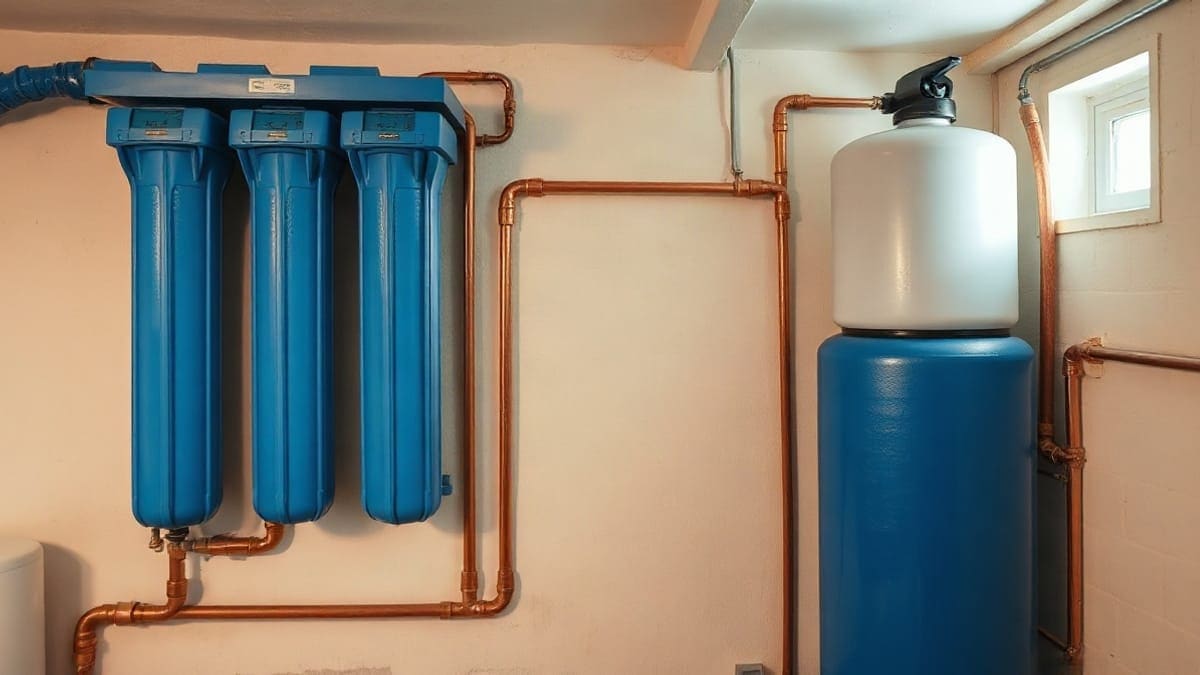
Well water arrives without a utility report, so the system you buy has to match a lab result, not a brand name. Nine systems are compared below on flow, the iron, manganese and sulfur ceilings each maker states, pipe size, pressure range and any listing you can look up. Every figure comes from a maker page, the NSF database, EPA or a university extension, and conflicts between two pages are named in the text. No price appears anywhere. Our well water treatment finder turns your lab numbers into a shopping order, and the sections below show the logic behind it.
What is the best water filtration system for well water?
Water check
No single filter is best: iron, manganese or sulfur above 0.3 ppm needs an oxidizing tank such as the SpringWell WS1 (12 GPM), bacteria need UV rated NSF/ANSI 55, and chlorine-style taste needs carbon. The right chain follows your lab report.
Stated limits are maker claims, not certifications, and they come from different test conditions, so compare them with a lab report, not with each other.
| System | Job | Flow stated | Iron, manganese, sulfur stated | Connection |
|---|---|---|---|---|
| SpringWell WS1 | Oxidizing iron filter | 12 GPM service | 7 ppm, 1 ppm, 8 ppm | 1 in |
| SpringWell WS4 | Oxidizing iron filter | 20 GPM service | 7 ppm, 1 ppm, 8 ppm | 1 in |
| iSpring WCFM500K | Iron, manganese, sulfur filter | not read | 12 ppm, 20 ppm, 20 ppm | not read |
| SpringWell SS1 | Salt softener | 11 GPM (9 in size guide) | no iron limit stated | 1 in |
| SpringWell CF1 | Carbon filter | 9 GPM service | none | 1 in |
| SpringWell MWS1 combo | Iron filter, carbon, softener in one order | 9 to 12 GPM by part | see WS1 | 1 in |
| iSpring WGB32B | Sediment and carbon block | up to 15 GPM | none | 1 in female NPT |
| SpringWell UV | UV disinfection | 15 GPM service | iron under 0.3 ppm | 1 in MNPT |
| Aquasana Rhino Well Water with UV | Carbon, sediment and UV | 7.0 GPM rated, 6.0 UV | iron under 0.3 ppm for the UV | not read |
Which system fits which well?
Match your lab result to a row. Flow is the second filter: a tank rated below your peak demand costs pressure at the shower, and a limit matters only if your water is near it.
| Your well test shows | Pick | Why |
|---|---|---|
| Iron up to 7 ppm, manganese up to 1 ppm, 1 to 4 bathrooms | SpringWell WS1 | 12 GPM, air injection, 25 to 80 psi, pH 6.5 to 10 |
| Same limits, 4 or more bathrooms | SpringWell WS4 | 20 GPM, 13 in by 54 in tank |
| Iron above 7 ppm, or manganese above 1 ppm | iSpring WCFM500K | stated 12 ppm iron, 20 ppm manganese and sulfur |
| Iron, plus 10 to 20 gpg hardness | SpringWell MWS1 | WS1, CF1 and SS1 sold as one set |
| Total coliform positive, water otherwise clear | SpringWell UV or Aquasana Rhino Well Water | 15 GPM or 6.0 GPM UV stage, lamp changed every 12 months |
| Sand and rust only, nothing dissolved | iSpring WGB32B | 5 micron sediment stage, two carbon blocks |
| Chlorine or chemical taste after the iron filter | SpringWell CF1 | 1,000,000 gallons or 10 years of carbon, 9 GPM |
For hardness on a well, our softener for well water page does the sizing; the SpringWell and iSpring pages cover each brand.
In what order should well water treatment go?
Water check
Put sediment removal first, then an oxidizing iron filter, then a softener for hardness, then carbon, and UV last. UV comes last because SpringWell and Aquasana both require iron under 0.3 ppm and hardness under 7 gpg at the lamp.
Sediment and sand wear out a valve head, and oxidized iron fouls softener resin, so Penn State Extension says raw water should not meet air or chlorine before a softener that is meant to take out dissolved iron. UV makers state iron, hardness and tannin limits for the same reason.
| Step | Treatment | Protects | Number that triggers it |
|---|---|---|---|
| 1 | Spin-down or 5 micron sediment filter | Valve heads, later stages | sand or turbidity you can see |
| 2 | Oxidizing iron filter (WS1, WS4, WCFM500K) | Softener resin, UV lamp | iron above 0.3 mg/L, manganese above 0.05 mg/L |
| 3 | Salt softener (SS1) | Water heater, fixtures | hardness above 7.0 gpg |
| 4 | Carbon filter (CF1, WGB32B) | Taste and smell | chlorine, organics, leftover sulfur odor |
| 5 | UV (SpringWell UV, Rhino Well Water) | Health | any positive total coliform |
Two caveats. iSpring says its WCFM500K does not soften and should go ahead of a softener. And Penn State Extension generally recommends a softener alone for dissolved iron under 5 mg/L at pH above 6.7 and 3 to 20 gpg hardness; above that, a dedicated iron filter goes in front.
What do EPA numbers say about iron, manganese, sulfur and pH?
Water check
EPA's secondary standards are 0.3 mg/L for iron, 0.05 mg/L for manganese and pH 6.5 to 8.5, and EPA does not enforce them. Health limits are separate: nitrate 10 mg/L, arsenic 10 ppb, and no more than 5% of monthly samples coliform-positive.
EPA's secondary standards page, last updated May 26, 2026, sets guideline levels for taste, color and odor. Private wells are not regulated at all, so the numbers act as targets. The health limits come from EPA's national primary regulations, last updated August 31, 2026.
| Substance | EPA level | Type | What it means for the filter |
|---|---|---|---|
| Iron | 0.3 mg/L | secondary (aesthetic) | stains, metallic taste; oxidizing filter |
| Manganese | 0.05 mg/L | secondary (aesthetic) | black stains; oxidizing filter |
| pH | 6.5 to 8.5 | secondary | below 6.5, check each system's pH range |
| Total dissolved solids | 500 mg/L | secondary | none of the nine systems claims TDS removal |
| Nitrate (as N) | 10 mg/L | primary (health) | none of the nine claims nitrate removal |
| Arsenic | 0.010 mg/L (10 ppb) | primary (health) | none of the nine claims arsenic removal |
| Lead | 15 ppb action level; 10 ppb under the 2024 rule (EPA's lead rule improvements Q&A) | primary | see lead filters |
| Total coliform | 5% of monthly samples at most | primary | UV or disinfection after shock chlorination |
Hydrogen sulfide has no EPA standard. Penn State Extension says most people smell it well below 0.5 mg/L and that oxidizing filters take out up to about 2 to 3 mg/L, which is below SpringWell's stated 8 ppm. Penn State's hydrogen sulfide page, updated December 10, 2024, also says a smell on hot water only usually points to the water heater's magnesium anode rod. A lab test with the sulfur reading, not the maker limit, settles which tank you need. Our rotten egg smell guide goes deeper.
What does your well water test tell you to buy?
Water check
Read four numbers: iron and manganese in ppm, hydrogen sulfide, pH and total coliform. EPA says to test a private well every year for coliform, nitrates, TDS and pH, and the SpringWell WS will not ship until a well test is on file.
Penn State figures describe treatment methods in general; maker figures describe one product and are claims.
| Test result | General treatment (Penn State) | Product in this page |
|---|---|---|
| Iron under 1.0 mg/L, dissolved | Catalytic carbon if 4.0 mg/L dissolved oxygen | SpringWell CF1 is carbon, but SpringWell says call first on a well |
| Iron under 5 mg/L, pH above 6.7 | Softener | SpringWell SS1 |
| Iron plus manganese 3 to 10 mg/L | Oxidizing greensand filter | SpringWell WS1 (7 ppm iron stated) |
| Iron plus manganese above 10 mg/L | Oxidation then filtration | iSpring WCFM500K (12 ppm iron stated) |
| Hydrogen sulfide under 0.5 mg/L | Activated carbon below about 1.0 mg/L | SpringWell CF1, iSpring WGB32B |
| Hydrogen sulfide 2 to 3 mg/L | Oxidizing filter | SpringWell WS1, iSpring WCFM500K |
| Hydrogen sulfide above 6 mg/L | Continuous chlorination | none of the nine is a chlorinator |
| Coliform positive | Shock chlorinate, retest in 10 to 14 days | SpringWell UV, Aquasana Rhino Well Water |
For bacteria, Penn State says to retest 10 to 14 days after shock chlorination, again 2 to 3 months later, and to add continuous disinfection if coliform returns. Do not buy a filter for a positive bacteria test that has not first led you to the well itself: a cracked cap or a casing leak is a source problem.
Should you test well water before or after filtration?
Both: raw water first, so you buy the right stages, then again after installation to confirm they did what the maker claimed.
Does a private well always need treatment?
Water check
A well needs treatment when your lab report shows iron, manganese or sulfur above 0.3 mg/L, 0.05 mg/L or the smell threshold, or if sand and sediment reach your fixtures. A clean test with no complaints needs no filter at all.
A whole house system makes sense when stains, smell or sediment affect the shower, laundry and every tap. If the test is clean, EPA still wants the annual retest, but a filter adds nothing. If only drinking water worries you, a kitchen tap filter or reverse osmosis treats about 1 gallon per person per day instead of 75, according to Penn State Extension.
The nine well water systems in detail
Water check
The nine systems stand 28 to 64 in tall and state flows of 6.0 to 20 GPM. Each section gives size, flow, limits, the certification the maker can name and who should look elsewhere.
SpringWell WS1: the air-injection iron filter
The WS1 is a 10 in by 54 in tank (64 in with head), serves 1 to 4 bathrooms at 12 GPM on a 1 in connection, and states 7 ppm iron, 1 ppm manganese and 8 ppm hydrogen sulfide. SpringWell's product page lists 25 to 80 psi, 36 to 120°F, pH 6.5 to 10, chemical-free air injection oxidation and greensand fusion media with a stated 10 or more year life. It backwashes nightly. Ask SpringWell what backwash flow your pump must deliver, since the page gives none.
The warranty is lifetime on covered parts, 5 years on the head on the product pages (7 years on the warranty page) and a 6 month performance promise, but the page says hydrogen sulfide must be absent for private well coverage, which sits oddly beside the 8 ppm claim, so ask in writing. SpringWell's llms.txt file says up to 8 ppm iron, while the product page says 7.
Best for: a 1 to 4 bathroom house with a lab-confirmed iron and manganese problem below the limits. Not for: high hydrogen sulfide, any amount of bacteria, or water under pH 6.5.
SpringWell WS4: the same tank for larger homes
The WS4 is 13 in by 54 in (64 in with head), serves 4 or more bathrooms at 20 GPM and shares the WS1's 25 to 80 psi range, 36 to 120°F limit, pH 6.5 to 10 and 7, 1 and 8 ppm claims. The size guide on the same site lists the Pro size at 12 GPM for up to 6 bathrooms, so two SpringWell tables disagree; the spec table's 20 GPM is used here.
Best for: 4 or more bathrooms on a well that can feed 20 GPM. Not for: a 2 bathroom house, where the WS1 does the same job.
iSpring WCFM500K: the higher-limit iron, manganese and sulfur tank
iSpring says the WCFM500K reduces iron up to 12 ppm and manganese and hydrogen sulfide up to 20 ppm, uses 3 micron sediment filtration and cleans itself with air only, for up to 10 years or 500,000 gallons. iSpring's product page says the unit does not reduce TDS and is not a softener, to install it ahead of any softener and to add a pre-filter for large particles.
Flow, pipe size and pressure were not readable on the page when we fetched it, so this page prints none; check them before ordering. The page's stock status also read as out of stock when read through our tools on November 18, 2026, so confirm availability. NSF lists iSpring reverse osmosis models only.
Best for: iron above 7 ppm or manganese above 1 ppm. Not for: a buyer who needs a published flow rate, bacteria, or hardness.
SpringWell SS1: the salt softener for the hardness step
The SS1 holds 32,000 grains, is rated 11 GPM (9 GPM in the size guide), stands 9 in by 48 in (57 in with head) on a 1 in connection and works at 25 to 80 psi and pH 6.5 to 10. SpringWell's softener page pairs it with an 18 in by 33 in brine tank and a lifetime defect warranty. No iron tolerance or certification is stated.
Size it from your hardness plus iron. A rule of thumb used by softener makers adds 4 to 5 gpg for each 1 ppm of iron, depending on the maker (Whirlpool, GE, Rheem and EcoPure manuals say 5, and our calculator uses 4). Taking 4, at 10 gpg hardness and 2 ppm iron, effective hardness is 18 gpg, and four people at 75 gallons each use 4 x 75 x 18 = 5,400 grains a day, so a 32,000-grain unit regenerates about every 6 days. Use our softener size calculator or read what size softener you need.
Best for: hardness after an iron filter. Not for: iron above 5 ppm without a filter in front.
SpringWell MWS1: iron filter, carbon and softener as one set
The Ultra combo sold as MWS1 is a WS1 iron filter (12 GPM), a CF1 carbon filter (9 GPM, 1,000,000 gallons) and an SS1 softener (11 GPM, 32,000 grains), so the set's bottleneck is the 9 GPM carbon tank. SpringWell's combo page lists the MWS4 size too: WS4 (20 GPM), CF4 (12 GPM) and SS4 (13 GPM, 48,000 grains).
The carbon pre-filter changes every 6 to 9 months and the carbon media every 10 years or 1,000,000 gallons. The page requires a well water test before the order moves and says UV is a separate add-on. The warranty terms allow no hydrogen sulfide, and no certification is named.
Best for: a well with iron and hardness together, bought in one order. Not for: a 4 or more bathroom house that needs 12 GPM or more from the carbon stage unless you take the MWS4.
SpringWell CF1: the carbon polish
The CF1 is 9 in by 48 in (52 in with head), serves 1 to 3 bathrooms at 9 GPM on a 1 in connection and is rated by SpringWell for 1,000,000 gallons or 10 years. SpringWell's page lists 25 to 80 psi, a sediment filter change every 6 to 9 months and a lifetime defect warranty. SpringWell's 2020 installation guide says not to install on well water without calling SpringWell first, so treat it as a final stage after an iron filter, not a first one.
Best for: chlorine, taste and leftover sulfur smell after the oxidizing tank. Not for: raw well water, iron or any bacteria. Read the CF1 review.
iSpring WGB32B: the sediment and carbon pair
The WGB32B is 24.5 in by 8 in by 28 in, weighs 60 lb, takes 20 in by 4.5 in cartridges and lists up to 15 GPM on 1 in female NPT ports, with 25 to 80 psi, 40 to 100°F and pH 6 to 9. iSpring's page lists a 5 micron sediment stage and two carbon blocks, a cartridge set rated for 100,000 gallons or up to 12 months, and a 1 year warranty. iSpring words the carbon claim as a third-party test against NSF/ANSI standards, and a test claim is not a listing.
On a well, treat it as a sediment and taste stage. It does not claim iron, manganese or bacteria removal, and iSpring says it leaves minerals in the water.
Best for: sand, rust particles and taste on a clear, tested well. Not for: dissolved iron, bacteria or fluoride. Read the iSpring guide to whole house filters.
SpringWell UV: the 15 GPM disinfection stage
The SpringWell UV is 4 in by 20 in, serves 1 to 7 bathrooms at 15 GPM on a 1 in MNPT connection, changes its lamp every 365 days and needs iron under 0.3 ppm, hardness under 7 gpg and tannins under 0.1 ppm. SpringWell's UV page lists 10 to 150 psi and 36 to 104°F. It gives no lamp wattage, no power rating and no NSF/ANSI 55 listing, and NSF's search for SpringWell found no products.
Best for: a well with a positive coliform test and water already cleared of iron and hardness. Not for: a buyer who needs an NSF/ANSI 55 listing. Read the UV system review.
Aquasana Rhino Well Water with UV: the listed UV stage
The Rhino Well Water with UV (WH-WELL-UVS) rates 7.0 GPM for the filter (14.7 peak) and 6.0 GPM for the UV (15.0 peak), lasts 500,000 gallons or 5 years and is sized for 2.5 bathrooms and 4 people or fewer. Aquasana's product page lists 100 psi maximum, 40 to 90°F, a pre-filter every 2 months (6 months with the low-maintenance option), a post-filter every 6 months and a UV lamp every 12 months of about 9,000 hours. It states 99.8% of bacteria and nonpathogenic viruses and a 5 year limited warranty.
The UV needs iron under 0.3 ppm, hardness under 7 gpg and turbidity under 1 NTU, and the page sends iron cases to a Water Expert, so this is not an iron filter. NSF lists two Aquasana UV units, the 6 GPM AQ-UV-SF and 19 GPM AQ-UV-MF, as NSF/ANSI 55 Class B point-of-entry. The 6.0 GPM rating matches the first, but the page does not name the model.
Best for: a small, clear-water well that needs a listed UV stage. Not for: iron, hardness over 7 gpg or a house that peaks above 6 GPM.
Which certifications can the makers actually name?
Water check
Only the Aquasana UV carries an NSF/ANSI 55 listing in the NSF database (6 GPM and 19 GPM, Class B). NSF returns no products for SpringWell and lists only reverse osmosis models for iSpring.
We searched the NSF certified drinking water treatment unit database by maker on November 18, 2026. The result is uneven, and it matters because "up to 7 ppm" is a claim while a listing can be looked up.
| System | What the maker says | What the database shows | Database |
|---|---|---|---|
| Aquasana Rhino Well Water | UV tested and certified to NSF/ANSI 55 Class B | Two Aquasana UV units listed, 6 and 19 GPM, Class B | NSF, Aquasana |
| SpringWell WS1, WS4, SS1, CF1, UV | No certification named on the pages read | No matching products | NSF, SpringWell |
| iSpring WGB32B | Carbon "tested by a third-party to meet NSF/ANSI standards" | 14 reverse osmosis models, standard 58 only | NSF, iSpring |
| iSpring WCFM500K | Iron, manganese and sulfur limits stated | Not listed | same iSpring listing |
We could not query the WQA and IAPMO search forms, so a certification held only there would not appear in this table. Check the model number in WQA's product search and the IAPMO directory before you rely on it for a lender, an insurer or a health reason.
What separates a lab test from a listing?
A listing names a model number in a public database that anyone can search; a "tested to" line points to a lab report you may never see. Only the first can be checked in a minute.
A certifier audits the plant and publishes the model, while a test may be one the maker commissioned. NSF's listing page names standard 55 as ultraviolet microbiological water treatment, with a Disinfection Performance claim of Class B for the two Aquasana units. An iron limit of 7 ppm has no standard behind it in this niche, so it is a maker claim.
Are SpringWell well water filters good, and are they NSF certified?
They are well documented and not certified: SpringWell publishes flow, tank size, pressure, pH range and limits for the WS, but names no NSF or WQA standard and NSF returns no SpringWell products. Judge it on your lab report, the warranty conditions and the 6 month performance promise.
How do you choose a water filtration system for well water?
Water check
Check five numbers in order: your lab report, your peak flow (about 6.5 GPM for two showers and a tap), the well's ability to feed the backwash, the pipe size and the pressure. A tank rated under peak demand loses pressure.
What GPM does a well house need at peak?
EPA says a standard showerhead uses 2.5 gallons per minute and a WaterSense model 2.0 gallons per minute (EPA WaterSense). Two showers are 5.0 GPM, and we assume 1.5 GPM for a kitchen tap, which gives 6.5 GPM at the busiest minute.
| System | Stated service flow | Against 6.5 GPM peak |
|---|---|---|
| Aquasana Rhino Well Water UV stage | 6.0 GPM rated, 15.0 peak | Below by 0.5 GPM |
| SpringWell CF1 | 9 GPM | Above by 2.5 GPM |
| SpringWell SS1 | 11 GPM | Above by 4.5 GPM |
| SpringWell WS1 | 12 GPM | Above by 5.5 GPM |
| SpringWell UV | 15 GPM | Above by 8.5 GPM |
| SpringWell WS4 | 20 GPM | Above by 13.5 GPM |
What micron, mesh and tank size does a well filter need?
A 5 micron stage, as on the iSpring WGB32B, catches sand and rust; iSpring states 3 microns for the WCFM500K. We found no maker datasheet that pins down a spin-down mesh, so ask before buying by mesh. SpringWell's tanks run 10 in by 54 in for 1 to 4 bathrooms and 13 in by 54 in for 4 or more.
How many years before the media runs out?
Four people at 75 gallons each (the average Penn State Extension uses) use 300 gallons a day, or 109,500 a year. The Rhino Well Water's 500,000 gallons last about 4.6 years, the CF1's 1,000,000 gallons about 9.1 years, and an iSpring cartridge set of 100,000 gallons about 11 months.
Oxidizing tank, carbon or UV: what happens inside a well water treatment tank?
Water check
An oxidizing tank such as the WS1 mixes air into the water so dissolved iron, manganese and sulfur turn into solid particles, then catches them in media and flushes them out in a nightly backwash. UV works differently: it disinfects without removing anything.
SpringWell describes air injection oxidation in a single tank with a greensand fusion media. Dissolved iron, often clear at first, turns into rust-colored solids once it meets air, and the media catches them. Carbon holds chlorine and organic chemicals until its surface is full. UV stops microbes from reproducing but removes no dissolved metal, nitrate or arsenic.
Reverse osmosis pushes water through a membrane at one tap; see our reverse osmosis for well water page. For hardness work read water softener vs water filter or our water softener guide.
Is a water softener or carbon filter enough for a well?
No. A softener takes out hardness and a little dissolved iron, carbon takes out chlorine and some smell, and neither disinfects. Penn State limits softeners to dissolved iron under 5 mg/L and carbon to hydrogen sulfide under about 1.0 mg/L. For a well with several problems, combine them in the order shown above. The filter and softener combo guide shows how.
Will well water filtration reduce TDS?
None of the nine systems claims it. iSpring says the WCFM500K does not reduce TDS. EPA's secondary level is 500 mg/L, and reverse osmosis, not a whole house filter, lowers dissolved solids at one tap.
What does a well water setup cost to run each year?
Water check
This site prints no prices, because none can be checked at the time you read them. What you can calculate is running cost: one UV lamp a year, 6 sediment changes a year at 2 months, and 1 water test a year.
Our well water filtration cost page lists what drives the total. Beyond the equipment, the repeating items are the UV lamp (every 12 months), the Aquasana pre-filter (every 2 months, or 6 with the low-maintenance option), the SpringWell sediment filter (every 6 to 9 months), softener salt, and the annual lab test EPA recommends.
How do you install a well water filtration system?
Water check
Install it after the pressure tank on the line that feeds the house, in a dry spot between 36 and 120°F for SpringWell and 40 to 90°F for Aquasana, with a bypass so you can service it. Treat the water at the main, not at a tap.
SpringWell's 2020 CF installation guide says those systems go on the main supply line, follow local plumbing code and include a 3-valve bypass. The WS ships with a power supply and backwashes nightly, so plan for a drain, an outlet near the head and room for its 64 in height. Check permit and backflow rules in your town, and keep every tank where water cannot freeze. Steps are in our installation guide and how to install and change a well water filter.
When is a well water filter due for replacement?
Water check
Change a sediment stage every 2 to 9 months, a UV lamp every 12 months and carbon every 10 years or 1,000,000 gallons for the CF1. Change sooner when pressure drops or the water changes color.
| System | Part | Interval stated |
|---|---|---|
| SpringWell WS1 and WS4 | Greensand fusion media | 10 or more years, no gallon rating given |
| SpringWell CF1 | Sediment filter | every 6 to 9 months |
| SpringWell CF1 | Carbon media | 1,000,000 gallons or 10 years |
| SpringWell UV | Lamp | every 365 days |
| Aquasana Rhino Well Water | Pre-filter | every 2 months, or 6 with the low-maintenance pre-filter |
| Aquasana Rhino Well Water | Post-filter, lamp, tank | 6 months, 12 months, 5 years |
| iSpring WGB32B | Cartridge set | 100,000 gallons or up to 12 months |
More in upkeep schedules for whole house filters.
How do you change a well water filter?
Shut the bypass, close the inlet, relieve pressure at a tap, unscrew the housing, swap the cartridge, hand-tighten, reopen slowly and flush. Media in a WS1 or CF1 tank lasts years, so ask the maker how it should be replaced.
How do you clean a well water filter?
Sediment cartridges are replaced, not cleaned. An air-injection tank cleans itself with its nightly backwash.
Why is my well water filter black?
A black cartridge usually means manganese or fine sediment has collected, which is a sediment stage's job. If it blackens within weeks, test for manganese and iron.
Can you build your own well water filtration system?
Water check
Not safely for health reasons. A homemade sand and charcoal filter has no flow rating, no listing and no limit you can check. You can install a sized, listed system yourself where plumbing code allows, but do not build the filter.
Your test results, not the installer, decide what goes in the chain.
Well water filtration: our conclusion
Water check
Test first, then buy by the number: the SpringWell WS1 for iron up to 7 ppm and manganese up to 1 ppm, the iSpring WCFM500K above that, and UV for bacteria, which no iron filter removes.
The SpringWell WS1 (12 GPM, air injection) Check price on Amazon and the larger WS4 Check price on Amazon cover moderate iron. The iSpring WCFM500K claims up to 12 ppm of iron and 20 ppm of manganese and sulfur, with a sediment pre-filter Check price on Amazon. Iron under 5 mg/L at pH above 6.7 can go to a softener such as the SpringWell SS1 Check price on Amazon. A coliform-positive well needs the SpringWell UV Check price on Amazon or the Aquasana Rhino Well Water Check price on Amazon, after shock chlorination and a retest in 10 to 14 days.
6 common mistakes with well water filtration
Water check
Six mistakes cost buyers most: skipping the lab test, putting UV before the iron filter, ignoring peak flow, using carbon on raw well water, trusting a 7 ppm claim without a margin, and never retesting.
- Buying before the lab test. SpringWell will not ship a WS until a well test is on file, because iron, pH and hydrogen sulfide decide the tank. Cost: an out-of-spec tank and a voided warranty.
- Putting UV first. Both UV makers require iron under 0.3 ppm and hardness under 7 gpg, so UV goes last.
- Ignoring peak flow. A UV stage rated 6.0 GPM on a house that peaks at 6.5 GPM loses dose.
- Using carbon alone on raw well water. SpringWell says to call before putting its CF on a well, and Penn State puts carbon below about 1.0 mg/L of hydrogen sulfide.
- Trusting the top of a stated range. A 7 ppm claim is a ceiling, and Penn State puts oxidizing filters at about 2 to 3 mg/L of sulfide.
- Never retesting. EPA says every year, because a cracked casing or a flood changes water after the filter is in.
Frequently asked questions
What is the best well water filter?
The one matched to your lab report. For iron under 7 ppm, the SpringWell WS1. For iron above that, the iSpring WCFM500K by its stated 12 ppm. For bacteria, a UV stage. The full table is above.
What is the best whole house well water filtration system for a family of four?
Four people use about 300 gallons a day and peak near 6.5 GPM. The WS1 (12 GPM) with a carbon stage handles that, and the MWS1 set adds a softener. Add UV if coliform is positive.
What kind of filtration system do I need for a well?
Sediment first, an oxidizing filter for iron, manganese and sulfur, a softener for hardness, carbon for taste, UV for bacteria. You need only the stages your test shows.
How much is a well water filter for a house?
This site prints no prices. Use the Check price buttons, and see the cost page. Running costs are a lamp each year and sediment filters every 2 to 9 months.
How long does a well water filtration system last?
The WS1 media is stated at 10 or more years, a CF1 at 10 years or 1,000,000 gallons, the Rhino Well Water at 500,000 gallons or 5 years. UV lamps last 12 months.
Where do you install a well water filter, and where is mine?
After the pressure tank on the line to the house, and before the water heater for most chains. To find an existing one, trace the pipe from the pressure tank; filters are tanks or housings with a head.
How do you remove a stuck well water filter housing?
Close the inlet, relieve pressure, and use a housing wrench. Do not pry.
Can I pour vinegar in my well water filter?
Not unless the maker says so. The pages we read give no vinegar step, and cleaning agents can harm media and seals. Ask SpringWell or iSpring before using any chemical.
How do I know when a well water filter is not working?
Stains or smell return, a gauge shows pressure falling from its clean-filter value, or a repeat lab test shows the contaminant. A sediment cartridge that fails early points to dirty water.
Is a well water filter necessary?
For stains, smell, sediment or bacteria, yes. For a clean lab report, no. EPA says to test every year either way.
Does SpringWell water filter remove fluoride?
SpringWell's pages we read do not claim fluoride removal for the WS, CF or SS series. Fluoride's EPA limit is 4.0 mg/L; see best water filter for fluoride.
Should there be a check valve after a well water filter?
Neither maker page we read says so. A check valve is a plumbing-code and pump question, so ask your installer and local code.
How can I purify my well water?
Start with a test from a state-certified lab, because EPA says private well owners are responsible for testing and treating their own water (EPA private wells). Then match the stage to the result: an iron filter for iron and manganese, a softener for hardness, and UV after a sediment filter for bacteria. See the best iron filter for well water and the best UV water purifier for well water.
What should you not do with well water?
Do not buy a system before you have a lab result, do not treat bacteria with a carbon or iron filter, and do not assume that a filter makes unsafe water safe. A treatment tank that is never serviced can also stop working without any change you can taste. Use the table of EPA numbers on this page and ask the maker in writing about your water.
How we researched this page
Water check
Nine systems were chosen from brands in our Impact program and Amazon US, all on sale in the United States as far as we could confirm. We read maker pages, the NSF database by maker, EPA pages and Penn State Extension. We did not test any filter ourselves and publish no store ratings.
Not confirmed: the iSpring WCFM500K flow, pipe size and pressure, because iSpring's page refused our request on repeated tries and we use no retailer figure. The WQA and IAPMO search forms were not available to our tools. CDC and CPSC pages refused our requests. We could not confirm a "Clearsource Premier" system on the maker's site, so none is listed. Check price links may pay this site a commission at no extra cost to you. Figures were read on November 18, 2026.
Sources
Our sources by topic
Public agencies and universities
- U.S. EPA, private wells, protect your home's water, secondary standards, national primary regulations and WaterSense showerheads.
- Penn State Extension, iron and manganese, hydrogen sulfide, shock chlorination and water softening; CPSC recalls.
Certification and standards bodies
Manufacturers, retailers and other references
- SpringWell, WS well water iron filter, Ultra combo, salt-based softeners, UV system, whole house filters, CF1, CF4 installation instructions (2020) and llms.txt.
- Aquasana, Rhino Well Water with UV.
- iSpring, WCFM500K and WGB32B.
Keep comparing
 Water Softener for Well WaterTen well water softener setups compared by grains, GPM, printed iron limits and NSF or WQA listings
 Iron Filter for Well WaterEight iron filters for well water judged by their printed iron, manganese and sulfur limits, pH
 Whole House Water Filtration SystemEight whole house water filters compared by rated flow in GPM, capacity in gallons
 Reverse Osmosis System for HomeEight reverse osmosis systems compared by NSF-listed output, drain water, feed pressure and certification
 Water SoftenerEleven water softeners sold in the US compared by grains, GPM, salt use and certification
 Salt-Free Water SoftenerEight salt-free water conditioners compared by flow in GPM, hardness limit in gpg