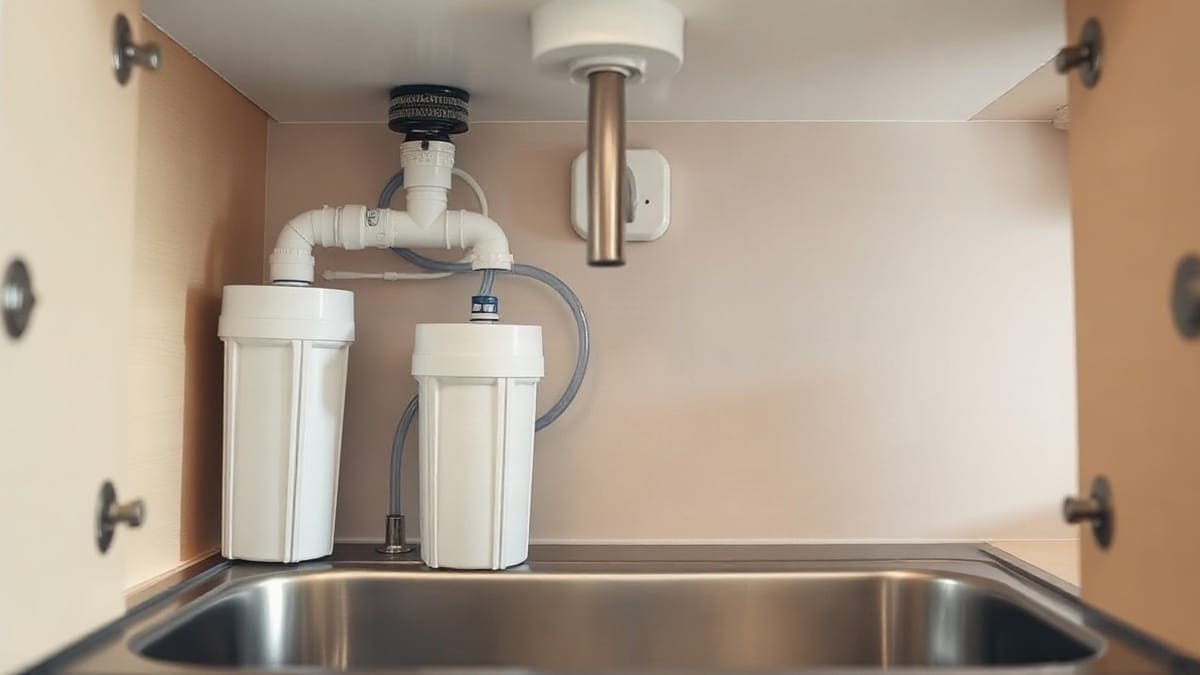
A countertop reverse osmosis system sits by the sink, takes tap water from a tank you fill by hand and sends the rejected water to a second tank you empty. Nothing is drilled, so it suits renters, dorms and small kitchens. The catch is the paperwork: few of these makers can point to a database listing. Ten units sold in the U.S. go through the same checks below: each maker's product page, NSF's product database (read November 17, 2026), the WQA and NSF certificates that Bluevua publishes, and public health pages. This page prints no price; the buttons lead to the current one. Start with the certificate table, then the drain water math.
Ten countertop reverse osmosis systems at a glance
Water check
Ten plug-in systems list tanks and carafes from 40 oz to 2 gallons and drain ratios from 1.5:1 to 4:1. Only four state a rated output (50 to 100 GPD), and only two publish a wattage: 748 W for the Brio 630 and 1,500 W for the CovePure CP-16.
The table copies what each maker page says. A blank cell means the page we read did not give the figure.
| Model | Stages | Water holder | Rated output | Pure to drain | Power |
|---|---|---|---|---|---|
| AquaTru Classic | 4 | 0.75 gal pure tank | Not stated | 75% efficiency | 120 V, 60 Hz |
| AquaTru Carafe | 4 | 0.66 gal tap, 0.5 gal clean | Not stated | 63% efficiency | 120 V |
| Bluevua ROPOT(UV) | 6 | 60 oz carafe | Not stated | Not stated | 100 to 240 V in, 1.5 A out |
| Bluevua ROPOT-Lite(UV) | 7 | 40 oz carafe | Not stated | Not stated | 100 to 240 V in, 2.0 A out |
| Waterdrop A2G | 6 | 159 oz tank, 40 oz pitcher | 100 GPD | 3:1 | Yes, watts not stated |
| Frizzlife WB99-C | Not stated | 152 oz (4.5 L) tank | 100 GPD | 3.5:1 | Mains, watts not stated |
| CovePure CP-16 | 4 | 5 L raw, 0.5 L cold, 1.8 L pitcher | Not stated | 4:1 | 110 V, 1,500 W |
| Express Water ROC001 | 5 | 2 gal tank | 50 GPD | 1 gal per 3 made | Plug-in, watts not stated |
| Dreo RO Water Filter 113S | 7 | 169 oz (5 L) tank, 37 oz pitcher | Not stated | 3:1 | Plug-in, watts not stated |
| Brio 630 | 3 | 1.32 gal tank | 75 GPD | 2:1 in the text, 1.5:1 in a bullet | 748 W |
The AquaTru FAQ calls its 75% and 63% figures an efficiency rate, which we read as pure water divided by tap water used. That is our reading, so the drain math below states it. The Waterdrop RO systems compared page covers the rest of that brand.
Which plug-in unit has a certificate you can read?
Water check
None of the ten appears as a system in the NSF/ANSI 58 database. One brand, Bluevua, publishes a WQA certificate that lists NSF/ANSI 58 for its Lite models and only a lead-content standard for the base ROPOT.
We searched the NSF drinking water treatment unit list for standards 42, 53, 58, 372 and 401 under Waterdrop, AquaTru, Bluevua, Frizzlife, CovePure, Dreo and Brondell. NSF dated its listings November 17, 2026, and each search came back with no matching product in the reverse osmosis standard 58 (Waterdrop does have 555 rows by trade name, in 42 for pitchers, faucet and inline filters, none in 58). A company can certify under another legal name, so an empty search is not proof of fraud. It does mean you cannot confirm the claim in that database yourself.
| Model | Standard the maker names | Body named | What we could confirm |
|---|---|---|---|
| AquaTru Classic | NSF 42, 53, 58, 372, 401 (data sheet 10/2024; FAQ adds P473) | IAPMO | Maker pages only; FAQ prints "41" for 42 |
| AquaTru Carafe | NSF 42, 53, 58, 372, 401 | IAPMO | Data sheet (10/2024), manual (11/2024) and page say "certified by IAPMO R&T"; FAQ says pending, 78 of 83 passed (read Nov 18, 2026) |
| Bluevua ROPOT(UV) | NSF/ANSI/CAN 372 (lead content) | NSF and WQA | Both read; base ROPOT under 372 only |
| Bluevua ROPOT-Lite(UV) | NSF/ANSI 58-2022 and 372 | WQA Gold Seal, Oct 6, 2025 | Certificate read; WQA's own search not run |
| Waterdrop A2G | None on the page | None | Claims "third-party tested" |
| Frizzlife WB99-C | NSF/ANSI 58 | Report link points to IAPMO | Covers the membrane; report not opened |
| CovePure CP-16 | NSF/ANSI 42, 53, 58 | SGS | SGS statement; no database listing |
| Express Water ROC001 | None on the page | None | Its under-sink models are listed, not this one |
| Dreo 113S | None named | SGS | "Certification: SGS", no standard |
| Brio 630 | None on the page | None | Its NFMRO75GPD membrane is a listed component only |
What does the Bluevua certificate actually cover?
The WQA Gold Seal certificate, dated October 6, 2025, lists NSF/ANSI 58-2022 for the RO100ROPOT-LITE, RO100ROPOT-LITE(UV), RO100ROPOT-Travel and RO100ROPOT-YMT. The base RO100ROPOT and RO100ROPOT(UV) appear only under NSF/ANSI/CAN 372, which measures lead content. A separate NSF certificate, number C0878345-01 and dated June 12, 2026, also covers 372. The Bluevua ROPOT(UV) page says "NSF & WQA Certified" without naming the standard, so the sale page reads wider than the paper behind it.
What do the other certification claims mean?
AquaTru's own page explains the numbers: NSF 42 covers aesthetic impurities such as chlorine, NSF 53 covers a contaminant with a health effect and NSF 401 covers emerging contaminants. Waterdrop's M6CG page says 372 means lead-free materials. Standard 58 is the reverse osmosis one. Waterdrop's M6CG page claims NSF/ANSI 58 and 372, yet the same page says its contaminant claims rest on "theoretical evaluation by our internal R&D laboratory", and no Waterdrop reverse osmosis system shows in the NSF list (its other filters do, under 42). Brio is the opposite case: NSF's 58 listing for Brio holds membrane elements, including the NFMRO75GPD that the Brio 630 uses, marked as conforming to material and structural integrity requirements only. For a model that is in the list, see the Express Water listing. Request the performance data sheet and compare the model number on it with the one you are buying.
Do countertop reverse osmosis systems work, and how?
Water check
Yes, a countertop unit works like an under sink one: a pump pushes tap water through a 0.0001 micron membrane, and the rejected water collects in a separate tank. It needs a 110 to 120 V outlet, not a water line.
Penn State Extension describes the process: it forces water through an extremely thin membrane barrier under pressure. A countertop unit has no line pressure to use, so it carries its own pump; Dreo's page says that pump runs at 55 dB(A) or lower. You pour tap water into the raw tank, press start, and the unit fills a pure tank or carafe. Most also have a sediment stage and a carbon stage before the membrane, and a post-carbon or mineral stage after it. Yes, there is such a thing as a countertop reverse osmosis filter: all ten here are one. The CDC page on home water treatment lists parasites, bacteria and viruses among what RO removes, and tells buyers to check the label for the chemicals a system removes. For the theory, read what is reverse osmosis and how does it work.
How do you set up and use a countertop reverse osmosis system?
Setup is the same on all ten: place it on a level counter near an outlet, install the filters, rinse the system as the manual directs, fill the tap tank and press start. AquaTru's page says "no plumbing, no drilling", and CovePure says "takes two minutes to set up". Bluevua tells you to prime the unit with four to six rounds of water, TechGearLab reports from the maker's guidance. Read the manual for the first flush: Dreo's page says to flush the system with 2 tanks of tap water before first use.
How many gallons go down the drain for a family of 4?
Water check
For a family of 4 drinking and cooking with 4 gallons a day, the eight systems that state a ratio send between 1.0 and 2.7 gallons down the drain daily, 365 to 973 gallons a year. EPA's typical figure for any RO would be 20 gallons a day.
Penn State Extension's water softening guide lists 1 gal/person/day for drinking and cooking, which gives a household of four 4 gallons daily and 1,460 gallons across a year. EPA's WaterSense page on point-of-use RO says typical systems send five gallons or more to the drain per gallon treated, some up to 10, and a WaterSense unit must stay at 2.3 gallons or less. None of the ten maker pages mentions a WaterSense label. The math below multiplies 4 gallons by each drain ratio: a 3:1 system sends 1 gallon down for every 3 made, so 0.33 gallon per gallon, or 1.33 gallons a day.
| System and its ratio | Drain per gallon made | Drain per day | Drain per year |
|---|---|---|---|
| EPA typical, 5 gal or more | 5 gal | 20 gal | 7,300 gal |
| WaterSense limit | 2.3 gal | 9.2 gal | 3,358 gal |
| Brio 630 at 1.5:1 | 0.67 gal | 2.67 gal | 973 gal |
| AquaTru Carafe, 63% | 0.59 gal | 2.35 gal | 857 gal |
| Brio 630 at 2:1 | 0.5 gal | 2.0 gal | 730 gal |
| AquaTru Classic, 75% | 0.33 gal | 1.33 gal | 487 gal |
| Waterdrop A2G, Dreo 113S, Express ROC001, 3:1 | 0.33 gal | 1.33 gal | 487 gal |
| Frizzlife WB99-C, 3.5:1 | 0.29 gal | 1.14 gal | 417 gal |
| CovePure CP-16, 4:1 | 0.25 gal | 1.0 gal | 365 gal |
Between the Brio 630 at 1.5:1 and the CovePure CP-16, the same four people would waste 608 more gallons each year. Bluevua prints no ratio on the pages we read. TechGearLab lists a 2:1 "wastewater-to-filtered" ratio for the earlier ROPOT, which would mean 2 gallons of drain per gallon, or 2,920 gallons a year, so ask Bluevua before you count on a low figure. Water Filter Guru writes that the AquaTru Carafe wastes 1 gallon for every 4 filtered, against the 63% efficiency on AquaTru's FAQ. Every ratio here is the maker's own, measured under the maker's conditions. What the units cost to run is the subject of reverse osmosis system cost.
Does the reject tank matter for a septic system?
The reject goes to a tank you empty, so it reaches a septic field only if you pour it down a drain. That is 1 to 2.7 gallons a day, and reviews on the Express Water page say the waste tank fills fast.
Is the tank big enough for a family of 4?
Water check
Only the Express Water ROC001, with a 2 gallon tank, comes under 3 refills a day for 4 gallons. The others need 3.8 to 4.5 raw tank fills, and the AquaTru Carafe about 10, because their tanks hold 0.66 to 1.32 gallons.
A countertop system has two limits: how much tap water it holds, and how much pure water it stores. Tank size is the real ceiling, since every maker's rated output is far above 4 gallons a day. Our arithmetic: tap water needed is 4 gallons times (1 plus the drain per gallon made), divided by the tank size. It assumes each fill uses the whole tank, and a few units share one tank between tap and reject water, so real fills can be higher.
| Model | Tap water needed per day | Tank | Fills per day | Pure water holder | Pours for 4 gal |
|---|---|---|---|---|---|
| Express Water ROC001 | 5.33 gal | 2 gal | 2.7 | Not stated | n/a |
| CovePure CP-16 | 5.0 gal | 5 L (1.32 gal) | 3.8 | 1.8 L pitcher (0.48 gal) | 8.4 |
| Dreo 113S | 5.33 gal | 5 L (1.32 gal) | 4.0 | 37 oz pitcher (0.29 gal) | 13.8 |
| Waterdrop A2G | 5.33 gal | 159 oz (1.24 gal) | 4.3 | 40 oz pitcher (0.31 gal) | 12.8 |
| Frizzlife WB99-C | 5.14 gal | 152 oz (1.19 gal) | 4.3 | Not stated | n/a |
| Brio 630 (2:1) | 6.0 gal | 1.32 gal | 4.5 | Not stated | n/a |
| AquaTru Carafe | 6.35 gal | 0.66 gal tap | 9.6 | 0.5 gal clean tank | 8.0 |
| AquaTru Classic | 5.33 gal | Tap tank not stated | n/a | 0.75 gal pure tank | 5.3 |
For one person at 1 gallon a day the figures divide by four and every unit is comfortable. For four people who cook, refilling four times a day is the main cost of skipping plumbing. The under sink reverse osmosis and tankless reverse osmosis pages cover the no-refill formats, and the tank versus tankless guide compares them.
What does a countertop reverse osmosis system remove?
Water check
An RO membrane holds back most dissolved solids, yet only a claim printed on a listing has outside testing behind it. EPA sets lead at a 15 ppb action level (10 ppb under its 2024 rule) and PFOA and PFOS at 4.0 ppt each, while a standard 58 test uses a combined 20 ng/L.
Bluevua, Dreo and others advertise up to 99.99% removal. Treat that as advertising: what a lab confirmed is written on the performance data sheet. Penn State's PFAS guide names the two claims to find on a standard 58 listing, "PFOA Reduction" and "PFOS Reduction", and warns that today's tests only reach a combined 20 ng/L, so a pass does not prove the EPA limit is met. The EPA PFAS page sets PFOA and PFOS at 4.0 ppt each, with compliance in 2029 under the April 2024 rule; a May 18, 2026 EPA proposal (not final) would allow extensions to 2031 and rescind the limits for four other PFAS. The EPA lead page gives the action level as 15 ppb and says there is no known safe level of lead in a child's blood.
| Contaminant | Maker claims on the pages we read | Where it can be checked |
|---|---|---|
| Lead | AquaTru (84 contaminants), Waterdrop A2G | Data sheet for your model |
| Fluoride | AquaTru, Waterdrop A2G FAQ | Performance data sheet |
| PFOA and PFOS | AquaTru, Waterdrop A2G, Dreo | A listing with PFOA and PFOS claims; none found |
| Chlorine | AquaTru, Waterdrop A2G, Brio | NSF 42 or 53 listing |
| TDS | Frizzlife and Waterdrop name TDS reduction | NSF/ANSI 58 |
| Microplastics | AquaTru and the Waterdrop M6CG list them | No standard 58 claim found |
Single-contaminant questions have their own pages: microplastics, fluoride, PFAS, lead and nitrates. The longer list sits on what does reverse osmosis remove.
The ten countertop systems in detail
Water check
All ten units are sold in the U.S., and each spec below was read on its maker's page. AquaTru and CovePure are the long-running plug-in models, and Bluevua is the only brand whose certificate lists NSF/ANSI 58 for a countertop model.
Every card below separates what the page states from what a database or certificate backs. A purchase through a Check price button earns this site a commission, and your cost stays the same. For brand-level reads, see the AquaTru comparison and the Waterdrop brand review.
AquaTru Classic: the plug-in countertop for renters
The AquaTru Classic page lists a 4-stage system measuring 12 x 14 x 14 in, about 17 lb, a 0.75 gallon purified tank and 120 V at 60 Hz. The FAQ gives 75% efficiency and a hardness limit of 10 gpg, since scale clogs the membrane above it. The RO filter lasts up to two years, and filters run from 6 months to 2 years. The warranty is 1 year. See the AquaTru Classic review.
Best for: renters and one or two people who want a plug-in unit. Not for: a family that cooks a lot, or water above 10 gpg. Check price on Amazon
AquaTru Carafe: the compact version
The AquaTru Carafe page lists 7.5 x 14 x 13 in, about 9 lb, a 0.66 gallon tap tank, a 0.5 gallon clean tank and a 64 oz glass carafe, at 120 V. It uses its own filters, which the Classic does not accept. Efficiency is 63% on the FAQ. The data sheet, manual and product page say certified by IAPMO R&T, while the FAQ says IAPMO certification is still pending; we read both on November 18, 2026, and NSF lists nothing. See the AquaTru Carafe review and the AquaTru Classic versus Carafe page.
Best for: a one person kitchen with little counter space. Not for: a household that needs a certification you can confirm today. Check price on Amazon
Bluevua ROPOT(UV): carafe unit with a UV stage
The Bluevua ROPOT(UV) has 6 stages: 5 micron polypropylene, 0.5 micron carbon, the 0.0001 micron RO membrane, a post carbon, UV at 270 to 280 nm and a mineral filter. It measures 14.3 x 10.9 x 15.4 in, weighs 23.2 lb and holds a 60 oz glass carafe. Filter life is 12 to 24 months. The certificates list it under NSF/ANSI/CAN 372, not 58. Bluevua's Lite page is the model with the 58 listing. See the Bluevua countertop RO review.
Best for: a buyer who wants a large carafe and a UV stage. Not for: anyone who needs an NSF/ANSI 58 claim on this exact model. Check price on Amazon
Bluevua ROPOT-Lite(UV): the one with a 58 certificate
The ROPOT-Lite(UV) has 7 stages, including a 1 micron polypropylene stage, UV and a mineral filter. It measures 9.7 x 9.5 x 14.1 in, weighs 18.5 lb and holds a 40 oz carafe. Filters last 12 months. It draws 100 to 240 V in and 24 V DC at 2.0 A out. Its WQA Gold Seal certificate lists NSF/ANSI 58-2022 and 372.
Best for: a small household that wants a certificate you can read. Not for: a family of 4, since a 40 oz carafe means about 13 pours for 4 gallons. Check price on Amazon
Waterdrop A2G: hot and cold with minerals
The Waterdrop A2G page lists 100 GPD, a 3:1 ratio, a 159 oz tank, a 40 oz portable pitcher, 15.9 x 8.2 x 15.7 in and 21.14 lb. Water runs from 59 to 203°F, and the filter lasts 12 months. The page says 6 stages, while its FAQ describes a 5-stage countertop RO, and it names no certification. See the Waterdrop systems compared guide.
Best for: a household that wants hot and cold water and a 3:1 ratio. Not for: a shopper who must look the certificate up first. Check price on Amazon
Frizzlife WB99-C: 3.5:1 and a removable tank
The Frizzlife WB99-C page lists 100 GPD, a 3.5:1 ratio, a 152 oz (4.5 L) removable tank and 9 x 16.5 x 14.8 in. The FCR100+ RO membrane lasts 1 year and the alkaline post-filter 3 months. It states NSF/ANSI 58 for the RO membrane and links a report on IAPMO's site. Frizzlife's certification guide says wording must stay model specific. The spec table is unclear on installation and power, while the copy says "ZERO installation".
Best for: a 3.5:1 ratio with a 4.5 L tank. Not for: buyers who need the whole system confirmed to 58 before purchase. Check price on Amazon
CovePure CP-16: hot and cold at 4:1
The CovePure CP-16 page lists 16.54 x 9.13 x 16.54 in, 22.04 lb, 110 V, 1,500 W, a 5 L raw tank, a 0.5 L cold tank, a 1.8 L pitcher and a 4:1 ratio. Its 4 stages end in an alkaline polish at pH 7.5 to 8, and the membrane is rated for up to 24 months. SGS "tested and certified" it against NSF/ANSI 42, 53 and 58, and the warranty is 1 year. See the CovePure review.
Best for: a small kitchen or office wanting the least drain water. Not for: anyone who needs a database entry, or has very hard water. Check price on Amazon
Express Water ROC001: the biggest tank
The Express Water 5-stage countertop RO lists sediment, pre-carbon, RO, post-carbon and UV LED stages, 50 GPD, a 2 gallon tank, 1 gallon of discharge per 3 produced, 19 lb and 17.5 x 8.5 x 16 in. The CB and PAC filters last 6 months and the membrane up to 24 months. The warranty is 1 year. The page names no certification. See the Express Water review.
Best for: fewer refills, from a 2 gallon tank. Not for: a shopper who needs a named certificate, or a quiet counter. Check price on Amazon
Dreo RO Water Filter 113S: app and two pitchers
The Dreo 113S page lists 7 stages, a 0.0001 micron membrane, a 169 oz (5 L) tank, a 37 oz pitcher, 15.7 x 6.7 x 13.3 in, a 3:1 ratio and 265 gallons or 6 to 12 months of filter life. It reports TDS and filter life in an app, and lists "Certification: SGS" without a standard. See the Dreo countertop RO review.
Best for: a shopper who wants app tracking and a 3:1 ratio. Not for: anyone needing a named standard. Check price on Amazon
Brio 630: a bottleless dispenser
The Brio 630 is a 3-stage RO dispenser with a 1.32 gallon tank, 75 gallons a day, a 0.58 GPM flow, hot above 185°F, cold below 50°F and UV self-cleaning. It draws 748 W and measures 14.4 x 16.73 x 19.29 in. The text says 2:1 pure to drain and a bullet says 1.5:1. It names no certification. See the Brio review.
Best for: an office that wants hot, cold and room temperature water. Not for: a small counter or a tight water budget. Check price on Amazon
Which type of countertop unit fits your situation?
Water check
Pick by household size first: a 40 oz carafe suits one person, a 5 L tank two to three, and a 2 gallon tank a family. Then check hardness at 10 gpg, and only then the certificate.
| Your situation | Model to look at | Reason from the specs |
|---|---|---|
| One person, rental, little space | AquaTru Carafe, Bluevua Lite(UV) | 0.5 gal and 40 oz holders |
| Renter, two people | AquaTru Classic | 0.75 gal pure tank, 75% efficiency |
| Wants a certificate you can read | Bluevua ROPOT-Lite(UV) | WQA lists NSF/ANSI 58-2022 |
| Lowest drain water | CovePure CP-16 | 4:1, 365 gal a year for 4 people |
| Hot and cold water | CovePure CP-16, Waterdrop A2G, Brio 630 | Heating built in |
| Fewest refills for a family | Express Water ROC001 | 2 gal tank, 2.7 fills a day |
| App tracking | Dreo 113S | TDS and filter life in an app |
How do you choose a countertop reverse osmosis system in an afternoon?
Water check
Check your hardness, count your gallons, then read the certificate for your own contaminant. A family of 4 drinks and cooks with about 4 gallons a day, so tank size and drain water matter more than any rated GPD.
Work through these steps in order, in one afternoon.
- Get your numbers. Read your annual water quality report through EPA's local lookup, or test a well at a state lab. Convert hardness with the water hardness converter, or use the well water treatment finder. A water hardness test kit gives a fast home reading.
- Count gallons. Use 1 gallon per person per day, from Penn State. Four people means 4 gallons, or 1,460 gallons a year.
- Match the tank. Divide the tap water you need by the tank size, as in the table above.
- Read the paper. Ask for the performance data sheet and match your model number, as Frizzlife itself advises.
- Check hardness. AquaTru's limit is 10 gpg, which is 170 ppm at 17 ppm per gpg (Penn State).
Can you use a countertop reverse osmosis system on hard water?
Only under the limit the maker gives. AquaTru says its units are meant for water below 10 gpg, and that lime scale builds on the membrane above it, which plugs the filter and calls for more descaling and earlier replacement. The other pages we read state no hardness limit, so ask. Above 10 gpg, soften first: see do you need a water softener with reverse osmosis, the water softener size calculator and what is hard water. Our water softener pillar covers the softener side.
Are countertop reverse osmosis systems worth it and good?
Water check
A countertop RO is worth it when you rent, need no drilling and drink 1 to 2 gallons a day. It is a poor fit for a family of 4, where 4 to 5 tank fills a day and 365 to 973 gallons of drain a year add up.
The upside is real: no plumber, no landlord permission and a membrane that rejects dissolved solids. The costs are refilling, emptying the reject tank, counter space, electricity and filters. For a household that outgrows a countertop unit, the under sink reverse osmosis system page compares the plumbed formats. For the wider question, see is reverse osmosis worth it. A renters water filter guide covers cheaper options.
Do minerals matter if you drink only RO water?
Water check
The downside is minerals: RO strips most of them. A December 2025 review says water under 50 mg/L TDS has not been associated with risk for the general population, with limits for children, pregnancy and unbalanced diets.
The Nutrients review by Pereira and Martins is a narrative review that found only four relevant articles. It says very low mineral water "has not been associated with health risks for the general population", and that people with very unbalanced diets, prolonged fasting, strenuous exercise, pregnancy or breastfeeding should keep their mineral intake up. It also says data on children are limited and inconsistent: two studies on schoolchildren found shorter height and weaker bone markers. Mineral filters, such as the stage in the Bluevua and CovePure units, return some minerals. See the remineralization guide and is reverse osmosis water good for you.
Is RO water hard on the kidneys?
We found no study in the sources we read that ties RO water to kidney damage. The Nutrients review reports no new kidney outcome data, and notes only that bicarbonate and magnesium in calcium-rich waters may protect against calcium oxalate stones. If you have kidney disease or are on a restricted diet, ask your doctor before you switch your drinking water.
How do you clean and maintain a countertop reverse osmosis system?
Water check
Rinse the tanks regularly, descale if your water is near 10 gpg, and change filters on the maker's schedule: 6 to 12 months for pre-filters, 12 to 24 months for the membrane, per the pages we read.
The intervals below are the makers' own. Under sink and tankless formats follow different cycles, laid out on the reverse osmosis filter replacement schedule page.
| Model | Pre-filters | RO membrane |
|---|---|---|
| AquaTru Classic | 6 months to 2 years across filters | Up to 2 years |
| Bluevua ROPOT(UV) | About 12 months | 12 to 24 months |
| Bluevua ROPOT-Lite(UV) | 12 months | 12 months (5-in-1 set) |
| Waterdrop A2G | One A2RFG filter, 12 months | Same filter |
| Frizzlife WB99-C | Not stated | 1 year |
| CovePure CP-16 | Not stated | Up to 24 months |
| Express Water ROC001 | CB and PAC filters, 6 months | Up to 24 months |
| Dreo 113S | 6 to 12 months or 265 gal | Same 7-in-1 filter |
To clean it, empty both tanks and rinse them as the manual directs. AquaTru sells a descaling kit for scale, and a UV stage does not replace cleaning. Our recall search found nothing for countertop units; the dated result is on the water softener recalls page.
Countertop reverse osmosis: our conclusion
Water check
Choose by your kitchen first: the AquaTru Classic for most renters, the CovePure CP-16 for the least drain water, and the Bluevua ROPOT-Lite(UV) for a certificate you can read. Above 10 gpg or 4 gallons a day, move to under sink.
A renter with one or two people and soft water takes the AquaTru Classic (0.75 gallon pure tank, 75% efficiency) Check price on Amazon. Anyone who wants the lowest drain water takes the CovePure CP-16 (4:1, hot and cold) Check price on Amazon. A buyer who wants a named standard takes the Bluevua ROPOT-Lite(UV), where WQA lists NSF/ANSI 58-2022 Check price on Amazon. A family that hates refills looks at the Express Water ROC001 (2 gal tank) Check price on Amazon, and a shopper who wants app tracking takes the Dreo 113S Check price on Amazon. Water harder than 10 gpg, or more than 4 gallons a day, belongs with an under sink reverse osmosis system.
6 common mistakes with countertop reverse osmosis systems
Water check
Six mistakes cost buyers most: trusting a sale page that says "NSF certified", ignoring the hardness limit, undersizing the tank, forgetting the drain tank, skipping filter dates and treating a UV stage as safety for a well.
Trusting "NSF certified" on the sale page
Bluevua's ROPOT(UV) page says "NSF & WQA Certified", while its certificates list the base model under 372, lead content, not 58. Open the data sheet.
Ignoring the 10 gpg limit
AquaTru's limit of 10 gpg equals 170 ppm. Above it, scale plugs the membrane.
Undersizing the tank
A 0.5 gallon clean tank, as in the AquaTru Carafe, means 8 pours for 4 gallons. Buy to your gallons, not to the rating.
Forgetting the reject tank
The reject tank fills faster than you expect: a 3:1 unit sends 1 gallon down for every 3 made. Empty it daily.
Skipping filter dates
A worn membrane lets more through. The Waterdrop A2G lists 12 months, and a TDS meter shows the trend (TDS meter and ppm).
Treating a UV stage as well water safety
Membranes do not disinfect, and no UV certification turned up on the pages we read. Test a well first and ask a professional.
Frequently asked questions
Which countertop unit is the pick for most people?
For most renters the AquaTru Classic, for the least drain water the CovePure CP-16, and for a readable NSF/ANSI 58 certificate the Bluevua ROPOT-Lite(UV). See the reverse osmosis system page for under sink models.
Do countertop reverse osmosis filters work?
Yes, a pump pushes tap water through a 0.0001 micron membrane, as Penn State Extension describes. Whether a given model removes your contaminant depends on its data sheet, so read that, not the sale page.
What happens to the water inside a countertop unit?
Tap water from the raw tank passes sediment and carbon stages, the membrane rejects dissolved solids into a waste tank, and a post stage polishes the taste. See what is reverse osmosis and how does it work.
When do the filters in a countertop unit expire?
Pre-filters run 6 to 12 months and membranes 12 to 24 months on these pages, and the Frizzlife alkaline stage is 3 months. The per-model dates are in the maintenance table above.
Why use a reverse osmosis water filter?
It reduces dissolved solids and some chemicals that a basic filter leaves, such as the fluoride and lead claims listed on data sheets. Read your water quality report to see whether you need it.
Can I install a reverse osmosis system under the counter instead?
Yes, and that format ends the daily refilling. Compare models on the under sink picks page and read the installation guide first.
Can you use different filters with a countertop reverse osmosis system?
Use the maker's own filters. AquaTru says the Classic uses a dedicated set that is not compatible with Carafe filters, and Brio lists its own part numbers, such as NFMRO75GPD for the 630.
Do Brita filters use reverse osmosis?
No. A pitcher filter does not push water through a membrane under pressure. In the NSF database Brita has 9 products under standard 42 and none under 58 as of November 17, 2026, per the NSF 42 listing. See the water filter pitcher.
Does reverse osmosis filter out microplastics?
AquaTru and the Waterdrop M6CG list microplastics among the contaminants they reduce, but we found no standard 58 listing that proves it. See does reverse osmosis remove microplastics.
Does a countertop reverse osmosis system filter out fluoride?
AquaTru and the Waterdrop A2G list fluoride, and a standard 58 listing can include it. Confirm the claim for your exact model on its data sheet, then see the fluoride filter page.
How does a countertop system compare with a countertop filter?
A plain countertop filter has no membrane and no reject tank, so it leaves more dissolved solids in the glass. The countertop water filter page compares those.
Does a countertop reverse osmosis system remove minerals?
Mostly yes. The Bluevua, CovePure and Waterdrop units add a mineral or alkaline stage. See the remineralization guide.
How we researched this page
Water check
Our sources are ten maker pages, the NSF database as it stood on November 17, 2026, one WQA and one NSF certificate, and EPA, CDC and extension pages. No unit was tried by us, and no store ratings appear.
Any figure that did not appear on a page we opened stayed out. The IAPMO and WQA search forms would not run for us, so brands that rely on them are marked "not checked". The Water Filter Guru and TechGearLab pages are third-party reports, labelled where used. Several maker pages disagree with themselves: AquaTru's Carafe status, the Waterdrop A2G stage count, the Brio 630 ratio and the Frizzlife installation line. The CPSC recall search of November 18, 2026 returned nothing for countertop RO units. Check price buttons pay this site a commission.
Sources
Our sources by topic
Public agencies and universities
- U.S. EPA, WaterSense point-of-use RO, PFAS, lead, private wells and water quality reports; CDC, home water treatment systems.
- Penn State Extension, Water Softening and Home Water Treatment for PFAS; Pereira and Martins, Nutrients 2025.
Certification and standards bodies
- NSF International, drinking water treatment unit database, Brio standard 58 listing, Express Water standard 58 listing and Brita standard 42 listing.
Manufacturers, retailers and other references
- Certificates from Bluevua: WQA Gold Seal certificate and NSF/ANSI/CAN 372 certificate; two search tools our requests could not use, IAPMO listings and WQA find products.
- Makers: AquaTru Classic, AquaTru Carafe, AquaTru FAQ, Bluevua ROPOT(UV), Bluevua ROPOT-Lite(UV), Waterdrop A2G, Waterdrop M6CG, Frizzlife WB99-C, Frizzlife certification guide, CovePure CP-16, Express Water ROC001, Dreo 113S and Brio 630.
- Third-party reports: TechGearLab on the Bluevua ROPOT and Water Filter Guru, AquaTru vs Rorra.
Keep comparing
 Whole House Water Filtration SystemEight whole house water filters compared by rated flow in GPM, capacity in gallons
 Reverse Osmosis System for HomeEight reverse osmosis systems compared by NSF-listed output, drain water, feed pressure and certification
 Under Sink Water Filters (Without Reverse Osmosis)Nine under sink filters with no drain water compared by rated gallons, flow
 Shower Filter for Hard WaterNine shower filters compared by rated flow, cartridge life and NSF/ANSI 177 status
 Whole House Water Filter and Softener ComboEight packaged whole house filter and softener combos compared on flow in GPM, grains, filter life in gallons
 Water Softener vs Water FilterHardness, chlorine, lead, PFAS, sodium, upkeep and certifications