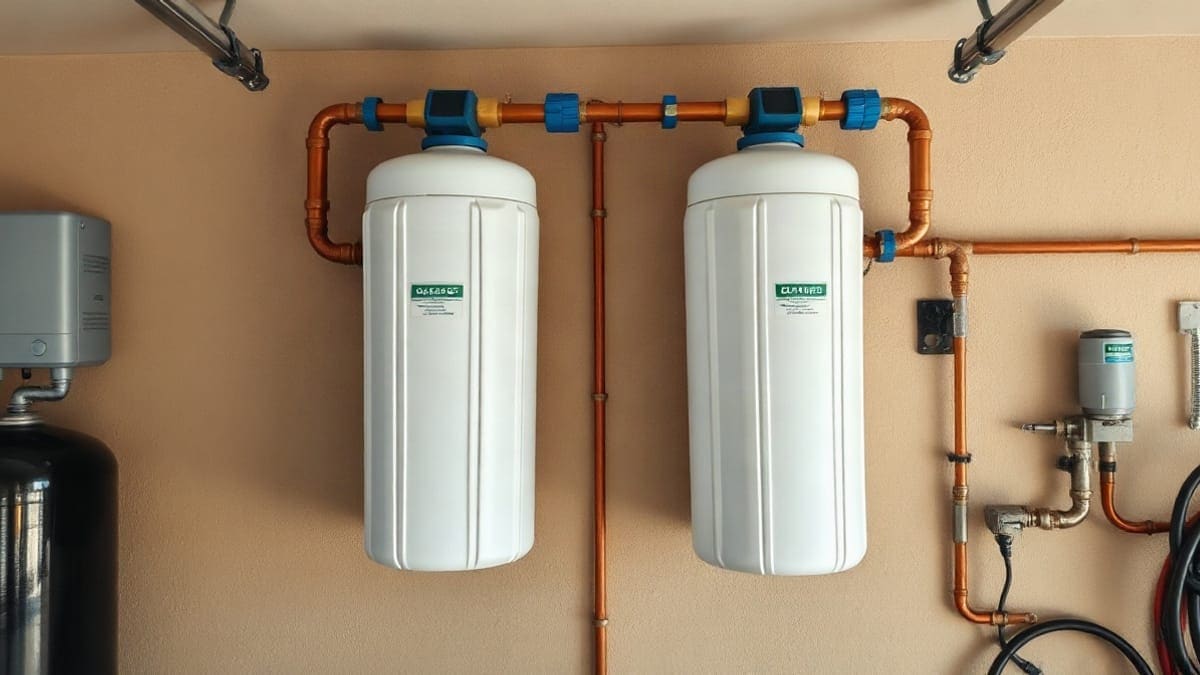
A whole house filter treats water where the main line enters the house, so every shower, tap and appliance gets it, from the 2.5 GPM shower to the washing machine fill. Eight systems are compared below by rated flow, capacity, pipe size, weight and the certification each maker can actually name. The figures come from maker pages, data sheets and the NSF database, any two-page conflict is named in the text, and no price appears anywhere. Few whole house filters carry a listing we could trace, so the claims are sorted into certified, tested and merely stated. The chlorine and chloramine guide goes deeper on disinfectants.
Eight whole house filters at a glance
Water check
Eight systems span 5.7 to 15 GPM of rated flow and 100,000 to 1,000,000 gallons of capacity. Only the HealthShield and the Clearsource name a certification, and they cover different standards.
The table lists each system as its maker describes it on the pages we read in November 2026. A dash means the page gives no figure. Some makers state a service or rated flow and others a peak, so compare "rated" with "rated" and treat "up to" figures as ceilings. Where two pages from one maker disagree, we say so in the detail sections below.
| System | Media | Flow stated | Capacity stated | Connection |
|---|---|---|---|---|
| SpringWell CF1 | Sediment, KDF, catalytic carbon | 9 GPM service | 1,000,000 gal or 10 years | 1 in |
| SpringWell CF4 | Sediment, KDF, catalytic carbon | 12 GPM service | 1,000,000 gal or 10 years | 1 in |
| Aquasana Rhino | Sediment, carbon, KDF | 7.0 GPM rated, 14.6 peak | 1,000,000 gal or 10 years | not stated |
| Aquasana HealthShield | Pre-filter plus three media layers | 5.7 GPM rated, 11.2 peak | 165,000 gal, about 2 years | not stated |
| iSpring WGB32B | 5 micron sediment, two carbon blocks | up to 15 GPM | 100,000 gal per set, up to 12 months | 1 in female NPT |
| iSpring WF150K-PF | KDF and catalytic carbon, auto backwash | not stated | 5 to 10 years | 1 in and 3/4 in |
| Clearsource Whole Home | 5 micron, 0.5 micron, VirusGuard | not stated | not stated | not stated |
| Express Water WH300SCKP | Polyphosphate, KDF, carbon block | 0.25 gal per second (15 GPM) | 100,000 gal or 6 to 12 months | 1 in |
Which whole house filter suits which home?
Match your water source, bathrooms and worry to a row. Flow is the first filter, because a filter rated below your peak demand costs you pressure at the shower, and a certification matters only if the water has something to remove. Read your utility's annual report first, then use the table, and remember that one maker can appear in two rows for two different problems.
| Your situation | Pick | Why |
|---|---|---|
| City water, PFAS or solvents on your utility report | Aquasana HealthShield | WQA certification to NSF/ANSI 53 and 401 named by Aquasana |
| City water, chlorine taste, 1 to 3 bathrooms | SpringWell CF1 | 9 GPM, 1,000,000 gal, 6 to 9 month sediment change |
| City water, 4 to 6 bathrooms | SpringWell CF4 | 12 GPM on the current product page |
| Chlorine only, lowest first cost, plumber available | iSpring WGB32B | 15 GPM, 5 micron sediment stage, cartridge set rated 100,000 gal |
| Viruses and bacteria on the label matter to you | Clearsource Whole Home | Filter certified to NSF/ANSI 42 and 61 by IAPMO R&T, lab data on microbes |
| Chloramine in your city water | Aquasana Rhino Chloramines or SpringWell | Rhino Chloramines tested to NSF/ANSI 42 for up to 83% chloramine |
| Large home, heavy PFAS interest, 120 lb tank is fine | iSpring WF150K-PF | SGS lab test, up to 99.69% PFAS, auto backwash |
| Steel-framed, wall-mounted, filter swaps by hand | Express Water WH300SCKP | 63 lb, three gauges, 3 to 5 psi typical drop |
Brand pages: SpringWell, iSpring and Express Water.
What does each filter really have on paper: certified, tested or claimed?
Water check
Of the eight, the HealthShield (WQA, NSF/ANSI 53 and 401) and the Clearsource filter (IAPMO R&T, NSF/ANSI 42 and 61) name a certification. The Rhino is tested to NSF/ANSI 42, and five makers publish figures with no listing we could trace.
We searched the NSF certified drinking water treatment unit database on November 18, 2026 for each maker, and read each maker's data sheet or certification page. The result is uneven, and it explains why "99% of chlorine" on a product page tells you little.
| System | What the maker says | What we traced | Database |
|---|---|---|---|
| Aquasana HealthShield | WQA tested and certified to NSF/ANSI 53, 401 and CSA B483.1 | Data sheet names WQA; chlorine and chloramine "internally tested", WQA did not evaluate them | WQA find products |
| Aquasana Rhino | Independently tested to NSF/ANSI 42 for up to 97% chlorine; tank certified to NSF/ANSI/CAN 61 | "Tested", not "certified" for the filter; NSF lists two Aquasana UV units only | NSF, Aquasana |
| Clearsource Whole Home | VirusGuard Ultra-D filter certified to NSF/ANSI 42 and 61 by IAPMO R&T | Maker certification page; 42 is aesthetic effects, 61 is materials | IAPMO directory |
| SpringWell CF1 and CF4 | Chlorine, chloramine and PFAS reduction | No standard named on the product page; NSF search for "springwell" returned no matching products | NSF, SpringWell |
| iSpring WGB32B | Carbon blocks "tested by a third party to meet NSF/ANSI standards" | Not a certification; NSF lists iSpring reverse osmosis models only | NSF, iSpring |
| iSpring WF150K-PF | SGS-tested, up to 99.69% PFAS | A lab test, not a certification | same iSpring listing |
| Express Water WH300SCKP | Heavy metal and anti-scale stages | No standard named; NSF lists two Express Water reverse osmosis models only | NSF, Express Water |
One pattern is worth noticing: the loudest claims ("99% of chlorine", "forever chemicals") do not always come with listings, and the makers with listings word things more carefully. The HealthShield data sheet even says what its certifying body did not evaluate. We could not query the WQA and IAPMO search forms from our tools, so the HealthShield and Clearsource certifications rest on each maker's own documents. Check the model number in each database before you rely on it for a rental, an insurer or a health reason.
What do NSF/ANSI 42, 53, 401 and P231 certify?
The NSF listing page names each standard: 42 covers aesthetic effects, 53 health effects, 401 emerging compounds and incidental contaminants, 55 ultraviolet systems and P231 microbiological purifiers. A filter certified to 42 can taste better without being certified to remove a single regulated contaminant.
| Standard | What it covers | Matters for |
|---|---|---|
| NSF/ANSI 42 | Aesthetic effects, such as chlorine, taste and odor | Taste, smell, shower comfort |
| NSF/ANSI 53 | Health effects, such as lead, cysts, PFOA and PFOS | Contaminants with health limits |
| NSF/ANSI 401 | Emerging compounds, such as ibuprofen and bisphenol A | Trace chemicals |
| NSF/ANSI 55 | Ultraviolet microbiological systems, Class A and B | Well water microbes |
| NSF/ANSI/CAN 61 | Materials that touch drinking water | Tank and housing safety |
Why is "tested to" not the same as "certified to"?
Certified means an outside body tested the product, audited the plant and lists the model number. Tested means a lab ran a protocol, often one the maker paid for, with no listing to look up. Both can be honest, but only one can be checked in a database. The Rhino's own page says "independently tested", while its tank is "WQA certified" to NSF/ANSI/CAN 61, so the carbon is not certified by that sentence.
The eight whole house filters in detail
Water check
The eight systems weigh 59 to 120 lb and stand 29 to 63.5 in tall. Each section gives size, flow, capacity, certification status and who should look elsewhere.
Aquasana HealthShield: the PFAS and solvent pick
The HealthShield has a 57 in by 12 in tank, a rated flow of 5.7 GPM (11.2 GPM peak) and a rated capacity of 165,000 gallons, which Aquasana puts at about 2 years. Aquasana's product page lists a 25 to 100 psi range, 40 to 100°F water, a 2 year limited warranty and a 120 V outlet within 10 ft for the flow meter. Its performance data sheet says WQA tested and certified it to NSF/ANSI 53 and 401 for PFOA, PFOS, PFHpA, PFHxS and PFNA and for VOCs by chloroform surrogate (99.8%).
The same sheet says chlorine (above 97.4%) and chloramine (97.49%) reduction were "internally tested" and that WQA did not evaluate them. A 20 in pre-filter is changed every 2 months. At 5.7 GPM rated it sits near the low end for a busy house.
Best for: city water with PFAS or solvents on the utility report. Not for: a family of six running three showers at once, or anyone without an outlet near the tank.
SpringWell CF1: the 9 GPM carbon filter
The CF1 is 9 in wide and 48 in tall (52 in with head), serves 1 to 3 bathrooms at 9 GPM on a 1 in connection, and SpringWell rates its media at 1,000,000 gallons or 10 years. SpringWell's product page lists 25 to 80 psi, 36 to 120°F, a sediment filter change every 6 to 9 months and a lifetime warranty against defects, with a 6 month return window.
The page claims chlorine, chloramine and PFAS reduction but names no NSF/ANSI standard, and the NSF search found no SpringWell listing. SpringWell's 2020 installation guide gives media life as 6 years, so the 10 year figure is the current claim and the older one is a warning to ask. The guide also says not to install on well water without calling SpringWell first.
Best for: a city house with 1 to 3 baths that wants chlorine gone at the shower. Not for: a buyer who needs a certification number, or a private well. Read the CF1 review.
SpringWell CF4: the same media, a bigger tank
The CF4 is 10 in wide and 54 in tall (58 in with head), serves 4 to 6 bathrooms and is listed at 12 GPM on the current product page. The 2020 installation guide lists 11 GPM, so the two SpringWell documents disagree by 1 GPM, and the larger CF+ is listed at 20 GPM on a 1.5 in connection. Capacity, pressure range (25 to 80 psi) and certification status match the CF1.
Best for: a 4 to 6 bathroom house on city water. Not for: a 2 bathroom house, where the CF1 does the same job at lower size.
Aquasana Rhino: the long-life chlorine filter
The Rhino is 46 in tall and 9 in across, rated at 7.0 GPM (14.6 GPM peak) and 1,000,000 gallons or 10 years, with a 100 psi maximum, a 40 to 90°F range and a 10 year limited warranty. Aquasana says it is independently tested to NSF/ANSI 42 for up to 97% of chlorine and that the tank is WQA certified to NSF/ANSI/CAN 61. Its certified products page says the Rhino Chloramines is tested to NSF/ANSI 42 for up to 83% of chloramines and 97% of chlorine. Pre-filters change every 2 months and the post-filter every 6 months.
Best for: a house that wants chlorine reduction backed by a named test standard. Not for: PFAS, which this model does not claim. Our Rhino review has more.
iSpring WGB32B: the 15 GPM budget cartridge system
The WGB32B is 24.5 in by 8 in by 28 in, weighs 60 lb, takes 20 in by 4.5 in cartridges and lists up to 15 GPM on 1 in female NPT ports, with 25 to 80 psi on the product page (the 2014 manual says 45 to 80), 40 to 100°F and pH 6 to 9. iSpring's page lists a 5 micron sediment stage and two carbon block stages, a cartridge set rated for 100,000 gallons or up to 12 months, and a 1 year warranty.
The carbon is "tested by a third-party to meet NSF/ANSI standards", which is not a certification. iSpring's FAQ says the filter does not remove fluoride and leaves minerals in the water. Read the WGB32B review.
Best for: chlorine and sediment on city water with a plumber or DIY owner. Not for: PFAS, chloramine claims or hardness.
iSpring WF150K-PF: the backwashing PFAS tank
The WF150K-PF is 11 in by 11 in by 63.5 in, weighs 120 lb and uses KDF and catalytic carbon with an automatic backwash valve, rated 5 to 10 years for 2 to 3 bathrooms. iSpring's page says SGS tested it for up to 99.69% PFAS. SGS is a testing firm, so this is a lab result, not a listing. The page gives no flow rate and a 1 year warranty, with 1 in and 3/4 in connectors.
Best for: a large house wanting a tank with timed backwash. Not for: a buyer who needs a published GPM, or a small utility closet.
Clearsource Whole Home: the three-stage frame with a virus filter
The Clearsource system is 29 in tall, 25 in long and 9 in deep, weighs 59 lb and passes water through a 5 micron filter, a 0.5 micron carbon block and a VirusGuard filter. Clearsource's certification page says the VirusGuard Ultra-D filter is certified to NSF/ANSI 42 and 61 by IAPMO R&T, and that separate independent lab work showed more than 99.99% reduction of viruses and bacteria and more than 99.95% of cysts, at pH 6.5. The same table gives lead above 95%, arsenic V above 95% and mercury above 60%.
The page states that 42 covers aesthetic effects, so the microbe figures come from the lab report, not the certification. The product page gives no flow rate or capacity, and recommends a licensed plumber.
Best for: a buyer who wants microbe and heavy metal lab data. Not for: anyone who needs a published GPM, or who reads "virus" as "safe to drink from an unsafe source".
Express Water WH300SCKP: the framed 3-stage system
The WH300SCKP is 29.25 in by 23.5 in by 8.5 in, weighs 63 lb and delivers up to 0.25 gallons per second (15 GPM) on 1 in connections, with polyphosphate, KDF and carbon block stages and three pressure gauges. Express Water's page lists a 1 year warranty, 40 to 100°F and a filter set good for 100,000 gallons or 6 to 12 months. The pressure range reads 45 to 80 psi in the text and 40 to 80 psi in the spec table. Express Water says to expect a 3 to 5 psi drop after installation and to replace filters at a 10 to 12 psi drop.
Best for: a handy owner who wants gauges and a stainless frame. Not for: a buyer who needs a certification number.
What is whole house water filtration, and how does it work?
Water check
A whole house filter sits on the main water line and passes every gallon through sediment and carbon stages, usually at 5 to 15 GPM, so showers, taps and appliances all get treated water. It does not soften or disinfect.
Water filtration pushes water through media that trap particles or hold chemicals on a surface. A sediment stage (5 micron on the iSpring and Clearsource) catches sand and rust. Carbon, usually coconut shell, adsorbs chlorine and organic chemicals. KDF is a copper-zinc media that SpringWell and Aquasana use to hold back bacteria growth in the bed. Catalytic carbon speeds the reaction that breaks chlorine and chloramine down.
A sediment stage catches sand and rust, a carbon block takes chlorine and taste, catalytic carbon handles chlorine and chloramine, and KDF protects the bed. Express Water adds polyphosphate, a scale inhibitor that is not a softener.
Two limits follow from the design. Carbon holds chemicals only until its surface is full, so a filter that runs past its rated gallons can stop working with no visible sign, which is why the gallon rating matters more than the calendar. And a filter bed that sits wet can grow bacteria, which is the reason KDF is added and the reason most makers insist on changing the sediment stage on schedule.
Reverse osmosis works differently: it pushes water through a membrane at one tap. Our what is reverse osmosis page explains the membrane and its wasted water, the best reverse osmosis system page ranks the models, and the installation guide covers the under-sink fit. For a single tap you can also use a countertop filter or a water filter pitcher. Our reverse osmosis versus water filter page compares them, and water filtration vs purification explains why filters do not disinfect.
How do you choose a whole house water filter?
Water check
Check four things in order: flow against your peak demand (5 to 15 GPM), capacity against your yearly use (about 109,500 gallons for four people), what your utility actually adds to the water, and the certification. A filter that fails flow will not be saved by a good brand.
How much flow do you need?
Add up what runs at once. EPA says standard showerheads use 2.5 gallons per minute, so two showers are 5.0 GPM, and we assume 1.5 GPM for a kitchen tap, which gives 6.5 GPM at the busiest minute.
| Filter | Rated or stated flow | Against 6.5 GPM peak |
|---|---|---|
| Aquasana HealthShield | 5.7 GPM rated, 11.2 peak | Below, so expect less contact time or pressure |
| Aquasana Rhino | 7.0 GPM rated | Just above |
| SpringWell CF1 | 9 GPM service | Above by 2.5 GPM |
| SpringWell CF4 | 12 GPM service | Above by 5.5 GPM |
| iSpring WGB32B | up to 15 GPM | Above by 8.5 GPM |
| Express Water WH300SCKP | 15 GPM | Above by 8.5 GPM |
Aquasana says contaminant reduction was measured at the rated flow, and values change at faster or slower flows. A flow above the rating is not a failure, but the claims no longer apply exactly. EPA's WaterSense showerhead page shows that a 2.0 GPM showerhead cuts the demand.
How long will the filter last?
Four people at 75 gallons each use 300 gallons a day, or 109,500 gallons a year. The 75 gallon figure is the average Penn State Extension uses. Divide each rated capacity by it.
| Filter | Rated capacity | Years at 300 gal per day |
|---|---|---|
| iSpring WGB32B cartridges | 100,000 gal | 0.9 (about 11 months) |
| Aquasana HealthShield | 165,000 gal | 1.5 (about 18 months) |
| Aquasana Rhino | 1,000,000 gal | 9.1 |
| SpringWell CF1 | 1,000,000 gal | 9.1 |
SpringWell's 10 year claim holds only under about 274 gallons a day (1,000,000 divided by 3,650). Aquasana's "about 2 years" for the HealthShield implies about 226 gallons a day. Heavy sediment shortens any of them.
Is your city water chlorinated or chloraminated?
Look at your annual water quality report, found through EPA's Consumer Confidence Report page. EPA says more than one in five Americans drink water treated with chloramines, and its regulation table sets the limit for both disinfectants at 4.0 mg/L as chlorine. Chloramine is harder for plain carbon to remove, so look for a model with a tested chloramine figure: the Rhino Chloramines at up to 83% or the HealthShield data sheet's 97.49% (internal). See the full chlorine and chloramine guide.
Which pipe size and pressure does the house have?
Most systems here use a 1 in connection and need 25 to 80 psi (SpringWell, iSpring) or up to 100 psi (Aquasana). A 1.5 in main needs the CF+ or an adapter. Measure pressure with a hose-bib gauge before buying, because a house under 25 psi will not run any of them well.
Do you need a whole house filter at all?
Not always. If you only want better drinking water, a kitchen tap filter treats 1 gallon per person per day, not 75. A whole house system makes sense when showers, laundry and skin matter, or when you want every tap covered. Read do you need a whole house water filter and the cost page.
Which whole house filter is best for each kind of water?
Water check
Pick on the contaminant: chlorine and sediment need carbon and 5 to 15 GPM, chloramine needs catalytic carbon or a tested figure, PFAS needs a certified listing, and hardness needs a softener, which no filter here is.
| Water problem | What a whole house filter can do | Pick from this page |
|---|---|---|
| Chlorine taste and smell | Carbon, up to 97% (Rhino, NSF/ANSI 42 test) | Rhino, CF1, WGB32B |
| Chloramine | Catalytic carbon, needs a tested figure | Rhino Chloramines, HealthShield |
| PFAS | Only with certification to NSF/ANSI 53 or a lab test | HealthShield, WF150K-PF |
| Sediment, rust | 5 micron stage | WGB32B, Clearsource |
| Bacteria and viruses | Lab data on one filter; not a purifier | Clearsource; UV for wells |
| Hard water scale | Not removed by a carbon filter | Water softener |
For hard water, read hard water filter and water softener vs water filter. For both jobs together see the filter and softener combo.
Does a whole house filter remove lead, PFAS, fluoride or bacteria?
Water check
Often not on its own. EPA sets PFOA and PFOS at 4.0 ppt, lead has its own action level, fluoride passes through carbon (iSpring says so), and a filter that is not a purifier does not make unsafe water safe.
PFAS: EPA's April 2024 rule set 4.0 ppt for PFOA and PFOS and its page, updated May 18, 2026, notes proposals to extend compliance to 2031 and to rescind the limits for four other PFAS. A kitchen tap filter treats the gallon you drink for much less. See best water filter for PFAS, for lead and for fluoride.
Microbes: SpringWell's page warns not to use its system where water is microbiologically unsafe. UV is the standard route, and Aquasana's UV units appear in the NSF database as NSF/ANSI 55 Class B (6 and 19 GPM point-of-entry models). Our UV purifier guide and iron filter guide cover wells.
How do you install a whole house water filter?
Water check
Install it on the main line after the shutoff and before the water heater, with a 3-valve bypass, a 48 hour carbon soak for the SpringWell and a dry, frost-free spot. A 120 V outlet within 10 ft is needed for the HealthShield.
SpringWell's guide says the system must be on the main water supply line, follow local plumbing codes and have a 3-valve bypass, which lets you change filters without shutting off water to the whole house. It also asks for a 48 hour carbon soak and a flush of 5 to 10 minutes. Express Water says to use a dry, level area protected from freezing and sun. iSpring says DIY is possible with its manual and video, while Clearsource recommends a licensed plumber.
Plan on a half day for a first install, longer if the main is hard to reach, and check whether your town requires a permit or a backflow device. Full steps are in our installation guide.
How often do you replace a whole house water filter?
Water check
Change the sediment stage every 2 to 9 months, depending on the brand and your water, and the carbon every 1 to 10 years or at the rated gallons. Watch the pressure gauges: Express Water says replace at a 10 to 12 psi drop.
| System | Sediment or pre-filter | Main media or cartridge |
|---|---|---|
| SpringWell CF1 | every 6 to 9 months | 1,000,000 gal or 10 years (6 years in the 2020 guide) |
| Aquasana Rhino | every 2 months (pre-filter) | 1,000,000 gal or 10 years, post-filter every 6 months |
| Aquasana HealthShield | every 2 months | 165,000 gal, about 2 years |
| iSpring WGB32B | stage 1 with the set | 100,000 gal or up to 12 months |
| Express Water WH300SCKP | with the set | 100,000 gal or 6 to 12 months |
| iSpring WF150K-PF | auto backwash | 5 to 10 years |
Write the install date on the housing. A sediment stage that clogs early points to dirty water, not a bad filter, and a pressure gauge on each side shows it before the shower does. More in filter maintenance and replacement.
Is a whole house filter, a softener or reverse osmosis the right tool?
Water check
A whole house filter treats chlorine and sediment at every tap, a softener treats hardness, and reverse osmosis treats the water you drink at one tap. They solve different problems, and the filters on this page do not soften.
iSpring says its whole house filters do not reduce TDS or hardness. Express Water's polyphosphate stage inhibits scale but is not a softener. For hardness, the water softener guide and softener and filter combo apply. If you want drinking water that is closer to bottled, see the drinking water filtration system guide and SpringWell versus Aquasana. Read what is hard water to see what the water in your house actually carries.
No CPSC recall of a whole house filter is known as of November 18, 2026 (CPSC search of that date); check the CPSC recall list for new notices before you buy.
Whole house water filters: our conclusion
Water check
Pick on the contaminant: the Aquasana HealthShield for PFAS or solvents, the SpringWell CF1 for chlorine in a 1 to 3 bathroom house, and a softener for hard water, which no filter here is.
The Aquasana HealthShield cites WQA certification to NSF/ANSI 53 and 401 (5.7 GPM, 165,000 gallons, 120 V outlet) Check price on Amazon. The SpringWell CF1 gives 9 GPM and 1,000,000 gallons Check price on Amazon. The Aquasana Rhino suits chlorine taste, with up to 97% in an NSF/ANSI 42 test Check price on Amazon, and the iSpring WGB32B suits sediment and rust Check price on Amazon. The iSpring WF150K-PF is the other PFAS pick Check price on Amazon. A private well needs a test first, because carbon alone does not make an untested well safe.
6 common mistakes with whole house water filters
Water check
Six mistakes cost buyers most: buying on "99% chlorine" without a standard, ignoring flow against peak demand, skipping the bypass, trusting carbon on a raw well, expecting softer water, and forgetting the sediment stage.
- Buying on "up to 99% of chlorine". Ask for the standard and the model listing, as the Rhino and HealthShield sheets show.
- Ignoring flow. A 5.7 GPM rated filter on a 6.5 GPM peak loses contact time.
- Skipping the bypass. Without it, the main goes off at every filter change.
- Using carbon on untested well water. SpringWell warns against microbiologically unsafe water.
- Expecting soft water. None of the eight lowers hardness.
- Forgetting the sediment stage. A clogged 5 micron stage is the usual cause of a 10 to 12 psi drop.
Frequently asked questions
What is the best whole house water filtration system?
For PFAS and solvents, the Aquasana HealthShield, because its maker names WQA certification to NSF/ANSI 53 and 401. For chlorine in a 1 to 3 bathroom house, the SpringWell CF1 at 9 GPM, or the Rhino with its NSF/ANSI 42 test. No single model suits every water.
What is the best whole house water filter for a family of four on city water?
Four people use about 300 gallons a day, so you want 6.5 GPM or more and a cartridge life that fits 109,500 gallons a year. The CF1 (9 GPM, 1,000,000 gallons) or the Rhino (7.0 GPM) fit. The HealthShield fits if PFAS is the concern and the water is not heavily used at one time.
How much does a whole house water filtration system cost?
Prices change often and this site prints none. The cost you can calculate is replacement: a 100,000 gallon cartridge set lasts about 11 months at 300 gallons a day. See the cost guide and use the Check price links for today's price.
Do I need a whole house water filter?
You need one if you want chlorine, chloramine or sediment removed from showers, laundry and every tap. If you only want clean drinking water, a tap filter treats about 1 gallon per person per day. Read do you need a whole house water filter.
Are whole house water filtration systems worth it?
They are worth it for a house with chlorine or sediment complaints and 1,000,000 gallon media, which lasts about 9 years at 300 gallons a day. They are not worth it as a hardness fix: a softener does that. See softener versus filter.
How does a whole house water filter work?
Water enters through the main line and passes through a sediment stage, then carbon or KDF media. Carbon holds chlorine and organics on its surface, and sediment stages catch particles at 5 micron. It does not use electricity, except the HealthShield flow meter, and sends no water down the drain.
What does a whole house water filter remove?
Chlorine, sediment, taste and odor on all eight, plus VOCs and PFAS on the HealthShield (WQA certification claimed) and lead, arsenic and mercury in Clearsource's lab data. Fluoride and hardness are not removed, as iSpring says of its own filters.
Does water filtration remove lead?
Only if the filter is certified to NSF/ANSI 53 for lead. The Clearsource page lists lead above 95% from lab testing at pH 6.5, but its certification covers 42 and 61, so it is not a lead certification. EPA says testing is the only sure way to know.
Does water filtration remove fluoride?
Not these filters. iSpring says its whole house filter does not remove fluoride; reverse osmosis does. See best water filter for fluoride.
Does a whole house water filtration system soften water?
No. Carbon and KDF do not lower hardness, and iSpring says its filters leave minerals in place. The Express Water polyphosphate stage inhibits scale but does not soften. Choose a softener for hardness.
How do I choose a whole house water filter?
Check flow (5 to 15 GPM against your peak), capacity (rated gallons divided by 109,500 for four people), the disinfectant your city uses and the certification. Then check pipe size and pressure, 25 to 80 psi for most.
Where are installation and filter-change questions answered?
Installing the filter, where it goes and how often to change it have their own pages: the whole house water filter installation guide and whole house water filter maintenance and replacement. In short, cut it into the main line after the shutoff with a 3-valve bypass, and change sediment stages every 2 to 9 months.
Can I build a whole house water filter myself?
A homemade sand and charcoal filter has no test report, no listing and no rated flow, so there is nothing to check. You can install a certified or tested system yourself, if plumbing codes allow, but do not build the filter. For an emergency, see our gravity filter guide.
What is reverse osmosis filtration, and which is better?
Reverse osmosis pushes water through a membrane at one tap and removes dissolved solids, including fluoride. Whole house carbon does not. They work together: carbon for the whole house, reverse osmosis for drinking. See reverse osmosis vs water filter.
Do water filtration systems work?
Within their claims, yes. A carbon filter reduces chlorine (up to 97% in the Rhino's NSF/ANSI 42 test) and taste. They do not disinfect, and a claim without a listing is only a claim.
What does charcoal or carbon do in water filtration?
Carbon holds chlorine, many chemicals and taste compounds on its surface. Coconut shell carbon block is used in the iSpring WGB32B and the Clearsource 0.5 micron stage. It does not remove hardness or dissolved minerals.
What is the most effective water filtration method for a home?
No single method covers every contaminant. Catalytic carbon handles chlorine, chloramine, taste and odor at the main line, a reverse osmosis system at one tap handles dissolved solids, and an ion-exchange softener is the tool for hardness. Pick by what your water report lists, then read the best reverse osmosis system and water softener vs water filter pages.
What are the downsides of a whole house water filtration system?
Three downsides show up in the specifications above. An undersized unit drops flow at a 2.5 GPM shower and a washing machine fill at once, media and sediment cartridges have to be replaced on a schedule, and no filter here softens water or removes dissolved solids. Size it by GPM first and use the best water softener page if hardness is the problem.
How we researched this page
Water check
Eight systems were chosen from brands in our Impact program and Amazon US, all on sale in the United States. We read maker pages and data sheets, searched the NSF database by maker, and did not test any filter ourselves. We publish no store ratings.
We could not query the WQA and IAPMO search forms, so two certifications come from the makers' own documents. We could not read CDC pages, which refused our request. Flow and capacity are missing for the Clearsource and the WF150K-PF because the pages we read did not give them. If you buy through a Check price link, the site earns a commission and your cost stays the same.
Sources
Our sources by topic
Public agencies and universities
- U.S. EPA, chloramines, drinking water regulations, PFAS rule, lead, private wells, Consumer Confidence Reports and WaterSense showerheads.
- Penn State Extension, Water Softening; CPSC recalls.
Certification and standards bodies
Manufacturers, retailers and other references
- Aquasana, HealthShield, HealthShield performance data sheet, Rhino and certified products.
- SpringWell, whole house water filter specifications and CF1, CF4 installation instructions (2020).
- iSpring, WGB32B and WF150K-PF.
- Clearsource, Whole Home system and testing and certifications.
- Express Water, 3-stage whole house system.
Keep comparing
 Reverse Osmosis System for HomeEight reverse osmosis systems compared by NSF-listed output, drain water, feed pressure and certification
 Under Sink Water Filters (Without Reverse Osmosis)Nine under sink filters with no drain water compared by rated gallons, flow
 Shower Filter for Hard WaterNine shower filters compared by rated flow, cartridge life and NSF/ANSI 177 status
 Countertop Reverse Osmosis Systems, No InstallationTen plug-in countertop reverse osmosis systems compared by tank size, drain water
 Whole House Water Filter and Softener ComboEight packaged whole house filter and softener combos compared on flow in GPM, grains, filter life in gallons
 Tankless Reverse Osmosis SystemsNine tankless reverse osmosis systems compared by GPD, flow in GPM, drain ratio