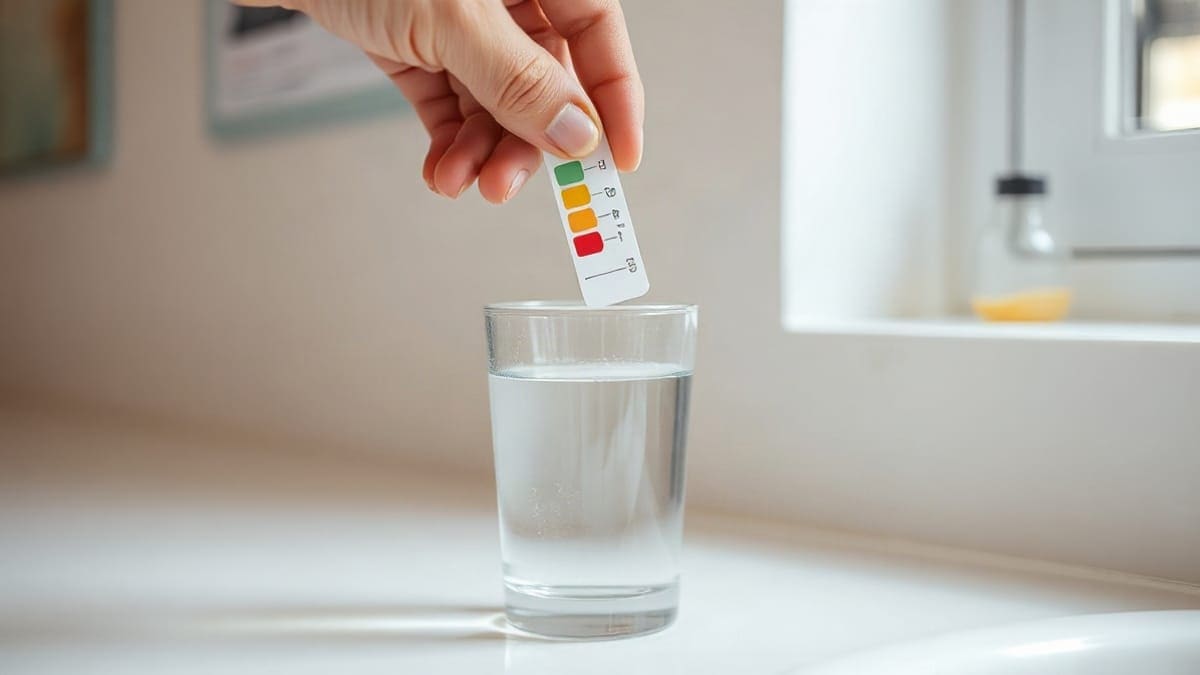
Water hardness appears as ppm on a lab sheet, mg/L in a city report, grains per gallon on a softener dial and degrees on a European strip. All four describe the same dissolved calcium and magnesium, and each converts with one division. This page gives the arithmetic, a finished table for every whole grain from 1 to 30 gpg, a second table that runs the other way from 50 to 500 mg/L, the USGS and Penn State scales, and a plain rule for each level. The converter below handles any value in seconds. Everything after it shows why the numbers come out as they do, so you can check them yourself.
- Softunder 1 gpg
- Slightly hard1 to 3.5 gpg
- Moderately hard3.5 to 7 gpg
- Hard7 to 10.5 gpg
- Very hardover 10.5 gpg
- mg/L or ppm
- 171
- grains per gallon
- 10
- French degrees
- 17.1
- German degrees
- 9.6
Hard. Scale builds up in the water heater, fixtures and appliances. This is where a salt-based softener pays off. Size it before you shop. Size your softenerBest water softeners
What do ppm, mg/L and grains per gallon mean?
Water check
All three count the calcium and magnesium in water, expressed as calcium carbonate (CaCO3). In water, 1 ppm equals 1 mg/L; a grain per gallon (gpg) is the same amount in the unit US softeners and test kits use.
Hardness is the total of dissolved calcium and magnesium. USGS defines it that way and notes that other metals add a little. Labs add the two minerals together by writing each as if it were calcium carbonate, so one number covers both. Hach says US reports usually give hardness in mg/L as CaCO3 or in gpg as CaCO3.
A liter of water weighs about 1,000,000 milligrams, so 1 mg in a liter is 1 part per million: ppm and mg/L are the same figure. The grain is an old weight of 64.8 mg, and a US gallon is 3.785 liters. One grain spread through one gallon therefore works out to 17.12 mg/L, and Wikipedia's hard water entry lists 17.118. Penn State Extension rounds it to "approximately 17". We use 17.1, which is within 0.1 percent of the exact value.
| Unit | In mg/L as CaCO3 | Where you meet it |
|---|---|---|
| 1 ppm | 1 | lab results, test strips |
| 1 mg/L | 1 | city water quality reports |
| 1 gpg (grain per US gallon) | 17.1 | softener dials, US strips, manuals |
| 1 °f (French degree) | 10 | European kits, some appliance manuals |
| 1 °dH (German degree) | 17.85 | dishwasher and coffee machine settings |
| 1 °e (English or Clark degree) | 14.25 | older British sources |
How do you convert ppm to grains per gallon?
Water check
Divide ppm or mg/L by 17.1 to get gpg. To go the other way, multiply gpg by 17.1. So 171 ppm is 10 gpg, 257 ppm is 15 gpg, and 12 gpg is 205 ppm.
The two steps are short enough to run on a phone:
- Take the number from the report in ppm or mg/L as CaCO3.
- Divide by 17.1. A report of 240 mg/L gives 240 divided by 17.1, which is 14.0 gpg.
A dial setting of 14 gpg is 14 times 17.1, or 239 mg/L. Softener manuals work in gpg, so a conversion is the first step of any water softener setting.
One caution on rounding. A reading of 120 mg/L is 7.02 gpg, so whether it is "moderately hard" (USGS, up to 120 mg/L) or "hard" (Penn State, from 7.0 gpg) depends on which table you read.
How many mg/L is each grain per gallon?
Water check
From 1 to 30 gpg the mg/L figure climbs by 17.1 each step: 17 at 1 gpg, 120 at 7 gpg, 171 at 10 gpg, 257 at 15 gpg, 342 at 20 gpg and 513 at 30 gpg. Classes follow in the scale table below.
The table lists every whole grain, so you can read your figure without a calculator. The factor is 17.1, and the mg/L column is rounded to the nearest whole number.
| gpg | mg/L | gpg | mg/L | gpg | mg/L |
|---|---|---|---|---|---|
| 1 | 17 | 11 | 188 | 21 | 359 |
| 2 | 34 | 12 | 205 | 22 | 376 |
| 3 | 51 | 13 | 222 | 23 | 393 |
| 4 | 68 | 14 | 239 | 24 | 410 |
| 5 | 86 | 15 | 257 | 25 | 428 |
| 6 | 103 | 16 | 274 | 26 | 445 |
| 7 | 120 | 17 | 291 | 27 | 462 |
| 8 | 137 | 18 | 308 | 28 | 479 |
| 9 | 154 | 19 | 325 | 29 | 496 |
| 10 | 171 | 20 | 342 | 30 | 513 |
How many grains per gallon is each mg/L value?
Water check
A lab figure of 100 mg/L is 5.8 gpg, 200 is 11.7, 300 is 17.5 and 500 is 29.2. Divide by 17.1 for gpg, by 10 for French degrees and by 17.85 for German degrees.
Lab sheets and city reports often round to the nearest 50 or 100, so the next table runs in that direction. The French column divides by 10 because a French degree is defined as 10 mg/L of calcium carbonate. The German column uses the 17.848 mg/L that Wikipedia gives for one °dH, which is 10 mg/L of calcium oxide expressed as calcium carbonate.
| mg/L or ppm | gpg | French degrees (°f) | German degrees (°dH) |
|---|---|---|---|
| 50 | 2.9 | 5 | 2.8 |
| 100 | 5.8 | 10 | 5.6 |
| 150 | 8.8 | 15 | 8.4 |
| 200 | 11.7 | 20 | 11.2 |
| 250 | 14.6 | 25 | 14.0 |
| 300 | 17.5 | 30 | 16.8 |
| 350 | 20.5 | 35 | 19.6 |
| 400 | 23.4 | 40 | 22.4 |
| 450 | 26.3 | 45 | 25.2 |
| 500 | 29.2 | 50 | 28.0 |
What is the water hardness scale, and how hard is hard?
Water check
USGS calls water soft up to 60 mg/L, moderately hard from 61 to 120, hard from 121 to 180 and very hard above 180. Penn State uses the same lines in gpg: 1.0, 3.5, 7.0 and 10.5, with a slightly hard step.
The USGS Water Science School publishes four classes in mg/L as CaCO3. Penn State publishes five in gpg. Both end at the same place: above about 180 mg/L (10.5 gpg), water is very hard. The World Health Organization's fact sheet also draws its lines at 60, 120 and 180 mg/L. Federal law sets no limit for hardness at all; EPA's secondary standards page lists only aesthetic limits for other minerals, such as iron at 0.3 mg/L and total dissolved solids at 500 mg/L.
| Class | USGS, mg/L | Penn State, gpg | Typical sign at home |
|---|---|---|---|
| Soft | 0 to 60 | under 1.0 | soap lathers easily, no scale |
| Slightly hard | (inside soft) | 1.0 to 3.5 | faint spots on glass |
| Moderately hard | 61 to 120 | 3.5 to 7.0 | light crust on faucets |
| Hard | 121 to 180 | 7.0 to 10.5 | scale in the water heater, soap film |
| Very hard | over 180 | over 10.5 | heavy scale, stiff laundry |
The last column summarizes what USGS and Penn State describe (scale in heaters, soap film, deposits when water heats). Penn State adds that levels below 7.0 gpg will probably not cause major scaling. For a fuller picture of effects, see what is hard water and hard water vs soft water.
Is 17 gpg considered hard water?
Water check
Yes. 17 gpg is 291 mg/L, nearly 1.7 times the 10.5 gpg line where Penn State says water is very hard. Water at 20 gpg is 342 mg/L and at 25 gpg is 428 mg/L, both very hard.
People type "17 grains", "20 grains" and "25 grains" into search boxes because softener makers print those numbers on dials and in specification tables. All three sit above the top of every public scale. For a household of four at 75 gallons each, 17 gpg means 5,100 grains of hardness a day (4 times 75 times 17), 20 gpg means 6,000 and 25 gpg means 7,500.
At that level the question is not whether the water is hard but how to size the equipment. The what size water softener do I need guide turns the daily load into a tank size, and the water softener size calculator does it for your household.
What are French and German degrees of hardness?
Water check
One French degree (°f) is 10 mg/L of CaCO3. One German degree (°dH) is 17.85 mg/L, so it is about 1.04 gpg. A reading of 10 °dH is 178.5 mg/L, or 10.4 gpg.
Dishwashers and coffee machines sold in North America often show a hardness scale in °dH or °f because the same appliance is sold in Europe. Hardness itself does not differ by country; only the unit does. Wikipedia's hard water page gives the definitions: °dH is 10 mg/L of calcium oxide, equal to 17.848 mg/L of CaCO3, and °f is 10 mg/L of CaCO3.
To convert a French reading to gpg, multiply by 10 and divide by 17.1. To convert a German reading, multiply by 17.85 and divide by 17.1, which is the same as multiplying by 1.044.
How do you calculate water hardness from calcium and magnesium?
Water check
Hardness in mg/L as CaCO3 equals 2.497 times calcium plus 4.118 times magnesium, both in mg/L. With 40 mg/L calcium and 10 mg/L magnesium: 99.9 plus 41.2 is 141 mg/L, which is 8.2 gpg.
A lab that reports calcium and magnesium separately leaves you one multiplication from total hardness. The factors come from molar masses: calcium carbonate is 100.09 g per mole, calcium is 40.078 and magnesium 24.305, so 100.09 divided by 40.078 is 2.497 and 100.09 divided by 24.305 is 4.118. This is our arithmetic, and it matches the standard definition on Wikipedia that total hardness is the sum of the calcium and magnesium concentrations in moles, with 1 mmol/L equal to 100.09 mg/L as CaCO3.
| Calcium (mg/L) | Magnesium (mg/L) | Total hardness (mg/L) | gpg |
|---|---|---|---|
| 20 | 5 | 71 | 4.2 |
| 40 | 10 | 141 | 8.2 |
| 60 | 15 | 212 | 12.4 |
| 80 | 20 | 282 | 16.5 |
| 100 | 25 | 353 | 20.6 |
If your supplier lists both minerals, add the two products. In a laboratory, total hardness is more often measured directly by EDTA titration, the method summarized by NEMI.
Where do you find your hardness number?
Water check
City customers read the annual Consumer Confidence Report; private well owners need a certified lab or a kit. Hardness is not federally regulated, so some reports leave it out, and then a call to the utility settles it.
Community water systems must deliver a yearly Consumer Confidence Report, and EPA's page links a lookup for your supplier. Washington State's health department confirms the July 1 delivery deadline. Because hardness is a nuisance property and not a health limit, a report may print it as "total hardness" in mg/L, in gpg, or not at all. If it appears, convert with the table above.
A map is a starting point only. USGS tested about 2,100 domestic wells and found hard water most common in the east-central and western states, and it warns that its map fits regions, not one house. The water hardness map and ZIP code lookup page covers regional ranges.
How do you check the hardness of water at home?
Water check
A strip reads a color block, such as 0, 25, 50, 120, 250 or 425 ppm on the Hach chart. A drop kit counts drops, and on the Hach 5-B one drop equals 1 gpg. Neither replaces a lab report.
Both methods end in a number you convert with this page. Hach says strips suit cases where a general range is enough and should not be used when an exact value is required, and that digital titrators measure more accurately than drop kits. The Hach 5-B kit adds titrant until the sample turns from red to blue, which is the same endpoint as the laboratory EDTA method; its product page gives the 1 gpg per drop scale.
A strip jumping from the 120 block to the 250 block cannot show 205 mg/L (12 gpg); a drop kit reads 12 drops. The full comparison is in the best water hardness test kit guide, and the sample steps without a kit are in how to test water hardness at home.
What should you do at each hardness level?
Water check
Under 3.5 gpg, do nothing. From 3.5 to 7 gpg, treat it as a comfort choice. From 7 gpg up, a salt-based softener sized to your gpg is the equipment that removes hardness. Salt-free units reduce scale but leave the reading unchanged.
Penn State says it is reasonable to live with water below 7.0 gpg, and its guide names low-sodium diets as the main drawback of softening. The table below is our reading of that guidance and of the USGS classes, with the page that handles each step.
| Converted reading | Class | Sensible move | Read next |
|---|---|---|---|
| under 3.5 gpg (60 mg/L) | soft to slightly hard | nothing needed | what is hard water |
| 3.5 to 7 gpg (60 to 120 mg/L) | moderately hard | descale kettles and shower heads as needed | how to treat hard water at home |
| 7 to 10.5 gpg (120 to 180 mg/L) | hard | softener, or a scale conditioner if you accept the same reading | salt vs salt-free water softener |
| over 10.5 gpg (over 180 mg/L) | very hard | salt-based softener sized to the load | best water softener |
| any level, with iron over 0.3 mg/L | well water | treat iron first or together | best water softener for well water |
A salt-free conditioner, such as those in the best salt-free water softener guide, is not a way to lower the number. A test strip will read the same before and after. Pick one only for scale, and use the table above to see whether you are in the range where scale matters.
How does the converted number set the size of a softener?
Water check
Grains per day equal people times 75 gallons times gpg. Two people at 10 gpg use 1,500 grains a day, four use 3,000 and six use 4,500. Penn State's own example is 75 times 10 times 4, or 3,000.
This is the method in Penn State Extension's guide: 75 gallons per person per day, multiplied by raw hardness in gpg and by the number of people, then the unit's capacity divided by that daily load gives days between regenerations. The EPA's WaterSense page puts household use above 300 gallons a day, which fits 75 for each of four people. Convert a ppm report to gpg first, or the daily figure will be 17 times too high.
| Report says (mg/L) | gpg | 2 people (grains a day) | 4 people | 6 people |
|---|---|---|---|---|
| 86 | 5 | 750 | 1,500 | 2,250 |
| 171 | 10 | 1,500 | 3,000 | 4,500 |
| 257 | 15 | 2,250 | 4,500 | 6,750 |
| 342 | 20 | 3,000 | 6,000 | 9,000 |
| 428 | 25 | 3,750 | 7,500 | 11,250 |
Iron adds to the load, because the resin removes dissolved clear-water iron the way it removes calcium. Makers give a rule of thumb, not a standard: Whirlpool and GE say add 5 gpg per ppm of iron, and others use 4. The EcoPure and Rheem manuals also say 5 gpg per ppm, with an example of 20 gpg and 2 ppm treated as 30. The table shows four people with 1 ppm of iron at both values.
| Report says (mg/L) | gpg | Grains a day, no iron | With 1 ppm iron, 4 gpg rule | With 1 ppm iron, 5 gpg rule |
|---|---|---|---|---|
| 86 | 5 | 1,500 | 2,700 | 3,000 |
| 171 | 10 | 3,000 | 4,200 | 4,500 |
| 257 | 15 | 4,500 | 5,700 | 6,000 |
| 342 | 20 | 6,000 | 7,200 | 7,500 |
| 428 | 25 | 7,500 | 8,700 | 9,000 |
Above about 3 to 5 ppm of iron, an iron filter before the softener is the normal fix; see the best iron filter for well water. The water softener size calculator takes the 4 gpg value, the low end of the range, and shows the size to buy.
Which products turn a hardness number into a decision?
Water check
Two test kits and three softener sizes cover most readings: Hach strips for a range, the Hach 5-B for gpg, and SpringWell and EcoPure units from 31,300 to 48,000 grains for hard and very hard water.
Capacity and flow are the maker's published figures, read in November 2026, with no prices.
Hach Total Hardness Test Strips 2745250
Hach lists a range of 0 to 425 mg/L (24.9 gpg by division) in 50 tests per bottle, read as a color block in about a minute. The Hach product page gives no accuracy figure.
Best for: a quick range for city water or a softener outlet. Not for: sizing a softener or any figure a third party relies on.
Hach 5-B drop count kit 145300
The Hach 5-B reads 1 to 30 gpg, one drop for each 1 gpg, about 100 tests per kit. Nine drops mean 9 gpg, or 154 mg/L.
Best for: a figure you can type straight into a softener control. Not for: a well with heavy iron and manganese, where Hach points to its HA-71A model.
SpringWell SS1 salt-based softener, 32,000 grains
SpringWell lists the SS1 at 32,000 grains with 1 in ports and 25 to 80 psi. Its flow is 11 GPM in the specification table and 9 GPM in the sizing guide, so ask which figure applies. Four people at 10 gpg use 3,000 grains a day, so it regenerates about every 10 days.
Best for: one to four people from 7 to about 15 gpg. Not for: six people on 20 gpg water.
SpringWell SS4 salt-based softener, 48,000 grains
The SS4 is listed at 48,000 grains for 4 to 6 bathrooms, with 13 GPM in the specification table. Five people at 15 gpg use 5,625 grains a day, a regeneration about every 8 or 9 days.
Best for: four to six people at 12 to 20 gpg. Not for: a two-person home, where it idles for weeks.
EcoPure EP31 softener, 31,300 grains
The EcoPure EP31 page lists 31,300 grains at 12.9 lb of salt per regeneration and 7.2 gpm. The NSF/ANSI 44 listing for the EP31 is in the NSF certified products database, which we read on 18 November 2026. Its manual caps clear-water iron at 8 ppm (EcoPure manual).
Best for: a household of two to four with a proven certification. Not for: very hard water with more than 8 ppm of iron.
5 common mistakes when converting water hardness
Water check
The five usual errors are mixing up ppm and gpg, treating a degree as a grain, reading a strip as exact, using calcium alone, and applying a regional map to one house. The first one makes the load 17 times too large.
Typing ppm into a gpg box
A report that says 171 ppm is 10 gpg. Entering 171 in a field that wants gpg gives a daily load of 51,300 grains for four people instead of 3,000, a number no softener fits. Divide by 17.1 first.
Treating a German degree as a grain
One °dH is 1.04 gpg. The two are close, so 10 °dH reads as 10.4 gpg, but a 20 °dH setting is 20.9 gpg, which shifts a size decision when it sits near a boundary.
Reading a strip as an exact value
The Hach chart steps run 0, 25, 50, 120, 250 and 425 ppm. A house at 205 mg/L (12 gpg) shows as either the 120 or the 250 block. Use a drop kit or a lab when the number sets a setting.
Using calcium hardness for total hardness
Calcium times 2.497 is calcium hardness only. At 40 mg/L calcium and 10 mg/L magnesium it gives 100 mg/L, where the total is 141. The missing 41 mg/L is 2.4 gpg.
Applying a regional map to your house
USGS says its national map describes regions. Wells in the same county can differ by several gpg. Use the report or a test for the house.
Frequently asked questions
What is the hardness in water?
It is the amount of dissolved calcium and magnesium, reported as mg/L or ppm of calcium carbonate, or as grains per gallon. USGS and Penn State call water hard from about 120 mg/L (7 gpg). See the first section above for the units.
What is a good hardness level for water?
For drinking and household use, anything under about 7 gpg (120 mg/L) is acceptable to Penn State, which says levels below 7.0 gpg will probably not cause major scaling. The WHO sets no health-based limit. Taste and scale, not safety, define "good".
What hardness of water is safe to drink?
WHO says hardness is not of health concern at the levels found in drinking water, so hard water is not unsafe to drink. Ask your doctor if you have a specific mineral or sodium restriction.
How do I calculate the hardness of water in ppm?
Add 2.497 times calcium (mg/L) and 4.118 times magnesium (mg/L). With 40 and 10 that gives 141 ppm. If your lab reports total hardness directly, no calculation is needed.
What is the difference between TDS and hardness of water?
TDS counts every dissolved solid, including sodium, chloride and sulfate. Hardness counts only calcium and magnesium, as calcium carbonate. EPA's secondary limit for TDS is 500 mg/L (EPA). A TDS meter cannot tell hardness from salt, so it is no stand-in for a hardness test.
Does the CCR report show hardness of water?
Sometimes. Hardness is not a regulated contaminant, so a supplier may leave it out of the Consumer Confidence Report. Call the utility, or test a tap sample at home.
What are temporary and permanent hardness of water?
Temporary (carbonate) hardness comes from calcium and magnesium bicarbonate and can be reduced by boiling. Permanent (non-carbonate) hardness comes from sulfates and chlorides and is hard to remove by boiling (Wikipedia). A softener handles both. Your test or report shows total hardness, which counts both types.
Does boiling remove hardness of water?
Only the temporary part. Boiling drives off carbon dioxide and precipitates calcium carbonate, so boiled and cooled water is softer, but permanent hardness stays. It is not a household method for the whole house.
Does reverse osmosis remove hardness of water?
A reverse osmosis membrane rejects most dissolved minerals, including calcium and magnesium, but it serves one tap and is not sized to run a house. The best reverse osmosis system guide lists models, and water softening methods compared lines up all options.
How do I reduce or remove the hardness of water?
An ion-exchange softener removes it from the whole house. The ways to deal with scale at home, from descaling to conditioners, are set out in how to treat hard water at home. The size follows from the grains table above.
What causes the hardness of water?
Water dissolves calcium and magnesium as it moves through limestone and other rock, mostly in groundwater. The full explanation is on the what is hard water page.
How do I convert dH to gpg?
Multiply °dH by 1.044. Ten °dH is 10.4 gpg and 20 °dH is 20.9 gpg. For French degrees, multiply by 10 to get mg/L and divide by 17.1.
Does a salt-free conditioner change my hardness reading?
No. Conditioners aim to keep scale from sticking and leave the minerals in the water, so a test strip still reads the same. A salt-based softener is what lowers the reading to near 0 gpg.
How we researched this page
Water check
We took conversion factors and classes from USGS, Penn State Extension, WHO and Hach, calculated every table ourselves, and read the maker pages for the five products in November 2026. We have not tested any product and publish no prices.
We read the USGS hardness page, Penn State's water softening guide, the Wikipedia hard water entry for degree definitions and temporary hardness, Hach's hardness page and the pages for its strips and 5-B kit, the EPA pages on consumer confidence reports, private wells, secondary standards and water use, the SpringWell specification page and the EcoPure page and manual. Each table is our arithmetic from the factors above, not a measurement.
Not confirmed: the WHO fact sheet was read through earlier notes on this site, because our tool could not decode the PDF. Hach's page does not state a conversion factor itself, only classes that imply about 17 mg/L per gpg. SpringWell's flow figures disagree between its specification table and its sizing guide. Buying through a Check price button pays this site a commission, at the same price to you.
Sources
Our sources by topic
Public agencies and universities
- USGS, Hardness of Water: classes in mg/L, 2,100 wells.
- Penn State Extension, Water Softening: 17 mg/L per gpg, classes in gpg, sizing example.
- WHO, Hardness fact sheet; Wikipedia, Hard water: degrees and temporary hardness.
- EPA, Consumer Confidence Reports, private wells, secondary standards and How We Use Water; Washington State Department of Health, CCR deadline.
Manufacturers, retailers and other references
- Hach, Hardness, strips 2745250 and 5-B kit; NEMI, Standard Methods 2340 C.
- SpringWell, salt-based softeners; EcoPure, EP31 and manual; NSF, certified products.
Keep comparing
 Water Softener InstallationPipe sizes, bypass, drain air gap, psi limits, first regeneration, DIY or plumber
 How Much Does a Water Softener Cost? Price GuideSalt, rinse water, power, warranty years and install work counted in pounds
 Water Softener SaltTen water softener salts in 40 lb bags compared by form, stated purity, iron additive and NSF listing
 Water Softener Maintenance Checklist (Monthly, Yearly)Salt checks every 2 to 4 weeks, cleaner every 4 months, brine tank yearly, resin life
 Water Softener RepairA symptom, cause, test and fix table, salt bridge and brine tank steps, error codes, who to call
 How Does a Water Softener Work? (Ion Exchange Explained)Resin beads swap calcium and magnesium for sodium, then a brine rinse recharges them