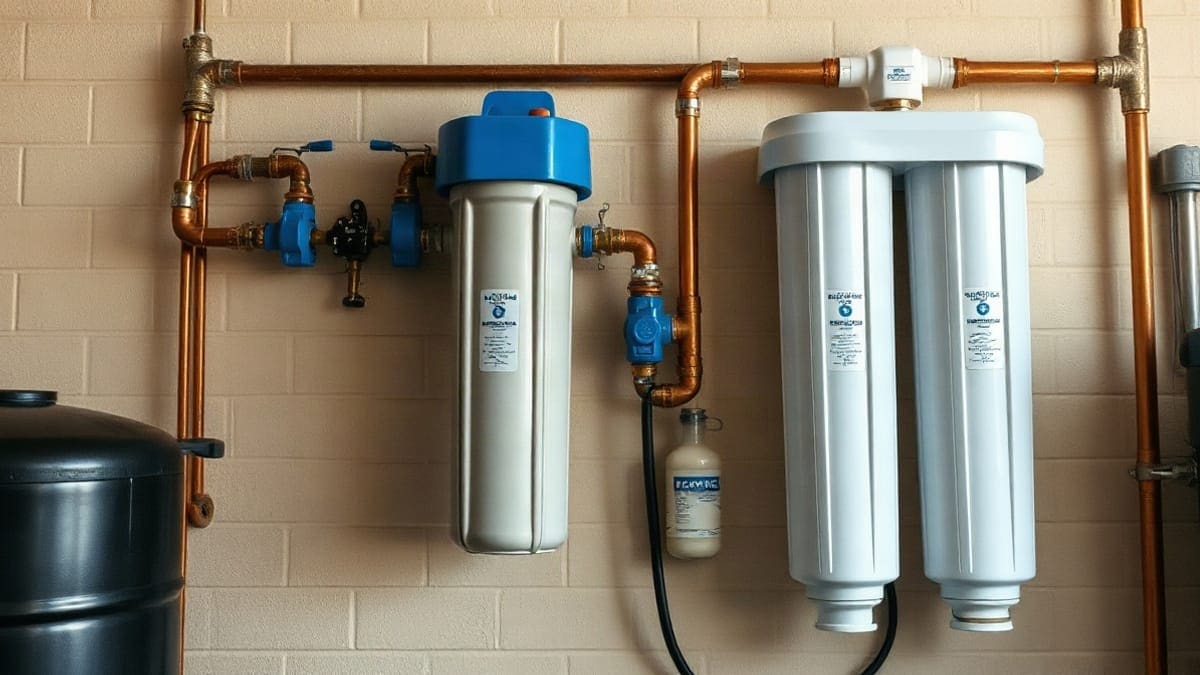
A combo is two jobs sold as one purchase: a filter that takes out chlorine, chloramine and sediment, and a softener or conditioner that handles hardness. The two stages sit in series on the main line, so the weaker one sets the pace. Below, eight packaged systems are compared on the flow of their weakest stage, the grains or gallons each stage is rated for, the floor space they need and the listing each maker can point to. Figures come from maker pages, manuals and the NSF database read in November 2026, and no price is printed anywhere on this page.
Eight filter and softener combos at a glance
Water check
Eight combos run from 7.0 to 15 GPM where a flow is printed, with salt-based units at 32,000, 45,000 and 48,000 grains. Only the SpringWell CSS1 and CSS4 and the iSpring WF150K+WCS45KG pair a filter with a true ion-exchange softener.
The table lists what each maker prints. A dash means the page we read gives no figure. In a series system the lowest-rated stage sets the flow of the whole set, so compare the weakest number, not the best one. When one maker's pages disagree, the detail section names both numbers.
| Combo | Filter stage | Softening stage | Flow printed | Connection |
|---|---|---|---|---|
| SpringWell CSS1 | CF1, 1,000,000 gal | SS1 salt-based, 32,000 grains | 9 GPM filter, 11 GPM softener | 1 in |
| SpringWell CSS4 | CF4, 1,000,000 gal | SS4 salt-based, 48,000 grains | 12 GPM filter, 13 GPM softener | 1 in |
| SpringWell CSF1 | CF1, 1,000,000 gal | FS1 salt-free (TAC) | 9 GPM filter, 12 GPM conditioner | 1 in |
| Aquasana Rhino + conditioner | Rhino, 1,000,000 gal | Salt-free conditioner, 1,000,000 gal | 7.0 GPM rated, both tanks | not stated |
| Kind E-3000 | 5 micron sediment, catalytic carbon | Salt-free TAC cartridge | 15 GPM | 1 in |
| Aquasure Harmony AS-HS48SCP | Sediment, carbon and zinc pre-filter | Salt-based, 48,000 grains | not printed | 1 in or 3/4 in |
| iSpring WF150K+WCS45KG | WF150K, auto backwash | WCS45KG salt-based, 45,000 grains | not printed | 1 in on the softener |
| iSpring WGB22B+ED2000 | Sediment and carbon block, 100,000 gal | ED2000 electronic descaler | up to 15 GPM | 1 in |
Which combo suits which home?
Start from your water source and what you want the hardness stage to do. A salt-based unit lowers hardness to near zero. A salt-free unit leaves hardness in the water and aims to stop scale. Read your utility's annual report first, or use the water hardness lookup guide. City water with 1 to 3 bathrooms points to the SpringWell CSS1 for soft water or the Kind E-3000 for scale control without salt. A 4 to 6 bathroom house points to the CSS4. A large house that wants a self-cleaning filter points to the iSpring WF150K+WCS45KG, and a small house with light scale to the WGB22B+ED2000.
Our best water softener page ranks the softeners alone, and the best whole house water filtration system page ranks the filters alone. The sister view of this topic, from the softener side, is best water softener and filter combo. This page treats the pair from the filter side and as a series install.
What does the filter do, and what does the softener do?
Water check
The filter takes out chlorine, chloramine, sediment and taste at 7 to 15 GPM. The softener or conditioner deals only with calcium and magnesium. Neither stage does the other stage's job, which is why a combo has two tanks.
A filter stage is a sediment cartridge, usually 5 micron, plus carbon. SpringWell's combo manual describes the carbon tank as coconut shell catalytic carbon that removes contaminants such as chlorine, a sediment filter that catches particles, and a softening tank that then uses ion exchange on the filtered water.
Ion exchange swaps calcium and magnesium for sodium. Penn State Extension puts the sodium added at 7.5 mg per quart for each grain per gallon (gpg) of hardness removed, so 10 gpg water gains about 75 mg per quart. It also says a cycle uses about 50 gallons of water. The same page says a softener will not necessarily remove more serious drinking water contaminants, which is the reason to pair it with a filter.
| Stage | What it handles | What it does not handle | Standard that covers it |
|---|---|---|---|
| Sediment cartridge | Sand, silt, rust | Chemicals, hardness | None named by these makers |
| Carbon filter | Chlorine, chloramine, taste, odor | Hardness, fluoride | NSF/ANSI 42 (taste, odor, chlorine) |
| Salt-based softener | Calcium, magnesium by ion exchange | Chlorine, lead, bacteria | NSF/ANSI 44 |
| Salt-free conditioner (TAC) | Scale formation | Hardness stays in the water | No listing standard we could find |
| Electronic descaler | Scale, partly | Hardness stays in the water | None |
Does a salt-free conditioner really prevent scale?
Partly, and it depends on the technology. A study run at Arizona State University for the WateReuse Research Foundation, project 08-06, compared devices with an untreated control. Template assisted crystallization (TAC) cut scale formation by more than 88%, while electromagnetic and electrically induced devices cut it by about 50%. The report names no devices, so the result belongs to the technology, not to any model here. The SpringWell and Kind conditioners use TAC; the iSpring ED2000 is electronic. For the full comparison see salt vs salt-free water softener and best salt-free water softener.
Which certifications does each combo really have?
Water check
None of the eight has a listing we could find for hardness reduction under NSF/ANSI 44. Kind names NSF/ANSI/CAN 61 and 372 and CSA B483.1 for its assembled system, which cover materials and lead content, not chlorine or scale performance.
We searched the NSF drinking water treatment unit database by company on November 18, 2026, and read each maker's page. The WQA and IAPMO R&T directories could not be searched by model from here, so anything credited to those bodies rests on the maker's own document.
| Combo | What the maker says | What we traced | Database |
|---|---|---|---|
| SpringWell CSS1, CSS4, CSF1 | Chlorine and chloramine reduction, up to 95% of scale on the salt-free combo | No standard named on the combo pages; NSF returned no matching products | NSF, SpringWell |
| Aquasana Rhino + conditioner | Rhino independently tested to NSF/ANSI 42 for up to 97% of chlorine; tank WQA certified to NSF/ANSI/CAN 61 | Conditioner page lists no certification; NSF lists two Aquasana UV units only | NSF, Aquasana |
| Kind E-3000 | System certified by WQA to NSF/ANSI/CAN 61, NSF/ANSI/CAN 372 and CSA B483.1; carbon "NSF/ANSI 42 material safety" | Materials and lead content, not performance; NSF search for "kind water" returned nothing | WQA find products |
| Aquasure AS-HS48SCP | "Reduces 99% of contaminants" | No standard named; NSF lists two Aquasure reverse osmosis membranes, material and structure only | NSF, Aquasure |
| iSpring WF150K+WCS45KG and WGB22B+ED2000 | Comparison row says "NSF/ANSI 58 Yes (full system certified)" | Standard 58 is reverse osmosis; neither set contains one; NSF lists 14 iSpring products, all under 58 | NSF, iSpring |
What do NSF/ANSI 42, 44, 53, 61 and 372 certify?
The NSF database page names the standards: 42 covers aesthetic effects such as taste, odor and chlorine, 44 covers cation exchange softeners and hardness reduction claims, 53 covers health effects such as lead and cysts, 55 covers UV systems, 58 covers reverse osmosis and 401 covers emerging compounds. NSF's own listing notes add that 61 means the product meets health effects requirements for materials and that 372 means it conforms with lead content requirements.
Does "independently tested" mean certified?
Certified means an outside body tested the product, audited the plant and lists the model, so you can look it up. "Tested" means a lab ran a protocol with no listing behind it. Aquasana's own page says the Rhino is "independently tested" to NSF/ANSI 42 while its tank is "WQA certified" to 61, so only the tank is certified. Kind's carbon line says "NSF/ANSI 42 certified for material safety and structural integrity", which is a materials statement, not a chlorine-reduction listing.
One benchmark shows what a data sheet looks like. Pentair's PC600-P carbon tank manual states IAPMO R&T certification to NSF/ANSI 42 and 61 and prints a chlorine result: 2 mg/L influent, 50% minimum required reduction, 95.93% average reduction, rated 8 GPM and 662,400 gallons. Pentair's pages for its PSE1800 combo, which paired that tank with a salt-free conditioner, returned "not found" on November 18, 2026, so we do not call it on sale and leave it out of the eight.
The eight combos in detail
Water check
The eight sets weigh from 40 lb to 246 lb where a weight is printed and stand 28 to 63 in tall. Each section gives flow, capacity, limits, certification status, and who should look elsewhere.
SpringWell CSS1: the 32,000-grain pair for 1 to 3 bathrooms
The CSS1 combines the CF1 carbon filter (9 GPM, 1,000,000 gallons) with the SS1 softener (32,000 grains, 11 GPM) on 1 in connections, for 1 to 3 bathrooms. SpringWell's combo page lists 25 to 80 psi, 36 to 120°F, a softener pH range of 6.5 to 10 and tanks 9 in wide and 48 in tall (57 in with the head on the softener). The combo manual plumbs the carbon tank first, then a sediment filter, then the softener, and includes a 50 ft drain line and a brine tank to fill with 4 to 5 bags of salt.
The filter stage is the limit: 9 GPM against the softener's 11. SpringWell's carbon guarantee reads 6 years or 1,000,000 gallons, against 10 years in its specification line. The pre-filter changes every 6 to 9 months. Warranty: lifetime against defects, 10 years on tanks 14 in or larger, 5 years on the electronic head on the combo page (SpringWell's warranty page says 7). The pages list no NSF or WQA certification. The manual says not to install on well water without calling SpringWell first.
Best for: a city house with 1 to 3 bathrooms that wants hardness removed and chlorine reduced from one maker. Not for: a well with iron or hydrogen sulfide, or a buyer who needs a certification number. See the SpringWell combo review.
SpringWell CSS4: the same pair for 4 to 6 bathrooms
The CSS4 pairs the CF4 filter (12 GPM on the current page, 1,000,000 gallons) with the SS4 softener (48,000 grains, 13 GPM), on 10 in by 54 in tanks and 1 in connections. The 2021 manual prints 11 GPM for the CF4, so SpringWell's two documents differ by 1 GPM, and the current page is the one to quote.
At 10 gpg a four-person house uses 3,000 grains a day, so 48,000 grains regenerates about every 16 days. At 15 gpg the same house regenerates about every 10.7 days.
Best for: a 4 to 6 bathroom house on city water. Not for: a 2 bathroom house, where the CSS1 does the same job in less space.
SpringWell CSF1: filter plus a salt-free conditioner
The CSF1 pairs the CF1 filter (9 GPM, 1,000,000 gallons) with the FS1 salt-free conditioner (12 GPM, 6 in by 35 in tank) for 1 to 3 bathrooms on city water. SpringWell's salt-free combo page lists 20 to 80 psi, 34 to 120°F, pH 7.0 to 9.5, free chlorine up to 3 ppm and iron, manganese, copper, oil and hydrogen sulfide all at 0 ppm. It says the conditioner prevents up to 95% of scale and that the filter reduces chlorine, chloramine and PFAS, without naming a standard.
The hardness limit reads 81 gpg on the combo page and 75 gpg on SpringWell's single-unit page, so ask which applies; the FutureSoft page names template-assisted crystallization and gives 12 GPM for the FS1 against 9 GPM in the size guide. Hardness stays in the water; only scale formation is aimed at.
Best for: a city house that wants scale control without salt or a drain line. Not for: a buyer who wants soft-feeling water, or any home with iron. See best salt-free water softener and filter system.
Aquasana Rhino with the salt-free conditioner: two matched tanks
The Rhino base unit is rated 7.0 GPM (14.6 GPM peak) and 1,000,000 gallons or 10 years; the conditioner tank is rated 7.0 GPM (15.3 GPM peak) and the same 1,000,000 gallons, each 46 in tall and 9 in across. Aquasana's Rhino page lists a conditioner option in eight bundle configurations. The conditioner page sets limits of under 15 gpg hardness, iron under 0.3 ppm, alkalinity under 250 mg/L, pH below 8.3, 40 to 90°F and 100 psi.
Aquasana answers "No" on its own page to whether the conditioner reduces hardness or TDS, and says it does not reduce iron or sulfur. A 20 in pre-filter changes every 2 months and a 10 in post-filter every 6 months. The warranty is 10 years limited with a 90-day satisfaction guarantee. At 7.0 GPM rated, it clears a 6.5 GPM peak by only 0.5 GPM.
Best for: soft-water-averse buyers on city water under 15 gpg who want a 10-year filter. Not for: a large house, hard water above 15 gpg, or any iron. Read the Rhino review.
Kind E-3000: the wall-mounted three-stage combo
The E-3000 is 29 in tall, 23.25 in wide and 8 in deep, rated 15 GPM on a 1 in connection, with a 20 in 5 micron pleated sediment filter, a catalytic carbon block and a salt-free TAC cartridge. Kind's page lists a maximum hardness of 75 gpg (1,282 ppm), 39 to 113°F, no electricity and no wastewater. The sediment and carbon filters change every 6 to 12 months; the softening cartridge lasts about 5 years.
Kind claims 88% scale prevention, in line with the TAC result in the university study, though that study did not name devices. It names NSF/ANSI/CAN 61, 372 and CSA B483.1 for the assembled system, which cover materials and lead content. Another Kind category page lists 12 GPM for the same model, against 15 GPM on the product page. Kind says the E-3000 is designed for city water and asks well owners to call.
Best for: city water, tight floor space, a DIY install and a salt-free approach. Not for: a buyer who needs hardness near zero, or private wells. See the Kind review.
Aquasure Harmony AS-HS48SCP: a 48,000-grain softener with a triple pre-filter
The AS-HS48SCP bundles the Harmony AS-HS48D, a metered 48,000-grain softener, with the AS-FS-25SCZ sediment, carbon and zinc pre-filter, on 1 in or 3/4 in NPT connections, with the pre-filter replaced every 6 months. Aquasure's bundle page claims it removes 99% of contaminants without naming one or a standard, and prints no GPM for the bundle.
Aquasure's pages disagree on size. The bundle page says 3 to 4 bathrooms and up to 5 people at the top and 1 to 3 bathrooms and up to 4 people in its description, while the stand-alone AS-HS48D page says 4 to 5 bathrooms and 5 to 6 people.
Best for: a buyer who wants the bundle's pre-filter included with a 48,000-grain softener. Not for: a buyer who needs a printed flow rate or a certification.
iSpring WF150K+WCS45KG: auto-backwash filter and a 45,000-grain softener
The set pairs the WCS45KG, a 45,000-grain salt-based softener on 1 in NPT with a digital valve, and the WF150K, a catalytic media filter with auto backwash rated for 5 to 10 years, for a set weight of 246 lb. iSpring's set page labels the softener Stage 1 and the filter Stage 2, but says nothing about plumbing order, so read the manual before you plumb it.
The page prints no GPM and a 1 year warranty with lifetime tech support. It says the softener has no built-in sediment filter and recommends a pre-filter, and adds an iron filter first if the water has iron (the WCFM500K for 3 to 12 ppm). It also lists "NSF/ANSI 58 Yes (full system certified)" in a comparison row, though 58 is a reverse osmosis standard and this set has no membrane.
Best for: a large house that wants a self-cleaning filter and a conventional softener from one maker. Not for: a buyer who wants a printed flow figure, or a house with a cramped utility room.
iSpring WGB22B+ED2000: two filter housings and an electronic descaler
The WGB22B+ED2000 bundle is a 2-stage filter with 20 in by 4.5 in cartridges, rated 100,000 gallons or up to 12 months, up to 15 GPM on 1 in NPT, plus the ED2000 electronic descaler, in a set weighing 40 lb. iSpring's bundle page lists the housings as 16 in by 8 in by 28 in. The descaler works on PVC, PEX and other pipe, needs no plumbing change and prints no hardness limit or flow.
The descaler is not a softener. Electronic devices cut scale by about 50% in the university study above, and the page gives no listing.
Best for: a small house with light scale and chlorine on a tight budget of space. Not for: hard water above moderate levels, or anyone who wants hardness removed.
Why does the filter go before the softener?
Water check
On city water, put the carbon filter first. Purolite says each 1 mg/L of chlorine cuts premium resin life by 50%, and SpringWell's combo manual plumbs the carbon tank, then a sediment filter, then the softener.
Chlorine attacks the cross-links in the resin beads. Purolite says that 0.3 ppm does little in cold water, that each 1 mg/L of chlorine cuts life by 50% and that the higher the cross-linking (DVB) the more resistance, with some cheap resins at 6% DVB or less. The page calls this a guideline. EPA sets the limit for chlorine and chloramine in tap water at 4.0 mg/L as chlorine (EPA regulations), and more than one in five Americans drink water treated with chloramines.
| Chlorine in the supply | Resin life from Purolite's 50% rule, 10-year resin | Our arithmetic |
|---|---|---|
| 0.3 mg/L, cold water | Little reduction | Purolite's wording |
| 1 mg/L | About 5 years | 10 x 0.5 |
| 2 mg/L | About 2.5 years | 10 x 0.5 x 0.5 |
| 4.0 mg/L, EPA ceiling | About 7.5 months | 10 x 0.5 four times, an upper bound |
Iron gives a second reason. Penn State Extension says raw water should not touch air or chlorine before the softener, because oxidized iron and manganese foul the resin, and that softeners are generally recommended only when dissolved iron is below 5 mg/L. Its softening page says filtration before softening keeps oxidized iron out of the unit.
A caution on labels: iSpring's set page calls the softener Stage 1 and the filter Stage 2, but a stage number is a product label, not an instruction. Pentair's carbon tank manual adds that the sediment filter goes before the tank on well water and after the tank on city water. For iron, sediment and UV variants of the order, read water filter before or after water softener.
How do you size a combo?
Water check
Size the filter for flow and the softener for grains. A four-person house at 10 gpg uses 3,000 grains a day and a peak of about 6.5 GPM, so a 32,000-grain softener regenerates every 10 to 11 days and the filter stage needs 7 GPM or more.
Does the weakest stage set your flow?
EPA says standard showerheads use 2.5 gpm and 2.0 gpm earns the WaterSense label. Two showers draw 5.0 GPM and we add 1.5 GPM for a kitchen tap, so the busiest minute asks for 6.5 GPM. In a series set the lowest-rated stage governs.
| Combo | Lowest printed flow | Against 6.5 GPM |
|---|---|---|
| Aquasana Rhino + conditioner | 7.0 GPM rated | Above by 0.5 GPM |
| SpringWell CSS1 | 9 GPM (filter) | Above by 2.5 GPM |
| SpringWell CSF1 | 9 GPM (filter) | Above by 2.5 GPM |
| SpringWell CSS4 | 12 GPM (filter), 11 GPM in the 2021 manual | Above by 5.5 or 4.5 GPM |
| Kind E-3000 | 15 GPM (12 on one category page) | Above by 8.5 or 5.5 GPM |
| iSpring WGB22B+ED2000 | up to 15 GPM | Above by 8.5 GPM |
| Aquasure AS-HS48SCP, iSpring WF150K+WCS45KG | not printed | Cannot be compared |
How many grains do you need?
Use the formula in Penn State's softening page: gallons per person per day (75) x hardness (gpg) x people gives grains a day, and capacity divided by that gives days between regenerations. Our water softener size calculator does the same sum with an iron adjustment, and what size water softener do I need explains it.
| Softener stage | Rated grains | Days at 10 gpg (3,000 grains a day) | Days at 15 gpg (4,500 grains a day) |
|---|---|---|---|
| SpringWell SS1 | 32,000 | 10.7 | 7.1 |
| iSpring WCS45KG | 45,000 | 15.0 | 10.0 |
| SpringWell SS4, Aquasure AS-HS48D | 48,000 | 16.0 | 10.7 |
At 10.7 days between cycles the SS1 regenerates about 34 times a year, so at Penn State's 50 gallons a cycle it sends about 1,700 gallons to the drain.
How many years does a 1,000,000 gallon rating last?
Four people at 75 gallons use 300 gallons a day, or 109,500 gallons a year. SpringWell's 1,000,000 gallons lasts about 9.1 years at that rate, and 6 years of that use is 657,000 gallons, below the rating. The iSpring cartridge set rated for 100,000 gallons lasts about 11 months. The WF150K and Kind's carbon use time ratings, 5 to 10 years and 6 to 12 months.
How much floor space does a combo take?
Water check
A SpringWell CSS1 needs about 42 in by 18 in, or 5.25 sq ft, with 3 in gaps. A CSF1 needs about 1.1 sq ft, the Rhino pair about 1.3 sq ft, and the wall-mounted Kind E-3000 takes no floor space.
Tank widths come from the makers' pages; the 3 in gaps and the arithmetic are ours.
| Combo | Footprint on the floor | Our arithmetic | Height |
|---|---|---|---|
| SpringWell CSS1 | 42 in x 18 in | 9 + 9 + 18 + 6 in of gaps | 57 in (head) |
| SpringWell CSS4 | 44 in x 18 in, 5.5 sq ft | 10 + 10 + 18 + 6 | 63 in |
| SpringWell CSF1 | 18 in x 9 in, 1.1 sq ft | 9 + 6 + 3 | 52 in |
| Aquasana Rhino + conditioner | 21 in x 9 in, 1.3 sq ft | 9 + 9 + 3 | 46 in |
| Kind E-3000 | none, wall 29 in x 23.25 in | 4.7 sq ft of wall | 29 in |
| iSpring WGB22B+ED2000 | 16 in x 8 in, 0.9 sq ft | as listed | 28 in |
Aquasure and the iSpring WF150K+WCS45KG pages print no footprint; the iSpring set weighs 246 lb.
How do you choose between a combo and the two parts separately?
Water check
A combo gives you matched pipe sizes, one warranty and one phone number. Buying separately lets you pick a softener size and filter media to your water. The deciding number is flow: the combo's lowest stage governs.
Buying a combo gives you fixed tiers, 32,000 or 48,000 grains on SpringWell, one warranty and one phone number, but the filter governs flow, 9 GPM on the CSS1. Buying separately lets you choose any softener size, such as a small water softener or a high efficiency water softener, and a softener whose manual prints NSF/ANSI 44 figures, as ranked on best water softener. On plain city water, the combo is simpler; if a listing matters, split the purchase.
Does a whole house water filter soften water or help with hard water?
Water check
No. A carbon filter does not lower hardness and a filter stage does not remove calcium. In each combo here, only the second tank touches hardness: ion exchange on the salt-based units, scale prevention on the others.
Calcium and magnesium are dissolved minerals. SpringWell's page says the first tank removes contaminants and the second prevents scale. Aquasana says its conditioner does not reduce hardness or TDS. Penn State's classes put 7.0 to 10.5 gpg as hard and over 10.5 gpg as very hard. See hard water filter and water softener vs water filter.
A filter can help with chlorine smell, but white scale and spotted glass stay. See what is hard water and hard water vs soft water.
Which water does a combo not fit?
Water check
Skip a packaged combo on untested well water, on iron above 3 to 5 mg/L, with hydrogen sulfide, or where lead, PFAS or fluoride are the worry. Those need a test and a dedicated treatment, not a bundle.
SpringWell's combo manual says not to install on well water without speaking to customer service, and its page says iron and manganese oxidize the media. Penn State says dissolved iron should be below 5 mg/L for a softener. Kind says the E-3000 is for city water.
EPA's secondary standards, which are non-enforceable guidelines for taste and color, are 0.3 mg/L for iron and 0.05 mg/L for manganese. For wells see best water softener for well water and best iron filter for well water; for PFAS and lead, best water filter for PFAS and best water filter for lead; for disinfectants, chlorine and chloramine filters.
No CPSC recall of a water softener, whole house filter or combo is known as of November 18, 2026 (CPSC search of that date). Check the CPSC recall list and our water softener recalls page before you buy.
Where does each tank go, and in what order do you plumb the set?
Water check
Install both on the main line after the shutoff, filter first, each with a bypass, on a level floor near a drain and a 120 V outlet for a salt-based head. SpringWell's carbon needs a 48 hour soak and a 3 to 5 minute flush.
SpringWell's manual says the system must be on the main supply, follow local plumbing codes and use the bypass valves. It supplies a 50 ft drain line, asks for 4 to 5 bags of salt in the brine tank and a power adapter on an outlet not controlled by a switch. Pentair's tank manual keeps outside faucets on unfiltered water, and Penn State says toilets, spigots and basement sinks can be bypassed.
Kind says about 40% of its customers install the E-3000 themselves in 2 to 4 hours with push-fit fittings. Full steps are in whole house water filter installation guide and water softener installation guide; the labor cost is in water softener installation cost.
What do the filters, cartridges and salt need, and when?
Water check
Change sediment or pre-filters every 2 to 12 months, carbon every 1 to 10 years, and a salt-free cartridge every 5 to 10 years. A salt-based unit needs salt topped up and no cartridge.
| Combo | Sediment or pre-filter | Carbon | Softening stage |
|---|---|---|---|
| SpringWell CSS1, CSS4 | Every 6 to 9 months | 1,000,000 gal or 10 years (6 in the manual) | Salt, resin lasts years |
| SpringWell CSF1 | Every 6 to 9 months | 1,000,000 gal or 10 years | FS media, no salt |
| Aquasana Rhino + conditioner | 20 in every 2 months | 10 in post-filter every 6 months | Tank every 10 years |
| Kind E-3000 | Every 6 to 12 months | Every 6 to 12 months | Cartridge about 5 years |
| Aquasure AS-HS48SCP | Triple filter every 6 months | included | Salt, resin |
| iSpring WGB22B+ED2000 | 100,000 gal or 12 months | same set | Descaler, no consumables |
Write the install date on each housing. For the softener side see water softener maintenance checklist and for filters whole house water filter maintenance and replacement.
Filter and softener combos: our conclusion
Water check
For true soft water on city supply, take the SpringWell CSS1; for scale control without salt, the Kind E-3000. The filter goes first, the weaker stage sets the flow, and an untested private well needs a test before any combo.
The SpringWell CSS1 pairs a 9 GPM catalytic carbon filter with a 32,000-grain softener for 1 to 3 bathrooms Check price on Amazon; the CSS4 serves 4 to 6 bathrooms on city water Check price on Amazon. Scale control without salt or a drain line is the Kind E-3000 (15 GPM, wall mounted) Check price on Amazon, the SpringWell CSF1 Check price on Amazon, or, on city water under 15 gpg, the Aquasana Rhino with the salt-free conditioner Check price on Amazon. A large house that wants a self-cleaning filter and a conventional softener from one maker can look at the iSpring WF150K+WCS45KG Check price on Amazon.
6 common mistakes with whole house filter and softener combos
Water check
Six mistakes cost buyers most: putting the softener first, reading the best flow instead of the lowest, expecting soft water from a salt-free stage, skipping the bypass, using a combo on iron water and trusting "99%" without a standard.
Putting the softener ahead of the carbon
At 1 mg/L of chlorine, Purolite's rule halves a 10-year resin to about 5 years. Put the carbon first.
Reading the strongest flow on the page
The CSS1 prints 11 GPM for the softener and 9 GPM for the filter, so it is a 9 GPM set.
Expecting soft-feeling water from a salt-free stage
Aquasana answers "No" on hardness; the gpg stays the same.
Skipping the bypass
Without it, the main goes off at every 2 to 12 month filter change.
Using a combo on iron water
Aquasana's conditioner lists iron under 0.3 ppm and SpringWell's FS media 0 ppm. Test first.
Trusting "99%" with no standard
Aquasure's claim names no contaminant and no standard. Ask for a database listing.
Frequently asked questions
What is the best whole house water filter and softener combo?
For soft water on city supply, the SpringWell CSS1 (9 GPM, 32,000 grains) or CSS4 (12 GPM, 48,000 grains). For scale control without salt, the Kind E-3000 at 15 GPM. None has a listing for hardness reduction, so the choice rests on flow, size and your water.
Can you have a water softener and a whole house water filter?
Yes. Put the carbon filter first, then the sediment filter, then the softener, as SpringWell's combo manual does. A softener does not filter chlorine and a filter does not lower hardness, so most city homes with hard water use both.
Does a whole house water filter soften water or help with hard water?
No. A carbon filter leaves calcium and magnesium in the water. Only ion exchange lowers hardness, and salt-free conditioners aim at scale instead. See water softener vs water filter.
Do I need both a whole house filter and a softener?
You need the filter for chlorine, chloramine or sediment and the softener for hardness above about 3.5 gpg, where Penn State's classes start to read as hard. If you have only one problem, buy only one device. See do you need a whole house water filter.
How does a combo change my pressure and the install job?
The general questions on pressure, installation and filter changes have their own pages: the whole house water filter installation guide and whole house water filter maintenance and replacement. For combos, Pentair prints a 13 psi drop at 8 GPM for its PC600-P tank, SpringWell lists 25 to 80 psi, and Kind says about 40% of buyers fit the E-3000 themselves in 2 to 4 hours.
How much does a whole house water filter and softener cost?
This site prints no prices. What you can calculate is running cost: 4 to 5 bags of salt per fill, about 50 gallons of water per regeneration, and filters every 2 to 12 months. See water softener cost guide and how much does a whole house water filter cost.
Can a combo work on well water?
Only after a test. SpringWell says not to install its combo on well water without calling, and Kind says the E-3000 is for city water. Iron above 3 to 5 mg/L needs a dedicated filter first. See best well water filtration system.
Is a whole house water filter worth it?
It is worth it for chlorine, chloramine or sediment at every tap, not as a hardness fix. A softener is worth adding when hardness is the problem: by Penn State's scale, water above 7 gpg counts as hard, and a salt-based softener takes it to near zero while a filter does not. See what size water softener do I need and the best water softener pillar.
Does a combo send water to the drain or need electricity?
A salt-based set does both: SpringWell's SS1 comes with a 50 ft drain line and a power adapter, and Penn State puts a cycle at about 50 gallons. The Kind E-3000 lists no electricity and zero wastewater. Aquasana's conditioner page lists neither a drain nor a power need.
Why does the carbon tank sit ahead of the resin tank?
The filter goes first, so the carbon takes chlorine off before the resin sees it; the order is explained in the section on where each tank goes above.
Do you need a bypass valve on a combo?
Yes. SpringWell's manual supplies bypass valves for both tanks, and Pentair's tank manual shows an in-service and an in-bypass position. A bypass lets you change a filter without shutting off the whole house for the job.
Do whole house filters remove lead or fluoride?
Only a filter certified to NSF/ANSI 53 for lead removes lead, and fluoride passes through carbon. None of the combos names those claims. See best water filter for lead.
How we researched this page
Water check
Eight combos were chosen from Impact brands and Amazon US, all on sale in the United States. We read each maker's page and manual, searched the NSF database by company on November 18, 2026, and did not use any product ourselves.
We could not search the WQA and IAPMO directories by model, so Kind's certification and the Pentair data sheet rest on the makers' own documents. The Pentair PSE1800 combo page returned "not found", so it is not in the eight. Where a maker prints no flow, the table says so. Buying through a Check price link earns this site a commission and does not change what you pay.
Sources
Our sources by topic
Public agencies and universities
- Penn State Extension, Water Softening and Iron and Manganese in Private Water Systems.
- WateReuse Research Foundation, project 08-06 report.
- U.S. EPA, chloramines, drinking water regulations, secondary standards, private wells, Consumer Confidence Reports and WaterSense showerheads; CPSC recalls.
Certification and standards bodies
Manufacturers, retailers and other references
- SpringWell, filter and salt softener combo, filter and salt-free combo, salt-free single units and CSS1, CSS4 installation instructions.
- Aquasana, Rhino and salt-free conditioner.
- Kind Water Systems, E-3000.
- Aquasure, AS-HS48SCP and AS-HS48D.
- iSpring, WF150K+WCS45KG and WGB22B+ED2000.
- Pentair, PC600-P and PC1000-P manual.
- Purolite, factors affecting softening resin life.
Keep comparing
 Whole House Water Filtration SystemEight whole house water filters compared by rated flow in GPM, capacity in gallons
 Reverse Osmosis System for HomeEight reverse osmosis systems compared by NSF-listed output, drain water, feed pressure and certification
 Under Sink Water Filters (Without Reverse Osmosis)Nine under sink filters with no drain water compared by rated gallons, flow
 Shower Filter for Hard WaterNine shower filters compared by rated flow, cartridge life and NSF/ANSI 177 status
 Countertop Reverse Osmosis Systems, No InstallationTen plug-in countertop reverse osmosis systems compared by tank size, drain water
 Water Filter PitchersEight water filter pitchers compared by cartridge gallons, flow and the certification each maker names