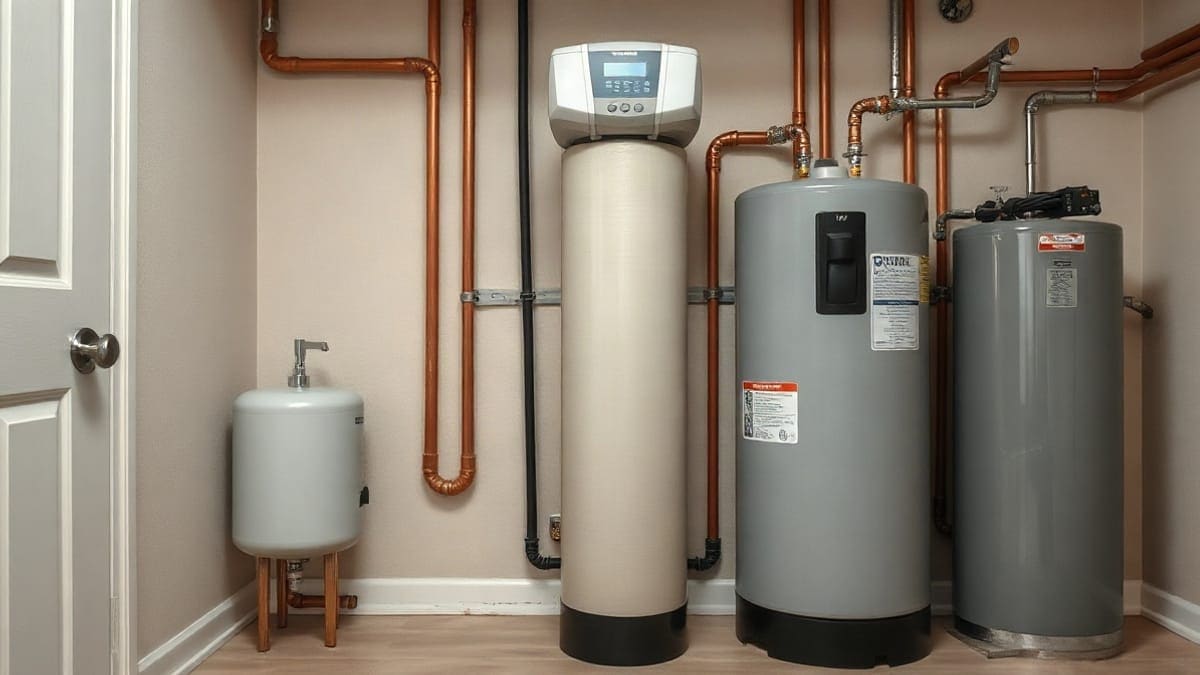
A softener needs very little, but the little things are the ones that stop it, and a neglected unit can fail in 3 to 5 years instead of 10 to 15. An empty brine tank, a plugged injector or a unit left in bypass all produce hard water within days, and nothing on the control head tells you why. The manuals from Rheem, EcoPure, Whirlpool and Pentair agree on the core routine, then differ on salt level and cleaner timing. This page lays the jobs out by month and by year, shows where the makers disagree, and says which jobs belong to a technician.
What maintenance does a water softener need?
Water check
Four routine jobs: keep salt in the brine tank, clear salt bridges, clean the nozzle and venturi (the injector), and run a resin cleaner on the maker's schedule. A fifth, checking the clock and hardness setting, matters after a power cut.
A salt-based softener is an ion exchange tank. Resin beads trade calcium and magnesium for sodium, and a salt brine recharges them, as Penn State Extension explains. Everything that goes wrong comes from one of three places: no brine (empty tank, salt bridge, plugged injector), a fouled resin bed (iron, sediment, bacteria) or a wrong setting (hardness, clock, bypass valve left open).
The Rheem RHS42 manual has a "Routine Maintenance" chapter of two pages: adding salt, breaking a salt bridge and cleaning the nozzle and venturi. The Whirlpool WHES48 manual adds a cleanser step. Hardness and recharge time "never require resetting" after an outage, it says; only the time of day does.
A softener does not filter chlorine or lead; see water softener vs water filter.
What does a water softener maintenance checklist look like by month and year?
Water check
Monthly: salt, bridge, leaks. Every 4 to 6 months: resin cleaner. Yearly: brine tank, injector, hardness test, valve and fittings. Every 12 to 18 months: a technician. Every 10 to 15 years: the resin.
The times below are our estimate of hands-on work, not maker figures. The frequencies come from the manuals and guides named in the last column.
| Task | How often | Hands-on time | Tool | Source |
|---|---|---|---|---|
| Lift the lid, check the salt level | Every 2 to 4 weeks | 2 min | Flashlight, ruler | Rheem, Whirlpool, SpringWell |
| Probe for a salt bridge | Monthly | 5 min | Broom handle | Rheem, SpringWell |
| Look for leaks, drips, loose fittings | Monthly | 3 min | Eyes, paper towel | SpringWell |
| Run resin cleaner | Every 4 months (Rheem, Whirlpool) to 6 months (GE) | 10 min plus a 2-hour regeneration | Maker's cleaner | Rheem, Whirlpool, GE |
| Test hardness at a tap after the softener | Every 3 to 6 months | 5 min | Hach strips | Hach |
| Clean nozzle and venturi | Once a year, or when hard water appears | 30 min | Warm soapy water, soft brush | Rheem |
| Empty and clean the brine tank | At least once a year | 1 to 2 hours | Wet vac, mild soap | SpringWell |
| Check pressure and temperature | Yearly | 5 min | Pressure gauge | Rheem |
| Technician inspection | Every 12 to 18 months | 1 hour | Technician | SpringWell |
| Replace the resin | About 10 to 15 years | Half a day | Technician | SpringWell, Purolite |
The salt line hides a gap worth knowing. Rheem and Whirlpool tell new owners to check every two or three weeks "until you have established a refilling routine"; SpringWell says "at least once a month". Pick the shorter interval for the first two months, then set your own from how fast the level falls.
How often should you check the salt, and how full should the brine tank be?
Water check
Every 2 to 4 weeks, with salt kept above the water line. Rheem and Whirlpool say add salt when the tank is under 1/4 full, Morton says keep it at least half full, SpringWell says half full and 3 to 6 inches above the water.
Salt below the water line cannot make brine, so the next regeneration uses weak brine and the water turns hard. The makers state the target differently:
| Source | Check | Level rule | Humid rooms |
|---|---|---|---|
| Rheem RHS32, RHS42 and EcoPure EP31 manuals | Every 2 to 3 weeks until a routine is set | Add if less than 1/4 full | Keep the level lower, refill more often |
| Whirlpool WHES48 manual | Every 2 to 3 weeks until a routine is set | Add if less than 1/4 full | Keep the level lower, refill more often |
| Morton Clean and Protect page | Look regularly | At least half full; two 40 lb bags every two months | Not stated |
| SpringWell maintenance guide | At least monthly | Half full and 3 to 6 in. above the water | More cleaning with high humidity |
| Kinetico owner pages | Lift the lid | If you can see water, add salt | Not stated |
Neither side is wrong: a fuller tank means fewer trips, a lower one gives the top layer less time to crust. In a damp basement, follow Rheem and Whirlpool.
How fast it drains depends on the house. Four people on 10 gpg water use about 27 to 35 lb a month by the arithmetic on the how much salt does a water softener use page, so one 40 lb bag lasts about 5 to 6 weeks. The water softener size calculator gives your own figure. For the type of salt, the Rheem RHS32 manual recommends nugget, pellet or coarse solar salt with less than 1% impurities and rules out rock, block, granulated and table salt. The best water softener salt page compares brands; how to add salt to a water softener has the steps.
How do you break a salt bridge?
Water check
Push a broom handle straight down through the salt in several places. If it stops on something hard before it reaches the water, that crust is a bridge. Never pound the outside of the tank or use a sharp tool.
A bridge is a hard crust with an empty gap under it, so the salt never touches the water. The Rheem and Whirlpool manuals blame high humidity or the wrong salt. They give a method: measure from the floor to the rim, push the handle down and watch for a hard stop before the pencil mark reaches the top. Push gently in several places. The manuals warn that sharp tools can puncture the tank and pounding the outside can damage it.
Kinetico's refill guide adds that low salt use and potassium chloride also invite crusting. Whirlpool says to keep no more than 60 lb of potassium chloride in the tank at a time and to check the tank and brinewell monthly for hardening, because potassium chloride hardens in humid rooms. If a bridge keeps coming back, the full fix is on the water softener salt bridge page.
How do you wash out the salt tank when it has sludge?
Water check
Once a year at least, or sooner if you see sludge, mush or clumps. Use up the salt, scoop out the sludge, wash with warm water and mild soap, rinse, refill, and start a manual regeneration.
SpringWell says to clean the brine tank "at least once a year" and more often with well water or high humidity. A retailer guide, Fresh Water Systems, puts it at every 6 to 12 months and sooner with salt mushing. The steps:
- Let the tank run low on salt first.
- Put the bypass valve in bypass so no hard water reaches the house if the unit regenerates.
- Scoop out salt and sludge. Use a wet vac for the last of the water.
- Wash the inside with warm water and mild dish soap, rinse, and drain.
- Add fresh salt, back to your usual level, and return the valve to service.
- Start a manual regeneration so the new brine reaches the resin.
Skip bleach unless the manual allows it. The Fleck 5600SXT user guide warns that sanitizing can introduce chlorine compounds "which may reduce the life of the ion exchange resins". The how to clean a water softener page covers the whole machine.
How do you clean the resin with a water softener cleaner?
Water check
Rheem, EcoPure and Whirlpool all say one bottle every 4 months; GE says at least every 6 months, sooner if iron appears. Pour it into the brinewell, start a manual regeneration, and flush a cold tap afterward.
A resin cleaner dissolves iron and organic film from the beads, which salt brine alone does not do. Penn State Extension notes that oxidized (red) iron clogs resin and that cleaners exist if the bed is fouled. The schedules differ:
| Source | Interval | Dose or method | Warranty tie |
|---|---|---|---|
| Rheem RHS32 and RHS42 | Every 4 months, display shows "CLn" | One bottle of Rheem RHWSC | 1 year becomes 5 years if used |
| EcoPure EP31 | Every 4 months | One bottle of EcoPure EPCL | 1 year becomes 5 years if used |
| Whirlpool WHES48 | Every 4 months | Full 16 oz of WHE-WSC into the brinewell, then hold RECHARGE 3 seconds | 2 years becomes 10 years if used |
| GE | At least every 6 months | Super Iron Out, more often with iron in soft water | None stated |
| Iron Out powder, via InspectApedia | First application, then regular | 1 cup in 1/2 gallon of cold water; later 1/4 cup per 40 lb of salt | None |
The warranty ties are worth reading closely. Each manual counts at most 3 bottles per 12 months, wants proof of purchase and refuses other additives. Whirlpool says the manual recharge takes about two hours; run a cold tap downstream until the water looks normal. InspectApedia's notes add that you should never pour a cleaner onto dry salt, only into the brinewell or onto water, and should ask the maker if the product can harm the resin. Compare products on the best water softener resin cleaner page.
On a well with clear-water iron, the cleaner schedule is not enough on its own. Whirlpool and GE tell you to add to the hardness setting, 5 grains per 1 ppm of iron; their example is 20 gpg plus 2 ppm iron set at 30. Our own sizing page uses 4 gpg per ppm as a maker rule of thumb, so the two differ. See best iron filter for well water when iron passes 3 to 5 ppm.
How do you clean the injector and venturi?
Water check
Once a year or whenever hard water returns with salt in the tank. Put the valve in bypass, unscrew the cap, wash the screen and nozzle disc in warm soapy water, brush off iron, and reseat everything with a silicone-greased o-ring.
The nozzle and venturi create the suction that pulls brine into the resin tank. Rheem calls a clean one "a necessity" and says if sand, silt or dirt plug it, "the water softener will not work, and hard water will result". The steps from the Rheem and Whirlpool manuals:
- Remove the top cover and put the bypass valve in bypass.
- Confirm the unit is in the soft water cycle, so there is no pressure at the nozzle.
- Unscrew the cap and keep the o-ring. Lift out the screen support and screen, then the disc, gasket and flow plugs.
- Wash in warm soapy water, rinse in fresh water, and clean both sides of the disc. Use a small brush for iron. Do not scratch the surfaces.
- Reassemble in order with the gasket hole centered over the nozzle hole and the numbers facing up. Grease the o-ring with silicone, hand-tighten the cap and return to service.
The water softener parts and components explained page names each piece.
How do you set the clock and settings after a power outage?
Water check
Reset only the time of day, and only if the display flashes. Whirlpool says hardness and recharge time never need resetting after an outage; regenerations just happen at the wrong hour until you fix the clock.
If the unit was regenerating when the power failed, Whirlpool says it finishes the cycle once power returns. Rheem lists a wrong time and a wrong hardness setting among the causes of hard water, so check the hardness number yearly against a fresh test. Avoid hot water during regeneration: the heater refills with hard water.
Yearly checks from the Rheem and Fleck documents: Supply pressure should stay in the 20 to 125 psi band (Rheem warns that above 100 psi daytime pressure a pressure reducing valve is needed, and below 20 psi brine draw can fail). Water temperature should stay under 120 °F. If the unit sits where it can freeze, drain it. The full set of choices is on water softener settings, hardness and programming; the how often should a water softener regenerate page explains cycle timing.
How do you test that the softener still works?
Water check
Take a cup of water from a tap after the softener and test it with a hardness strip. A working unit reads near 0 gpg; anything over 1 gpg (17 mg/L) is not soft by Penn State's scale.
Do two tests. First the untreated water, from a tap before the softener or the outdoor spigot, to set the hardness number. Then softened water from the kitchen cold tap. Hach strips step through 0, 25, 50, 120, 250 and 425 mg/L, so a first step above zero means the unit is slipping, and 25 mg/L is already about 1.5 gpg. If the reading is high, check the bypass valve, the salt, a bridge, then the injector, in that order. See how to test water hardness at home and best water hardness test kit.
Your city's hardness is in the yearly water quality report that the EPA consumer confidence report page describes. USGS calls water soft at 0 to 60 mg/L, moderately hard at 61 to 120, hard at 121 to 180 and very hard above 180. The water hardness converter turns those into gpg. Iron is a separate test: EPA's secondary standard is 0.3 mg/L, a staining and taste limit rather than a health one.
How long does softener resin last, and what shortens it?
Water check
Expect 10 to 15 years with normal care, and over 10 years from premium resin in a well-run system (Purolite). Chlorine is the main wear: each 1 ppm of chlorine in the supply roughly halves the life of premium resin.
The resin maker Purolite says a premium strong-acid cation resin "can give reliable operation for over ten years", that chlorine at 0.3 ppm cuts little off in cold water, and that each 1 mg/L of chlorine cuts the life by 50%, then by a further 50% for the next. The same page also says 1 mg/L at 15 °C can bring it under two years, so its own numbers are a range, not a promise. Heat speeds the damage. Iron builds up slowly and can act as a catalyst for oxidative attack; in extreme cases the page puts resin life under one year. Our arithmetic on 10-year resin:
| Chlorine in the supply | Resin life from Purolite's 50% rule |
|---|---|
| 0.3 ppm | Little reduction in cold water |
| 1 ppm | about 5 years |
| 2 ppm | about 2.5 years |
| 3 ppm | about 1.25 years |
| Heavy iron, left untreated | Under 1 year in extreme cases |
SpringWell's guide gives 10 to 15 years with normal maintenance and says a neglected unit "can fail within 3 to 5 years". Rheem's tank warranty runs 10 years and its control board 3 years, while resin itself is a wear part. Purolite notes some cheap resins have 6% DVB or less and resist chlorine poorly. A carbon prefilter takes out chlorine before the softener; see water softener resin guide and whole house water filter for chlorine and chloramine. Retailers quote 15 to 20 years; no maker manual we read prints it.
When should you call a technician for water softener service?
Water check
Call when hard water stays after salt, bridge, bypass and injector checks, when the control head shows an error code, leaks, or the unit is past 12 to 18 months without inspection. Do the routine jobs yourself.
SpringWell recommends a full professional inspection every 12 to 18 months. Kinetico's pages say the dealer can recommend or perform periodic maintenance, and the owner's manuals say to put the system in bypass and call an authorized dealer if it stops working. Rheem and Whirlpool print a toll-free number on the manual and ask for the model and serial number from the rating decal. This page prints no prices, because we found no reliable US figure; get a written quote that says what it covers.
| Job | You | Technician |
|---|---|---|
| Add salt, probe for a bridge | Yes | |
| Run resin cleaner | Yes | |
| Clean brine tank, nozzle and venturi | Yes, if comfortable | If the valve is stiff or the manual says dealer only |
| Error code, no regeneration, motor clicking | Yes | |
| Leak at the valve or between valve and tank | Yes | |
| Resin replacement | Yes | |
| Pressure over 100 psi | Licensed plumber |
For faults, water softener repair guide lists the usual causes by symptom. For a rented unit, see water softener rental vs buying.
Do salt-free systems, Kinetico units and reverse osmosis need maintenance?
Water check
Yes, a different kind. Salt-free media lasts months to years by model, Kinetico units run without electricity but still need salt, and reverse osmosis needs filters and a membrane changed on a schedule.
Salt-free conditioners have no brine tank, so no salt, bridge or cleaner jobs; media life is on best salt-free water softener. Kinetico says its softeners use non-electric technology with "no timers, computers or other electrical components", so there is no clock to reset; the salt check is the same, and its guidance is to add salt when you can see water in the tank. For osmosis, see reverse osmosis filter replacement schedule.
Which products make water softener maintenance easier?
Water check
For routine upkeep: Morton or Diamond Crystal pellets, the maker's own cleaner, Hach strips, and a softener whose manual spells out the jobs, such as the Rheem RHS32, EcoPure EP31 or SpringWell SS1.
Figures match the best water softener guide. We read the manuals and listings; we do not test products.
| Product | What it helps with | Source |
|---|---|---|
| Morton Clean and Protect pellets | Salt in 25, 40 and 44 lb bags; Morton says at least half full | Morton page |
| Diamond Crystal Bright & Soft | 40 lb pellets, typically 99.8% pure | Diamond Crystal page |
| Diamond Crystal Iron Fighter | Rust additive for 1 to 3 ppm clear-water iron | Diamond Crystal page |
| Hach Total Hardness Strips 2745250 | 50 tests, 0 to 425 mg/L | Hach product page |
| Rheem RHS32 | Printed 4-month cleaner reminder, "CLn" light | Rheem RHS32 manual |
| EcoPure EP31 | Same maintenance text, 5-year warranty with cleaner | EcoPure EP31 manual |
Salt: Morton Clean and Protect pellets
Pellets formulated to reduce bridging and mushing; 25, 40 and 44 lb bags. The salt page explains the NSF/ANSI/CAN 60 listing.
Best for: a pellet-only softener in a humid room. Not for: anyone who needs a stated purity percentage. Check price on Amazon
Salt: Diamond Crystal Bright & Soft
Typically 99.8% pure pellets, 40 lb bag. Best for: city water and low iron. Not for: well water above 1 to 2 ppm iron. Check price on Amazon · Check price on Amazon
Test strips: Hach 2745250
Range 0 to 425 mg/L, 50 strips per bottle, steps at 0, 25, 50, 120, 250 and 425.
Best for: monthly or quarterly soft water checks. Not for: an exact value; Hach says strips fit a general range. Check price on Amazon
Softeners with clear maintenance chapters
Rheem RHS32 and EcoPure EP31 print the same chapter: salt check, bridge, nozzle and venturi, cleaner every 4 months. The SpringWell SS1 pairs with a maintenance guide that sets a 12 to 18 month professional inspection. A Fleck 5600SXT kit is serviceable by any dealer that knows the Pentair valve.
Best for: owners who want a written routine. Not for: a heavy iron well, which needs a filter first. Check price on Amazon · Check price on Amazon · Check price on Amazon · Check price on Amazon
6 common mistakes with water softener maintenance
Water check
The costly ones are letting the salt run dry, leaving the unit in bypass, skipping the cleaner on iron water, using the wrong salt, ignoring chlorine, and never testing the result. Each can mean weeks of hard water.
Letting the salt run dry
Rheem says hard water follows if the unit uses all the salt before you refill it. Check every 2 to 4 weeks.
Leaving the bypass valve in bypass
Rheem lists bypass position as a cause of no soft water. After any service, turn the valve back and run a tap to confirm.
Using the wrong salt
Rheem rules out rock, block, granulated and table salt. Rock salt carries dirt that can plug the injector, which Kinetico also warns about.
Skipping the cleaner on iron water
Resin fouled by iron loses capacity slowly and brine will not fix it. Use the cleaner on schedule and add 5 grains per ppm to the hardness setting.
Ignoring chlorine
At 1 ppm in the supply, resin life can halve to about 5 years on Purolite's rule. A carbon prefilter protects the bed.
Never testing the result
A unit that looks fine can deliver hard water. Test every 3 to 6 months.
Frequently asked questions
Do water softeners need maintenance?
Yes. Salt-based units need salt, a bridge check, a cleaner every 4 to 6 months and a brine tank clean yearly, per the manuals above. Units run for 10 to 15 years with that care.
How to maintain a water softener?
Check the salt every 2 to 4 weeks, probe for a bridge monthly, run the maker's cleaner every 4 months, clean the injector and brine tank yearly, and test the softened water with a strip.
How to service a water softener yourself?
You can do the routine jobs: salt, bridge, cleaner, injector, brine tank. Leave error codes, valve leaks and resin replacement to a technician. The checklist table above shows the split.
How often should you service a water softener?
Routine checks run weekly to monthly. A professional visit is advised every 12 to 18 months by SpringWell, and Kinetico dealers set a schedule with you.
What should a water softener service quote include?
This page prints no prices. Get a written quote that lists the visit fee, parts and what the inspection covers, and compare it with the when to replace a water softener page. This page prints no prices.
How much does Culligan water softener service cost?
We found no published figure. Culligan service is arranged through your local dealer, so ask for a written quote and what it includes.
Do plumbers service water softeners?
Many do, and so do water treatment dealers. Kinetico tells owners to call an authorized dealer; Rheem and Whirlpool publish a toll-free support line. Ask whether they know your valve.
Who can service a water softener?
The maker's support line, an authorized dealer for your brand, or a licensed plumber who handles water treatment. For a Fleck-based kit, any dealer who knows the Pentair valve.
How to evaluate the reliability of water softener maintenance providers?
Ask for a written quote, proof of authorization for your brand, the parts they stock for your valve, and whether they test the water before and after.
Are there service plans for water softener upkeep?
Some dealers sell plans, and Kinetico says dealers can recommend or perform periodic maintenance. A maker's warranty extension can also depend on using its cleaner, as with Rheem and Whirlpool.
Is there a company that offers salt delivery and softener maintenance?
Some dealers combine the two. See water softener salt delivery vs buying bags before you sign up.
Does reverse osmosis require maintenance?
Yes. Prefilters and the membrane need replacing on a schedule, and the tank needs checking. The reverse osmosis filter replacement schedule page has the intervals, and the best reverse osmosis system page compares models.
Do salt-free water softeners require maintenance?
Less. There is no salt or regeneration, but the media is replaced: about 6 months for Aquios and NuvoH2O, 3 to 5 years for APEC, 5+ years for SpringWell.
Which water softener salt types require the least maintenance?
Pellets or coarse solar salt with under 1% impurities, which is Rheem's advice. Morton and Diamond Crystal pellets are made to reduce bridging and mushing.
Can a water softener lower appliance maintenance?
It removes the hardness that builds scale in heaters and washers; see water softener for washing machine and laundry and hard water vs soft water.
Is there a low-maintenance under-sink water filter?
Yes, a simple cartridge filter needs only a yearly or six-monthly change. See best under sink water filter.
How we researched this page
Water check
We read six maker manuals and guides in November 2026 and cite each one where its number appears; we do not test products, and the checklist times are our estimates, not maker figures.
We read the Rheem RHS32 and RHS42 manuals, the EcoPure EP31 manual, the Whirlpool WHES48 manual, the Fleck 5600SXT user guide and the SpringWell maintenance guide in November 2026. Purolite's resin page, Penn State Extension, GE's iron page, InspectApedia's cleaner notes and Kinetico's pages were opened too. We did not test any product. Morton's and Diamond Crystal's pages refuse our tools, so those details come from search excerpts and the NSF database. We could not open Morton's cleanser pages (403) and found no manual that prints a 15 to 20 year resin life. The times in the checklist are our estimates.
Sources
Our sources by topic
Public agencies and universities
- Penn State Extension, Water Softening
- USGS, hardness of water
- EPA, consumer confidence reports
- EPA, secondary drinking water standards
Manufacturers, retailers and other references
- Rheem RHS42 installation and operation manual
- Rheem RHS32 manual
- EcoPure EP31 manual
- Whirlpool WHES48 manual
- Pentair Fleck 5600SXT user guide
- SpringWell salt-based softener maintenance guide
- Purolite, factors affecting softening resin life
- GE Appliances, the effect of iron
- InspectApedia, water softener iron cleaning
- Kinetico water softeners
- Kinetico, refill your water softener salt
- Morton Clean and Protect pellets
- Hach hardness test strips
- Fresh Water Systems, maintenance 101
Keep comparing
 Water Softener InstallationPipe sizes, bypass, drain air gap, psi limits, first regeneration, DIY or plumber
 How Much Does a Water Softener Cost? Price GuideSalt, rinse water, power, warranty years and install work counted in pounds
 How Does a Water Softener Work? (Ion Exchange Explained)Resin beads swap calcium and magnesium for sodium, then a brine rinse recharges them
 Water Softener BrandsWater softener brands compared by who builds them, NSF and WQA listings, valve
 Water SoftenerEleven water softeners sold in the US compared by grains, GPM, salt use and certification
 Salt-Free Water SoftenerEight salt-free water conditioners compared by flow in GPM, hardness limit in gpg