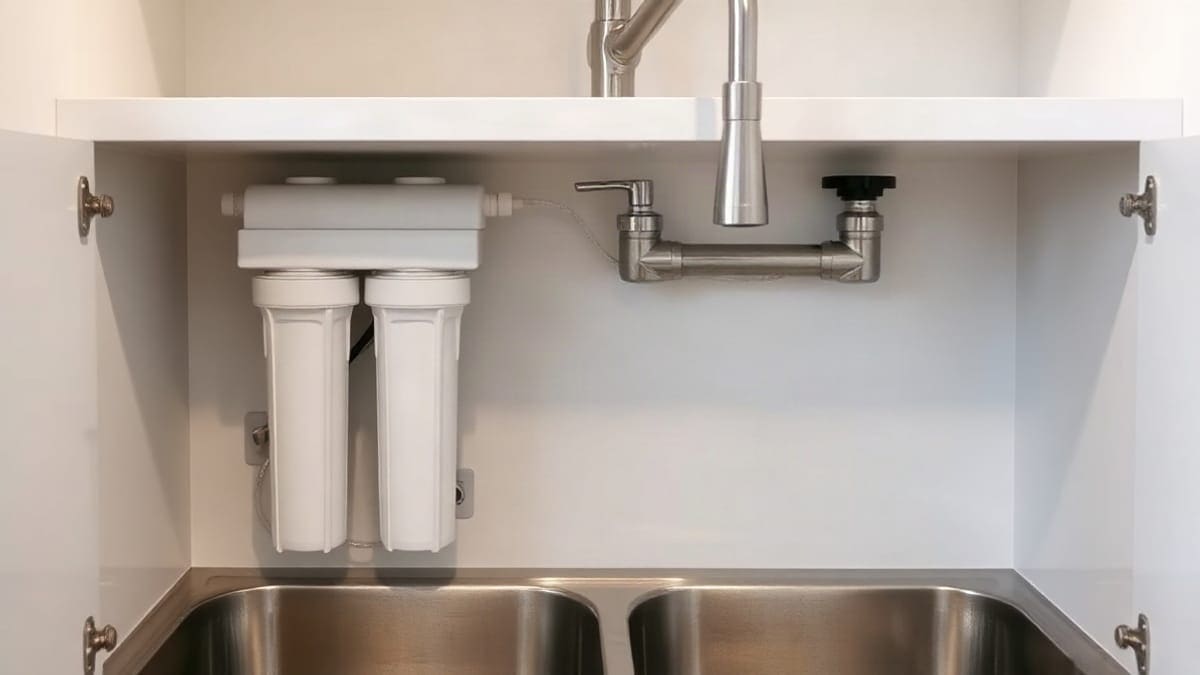
A tankless reverse osmosis system pushes tap water through the membrane with an electric pump and sends the product straight to a faucet. With no storage tank, the cabinet is freer and the tap does not run dry after a few glasses. The price of that design is a power outlet, a pump you may hear, and feed water limits stricter than most buyers expect. We compared nine models on what the makers publish and what the NSF database lists, with no price shown because we have no reliable U.S. price feed, and the text says where a figure was missing or two pages disagreed.
Which tankless reverse osmosis systems are on sale, and how do they compare?
Water check
Nine pumped, tankless under sink systems are on sale in the United States, rated 500 to 1,200 GPD. Where a maker lists a feed pressure floor it runs from 14.5 to 30 psi, and every pump model needs a cabinet outlet.
The table copies each maker's published figures. A blank cell says the page we read did not state the number. GPD is the membrane's rated daily output, GPM is the flow at the tap, and the drain ratio is pure water to drain water.
| Model | Rated output | Flow | Pure to drain | Feed pressure | Power | Size in inches |
|---|---|---|---|---|---|---|
| iSpring RO500AK-BN | 500 GPD | 0.4 GPM | 2:1 | 15 to 70 psi | 100 to 240 V adapter, 24 V DC out | 16.25 x 5.125 x 17.5 |
| Waterdrop G3P800 | 800 GPD | Not listed | 3:1 | 14.5 to 87 psi | Adapter, rating not listed | 18.06 x 5.65 x 17.75 |
| Waterdrop G3P600 | 600 GPD | 0.42 GPM | 2:1 | 14.5 to 87 psi | Adapter, rating not listed | 18.11 x 5.67 x 17.73 |
| Waterdrop D6 | 600 GPD | 0.42 GPM | 1.5:1 | 14.5 to 87 psi | 110 to 120 V, 85 W | 11.97 x 5.98 x 15.98 |
| Waterdrop X12 | 1,200 GPD | Not listed | 3:1 | Not listed | 110 to 240 V adapter | 16.72 x 6.25 x 18.2 |
| Frizzlife PD600-TAM3 | 600 GPD | 0.41 GPM | 2:1 | 20 to 80 psi | 85 W, 110 to 240 V | 5.3 x 14.7 x 15.5 |
| Frizzlife PD800-TAM4 | 800 GPD | 0.56 GPM | 2:1 | 20 to 80 psi | 120 W, 110 to 240 V | 5.3 x 14.7 x 15.5 |
| APEC ROTL-600 | 600 GPD at 60 psi | Not listed | 1:1 | 30 to 100 psi | 100 to 240 V | Not found |
| Express Water ROT600ALKMBN | 600 GPD | 0.42 GPM | 2:1 | 30 to 100 psi | Not found | 26 lb |
Where a maker page refused our requests, the row uses a third-party reading of the manual, named in the card below. The iSpring reverse osmosis systems guide and the Waterdrop reverse osmosis systems compared page cover the other models in those two families.
What did we leave out, and why?
The Brondell Circle has a 1.6 gallon flexible reservoir, so it is not tankless (TapWaterData reading); the iSpring RCD100 sits on the counter, and the Home Master TMAFC ships with a tank. The Electrolux PureOne has its own Electrolux review, as we could not read a clean spec sheet. The Mizudo Megaflo is sold at 800 GPD and 3:1, but we did not read the maker's page, so it stays out of the picks.
The nine tankless reverse osmosis systems in detail
Water check
Nine models are on sale with specs from the maker or its manual. Only the iSpring RO500AK-BN has an NSF/ANSI 58 row we could read, and the Frizzlife pair and the APEC and Express models state the least about their pumps.
Each card says what we could confirm. A Check price button may earn this site a commission at no extra cost to you.
iSpring RO500AK-BN: the tankless pick for most city homes
iSpring's page rates it at 500 GPD, up to 0.4 GPM and 2:1 pure to drain, and says an 8 oz cup fills in about 10 seconds. A TapWaterData reading of the manual adds a 15 to 70 psi working range (flow limited below 25 psi), feed water up to 500 ppm TDS, 41 to 100°F, and filters on 6, 12 and 24 month cycles. The NSF list shows the RO500AK-BN at 500 gpd for TDS reduction. The warranty is 1 year.
Best for: a family that wants tankless flow, low drain water and a listing you can look up. Not for: a cabinet without an outlet, or anyone who needs a lead or fluoride claim, since the NSF row is TDS only. Check price on Amazon
Waterdrop G3P800: the high-output pick
Waterdrop's G3P800 page lists 800 GPD, 3:1 pure to drain, 14.5 to 87 psi, 41 to 100°F, 18.06 x 5.65 x 17.75 in and a UV stage. It fills an 8 oz cup in 6 seconds by the page's own claim. Filter lives are 6 months for the sediment and carbon stage, 12 months for the carbon and 24 months for the membrane. The page names NSF/ANSI 58 and 372 and also says "SGS & CSA Tested." Its stage count is given as 9 in the marketing copy and as three filters plus membrane layers in the FAQ. TapWaterData reads the manual as limiting feed hardness to 7 gpg and TDS to 750 ppm. See our G3P800 review.
Best for: a large household that wants the lowest drain water here and fast fills. Not for: a buyer who needs a database listing, or hard water above 7 gpg. Check price on Amazon
Waterdrop G3P600: the same frame at 600 GPD
Waterdrop's G3P600 page lists 600 GPD at 0.42 GPM, 2:1 pure to drain, 14.5 to 87 psi, 18.11 x 5.67 x 17.73 in, an 8 stage build and a cup in 8 seconds. Its filters are 6 months or 550 gallons, 1 year or 1,100 gallons, and 24 months or 2,200 gallons. The pump is rated at no more than 65 dB under lab conditions. The page names NSF/ANSI 58 (TDS reduction) and NSF/ANSI 372 (lead-free materials) and no testing body. The G3P600 review goes deeper.
Best for: a household of 2 to 4 that wants the Waterdrop pump and filters at lower output. Not for: a family that fills large pots often, or a buyer who needs the NSF database. Check price on Amazon
Waterdrop D6: the compact one
The D6 is the smallest here at 11.97 x 5.98 x 15.98 in and about 22.2 lb, with one WD-D6RF composite cartridge. TapWaterData's reading of the manual gives 600 GPD, 0.42 GPM, 14.5 to 87 psi, 110 to 120 V at 85 W, no more than 55 dB, a 40 minute continuous run limit and a 12 month or 1,000 gallon cartridge. Waterdrop's own pages give the drain ratio as both 1.5:1 and 2:1, and the cartridge as 1,000 and 1,100 gallons. TapWaterData found no D6 listing at NSF, WQA or IAPMO.
Best for: a small cabinet and one cartridge to change. Not for: anyone who wants a certification you can verify, or the lowest drain water. Check price on Amazon
Waterdrop X12: 1,200 GPD with UV and minerals
Waterdrop's X Series page lists 1,200 GPD for the X12, 3:1 pure to drain, an 11 stage build with auto sensing UV, an alkaline mineral stage, a smart faucet with TDS display and a 2 year warranty. It states NSF/ANSI 42, 58 and 372, and says IAPMO R&T issued the 58 certification. The page gives no GPM or feed pressure. TapWaterData's manual reading adds 110 to 240 V, 16.72 x 6.25 x 18.2 in, filters at 6, 12 and 24 months, and limits of 7 gpg hardness and 750 ppm TDS.
Best for: a big household or a kitchen with a pot filler. Not for: a small cabinet, or a buyer who needs published pressure and flow figures. Check price on Amazon
Frizzlife PD600-TAM3: the 600 GPD alkaline pick
TapWaterData's reading of the manual gives 600 GPD, 0.41 GPM, 2:1, 20 to 80 psi, 39 to 100°F cold water only, 85 W and a 12 month pre-filter, a 24 month membrane and a 12 month alkaline core. The brand claims NSF/ANSI 42, 53, 58 and 372 with SGS, but NSF's database returned nothing for Frizzlife on November 17, 2026, and an NSF public notice dated August 25, 2023 says the company is not certified by NSF. Dimensions conflict between the spec table and Amazon, with length and width swapped.
Best for: a household that wants a remineralizing stage and a published 85 W pump. Not for: anyone who treats "NSF" on the box as proof. Check price on Amazon
Frizzlife PD800-TAM4: the 800 GPD version
TapWaterData's reading lists 800 GPD, 0.56 GPM, 2:1, 20 to 80 psi, 120 W, a 30 minute auto shutoff and the same 12, 24 and 12 month filters. The only third-party listing found was IAPMO file W-29648 for NSF/ANSI/CAN 372, which covers lead content of materials, not contaminant reduction. An Amazon listing gives a 300 ppm feed TDS limit that we did not see on a brand page.
Best for: a family that wants 0.56 GPM and a remineralizing stage. Not for: feed water above 300 ppm TDS until Frizzlife confirms the limit. Check price on Amazon
APEC ROTL-600: the high-pressure tolerant one
Search results from APEC's pages and its ROTL-600 manual give 600 GPD at 60 psi, a 30 to 100 psi feed range, 41 to 100°F, up to 1,000 ppm TDS, pH 2 to 11, a 100 to 240 V supply and a 1:1 drain ratio. The APEC page itself refused our requests, so these figures come from the search text. APEC's listing recommends a 12 month filter set. We found no dimensions. See the APEC Water Systems review.
Best for: a house with 60 psi or more and a high TDS feed. Not for: a drought area or a septic tank, since 1:1 is the highest drain ratio in this group. Check price on Amazon
Express Water ROT600ALKMBN: the 600 GPD with remineralizing
Express Water's page calls it a 600 GPD tankless system at 0.42 GPM with a remineralizing stage, a 30 to 100 psi feed range, 41 to 100°F, 1,000 ppm TDS and a weight of 26 lb (read on the Express Water review pass), and Home Depot lists 2:1 and a 1 year warranty. Stage count differs between listings (6 stages at Home Depot Canada, a five layer process on the maker page). We found no size or filter life. NSF lists two Express Water models under 58, the tank models RO10DX and RO5DX, and not this one. See the Express Water review.
Best for: a shopper who already buys Express Water filters. Not for: a buyer who needs a size or filter life before purchase. Check price on Amazon
Which tankless reverse osmosis systems can you verify as certified?
Water check
Only the iSpring RO500AK-BN appears in the NSF/ANSI 58 database, at 500 gpd for TDS reduction. Waterdrop, Frizzlife and APEC returned no row on November 17, 2026, and Express Water's two rows are tank models.
On November 17, 2026 we searched the NSF drinking water treatment unit list for standard 58, one company name at a time. The iSpring result shows four RO500 rows, all at 500 gpd with a TDS claim. The Express Water result shows only the RO10DX at 21.89 gpd and the RO5DX at 12.22 gpd. The Waterdrop result, by company name, the Frizzlife result and the APEC result each returned "No Matching Products Found." A Waterdrop search by trade name for standard 58 also returned nothing; the 555 rows Waterdrop has by trade name are standard 42 filters (pitchers, faucet, inline and refrigerator).
| Model | NSF/ANSI 58 database, Nov 17, 2026 | What the maker says | Other body named |
|---|---|---|---|
| iSpring RO500AK-BN | Listed, 500 gpd, TDS reduction | "NSF 58 Certified" for TDS reduction | None |
| Waterdrop G3P800 | No row | NSF/ANSI 58 and 372; "SGS & CSA Tested" | IAPMO R&T, per a Best Buy listing and TapWaterData |
| Waterdrop G3P600 | No row | NSF/ANSI 58 and 372 | Not named on the page |
| Waterdrop D6 | No row | 1,000+ contaminants, 0.0001 micron | None found by TapWaterData |
| Waterdrop X12 | No row | NSF/ANSI 42, 58, 372 | IAPMO R&T for 58, per Waterdrop |
| Frizzlife PD600, PD800 | No row | NSF/ANSI 42, 53, 58, 372 with SGS | IAPMO file W-29648, standard 372 only |
| APEC ROTL-600 | No row | Not stated on the pages we read | Not in WQA's APEC entry (read Nov 18, 2026) |
| Express Water ROT600 | Not listed (two tank models are) | Not stated on the pages we read | None |
Other labs can legitimately test to an NSF/ANSI standard, but IAPMO keeps its own directory, which our tools could not search, and the WQA entry we could read for APEC does not list the ROTL-600. The Waterdrop IAPMO claim therefore rests on Waterdrop's X Series page and on third-party summaries. Before you buy, request the performance data sheet and match the model number to the lab's own listing. A 372 listing proves only low lead in the materials, and "tested to" never means "certified to." Tank models are in the best reverse osmosis system table.
What does the pump change inside the cabinet?
Water check
A pump raises the pressure on tap water that has passed a sediment and carbon stage. The membrane holds back dissolved solids, which go to the drain, and the clean water goes straight to the faucet with no storage tank.
A tank system relies on line pressure, 40 to 70 psi at the sink, and fills a 3 to 4 gallon tank slowly. A tankless system lifts the pressure across the membrane with a pump: TapWaterData reads the Waterdrop D6 manual as 58 to 115 psi at the membrane for a feed of 14.5 to 87 psi.
The pump runs only while you draw water. The Waterdrop D6 and the Frizzlife PD800 also shut off by themselves after a continuous run of 40 minutes and 30 minutes, which matters if you fill a stockpot many times in a row. The chemistry of the membrane is in what is reverse osmosis.
Is tankless reverse osmosis better than a tank system?
Neither is better for every house. The tank vs tankless reverse osmosis comparison has the full argument; the table gives the figures.
| Point | Tankless with pump | Tank system, no pump |
|---|---|---|
| Space under the sink | One cabinet block, no 3 to 4 gallon tank | Filters plus a 3 to 4 gallon tank |
| Feed pressure needed | 14.5 to 30 psi floor | 40 to 45 psi or more (iSpring RCC7AK 45 to 70 psi, APEC ROES-50 40 to 85 psi) |
| Power | Outlet, 85 W to 120 W where published | None |
| Drain water per gallon made | 0.33 to 1 gal | 1 to 3 gal (RCC7AK 3 gal, or 2 on one iSpring page) |
| When the power or pressure fails | No water at the RO tap | Stored water until the tank is empty |
| Water age at the tap | Made on demand | Held in the tank until used |
| Sound | Pump hum, 55 dB (D6) to 65 dB (G3P600) | Mostly the drain trickle |
The water age row deserves a number. A 3 gallon tank takes 3 days to turn over for a one person home, since Penn State Extension counts 1 gallon per person per day for drinking and cooking. A family of 4 uses 4 gallons a day and empties it. We found no published comparison of bacteria counts between tank and tankless units, so any "fresher" claim stays a maker claim. The reverse osmosis storage tank guide covers tank sizing.
How fast does a tankless reverse osmosis system fill a pot?
Water check
At 0.4 GPM a 1 gallon pot takes 2.5 minutes to fill, and at 0.56 GPM it takes 1.8 minutes. GPD divided by 1,440 minutes gives the ceiling, so 600 GPD cannot exceed 0.42 GPM.
With no tank to dump a gallon at once, flow is capped by what the membrane makes: GPD divided by 1,440 gives the maximum GPM.
| Model | GPD | Maximum GPM from GPD | Flow we use | Seconds per 1 gal | Minutes per day for 4 gal |
|---|---|---|---|---|---|
| iSpring RO500AK-BN | 500 | 0.35 | 0.4 (maker) | 150 | 10.0 |
| Frizzlife PD600-TAM3 | 600 | 0.42 | 0.41 (manual) | 146 | 9.8 |
| Waterdrop G3P600, D6 | 600 | 0.42 | 0.42 (maker) | 143 | 9.5 |
| Frizzlife PD800-TAM4 | 800 | 0.56 | 0.56 (manual) | 107 | 7.1 |
| Waterdrop G3P800 | 800 | 0.56 | 0.56 (calculated) | 107 | 7.1 |
| Waterdrop X12 | 1,200 | 0.83 | 0.83 (calculated) | 72 | 4.8 |
The iSpring page's 0.4 GPM sits above the 0.35 GPM ceiling that 500 GPD allows, because ratings are set at test conditions and a daily figure is not a flow rate. An iSpring 8 oz cup in 10 seconds works out to 0.375 GPM, and a Waterdrop G3P800 8 oz cup in 6 seconds to 0.625 GPM, which is above the 0.56 GPM ceiling for 800 GPD, so it is a burst figure. Cold water slows production: TapWaterData reads the iSpring manual as limiting flow below 55°F and below 25 psi. For a quick pasta pot, pick 0.56 GPM or more.
How much drain water does a pump save you?
Water check
EPA puts the usual point of use unit at 5 gallons of reject water or more per gallon made. The tankless models here claim 1 gallon to 0.33 gallon, so a family of 4 sends 487 to 1,460 gallons down the drain each year.
EPA's WaterSense page, updated August 21, 2026, sets the label limit at 2.3 gallons and says inefficient units reach 10. Our household is 4 people at 1 gallon each per day, which is 1,460 gallons a year by the Penn State count. Pure to drain 3:1 means 0.33 gallon of drain per gallon made.
| Source of the ratio | Drain per gallon made | Drain water per year at 1,460 gal |
|---|---|---|
| EPA, typical point of use RO | 5 gal or more | 7,300 gal or more |
| WaterSense label limit | 2.3 gal | 3,358 gal |
| APEC ROTL-600, 1:1 | 1 gal | 1,460 gal |
| Waterdrop D6, 1.5:1 | 0.67 gal | 973 gal |
| iSpring RO500AK-BN, G3P600, PD600, PD800, ROT600, 2:1 | 0.5 gal | 730 gal |
| Waterdrop G3P800 and X12, 3:1 | 0.33 gal | 487 gal |
The gap between the EPA typical figure and a 3:1 model is 6,813 gallons a year for the same four people. These are maker ratios at the maker's test conditions, and we found no WaterSense label on any of the nine pages. Ratios drift with feed pressure and membrane age. On a septic tank, ask your installer about the added flow. For the dollar side, see reverse osmosis system cost.
Does a tankless reverse osmosis system work on low pressure or hard water?
Water check
Pump models start at 14.5 to 30 psi where the maker lists a floor, against 40 to 45 psi for a tank system. Hardness is the limit: Waterdrop's manual caps feed at 7 gpg, about 119 mg/L, and WaterWorld says hardness should not exceed about 7 gpg.
Measure your pressure with a hose bib gauge. The WaterWorld guide says a net pressure of about 30 psi is needed for satisfactory results and that a booster pump improves rejection and production on low pressure. A tankless unit has that booster built in, so it is the usual answer to a weak line. For a pump added to a tank system, see the reverse osmosis booster pump guide.
| Model | Feed pressure | Feed TDS limit | Feed hardness limit | Source of the limit |
|---|---|---|---|---|
| iSpring RO500AK-BN | 15 to 70 psi | 500 ppm | Not stated | Manual, via TapWaterData |
| Waterdrop G3P800, X12 | 14.5 to 87 psi (X12 not listed) | 750 ppm | 7 gpg | Manual, via TapWaterData |
| Waterdrop D6 | 14.5 to 87 psi | Not stated | pH 6.5 to 8.5, under 1 NTU | Manual, via TapWaterData |
| Frizzlife PD600-TAM3 | 20 to 80 psi | Not stated | Municipal water only | Manual, via TapWaterData |
| Frizzlife PD800-TAM4 | 20 to 80 psi | 300 ppm (Amazon only) | Not stated | Amazon listing, via TapWaterData |
| APEC ROTL-600 | 30 to 100 psi | 1,000 ppm | pH 2 to 11 | Manual, via search result |
At 7 gpg you are at the top of the "hard" band; Penn State calls 7.0 to 10.5 gpg hard and over 10.5 very hard. Read your number with the water hardness converter or a test kit. Above the limit, soften first: read the water softener vs water filter page and the best water softener pillar. Scale on the membrane is what shortens its life.
How much electricity does a tankless reverse osmosis system use?
Water check
Where a wattage is published it is 85 W to 120 W, and a pump that runs only while you draw water uses about 5 kWh a year for a family of 4. iSpring, Waterdrop and APEC publish voltage, not watts.
The pump runs only while water flows. For 4 gallons a day, run time is 4 divided by GPM, and energy is watts times hours. The Waterdrop D6 at 85 W and 9.5 minutes uses 13.5 Wh a day, or 4.9 kWh a year. The Frizzlife PD600-TAM3 at 85 W and 9.8 minutes uses 13.8 Wh, or 5.0 kWh. The PD800-TAM4 at 120 W and 7.1 minutes uses 14.3 Wh, or 5.2 kWh. The figure leaves out standby draw from faucet displays and adapters, which no maker published.
With no tank, a power cut or an unplugged adapter means no RO water, so keep a pitcher of filtered water. An outlet inside the cabinet is the one installation requirement that a pumpless tank system does not have.
Which tankless reverse osmosis system suits which home?
Water check
Take the iSpring RO500AK-BN for low pressure and a database listing, the Waterdrop G3P800 or X12 for a large household, the D6 for a small cabinet and the APEC ROTL-600 for high pressure and a high TDS feed.
| Your situation | Model to look at | Why |
|---|---|---|
| City water, 15 to 45 psi, wants a listing | iSpring RO500AK-BN | NSF 58 row at 500 gpd, 15 psi floor |
| Family of 5 or more, low drain wanted | Waterdrop G3P800 | 800 GPD, 3:1 |
| Very large household or pot filler | Waterdrop X12 | 1,200 GPD, 3:1, UV |
| 2 to 4 people, standard cabinet | Waterdrop G3P600 | 600 GPD, 0.42 GPM |
| Small cabinet | Waterdrop D6 | 11.97 in wide block, 85 W |
| Wants a remineralizing stage and a published wattage | Frizzlife PD600-TAM3 or PD800-TAM4 | 85 W and 120 W, alkaline core |
| 60 psi or more, TDS up to 1,000 ppm | APEC ROTL-600 | 30 to 100 psi, 1,000 ppm |
| No outlet in the cabinet | A tank system | See the best under sink reverse osmosis system |
How do you choose a pump driven unit? Check these before you buy
Water check
Count your gallons, measure your pressure, test your hardness and TDS, check for an outlet, then read the certification. A family of 4 needs about 4 gallons a day, so 600 GPD is already 150 times that.
- Count gallons. Penn State puts drinking and cooking at 1 gallon per person per day. A 4 person house needs 4 gallons, or 1,460 gallons a year. At 4 gallons a day, 600 GPD is 150 times the need, so output is rarely the constraint; flow in GPM is.
- Measure pressure. Under 40 psi points to a pump model. Over 80 psi, check the maker's ceiling (Frizzlife 80 psi, Waterdrop 87 psi, APEC 100 psi).
- Test hardness and TDS. Compare to the limits in the table above. Read your city's annual water quality report or test a well.
- Find the outlet. A 120 V outlet in the cabinet, and a drain pipe for the saddle.
- Open the database, not the box. Penn State tells buyers to look for NSF and WQA certification.
- Check the filter cycle against your gallons. At 4 gallons a day, a 550 gallon pre-filter limit is reached in about 137 days, sooner than the 6 months printed, if the maker counts filtered water. Ask which gallons count.
How often do the filters change?
Intervals come from the maker pages and manuals, and a gallon limit and a calendar limit both apply. The iSpring RO500AK-BN runs 6, 12 and 24 months. The Waterdrop G3P800, G3P600 and X12 run 6 months or 550 gallons, 12 months or 1,100 gallons, and 24 months or 2,200 gallons. The D6 has one cartridge at 12 months or 1,000 gallons. The Frizzlife pair runs 12, 12 and 24 months, and APEC sells a complete set for 12 months. The Penn State PFAS guide gives roughly 6 to 12 months for carbon blocks and 12 to 24 months for RO cartridges, which matches the makers.
Which contaminants can a tankless unit's paperwork actually back up?
Water check
Only a claim on a listing was confirmed by a lab, and the iSpring RO500AK-BN row lists TDS reduction only. EPA sets the lead action level at 15 ppb (10 ppb under its 2024 rule) with a goal of zero, and the PFOA and PFOS limits at 4.0 ppt each.
On PFAS, Penn State says the claim to look for is PFOA and PFOS reduction under NSF/ANSI 58, tested to a combined 20 ng/L. EPA's PFAS page gives water systems until 2029 to meet the 4.0 ppt limit under the April 2024 rule; a May 18, 2026 EPA proposal (not final) would allow extensions to 2031 and rescind the limits for four other PFAS.
| Contaminant | EPA level | Claim in the iSpring RO500AK-BN NSF row | Other tankless models |
|---|---|---|---|
| TDS | Secondary standard, not enforceable | Yes, TDS reduction | Maker claims only |
| Lead | 15 ppb action level, 10 ppb under the 2024 rule, goal zero (EPA) | No | Maker claims only |
| PFOA and PFOS | 4.0 ppt each | No | No listing found |
If lead or PFAS is why you are shopping, start with the lead filter picks and the PFAS filter picks. A CPSC database search on November 18, 2026 found no recall of any reverse osmosis system; the recalls page keeps the list.
Is a tankless reverse osmosis system worth it, and does the water need minerals?
Water check
A tankless unit pays off when your water test shows something you want gone and you can accept a pump and some drain water. It also strips minerals, and a December 2025 review found no clear harm from that in healthy adults.
A Nutrients review published December 28, 2025 says water with TDS below 50 mg/L has not been linked to health risks for the general population, though people on very restricted diets, pregnant or breastfeeding women and children should check their mineral intake, and the authors call the evidence "limited and inconsistent." If a child or someone on a restricted diet drinks it daily, ask your doctor. Several models above add a remineralizing stage; see the remineralization guide and is reverse osmosis water good for you.
What is the downside to drinking reverse osmosis water?
The downsides are practical. You waste 0.33 to 1 gallon per gallon made, the unit needs power, filters need changing every 6 to 24 months, and the water has few minerals unless a stage adds them. The health downside is limited and unproven, per the review above. On softened water, RO also removes the added sodium; read can you drink softened water.
Tankless reverse osmosis: our conclusion
Water check
Take the iSpring RO500AK-BN for low pressure and the one NSF/ANSI 58 listing we found, the Waterdrop G3P800 for a large household at 3:1, and a tank system if the cabinet has no outlet.
Low pressure, from 15 psi, with a database listing points to the iSpring RO500AK-BN Check price on Amazon. A family of 5 or more that wants low drain water takes the Waterdrop G3P800, at 800 GPD and 3:1 Check price on Amazon; a very large household or pot filler takes the X12 at 1,200 GPD Check price on Amazon. Two to four people in a standard cabinet suit the G3P600 Check price on Amazon, and a small cabinet the D6 Check price on Amazon. A remineralizing stage and a published wattage lead to the Frizzlife PD600-TAM3 Check price on Amazon. For 60 psi or more with TDS up to 1,000 ppm, take the APEC ROTL-600 Check price on Amazon.
6 common mistakes with tankless reverse osmosis systems
Water check
Six mistakes cost buyers most: trusting a database claim that is not there, ignoring hardness, buying for GPD instead of GPM, forgetting the outlet, skipping the pressure check and missing filter dates.
Trusting "NSF certified" on the box
Only the iSpring RO500 models of the nine have an NSF 58 row, and NSF's public notice says Frizzlife is not NSF certified. Look the model up.
Running hard water into the membrane
A 7 gpg cap is 119 mg/L, and a well at 15 gpg is 255 mg/L. Soften first.
Buying for GPD instead of GPM
A 1,200 GPD model fills a gallon in 72 seconds, a 500 GPD model in 150.
Forgetting the outlet
No outlet means a tank system.
Skipping the pressure check
Waterdrop copes with 14.5 psi, but APEC lists 30 psi at the low end. Measure first.
Missing filter dates
At 4 gallons a day, a 550 gallon pre-filter limit arrives in about 137 days.
Frequently asked questions
Which tankless model should you start with?
For most city homes the iSpring RO500AK-BN, for a large household the Waterdrop G3P800 and for a very large one the X12. Tank models are on the best reverse osmosis system page.
Are tankless reverse osmosis systems worth it?
Yes, if your test shows what you want removed and you have an outlet and pressure to suit. For a mild problem a carbon filter is enough; see is reverse osmosis worth it.
What path does the water take through a pump driven unit?
A pump pushes filtered tap water across the membrane, solids go to the drain and the clean water goes straight to the faucet. The section on the pump covers it.
Do all tankless reverse osmosis systems require electricity?
Every model on this page does, because the pump needs power. A pumpless tankless design would not reach the membrane pressure the models above list. A tank system with no pump needs none.
Do under sink reverse osmosis filters reduce hardness?
A membrane rejects dissolved solids, which include calcium and magnesium, but none of the nine tankless pages we read lists a hardness claim, and hardness shortens membrane life. Above 7 gpg, soften first. A "tankless water softener" is a different product, covered in how does a water softener work.
How do you add a tank to an iSpring tankless reverse osmosis?
Tankless pump models are built to run without a tank, and whether a given iSpring model accepts one is stated in its manual. Read the reverse osmosis storage tank guide before you drill.
Does a tankless reverse osmosis system remineralize the water?
Some do. The iSpring RO500AK-BN, Frizzlife PD600 and PD800, Express Water ROT600ALKMBN and Waterdrop X12 list a mineral or alkaline stage. See the remineralization guide.
How loud is a tankless reverse osmosis pump?
Waterdrop's G3P600 page rates its pump at no more than 65 dB in lab conditions, and TapWaterData reads the D6 manual as 55 dB. iSpring, Frizzlife, APEC and Express publish no dB figure on the pages we read.
Is the drain ratio better with a pump?
On maker ratios, yes: 0.33 to 1 gallon of drain water per gallon made, against 5 gallons or more for a typical unit, per EPA.
Does tankless reverse osmosis work on low water pressure?
It is the usual answer, with 14.5 to 15 psi floors at Waterdrop and iSpring. Flow drops below 25 psi on the iSpring.
Does tankless reverse osmosis remove PFAS or lead?
Only a listing can prove it. The NSF row for the iSpring RO500AK-BN lists TDS reduction and no lead or PFAS claim. See the water filter for PFAS.
What should you expect to pay for a tankless unit?
This page shows no prices, because we have no reliable U.S. price feed. The Check price buttons go to current prices, and reverse osmosis system cost covers upkeep.
How do you install a tankless reverse osmosis system under the sink?
You mount the unit, connect the cold feed, the drain saddle and the faucet, and plug in the pump adapter. Our reverse osmosis installation guide walks through it.
How often do you change the filters on a tankless reverse osmosis system?
Every 6 to 12 months for the pre-filter and carbon, and every 24 months for the membrane. The paragraph on filter intervals above has each model, and the change calendar has the steps.
How we researched this page
Water check
We read maker pages and manuals for nine models, queried the NSF/ANSI 58 database for five companies on November 17, 2026, and marked every figure we could only read through a third party or a search result.
We read the iSpring RO500AK-BN page, the Waterdrop G3P600, G3P800 and X Series pages and the TapWaterData readings of the iSpring, Waterdrop D6, Frizzlife PD600 and PD800 manuals. We queried the NSF/ANSI 58 database for iSpring, Express Water, Waterdrop, Frizzlife and APEC on November 17, 2026. We read the EPA WaterSense, lead and PFAS pages, the Penn State Extension softening and PFAS pages, a WaterWorld article and a Nutrients review. We could not open the APEC and Express Water pages (they returned 429 errors), the Frizzlife brand page, the NSF public notice page (403, read by search result) or the IAPMO and WQA directories, so those figures are marked as read through a third party or a search result. We did not run any product ourselves, so noise is limited to the published numbers.
Sources
Our sources by topic
Public agencies and universities
- EPA WaterSense, point of use reverse osmosis
- EPA, basic information about lead in drinking water
- EPA, PFAS and drinking water
- EPA, private wells
- EPA, consumer confidence reports
- Penn State Extension, water softening
- Penn State Extension, home water treatment for PFAS
- Penn State Extension, tips for buying water treatment equipment
- Nutrients, should children drink water with very low mineral content
Certification and standards bodies
- NSF drinking water treatment unit list
- NSF/ANSI 58 listing, iSpring
- NSF/ANSI 58 listing, Express Water
- NSF public notice on Frizzlife, August 25, 2023
Manufacturers, retailers and other references
- iSpring RO500AK-BN page
- Waterdrop G3P800 page
- Waterdrop G3P600 page
- Waterdrop X Series page
- APEC ROTL-600 manual
- Express Water ROT600 page
- TapWaterData, iSpring RO500
- TapWaterData, Waterdrop D6
- TapWaterData, Frizzlife PD600
- TapWaterData, Frizzlife PD800
- TapWaterData, Brondell Circle
- WaterWorld, avoiding residential RO pitfalls
Keep comparing
 Whole House Water Filtration SystemEight whole house water filters compared by rated flow in GPM, capacity in gallons
 Reverse Osmosis System for HomeEight reverse osmosis systems compared by NSF-listed output, drain water, feed pressure and certification
 Under Sink Water Filters (Without Reverse Osmosis)Nine under sink filters with no drain water compared by rated gallons, flow
 Shower Filter for Hard WaterNine shower filters compared by rated flow, cartridge life and NSF/ANSI 177 status
 Countertop Reverse Osmosis Systems, No InstallationTen plug-in countertop reverse osmosis systems compared by tank size, drain water
 Whole House Water Filter and Softener ComboEight packaged whole house filter and softener combos compared on flow in GPM, grains, filter life in gallons