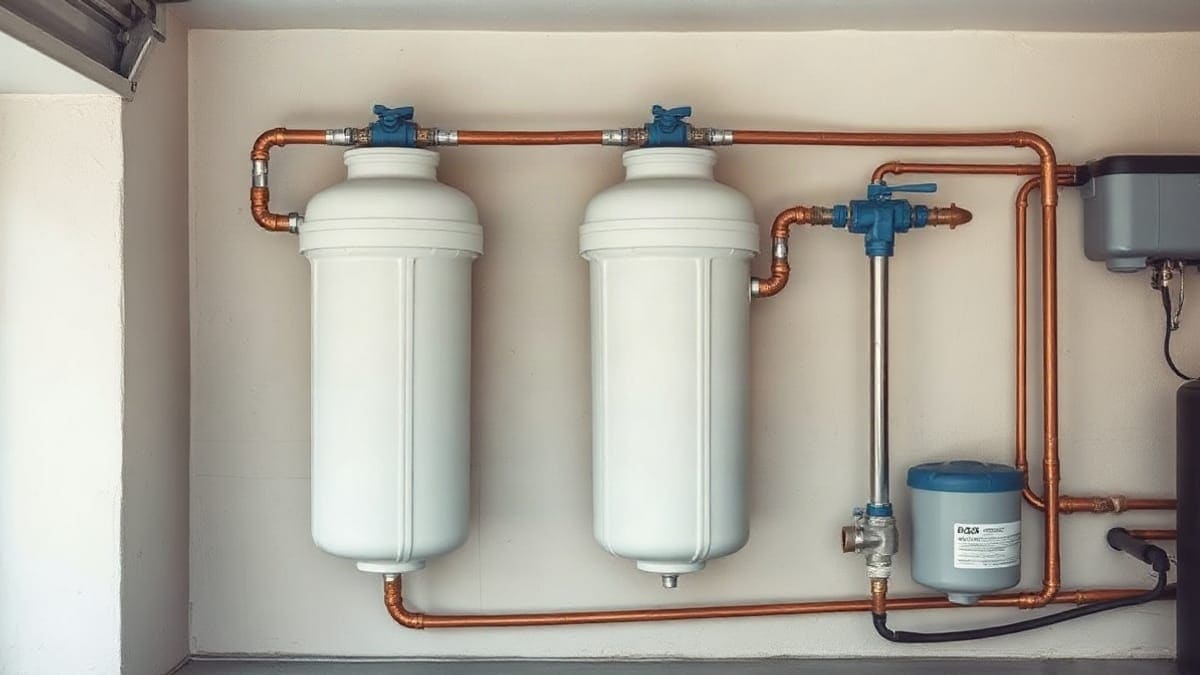
People search for "Cloud Water" expecting a brand with softeners and filters for the whole house. We read the maker's site on November 18, 2026 and found a narrower company: one reverse osmosis system, its replacement filters and a battery pack. We checked the whole catalog for a salt-free product and a filter and softener combo and found neither. What remains is a question about one product: what does its certification cover, and what happens at year two? We answer both and compare it with iSpring, AquaTru, Waterdrop and SpringWell. Our Cloud RO model review goes deeper on the one product, and the water softener brands page covers the rest of the field. Purchases through our buttons pay us a commission.
What does Cloud Water Filters actually sell?
Water check
Cloud Water Filters sells the Cloud RO under-sink reverse osmosis system, a replacement filter pack with a battery, a refrigerator kit as an add-on and a free tap-water lookup tool by zip code. It sells no softener, no conditioner and no whole house filter.
We read the maker's home page, its buy page, its replacement filters page, its FAQ and its sitemap, which lists only the home page and a tap water quality tool. The navigation offers Cloud RO, Replacement Filters, How Cloud Works, Why Cloud, FAQ, NSF Certified and My Water. Nothing else is for sale. The FAQ answers the whole house question directly: Cloud is "a drinking water filter only" and "should not be used for whole home applications."
| Item | What it is | In the range? |
|---|---|---|
| Cloud RO | Under-sink reverse osmosis, 2.8 gal tank, pump, battery, app | Yes, the only system |
| Replacement filter pack | Sediment, carbon block, RO membrane, remineralizing post filter, battery | Yes, sold as a set |
| Refrigerator kit | Add-on for a fridge or ice maker line | Yes, add-on in the cart |
| Salt-free softener or conditioner | Scale control for the whole house | No |
| Salt softener | Ion exchange for hardness | No |
| Whole house carbon or sediment filter | Point of entry filter | No |
| Filter and softener combo | Two tanks or one | No |
| Pitcher, faucet or shower filter | Small point of use filters | No |
Two things on the maker's site can mislead a quick reader. The replacement filters page headlines "8 powerful filtration stages" while its own text describes four cartridges plus a battery pack. And the FAQ's whole-home section describes softeners and whole house filters only to say a drinking water system pairs with them. If a softener or a combo is what you want, start with our best water softener guide and the best whole house water filtration system page.
Does Cloud Water make a salt-free softener or a whole house filter?
Water check
No. We found no salt-free conditioner, no salt softener, no whole house filter and no combo on cloudwaterfilters.com on November 18, 2026, and Cloud's FAQ says the system is for drinking water only.
This matters because searches like "cloud water system" and "cloud water filtration system" are often shopping for something that treats the whole house. A reverse osmosis system works on a small stream of drinking and cooking water. It makes about 42 gallons a day at most on the NSF listing, and a house with four people can easily use 300 gallons a day by the Penn State Extension figure of 75 gallons per person, as the Penn State water softening guide explains. Running that volume through an RO membrane would waste most of it and starve every tap.
If your target is hard water, these are the right products to look at:
- Scale on heaters, fixtures and glass: a salt softener, or a salt-free conditioner if you accept that it does not remove hardness. See salt vs salt-free and the best salt-free water softener page.
- Chlorine taste across the house: a carbon whole house filter, covered on the best whole house water filtration system page.
- Hardness plus chlorine in one order: a combo, compared at best whole house water filter and softener combo.
- Drinking water on top of any of these: a Cloud RO or another RO unit at the kitchen sink. The two jobs are different, and our water softener vs water filter page shows how they stack.
Who is behind Cloud Water Filters?
Water check
Cloud Water Filter, LLC is a San Diego, California company, and its NSF listing names a factory in Wujiang, Suzhou, China. We could not find a founding year on its own pages.
The company's NSF listing shows Cloud Water Filter, LLC at an address in San Diego and a phone number, with the facility in Wujiang, Suzhou, China. The FAQ says the same in plain words: a US company based in San Diego, with its primary manufacturing facility in Suzhou, China, and a stateside warehouse where each unit is inspected. The About page describes the brand as one that "delivers healthy water to you based on geography" and gives no date, founder or address. Treat the founding year as unknown.
Is the Cloud RO made in China or the USA?
China, by the maker's own account. The FAQ says it sources components all over the world, makes the system in one Suzhou factory that builds filtration devices for other companies and checks each unit again in the United States. It does not claim American manufacture. If country of origin matters to you, that is the answer.
Is Cloud Water a legitimate brand?
Yes, on the evidence we can check. It has a registered NSF listing under its company name, a published warranty, a 90 day return policy and a support email. Its claims deserve the same scrutiny as any maker's, which the certification and contradiction sections below do.
How does the Cloud RO work, and what are its specs?
Water check
The Cloud RO runs water through four cartridges (5 micron sediment, 1 micron carbon block, RO membrane, remineralizing post filter), stores it in a 2.8 gallon tank and delivers it at about 45 psi from a dedicated faucet. It runs on a battery, not a plug.
Reverse osmosis pushes tap water through a membrane that holds back most dissolved solids and sends them to the drain. The EPA's WaterSense page on point-of-use RO says these systems can reduce lead, VOCs, PFAS and arsenic, and that a typical unit sends five gallons or more to the drain per gallon it treats. Our what is reverse osmosis page explains the process in full. Here is what is specific to Cloud, read from its tech specs sheet and performance data sheet.
| Stage | What the maker says it does | Listed rating |
|---|---|---|
| Sediment filter | Traps dirt and rust | 5 micron polypropylene |
| Carbon block | Removes chlorine, disinfection byproducts and VOCs, with anti-scale properties | 1 micron coconut carbon |
| RO membrane | Reduces dissolved solids, metals and PFAS | 80 GPD rated, 96% salt rejection, 1:1 waste claim |
| Remineralizing post filter | Adds calcium, magnesium, potassium, sodium and zinc, raises pH | Ceramic mineral beads, pH 7.5 to 9.5 |
| Battery pack | Powers the TDS sensors and app | 2+ years, replaced with the filters |
The maker's spec sheets give these figures:
- Tank: 2.8 gal, stainless steel. System 11 in L x 7 in W x 16 in H; tank 9 in x 9 in x 15 in.
- Pressure: 40 to 100 psi working, 40 to 80 psi ideal; outlet 40 to 45 psi.
- Temperature: 41 to 95°F.
- Faucet flow: 0.5 to 0.75 GPM, a 10 to 12 oz glass in under 6 seconds. Faucet hole 0.5 in to 1.25 in.
- Power: battery pack, no outlet. Fridge and ice maker lines allowed within 10 ft vertical or 20 ft horizontal.
The permeate pump is what separates this system from a plain tank unit. It reduces back pressure on the membrane, which the maker says makes the tank fill up to four times faster and lets a small tank serve a fridge line. The FAQ says the tank fills in 30 to 45 minutes. At the NSF-listed 42.07 gpd, refilling a full 2.8 gallon tank would take about 1.6 hours (2.8 ÷ 42.07 × 24), so the 30 to 45 minute figure describes a partial refill or a faster rate than the listing. We cannot tell which.
How does the Cloud RO purify water?
Water at 40 psi or more is pushed against a semi-permeable membrane. Water molecules pass through, and most dissolved salts, metals and many organic compounds do not, so they leave as drain water. The carbon block before the membrane removes chlorine, which would damage it, and the post filter puts minerals back. The maker's FAQ calls the membrane's pore size roughly 0.0001 micron. We did not verify that figure against an independent source.
What does a Cloud reverse osmosis filter do?
It makes drinking and cooking water at one faucet. It does not treat the shower, the washing machine or the water heater, and it does not soften water for those uses. In our is reverse osmosis water good for you guide we look at the health evidence on drinking RO water.
Is Cloud Water NSF certified?
Water check
Yes for one claim. The NSF database lists Cloud Version 1 under NSF/ANSI 58 with a TDS reduction claim and 42.07 gpd. We found no listing for lead, fluoride or PFAS reduction, and none under NSF/ANSI 42, 53 or 401.
We queried the NSF drinking water treatment unit database on November 18, 2026 for the company name "Cloud" under standard 58. NSF stated its listings were current as of November 17, 2026. It returned one manufacturer and one product: Cloud Water Filter, LLC, trade name Cloud Version 1, replacement modules 02-200-0006 to 02-200-0009, daily production 42.07 gpd, claim "TDS Reduction", configuration "Plumbed-In to Separate Tap", and a note that the product was also evaluated for weighted average lead content of 0.25 percent or less. A listing at this level is the thing that proves certification. A product page does not.
| Claim on Cloud's pages | What we could verify | Where |
|---|---|---|
| NSF/ANSI 58 certified | Yes, listed, TDS reduction only | NSF database |
| 98% TDS reduction (720 ppm in, 17 ppm out) | Maker's data sheet quotes NSF performance testing; the NSF listing page shows no percentage | Performance data sheet |
| NSF 42 and 53 | "Third-party tested" by SGS Laboratories, not a certification | Maker's tech specs |
| Lead, PFAS, fluoride removal | Third-party SGS data from the maker; no NSF claim listed for these | Maker's data sheet |
| Microplastics removed (100%) | Maker's claim; we found no test result for it | Maker's FAQ |
| WQA or IAPMO | Not checked: WQA search did not return results to our requests | WQA |
The maker is clear on the difference itself. Its NSF page says a system "tested to NSF standards" is not the same as certified, and that it chose NSF 58 first and plans other standards later. That candor is useful, and it also means the 42, 53 and 401 claims on other pages of the site are test results, not marks. One older education article still says the system is "pending NSF 58 certification", which the database now contradicts.
Does the Cloud RO remove PFAS?
The maker says its carbon and RO stages remove PFAS, and its data sheet lists PFOS and PFOA passing in third-party SGS testing against the NSF/ANSI 53 limit. That is lab data from the maker, not an NSF claim. The EPA's page on PFAS drinking water regulation sets the national limits to compare with a lab result from your own tap. See our best water filter for PFAS page for products that list a PFAS claim.
Does the Cloud RO remove fluoride?
The maker says its membrane removes over 98 percent of fluoride, and fluoride is among the NSF/ANSI 58 test items on its SGS data sheet. The alignment of the table in the PDF is garbled, so we quote no per-contaminant numbers. Reverse osmosis generally reduces fluoride, as our best water filter for fluoride page shows for other systems. Fluoridation of public water is a dentist's and a pediatrician's question, so ask yours before removing it for a child.
How much water does the Cloud RO waste?
Water check
On the maker's 54 percent efficiency rating, the Cloud RO sends about 0.85 gallon to the drain per gallon of drinking water, against 5 or more for a typical RO and 2.3 for a WaterSense label. The "1:1" claim rounds that up.
The data sheet gives an efficiency rating of 54 percent. The maker's own formula on its NSF page converts efficiency to a waste ratio: waste per gallon made equals (1 minus efficiency) divided by efficiency, so (1 − 0.54) ÷ 0.54 = 0.85 gallon. The "1:1" shown on the data sheet and the how-it-works page is a rounded figure. We found no WaterSense label for the Cloud RO, and its figure is the maker's own, not an independent measure. Here is the yearly arithmetic for a home that drinks and cooks with 2 gallons a day, or 730 gallons a year.
| System type | Drain water per gallon made | Drain water per year at 730 gallons |
|---|---|---|
| Cloud RO at 54% efficiency (maker's figure) | 0.85 gal | about 620 gal |
| WaterSense limit for point-of-use RO | 2.3 gal | about 1,680 gal |
| Typical point-of-use RO (EPA) | 5 gal or more | 3,650 gal or more |
| Inefficient RO (EPA) | up to 10 gal | up to 7,300 gal |
The EPA figures come from the WaterSense point-of-use RO page. Our how much does a reverse osmosis system cost page puts the drain water next to the operating cost. A fair reading is that Cloud's efficiency is good for a tank system, if the figure holds in your kitchen. It depends on feed pressure, which the maker says should be at least 40 psi.
How long do Cloud filters last, and how do you change them?
Water check
Cloud tracks usage and water quality with TDS sensors and recommends filter changes by need, typically every 9 to 12 months for a family of four. The membrane is expected to last 1 to 2 years. The warranty excludes late-changed cartridges.
The replacement filters page says "on average the filters will last one year," and the buy page says the typical cadence for a family of four is every 9 to 12 months. The tech specs sheet says 1 to 2 times a year. A full replacement set is one pack of five items: sediment filter, carbon block, RO membrane, remineralizing post filter and battery pack. We publish no prices, and the maker states its own average annual filter spend on its pages. Check it before you buy, because yearly filters are the real cost of any RO. The maker rates the membrane at 1 to 2 years, the battery at 2 or more years and the system at a 10 year lifespan. Our reverse osmosis filter replacement schedule page covers other brands' intervals.
How often do you change the filters on a Cloud RO?
When the app says so, which the maker puts at 9 to 12 months for four people. A family of six drinks more water and changes sooner. Without the app, change on the one-year mark, and put the date in the calendar, because the warranty treats late changes as neglect.
How do you change the filters on a Cloud RO system?
Pull the front lever down, which shuts off the supply and releases the filter magazine, slide the magazine out of the cabinet, twist the old cartridges off on the countertop or floor, twist the new ones in, drop in the new battery pack and slide it back. The maker says you never touch the plumbing and you do not shut the main valve. A video replacement guide is linked from the page.
How do you install a Cloud RO, and what does your home need?
Water check
Installation takes 30 to 60 minutes with a drill, a 1/4 in bit and a wrench. You need 40 psi or more at the line, a spot for a faucet hole of 0.5 to 1.25 inches, and pre-treatment if you are on a well.
The buy page lists what is in the box: the system, the 2.8 gallon tank, a faucet, all four cartridges, a battery pack, tubing, quick-connect fittings, an inlet supply valve and a drain saddle valve. The FAQ asks you to supply a screwdriver, a power drill, a 1/4 in drill bit, an adjustable wrench and towels. A drinking-water faucet is required. It can reuse an existing soap dispenser, sprayer or plug hole. It does not feed your main faucet. For a step-by-step on any RO, see our reverse osmosis installation guide.
Cloud asks for at least 40 psi at the line (45 psi or more for full performance), pre-treated municipal or well water, a fridge line within 10 ft vertical or 20 ft horizontal, and a temperature of 41 to 95°F. An RV works if the supply is treated and above 40 psi.
Can you use the Cloud RO on well water?
The maker says yes, with pre-treatment for bacteria such as a whole house filter or UV, and 40 to 80 psi of pressure. A reverse osmosis membrane is not a disinfection device. The EPA says private well owners are responsible for testing their own water, so test first, run the numbers through our well water treatment finder, and see our best well water filtration system and best water softener for well water pages for the stage before an RO.
What does Cloud's warranty and return policy cover?
Water check
Cloud advertises a 5 year warranty on the system, which excludes the filter cartridges and requires installation to the manual and Cloud-only parts. Returns are accepted within 90 days, with return shipping paid by you.
The FAQ is the controlling text we read. A warranty is only as good as its exclusions, so here they are.
| Term | Length or rule | Condition |
|---|---|---|
| System warranty | 5 years from the purchase date | Covers defects in manufacturing, cosmetic and performance flaws from production or assembly |
| Cartridges | Not covered | Late replacement also voids claims |
| Installation | Must follow the user manual | Installation outside the manual is excluded |
| Non-Cloud parts | Voids the warranty | Includes replacement filters, valves, fittings and faucets |
| Claims | Email support@cloudwaterfilters.com | Support confirms and ships replacement parts |
| Return | 90 days, refund to the card on file | You pay return shipping; damage from misuse is not covered |
| Cancel before shipping | 3% fee | Orders are hard to cancel |
Two conditions are worth a second look. Using third-party filters would void the 5 year warranty, which closes off the cheaper cartridge market that exists for many RO brands. And the 10 year lifespan on the data sheet is a design estimate, not a warranty term.
Where do Cloud's own pages disagree?
Water check
Cloud's pages give three daily production figures (42.07, 50 and 80 GPD), two TDS rejection rates (96 and 98 percent), four pH ranges and two filter-life statements. The NSF listing is the one to trust for production.
We read the same company's data sheet, tech specs, how-it-works page and FAQ on November 18, 2026. A mismatch does not make a product bad. It means you should ask the maker which number applies, and keep the reply.
| Item | One place says | Another says | What to do |
|---|---|---|---|
| Daily production | 42.07 gpd (NSF listing) | 50 GPD (data sheet), 80 GPD (membrane rating) | Use the NSF figure |
| TDS rejection | 98% (NSF performance, how-it-works) | 96% (membrane salt rejection, NSF page comparison) | Treat 96 to 98% as the range |
| Waste ratio | 1:1 (data sheet) | 54% efficiency, which is 0.85:1 | Use 0.85 gal per gallon made |
| Water pH | 7.5 to 9.5 (data sheet) | 8 to 9 (Why Cloud), 7 to 10 (home page) | Expect a range that drifts down with filter age |
| Filter change | 9 to 12 months (buy page) | 1 to 2 times a year (tech specs) | Plan on one set a year |
| Number of stages | 4 stages (text) | "8 powerful filtration stages" (headline) | Four cartridges |
| Certification status | NSF 58 listed | "Pending" (older education article) | Check the database |
| Last stage before the faucet | Remineralizing post filter | A post-tank carbon block (FAQ, microplastics answer) | Ask support to confirm the cartridge order |
Which Cloud model fits which home?
Water check
There is one Cloud model, so the question becomes which home it fits: a drinking-water-only buyer with 40 psi or more, a place to drill one faucet hole and no need for a softener.
Best for: a household of two to six that wants a no-outlet RO under the kitchen sink, a pump to feed a fridge, and a listing that proves TDS reduction. Not for: a renter who cannot drill a hole, a home under 40 psi, an unpretreated well, or anyone who wants hard water treated at every tap.
How does the Cloud RO compare with iSpring, AquaTru, Waterdrop and SpringWell?
Water check
On what we could verify, Cloud and iSpring both hold NSF/ANSI 58 listings, for TDS reduction. Waterdrop and AquaTru were not found in the NSF 58 list on November 17, 2026, and SpringWell sells no listed RO of its own.
The table puts Cloud next to the RO systems a buyer usually cross-shops. The iSpring, AquaTru and Waterdrop rows come from the pages we wrote on those brands, which read the makers' pages and the NSF database the day before.
| System | Type | Rated output | Feed pressure | NSF/ANSI 58 listing |
|---|---|---|---|---|
| Cloud RO | Under sink, tank, pump, battery | 42.07 gpd listed; 50 GPD on data sheet | 40 to 100 psi | Yes, TDS reduction |
| iSpring RCC7AK | Under sink, tank, 6 stages | 75 GPD rated; 21.04 gpd listed | 45 to 70 psi | Yes, TDS reduction |
| iSpring RO500AK-BN | Under sink, tankless, pump | 500 gpd listed | 15 to 70 psi | Yes, TDS reduction |
| AquaTru Classic | Countertop, 0.75 gal tank | Not stated on the page we read | Not needed | Not found in the database |
| Waterdrop G3P800 | Under sink, tankless, pump | 800 GPD | 14.5 to 87 psi | Not found in the database |
| SpringWell RO | Moen unit, sold by SpringWell | Not stated | Not stated | None found |
Cloud RO vs iSpring: which one?
Choose Cloud for a battery-powered system with a permeate pump, an app and a smaller tank. Choose iSpring for lower feed pressure tolerance (the RO500AK goes to 15 psi), a plain tank system with no electronics (the RCC7AK) and a longer track record in the NSF list. Both list TDS reduction only on the base models. Read the exact listing for the suffix you buy.
Cloud RO vs AquaTru and Waterdrop?
AquaTru fits a renter because it sits on the counter with no plumbing. Waterdrop is tankless and handles lower pressure. Both name certifications from bodies other than NSF, which we could not confirm in the IAPMO or WQA search tools. Cloud's listing is the only one in this group we could read ourselves in the NSF database, apart from iSpring. Our best reverse osmosis system page ranks all of them by output, drain water and certification.
Cloud vs SpringWell?
Different jobs. SpringWell sells softeners, whole house filters, well systems and a Moen RO, with no NSF listing we could find for any of them. Cloud sells one drinking water system with a listing. Many homes would use both: a softener or a whole house filter, then an RO at the sink.
Cloud vs Aquasana?
Aquasana's products in the NSF database we searched on November 18, 2026 were two UV units, so there is no RO listing to set against Cloud's. See our best under sink water filter page and our water filtration brands comparison.
Who should skip Cloud and buy something else?
Water check
Skip Cloud when you need hardness or chlorine treated across the house, a system for under 40 psi, a countertop unit for a rental, or a certification beyond TDS reduction for a specific contaminant.
- Hard water at every tap: a softener, for example from the best water softener page. Cloud does not make one.
- Low pressure or no tank: a tankless pump RO from the best tankless reverse osmosis system list.
- Renting: a countertop RO, which needs no drilling.
- A listed claim for lead or fluoride: read each NSF listing for the exact model. Some iSpring finishes list eight metal and mineral claims in addition to TDS.
- Cartridge choice: Cloud's warranty is void with non-Cloud filters, so a buyer who wants third-party cartridges should look at a brand that permits them.
6 common mistakes when buying a Cloud RO
Water check
The costly mistakes are expecting it to soften water, drilling without measuring the hole, skipping a pressure check, using it on untreated well water, buying third-party filters and reading "certified" as covering every claim.
1. Expecting it to treat the whole house
Cloud says it is a drinking water system only. A hard water problem needs a softener, and an RO adds nothing for scale on a water heater.
2. Not checking pressure
Below 40 psi the maker says performance degrades. A pressure gauge on the line saves a return.
3. Drilling the countertop blind
The faucet hole is 0.5 to 1.25 inches. Check what the counter is made of before you drill, and reuse a soap dispenser hole if you have one.
4. Using it on untreated well water
An RO is not a disinfectant. Pre-treat for bacteria and test with a state-certified lab.
5. Using non-Cloud filters
The warranty is void with parts Cloud did not provide. A cheaper cartridge costs the 5 year coverage.
6. Reading "NSF certified" as covering lead, PFAS and fluoride
The listing is for TDS reduction. The contaminant results on the data sheet are third-party lab results from the maker. For a health contaminant, test your own tap and filtered water.
How we researched this page
Water check
We read Cloud's home, buy, replacement filter, FAQ, NSF, how-it-works and why-Cloud pages and its two data sheets on November 18, 2026, queried the NSF database by company name, and compared the competitor rows from our own earlier pages. We did not test any unit.
Not confirmed: the founding year, any WQA or IAPMO listing, per-contaminant figures from the garbled SGS tables, the cartridge order in the FAQ, and independent confirmation of the microplastic and 99 percent claims. We publish no prices, since they change often, and use the Check price buttons for current figures.
Frequently asked questions
Are Cloud water filters good?
The Cloud RO has what a buyer can check: an NSF/ANSI 58 listing for TDS reduction, a 5 year warranty, a 90 day return window and a pump that lets it feed a fridge. What it lacks is a listing for lead, PFAS or fluoride, and a way to use cheaper filters without voiding the warranty. Good for the right home, not a whole house answer.
How long does a Cloud water filter last?
The maker says about one year on average and 9 to 12 months for a family of four, with the app recommending changes from sensor data. It rates the membrane at 1 to 2 years, the battery at 2 or more years and the system at 10 years. Change on the app's prompt or at one year.
How often do you change the filters on a Cloud RO?
Once a year in typical use, sooner for a big household. The app tracks usage and TDS through the system and prompts you. The warranty does not cover issues from late changes, so write the date down.
How do you change the filters on a Cloud RO system?
Pull the lever down, which shuts the water and frees the magazine, take it out, twist the old cartridges off, twist new ones in and drop in the new battery pack. No tools and no plumbing work, per the maker.
Does a Cloud water filter remove microplastics?
The maker says it removes 100 percent of microplastics and cites a membrane pore size far below the size of nanoplastics. We found no test result for microplastics on its data sheets, and the NSF listing is for TDS reduction. A reverse osmosis membrane is a plausible barrier for particles, but treat the figure as the maker's claim.
Does the Cloud RO remove fluoride?
The maker says over 98 percent, and its SGS data sheet includes fluoride as a test item. NSF lists TDS reduction only. See the fluoride section above and our best water filter for fluoride page.
Does the Cloud RO remove PFAS?
The maker says so and shows PFOS and PFOA passing in third-party testing, but NSF lists no PFAS claim for it. Compare with the EPA's PFAS limits and a lab result from your own tap.
Where can I buy the Cloud RO water filter?
Direct from Cloud Water Filters at cloudwaterfilters.com, which also sells the replacement pack, or through the Check price button on this page, which goes to the same maker. We did not verify other sellers, and the warranty is for the original purchaser, so check registration before buying elsewhere.
Does Cloud sell a water softener or whole house filter?
No. The only product is the Cloud RO. Cloud's FAQ says it is for drinking water only. For softeners and whole house filters see our best water softener and best whole house water filtration system pages.
How do you install a Cloud RO water filter?
Mount the base and tank under the sink, tee into the cold line with the supplied valve, run the drain saddle, drill the faucet hole of 0.5 to 1.25 inches and connect the tubing. Maker says 30 to 60 minutes. See our reverse osmosis installation guide.
How does a Cloud reverse osmosis filter work?
Tap water goes through a sediment filter and a carbon block, then a membrane that rejects most dissolved solids to the drain, into a 2.8 gallon tank, and then a mineral post filter that raises pH. A pump boosts pressure at the faucet. Our what is reverse osmosis guide has the long version.
What does a Cloud reverse osmosis filter do?
It purifies drinking and cooking water at a dedicated faucet, and optionally a fridge line. It does not soften water or treat the rest of the house.
Is a reverse osmosis water filter worth it?
If your tap water carries dissolved solids, lead, PFAS or fluoride that a pitcher does not handle, and you will keep up with filter changes, an RO is a common answer. It wastes water (0.85 gallon per gallon on Cloud's rating) and strips minerals unless it has a remineralizing stage. Our reverse osmosis system cost and best reverse osmosis system pages weigh it for other homes.
Is the Cloud RO safe for a baby or someone on dialysis?
We did not research that. Ask your doctor, and use a state-certified lab result for your own water.
Sources
Our sources by topic
Public agencies and universities
- EPA WaterSense, point-of-use reverse osmosis
- EPA PFAS and drinking water
- EPA private wells
- Penn State Extension, Water Softening
Certification and standards bodies
- NSF listing for Cloud Water Filter, LLC
- NSF certified drinking water treatment units
- WQA product search
Manufacturers, retailers and other references
Keep comparing
 Culligan ReviewWho owns it, dealers versus the online shop, ZeroWater and MaxClear certificates read, hardware-store filters
 Waterdrop ReviewCalifornia seller, filters made in Qingdao, China, full US range, what NSF lists and what it does not
 AquaTru ReviewClassic, Carafe, Under Sink and Shower, NSF database check, drain water math, filter life, warranty
 APEC Water Systems ReviewCalifornia brand in the Culligan family, full range on sale, WQA and NSF listings read, warranty terms
 Boroux Water Filter ReviewLegacy and Legacy Compact gravity systems, Foundation and fluoride filters, WQA certifications, lab data
 Rorra Water Filter ReviewA gravity countertop filter, not reverse osmosis